


Loading Data ...
Arbitrum is the largest Ethereum Layer 2 by total value locked. It holds more capital inside its smart contracts than any other rollup, well over $13 billion in early 2026, ahead of Coinbase's Base. The technology is an Optimistic Rollup. Transactions are bundled and executed off-chain, then settled on the Ethereum mainnet, which keeps fees tiny while inheriting Ethereum's security. The native token is ARB, used for governance through the Arbitrum DAO rather than for paying gas. Offchain Labs built the network and launched its main chain, Arbitrum One, in 2021.
Three Princeton computer scientists. Ed Felten, Steven Goldfeder and Harry Kalodner started working on how to scale Ethereum in the mid-2010s and published the Arbitrum research paper in 2018. The same year, they founded Offchain Labs to turn that research into a product, licensing the technology from Princeton. Felten is the best known of the three. He served as Deputy Chief Technology Officer in the Obama White House and was a long-time Princeton professor before going full-time on the company as its chief scientist. Goldfeder is the CEO and continues to lead Offchain Labs today. Kalodner is the CTO. The team raised a $3.7 million seed round led by Pantera Capital in 2019, then a $120 million round led by Lightspeed Venture Partners in 2021 at a $1.2 billion valuation. Arbitrum One went live on mainnet on 31 August 2021.
Start with the word optimistic. The rollup assumes every batch of transactions is valid and posts it to Ethereum without re-running the maths upfront. That assumption is what makes it cheap. Transactions execute off-chain on Arbitrum, get compressed into batches, and each batch plus a state root is submitted to Ethereum L1. To stop anyone from cheating, there is a challenge period of seven days. During that window, any validator can submit a fraud proof showing a batch was invalid, and the network unwinds it. Ethereum stores the data and acts as the final judge, so Arbitrum earns Ethereum-grade security at a fraction of the cost. The trade-off is withdrawal time, because moving assets back to Ethereum takes about a week.
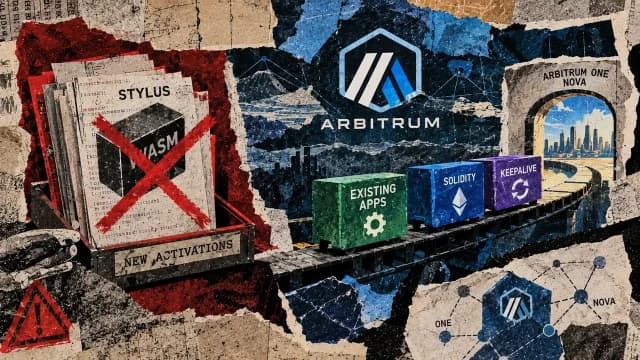
Nitro and Stylus are the two upgrades that define how Arbitrum runs today. Nitro arrived in August 2022. It rebuilt the stack around Geth, Ethereum's main execution client, so any Solidity contract runs unchanged, and it added heavy data compression that cut user fees by roughly half. Stylus came later, going live on mainnet in September 2024. It lets developers write smart contracts in Rust, C and C++, not just Solidity, by running a WebAssembly engine alongside the EVM. For computation-heavy work, Stylus contracts can run up to 70 times faster and are far cheaper. There is also BoLD, short for Bounded Liquidity Delay, which made Arbitrum's validation permissionless when it reached mainnet in February 2025. Anyone can now help police the chain.
The research came first. Felten, Goldfeder and Kalodner published the Arbitrum paper in 2018 and founded Offchain Labs the same year, raising seed money from Pantera in 2019. Arbitrum One launched on mainnet on 31 August 2021, and within months, the big Ethereum names moved over. Uniswap, Aave, Curve and Sushi all deployed, and total value locked climbed into the billions. 2022 was the build year. Offchain Labs launched Nova, a separate chain for gaming and social apps that pushes fees even lower, then shipped the Nitro upgrade on the network's first birthday. March 2023 changed the ownership. Arbitrum airdropped the ARB token to roughly 625,000 wallets and handed control to the Arbitrum DAO, so token holders now vote on upgrades and a multi-billion ARB treasury. 2024 was about reach and decentralisation. Stylus opened the chain to Rust and C developers, and the Orbit framework let teams launch their own custom chains on the Arbitrum stack. 2025 brought permissionless validation through BoLD and a marquee win, as Robinhood chose the Arbitrum stack to launch tokenised stocks and build its own chain. By 2026, Arbitrum and Base together hold more than three-quarters of all Layer 2 value, with Arbitrum still leading in capital locked.
Both are Optimistic Rollups on Ethereum, so the basic idea is the same. The differences are the ecosystem and the governance. Arbitrum runs as Arbitrum One and Nova with the Orbit framework for custom chains, and it holds more total value locked than any other L2. Optimism centres on the OP Stack and its Superchain, the shared standard that Base and other chains are built on. Arbitrum is governed by the ARB token and Arbitrum DAO; Optimism uses the OP token and the Optimism Collective. See Ethereum for the Layer 1, both settle to.
Yes. Holding, buying and selling ARB is legal in India. Crypto is not banned, but it is not legal tender either, and it sits in a separate class called Virtual Digital Assets under the Income Tax Act. You can trade ARB on Indian and offshore exchanges. What India regulates tightly is the tax and reporting, not ownership itself.
ARB is a governance token. Holders use it to vote on Arbitrum DAO proposals, which cover protocol upgrades, ecosystem grants and the DAO's large ARB treasury. It is not the gas token; fees on Arbitrum are paid in ETH. The total supply is fixed at 10 billion ARB, with the largest share controlled by the community through the DAO.
You move ETH or tokens from Ethereum to Arbitrum using a bridge, most commonly the official Arbitrum Bridge. Deposits from Ethereum are quick. Withdrawals back to Ethereum take about 7 days due to the rollup's challenge period, unless you use a third-party fast bridge. Indian users access the same bridges as everyone else, with no India-specific route.
Arbitrum inherits Ethereum's security because all its data and final settlement live on Ethereum. It is the only major Layer 2 rated Stage 1 by the tracker L2BEAT, meaning its fraud proofs became permissionless after the BoLD upgrade. That said, smart contract risk, bridge risk and market risk still apply, as with any crypto network. Security of the base chain is not the same as the safety of any single app running on it.
Profit from selling or swapping ARB is taxed at a flat 30% plus a 4% cess and any surcharge, under the Virtual Digital Asset rules. A 1% TDS applies on transfers above the threshold. You cannot offset crypto losses against gains or other income, and only the cost of acquisition is deductible. Crypto-to-crypto swaps count as taxable events too.
Look at fundamentals, not price alone. For a Layer 2 that means total value locked and how sticky it is, daily transactions and active users, the strength of the apps building on it, decentralisation milestones such as the L2BEAT stage, and token details like supply and treasury. The ICR Score combines these into a single number, and the methodology page explains how.