Record Keeping: The Silent Hero of Crypto Tax Compliance
How the ICR Crypto Tax Calculator Works
The Bottom Line
FAQs

 Part of a series
After seeing real examples of how crypto taxation works, one part of it usually feels uncomfortable.
Losses.
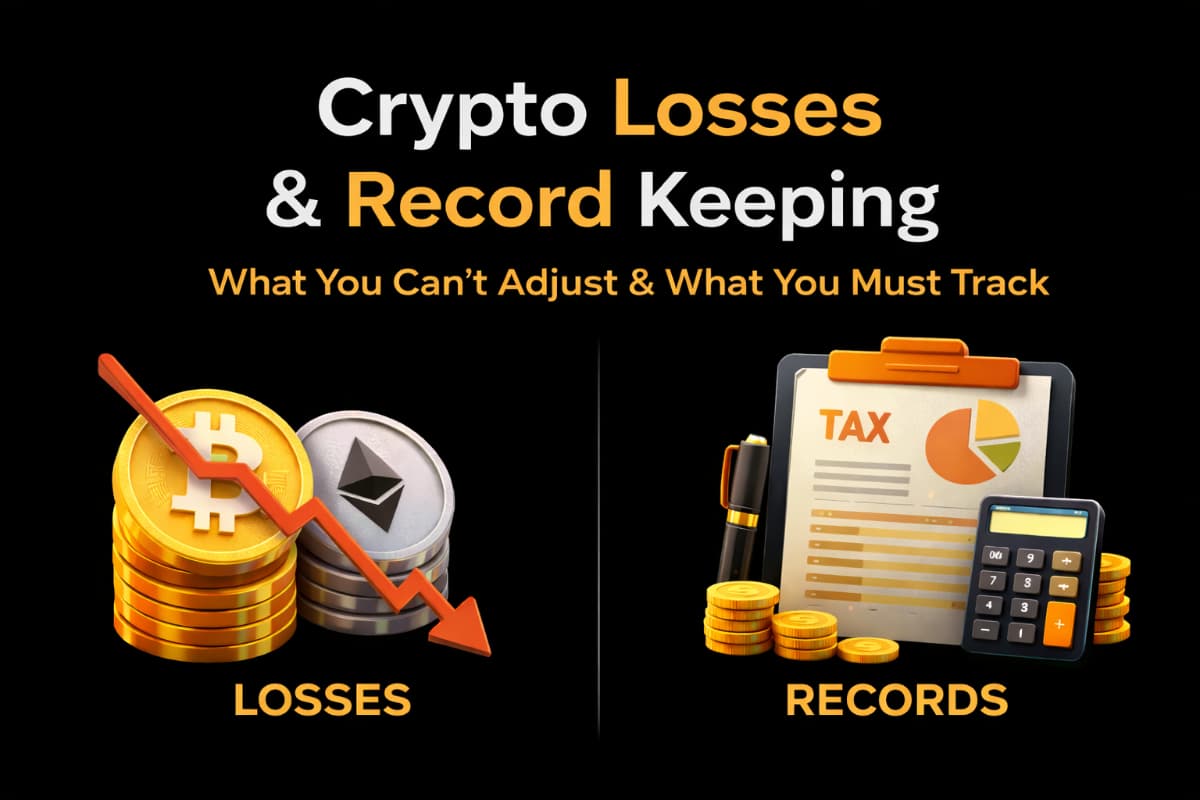
In most traditional investments, losses can reduce tax liability in some way. Crypto works differently in India.
If you make a loss in a crypto transaction, that loss cannot be used to reduce tax on salary, business income, interest, or even gains from other crypto transactions. Each crypto transaction is treated on its own.
This means:
This restriction often feels harsh, especially during volatile market periods. But it reflects how cautiously the system treats this asset class.
It is important to understand that a loss does not disappear just because it cannot be adjusted. The transaction still exists and still needs to be reported correctly.
Another common misunderstanding is around ignoring loss-making trades altogether. Some people assume that if there is no tax to pay, there is nothing to report. This assumption creates problems later.
Even loss-making transactions form part of your crypto activity record. When activity appears without a matching disclosure, it raises questions.
The system looks at consistency, not just outcomes.
This is why reporting discipline matters even in a losing year.

After understanding how crypto taxes work, many people realise that the real challenge is not the tax rate. It is remembering what happened.
Crypto activity can be frequent, spread across wallets, exchanges, and platforms. Without records, even simple transactions become hard to explain months later.
In the Indian crypto tax system, good record-keeping is not optional. It is what connects your activity to your tax return in a clear and defensible way.
At a minimum, you should be able to track:
This information helps answer the most common questions that arise during filing or review. When did the transaction occur? What was the value? How was tax handled?
For exchange-based activity, transaction reports usually help. For DeFi activity, wallets and blockchain explorers become the primary source of truth. Saving transaction hashes, screenshots, or exported data may feel tedious, but it builds long-term confidence.
The goal is not perfection. The goal is consistency.
When records are maintained using a clear method throughout the year, filing becomes a process rather than a puzzle.
Crypto activity rarely stays confined to a single exchange or a single year. Trades, rewards, and transfers often span multiple platforms and financial years, which makes manual tax calculation error-prone.
The ICR Crypto Tax Calculator is built to handle this reality.
Users can upload their trade history directly from supported crypto exchanges or connect their wallets to capture on-chain activity. Once the data is imported, the system organises every transaction by financial year, rather than treating everything as a single pool of activity.
For each financial year, the calculator applies Indian crypto tax rules independently. This includes:
This year-wise segregation is critical because tax treatment depends on when an activity occurred, not when it is remembered or reported.
At the end of the process, the tool generates a consolidated tax report. This report is structured to align with Indian filing requirements and can be shared directly with a Chartered Accountant for ITR filing. Instead of reconstructing history during filing season, the focus shifts to review and verification.
In practice, this approach mirrors how crypto compliance works best. Capture activity early, classify it correctly by year, and file with clarity.
Crypto in India has moved beyond curiosity. It is now part of the formal financial system.
When value is created, transferred, or received, the expectation of responsibility follows. This is not unique to crypto. What makes crypto feel different is the speed at which activity happens and the absence of familiar structures around it.
Indian crypto taxation can feel strict when viewed one transaction at a time. But when understood as a system built around visibility and disclosure, it becomes more predictable. The objective is not to discourage participation, but to ensure that economic activity is accounted for transparently.
Clarity comes from habits, not from chasing every update. Understanding what actions attract tax, maintaining consistent records, and reporting activity honestly reduces uncertainty far more effectively than reacting to headlines or speculation.
As the crypto ecosystem evolves, rules and interpretations will continue to develop. Staying aligned does not require constant vigilance. It requires access to reliable context and steady guidance.
India Crypto Research exists to provide that continuity. As frameworks evolve and new clarity emerges, ICR will continue to study the changes, interpret their impact, and share insights that help investors navigate crypto with confidence and discipline.
Crypto is no longer on the fringe. It is being integrated, observed, and measured. Approaching it with knowledge, structure, and a long-term perspective is not just prudent. It is the most sustainable way forward.
India Crypto Research operates independently. The information presented herein is intended solely for educational and informational purposes and should not be construed as financial advice. Before making any financial decisions, it's essential to undertake your own thorough research and analysis. If you're uncertain about any financial matters, we strongly recommend seeking guidance from an impartial financial advisor.