The Banking System Is Not Designed For Non-Human Accounts.
At 2% Per Transaction, every AI Task Costs More In Fees Than It Is Worth
Programmable Wallets Let Humans Set The Rules, Then Step Back
The Use Case Found The Infrastructure


AI is changing in a way most people have not registered yet. It is moving from being a tool you talk to, into a worker that acts on your behalf. These are called AI agents. An agent does not just suggest a flight; they book it. It does not just draft a report; it pulls the data, formats it, and sends it. The shift from "AI that answers" to "AI that does" is already happening.
But there is a fundamental problem nobody is talking about. For an AI agent to do anything in the real world, it needs to pay for things. Compute, data, APIs, tools. Every action in a pipeline has a cost attached. And our current financial system was built entirely for humans with ID cards and signatures. A piece of software cannot open a bank account. It cannot pass a KYC check. It has no passport.
This is where stablecoins come in. Not because of a trend. Because AI agents need a way to hold and spend money, and the payment system best built for machines is programmable digital cash.
Every bank account in the world is gated by identity verification. Show your ID, verify your address, and sign the form. This exists because regulators require it, and it works fine for humans.
An AI agent is code running on a server. It has no legal identity, no mailing address, no government ID. Under current rules, AI agents are structurally unbanked, not because anyone overlooked them, but because the system was never designed for non-human principals. You cannot fix this by calling your bank.
This matters now because the scale of agentic AI is growing fast. McKinsey estimates that the value of transactions flowing through autonomous AI agents could reach $3-5 trillion by 2030. Every dollar of that output involves a payment somewhere in the chain. Without a payment system that machines can actually use, none of this works.
The second problem is cost. The average credit card transaction costs a merchant 2.35% of the transaction value. For a human buying a phone or booking a hotel, this is invisible.
An AI agent working autonomously looks nothing like a human buyer. A single agent managing a content workflow might pay for image generation, text APIs, cloud storage, and data enrichment across one task. That could mean hundreds of micro-transactions, each worth fractions of a rupee. At 2% plus a fixed fee per transaction, the fees alone exceed the cost of the work. The economy simply does not function.
Stablecoins on modern blockchains eliminate this. average transaction fee is approximately $0.00025 (~₹0.04). Transfers settle in under 5 seconds. USDC, the largest regulated dollar-backed stablecoin with over $77 billion in circulation as of early 2026, moves on these rails with near-zero cost and no intermediary approval required. This is the first payment infrastructure that operates at machine speed and machine economics.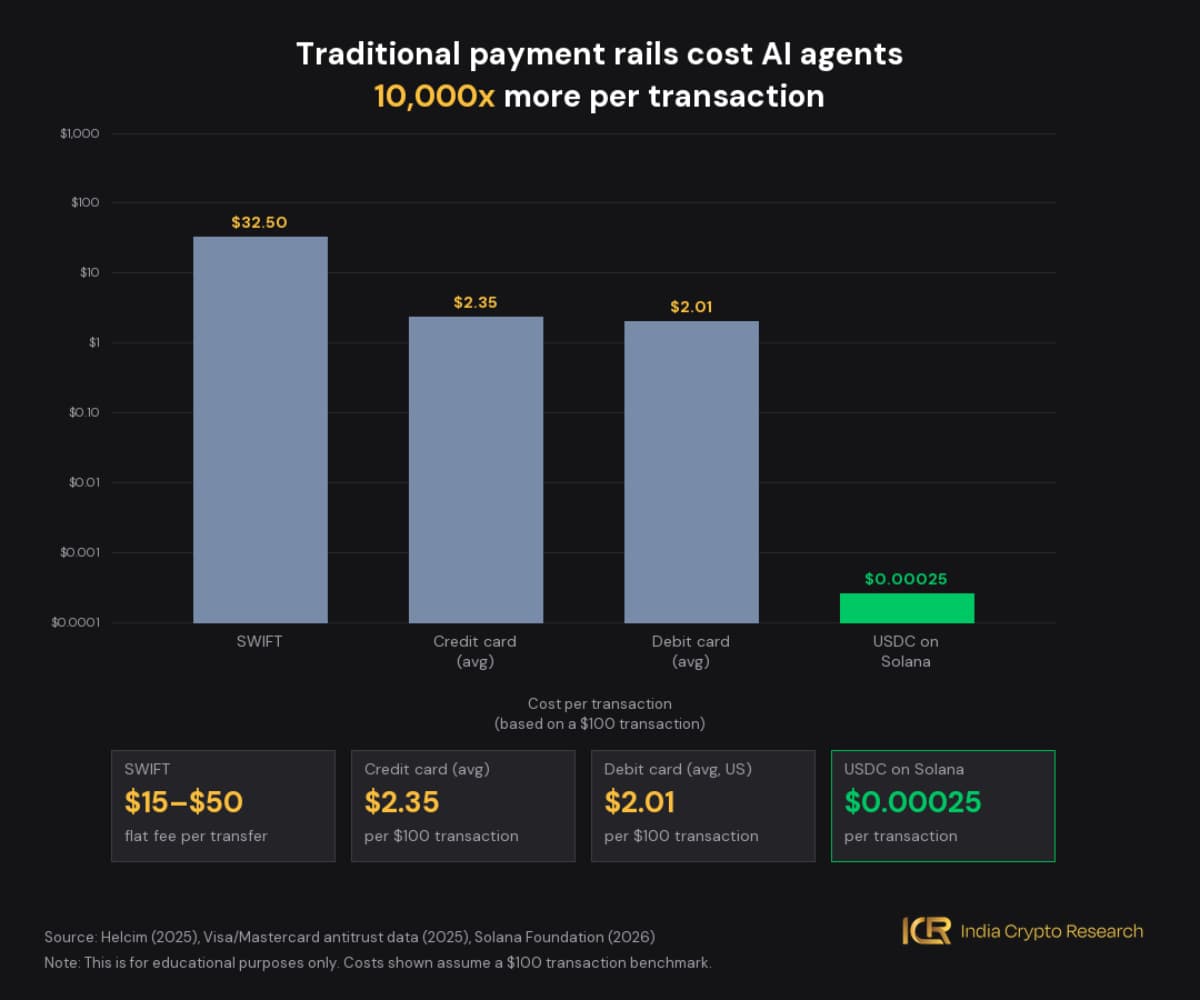
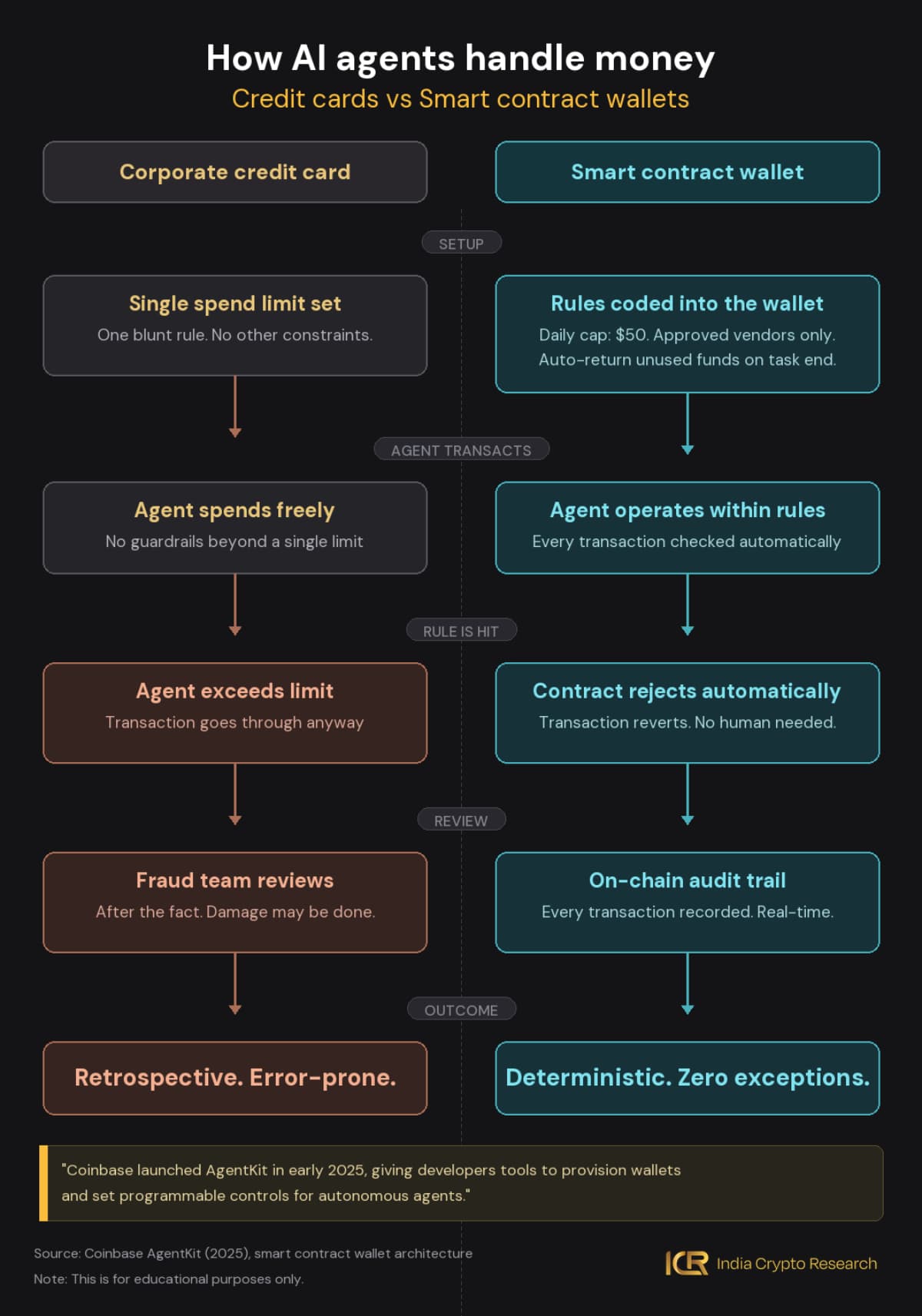
Handing an AI agent access to funds sounds risky. But this is where stablecoins offer something better than a credit card: programmable rules built directly into the wallet.
A developer deploying an AI agent can attach a wallet with hard-coded constraints. A daily spend cap of $50. A list of approved vendors. Automatic return of unused funds once the task is done. The agent operates within those rules exactly. It cannot exceed the budget. It cannot pay an unapproved vendor. Every transaction is recorded on-chain and auditable.
Compare this to a corporate credit card. The controls are blunt: a spending limit and a fraud team reviewing anomalies after the fact. Smart contract controls are deterministic. The rules run automatically, every time, with no room for error.
Coinbase launched AgentKit in late 2024, specifically for this, giving developers tools to provision wallets and set programmable controls for autonomous agents. The infrastructure is being built before most people have even framed the question.
Stablecoins were built for this before anyone knew it. The properties that made them useful for crypto trading, programmability, instant settlement, and zero permission required, turn out to be exactly what machine-to-machine commerce needs. The use case found the infrastructure, not the other way around.
India Crypto Research operates independently. The information presented herein is intended solely for educational and informational purposes and should not be construed as financial advice. Before making any financial decisions, it's essential to undertake your own thorough research and analysis. If you're uncertain about any financial matters, we strongly recommend seeking guidance from an impartial financial advisor.