
What the CLARITY Act Actually is
The Rally Before the Fall
What Happened on September 15
Why It Actually Failed
How Markets Reacted
What Happens Next
What This Means for India
The Bigger Picture
FAQs


 Part of a series
September 15 was supposed to be the day U.S. crypto regulation finally moved forward. It's the date we flagged as the next key test for the CLARITY Act weeks ago. The vote happened. It failed.
Here's the full story: what the bill actually does, why the days before the vote looked so promising, what went wrong, and where things go from here.
The Digital Asset Market Clarity Act was Congress's most serious attempt yet at giving the U.S. crypto industry an actual rulebook. Its core job: decide which regulator, the SEC or the CFTC, oversees which parts of the crypto market. Beyond that split, the bill covered digital commodities, DeFi, token fundraising, anti-money-laundering rules, tokenization, and stablecoin rewards.
It had already cleared two major hurdles before September: it passed the House with strong bipartisan backing, and it made it through the Senate Banking Committee. What it hadn't done was reach the Senate floor.
In the days leading up to the vote, crypto markets weren't just hoping, they were buying. As we covered when bitcoin broke past $80,000, its highest level since mid-May, the rally followed Trump hosting top crypto executives at the White House and personally pushing the Senate to move on the bill. Bitcoin gained 22% in a single week, the biggest weekly jump in over three years, wiping out more than $4 billion in short positions along the way.
And this wasn't pure political sentiment. Spot bitcoin ETFs pulled in $1.92 billion in that same week, the strongest inflows since October. Real money was positioning for a "yes."
But the math underneath the optimism told a more complicated story. As we broke down in Will the CLARITY Act Pass Today?, three prediction markets were showing three very different numbers: 16%, 29.5%, and 53%, because they were quietly answering three different questions: whether cloture passes, whether the bill passes this year, and whether it passes by a different deadline entirely. None of them were confidently betting on the outcome that mattered most on September 15 itself.
That's because September 15 was never a vote to make the CLARITY Act law. It was a cloture vote, a procedural step that only decides whether the Senate can keep debating the bill at all. Republicans held 53 votes. They needed 60. The gap had a name: seven Democrats who hadn't fully declared where they stood.
The divide in the room was stark. Cynthia Lummis called the bill the result of "a year of intense daily bipartisan negotiations." Chris Van Hollen, on the same bill, called it "Trump's crypto corruption giveaway." Same 630-page text, two completely different verdicts.
The Senate held the cloture vote at 2:15 p.m. ET. It needed 60 votes to advance. It got roughly 40 "no" votes instead, well short of the threshold.
This came despite a genuinely significant last-minute push. Senate Republicans released a revised draft incorporating 126 changes requested by Democrats, including new ethics restrictions on federal officials and their spouses. The White House's crypto adviser Patrick Witt called it the administration's "best and final offer." Trump himself reportedly agreed to divest his personal crypto holdings or place them in a blind trust, a real concession, given his family's ties to ventures like World Liberty Financial.
It still wasn't enough. Even with those concessions on the table, enough Democrats weren't convinced the ethics language went far enough, and the bill fell short.
The SEC/CFTC market-structure split, the technical heart of the bill, was never the real fight. Most senators from both parties had broadly agreed on that framework for months. The bill collapsed over three specific disputes:
Everyone wanted clarity. Nobody could agree on the fine print.
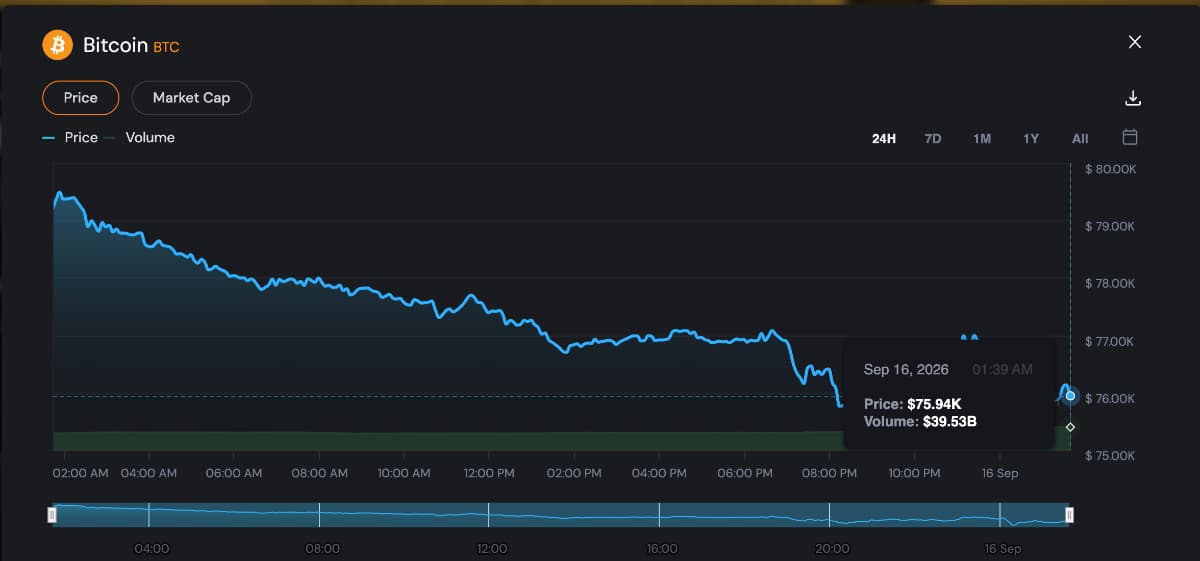
The rally that carried bitcoin to $80,000 unwound fast. As odds of passage slid from the mid-30s down toward 17% in the days before the vote, bitcoin gave back its gains, falling back toward $76,000. Coinbase and Circle shares dropped alongside it. Trading volume spiked even as futures open interest declined, traders closing positions rather than opening new bets into an uncertain outcome.
It wasn't a crash. But a market that had priced in real optimism didn't get the outcome it was betting on.
For Indian crypto investors, the immediate picture doesn't change. India already runs its own framework, a 30% tax on crypto gains and 1% TDS on every transaction, with no loss offsetting, and that stays exactly as it is regardless of what the U.S. Senate does.
But the indirect effects are real. The U.S. was expected to set a reference point that other countries, India included, often calibrate against. A stalled U.S. framework keeps that reference point blurry for longer, and can slow the rollout of new global crypto products for Indian users, since international platforms frequently plan India-specific compliance around how U.S. rules land. It also reinforces a trend already in motion: capital and talent gravitating toward jurisdictions like Dubai and Singapore that already offer regulatory certainty.
The practical takeaway: don't wait on Washington to define your strategy. India's rules are already set. The smarter move is understanding and working within them now, not betting on a global reset that keeps slipping further out.
Congress had almost everything lined up for this to succeed: a crypto-friendly White House, a historic bipartisan House vote, months of negotiation, and 126 concessions on the table in the final stretch. It still couldn't close the last seven votes.
That's less a story about crypto, and more a story about how hard it is to get anything through a divided Senate, even policy with broad, genuine bipartisan support.
Clarity doesn't have to come from Congress. Sometimes it comes from regulators moving on their own, and an industry that keeps building infrastructure regardless of what happens on Capitol Hill.
We'll keep tracking every next step of this story right here on India Crypto Research.
India Crypto Research operates independently. The information presented herein is intended solely for educational and informational purposes and should not be construed as financial advice. Before making any financial decisions, it's essential to undertake your own thorough research and analysis. If you're uncertain about any financial matters, we strongly recommend seeking guidance from an impartial financial advisor.


