
What do Senators actually vote on?
Three markets, three numbers, zero contradictions
The arithmetic doesn’t care about feelings.
Meet the seven people who actually decide this.
What really changed in the bill
What This Vote Will Tell Us
What Happens Next

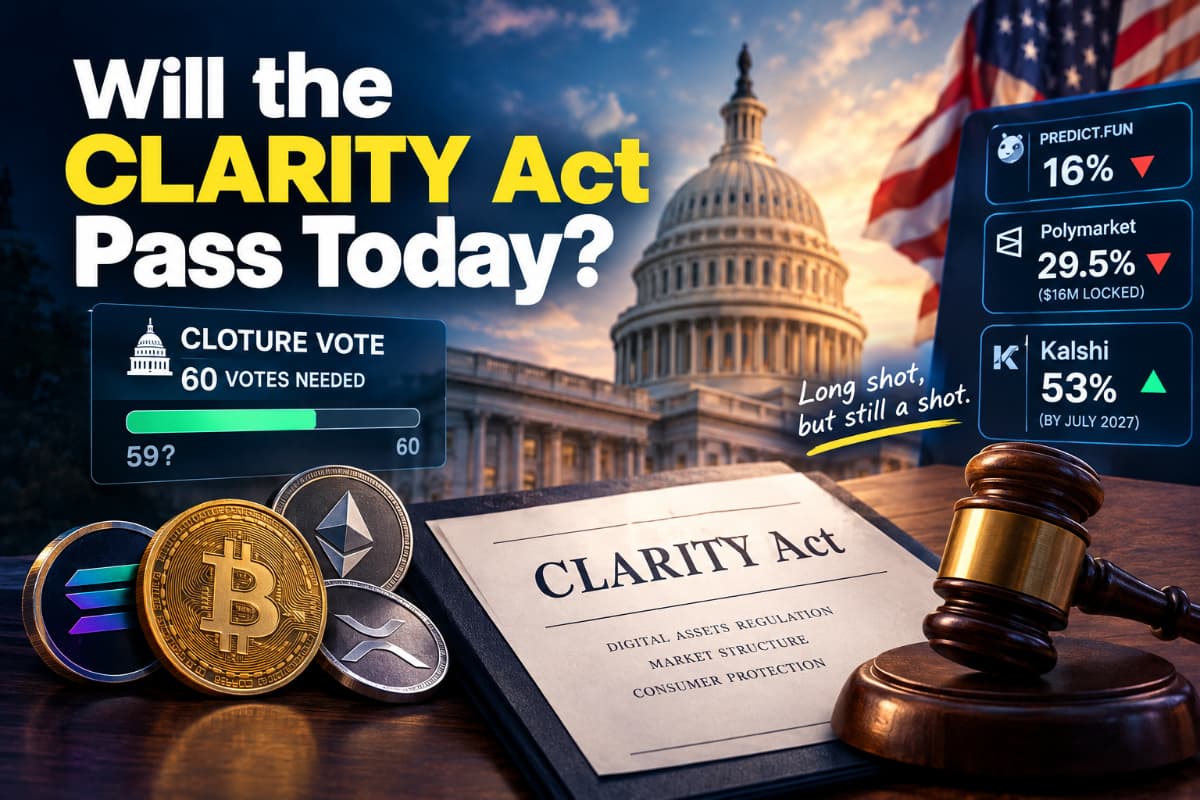
You know a bill has a really hard year if the best line describing its position is “long shot, but still a shot.” That's Stifel's Brian Gardner, and he is right.
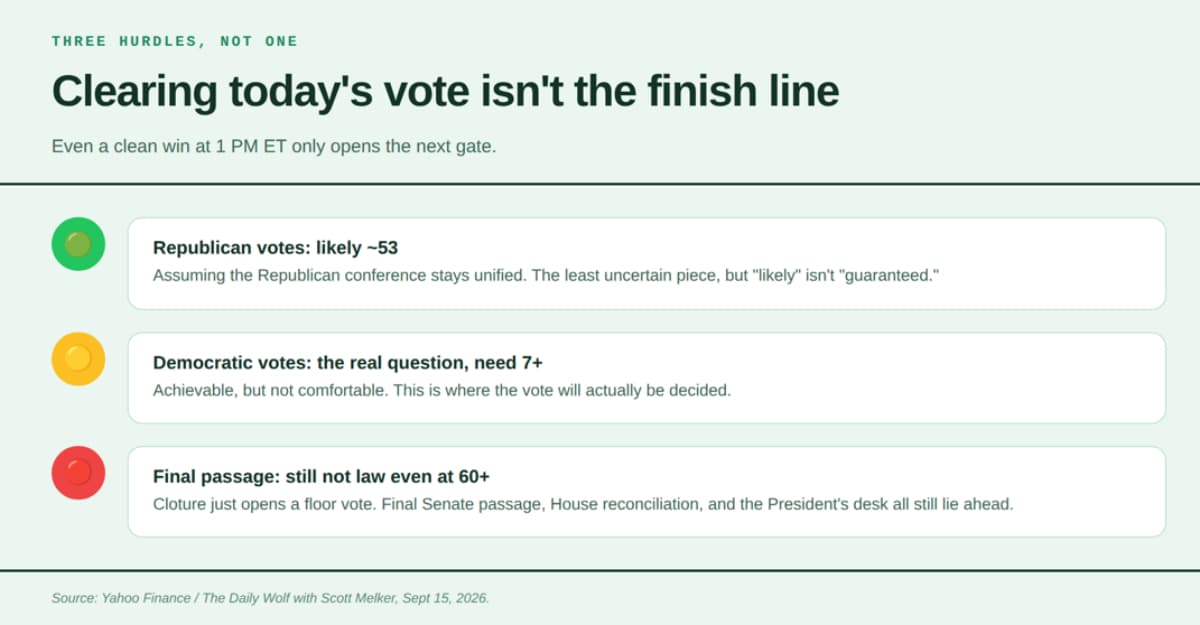
First, a correction to almost all the headlines you will see today: the Senate does not decide on regulating crypto this afternoon. Rather, they will take a cloture vote, which in Senate lingo means “can we finally stop blocking this debate so that we can actually debate on this issue.” At sixty votes, the bill advances. If fifty-nine votes are secured, this is likely over for the year since there is very little time before the midterm elections take over.
Lummis is not treating this like standard procedure. “After a year of intense daily bipartisan negotiations, this bill is ready,” she said after Republicans released the final version of the bill over the weekend. Her pitch to her colleagues was clear. Pass this bill or watch the entire crypto industry leave for the country that welcomes it the most.
Van Hollen is not going to let that happen. He spent the better part of Sunday posting to social media to remind people that this bill was already killed in the Senate in August, and that this is a bill written by “the crypto industry and their Republican flunkies in Congress,” a bill that, in his words, “does nothing to stop Trump's crypto corruption.” Neither of these two Senators is engaging in hyperbole. This really is how far away they are from a compromise, hours before the vote.
The majority of the media will likely get themselves tied in knots quoting a single number and thinking that is all the information they need.
Predict. Fun says 16%, and this number has taken a steep nose dive from 33% that was reported yesterday. This is the number that a lot of people have posted to their social media accounts.
Polymarket pegged the bill passage probability at 29.5% yesterday, and currently $16 million is locked in that market. However, the contract requires the bill to be signed by December 31, and the snapshot was taken prior to the news, which tanked Predict. fun overnight.
Kalshi has a totally different game. Their question hinges on the passage of the bill by July 2027. This has increased from roughly 30% to 53% in the last couple of weeks.
No market is incorrect here. They are simply placing their bets on different timeframes. A longer timeframe survives a bad afternoon. A same-year timeframe does not. If you only remember one thing from this section, remember to check the date against which a prediction market is betting before you compare it to another market.
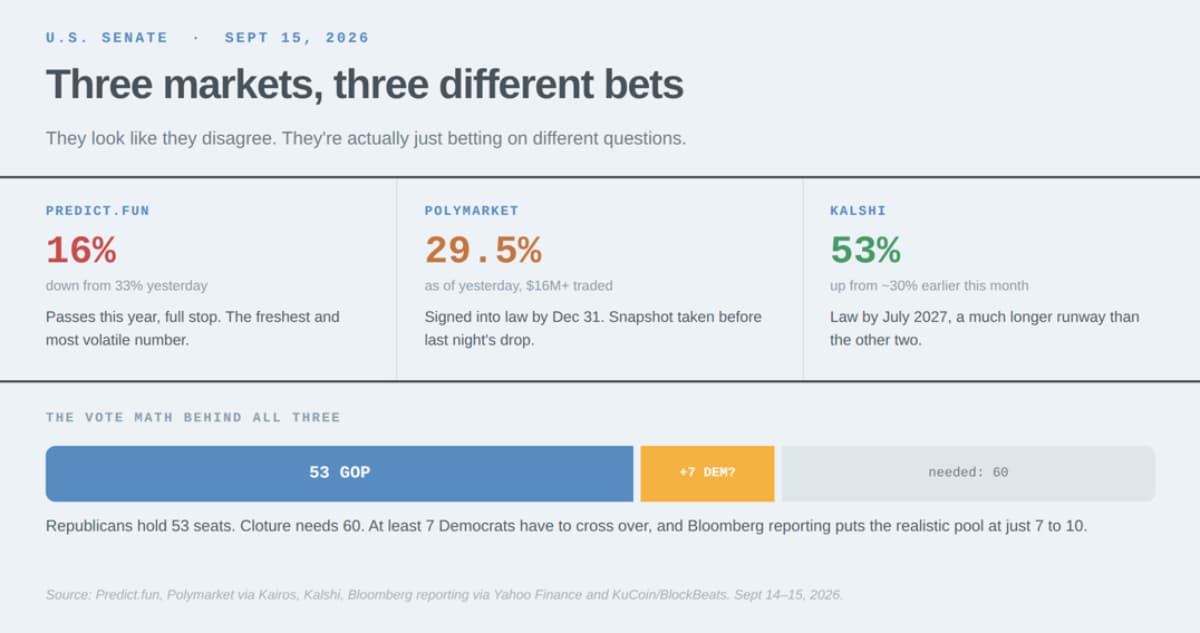
Everything above is opinion, mood, vibes, and dressed up as odds. The base of certainty kicks in here. Cloture requires 60 votes. Republicans have 53. That is math, not politics. Even a fully loyal Republican conference falls 7 short. Bloomberg’s count puts the number of Democrats who might cross over at 7 to 10. Do you see the problem? The number needed and the number available are the same.
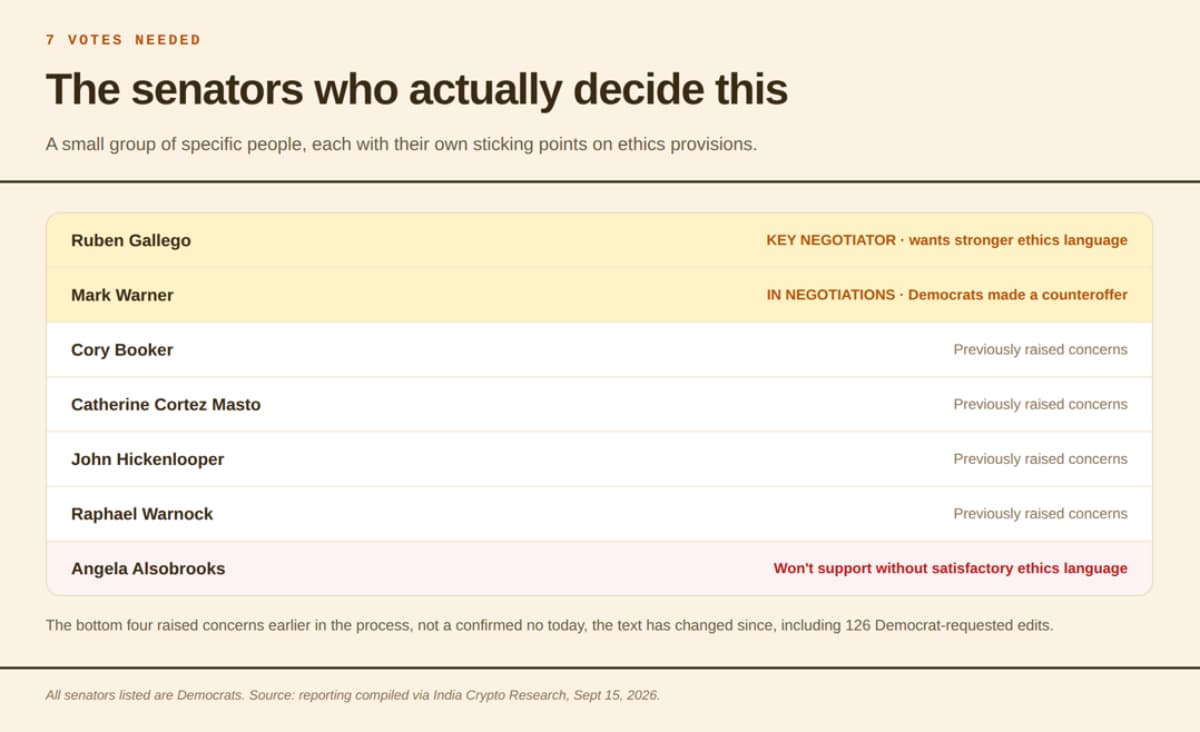
These senators make Tuesday afternoon actually important; everything else is background noise.
A quick stress test before you treat that table like a scoreboard. Four of those names, Booker, Cortez Masto, Hickenlooper, Warnock, voiced their concerns weeks or months ago, when the bill was different. Lummis’ camp claims the new draft incorporates 126 changes that Democrats specifically asked for. Maybe that moved them. Maybe it didn’t. Nobody will know for sure until the votes are counted. What the list shows for sure is that there is not one holdout that needs to be persuaded. There are seven with a slightly different flavor of the same complaint about the ethics provisions.
The number that everyone quotes is 635, the number of pages of the substitute text introduced by Lummis, Boozman and Scott. The number that is actually important is 126, the number of Democratic requests they claim were included in the draft.
There is actually a change that most people have overlooked, but is actually interesting. The DeFi provisions in the September 10 version were changed to only cover spot and cash trades of digital commodity purchases. Why? Well, Lummis says that the original language would have inadvertently written regulation for, among other things, contracts for predicting the outcome of events. What does that mean? It means that the bill about regulating crypto would have actually regulated the markets that predict whether the bill will actually become law. You really can’t make this up.
There has been a lot of feedback for and against the outcome of the CLARITY Act. According to Brian Armstrong, all Congress has to do is “get it done.” According to the Digital Chamber’s Cody Carbone, this is truly “the fight,” and he has been encouraging everyone to rally all week. Unfortunately, not everyone has been this hopeful. SALT’s John Darsie expressed his pessimism all the way back in August, saying, “I personally am a bit pessimistic about the CLARITY Act being passed.” All things considered, he might be right.
There is more to this than just who won. A 61-39 win is clear and decisive. A 60-40 vote is not. The bill would technically advance, but this isn’t the end.
Brooks, Gallego, and Warner will also matter, although not as much as the senators. They generally announce or signal their intentions before engaging in formal processes.
We will know these things before a vote is announced; Predict. fun and Polymarket will be the first and most trustworthy sources to announce a vote. Because of their early reaction times, they will announce before everyone else.
Overall, if no cloture is reached today, this was likely the last opportunity for the CLARITY Act in this Congress, which will almost certainly change, with different Congress people in different seats, by 2027.
“Long shot, but still a shot” proves the best two-line summary for this saga. The math is extremely tight and hinges on a handful of senators, and the ethics language has been the same fight for the last year. Three separate audiences, each with real dollars on the line, have been unable to arrive at odds for this. The reason is they are not even betting on the same thing. Whatever happens after the gavel falls will provide more evidence of where U.S. crypto policy really stands, and will cut through all of the conjecture that has been published this month.
India Crypto Research operates independently. The information presented herein is intended solely for educational and informational purposes and should not be construed as financial advice. Before making any financial decisions, it's essential to undertake your own thorough research and analysis. If you're uncertain about any financial matters, we strongly recommend seeking guidance from an impartial financial advisor.


