What is the CLARITY Act?
What would the framework change?
Why does the CLARITY Act matter?
Current status and legislative progress
Legislative timeline at a glance
What happened at Trump’s August 19, 2026 crypto meeting?
Impact of Trump’s CLARITY push on the crypto market
A Comparative table: GENIUS vs Clarity Act
What should the crypto market watch next?
Conclusion
Sources & further reading

 Part of a series
The Digital Asset Market CLARITY Act of 2025 (H.R. 3633) is a proposed U.S. federal framework for regulating digital assets. Its central objective is to reduce the long-running uncertainty over whether a crypto asset or activity falls primarily under the Securities and Exchange Commission (SEC) or the Commodity Futures Trading Commission (CFTC).
In practical terms, the bill tries to establish clearer categories, responsibilities and compliance pathways for the digital-asset industry. This matters because regulatory uncertainty has affected token issuers, exchanges, brokers, developers and investors, while also making it harder for institutions to determine how and where to participate in the market.
The significance of the bill goes beyond the classification of individual tokens. It is an attempt to create a market-structure framework for an industry that has largely operated through a patchwork of securities, commodities, banking, money-transmission and enforcement rules.
For the crypto industry, clearer rules could reduce legal uncertainty, support U.S. market participation and make it easier for traditional financial institutions to build products around digital assets. For regulators and policymakers, the challenge is balancing innovation with investor protection, anti-money-laundering controls, financial stability and conflicts of interest.
The bill has paced significantly but is yet to be formal law. In USA Congress, a bill has to go with certain process to be finalise as a law. Its journey through US Congress includes several key procedural milestones like:
House of Representatives~ Passed. The House of Representatives passed the bill on July 17, 2025, with a strong bipartisan majority of 294-134, including more than 70 democrats votes. The House version establishes a framework for digital commodities and gives the CFTC a central role in regulating qualifying digital-commodity markets.
Senate Banking Committee~ Passed. On May 14, 2026, the Senate Banking Committee advanced the CLARITY Act by a 15–9 vote after extensive bipartisan negotiations.
Updated Senate text~ Released. On July 22, 2026, Senator Cynthia Lummis released updated Senate text with 616-page draft reflecting merged work from the Senate Banking and Agriculture Committees.
Full Senate~ Pending. Senate Majority Leader John Thune has filed a cloture motion setting a procedural vote for September 15, 2026. To proceed to a formal floor debate, the bill requires a 60-vote supermajority. If it fails to secure 60 votes, the legislation will likely be dead for the remainder of 2026.
What does September 15 mean? It is not a final vote on the CLARITY Act. It is a procedural vote to advance debate. Cloture generally requires 60 votes, so the result will be an important test of whether enough bipartisan support exists to move the bill forward.
| Date | Milestone | Status |
| July 17, 2025 | House passes H.R. 3633 | Completed |
| May 14, 2026 | Senate Banking Committee advances bill 15–9 | Completed |
| July 22, 2026 | Updated Senate text released | Completed |
| August 2026 | Senate vote delayed during August recess | Completed |
| September 15, 2026 | Procedural Senate cloture vote | Upcoming |
| After Senate passage | House/Senate reconciliation and final approval | Not yet reached |
On August 19, President Donald Trump hosted major crypto and financial-industry executives at the White House and publicly urged Congress to pass a 'fair version' of the CLARITY Act. The meeting brought together regulatory leaders, including SEC Chairman Paul Atkins and CFTC Chairman Michael Selig along with the senior leaders from Coinbase, Ripple, Robinhood, Kraken, Nasdaq and other major firms. A smaller group was subsequently invited into the Oval Office, where the discussion focused on what was needed to move the legislation forward.
Trump framed the bill as important to U.S. technological and financial leadership. His intervention was significant because the bill was already stalled in the Senate, and the White House’s direct support signaled that digital-asset market structure remained a priority for the administration.
However, the meeting did not resolve the legislation’s major outstanding disputes. Ethics restrictions connected to public officials’ crypto interests, anti-money-laundering provisions, stablecoin rewards and protections for the banking system remain important points of contention.
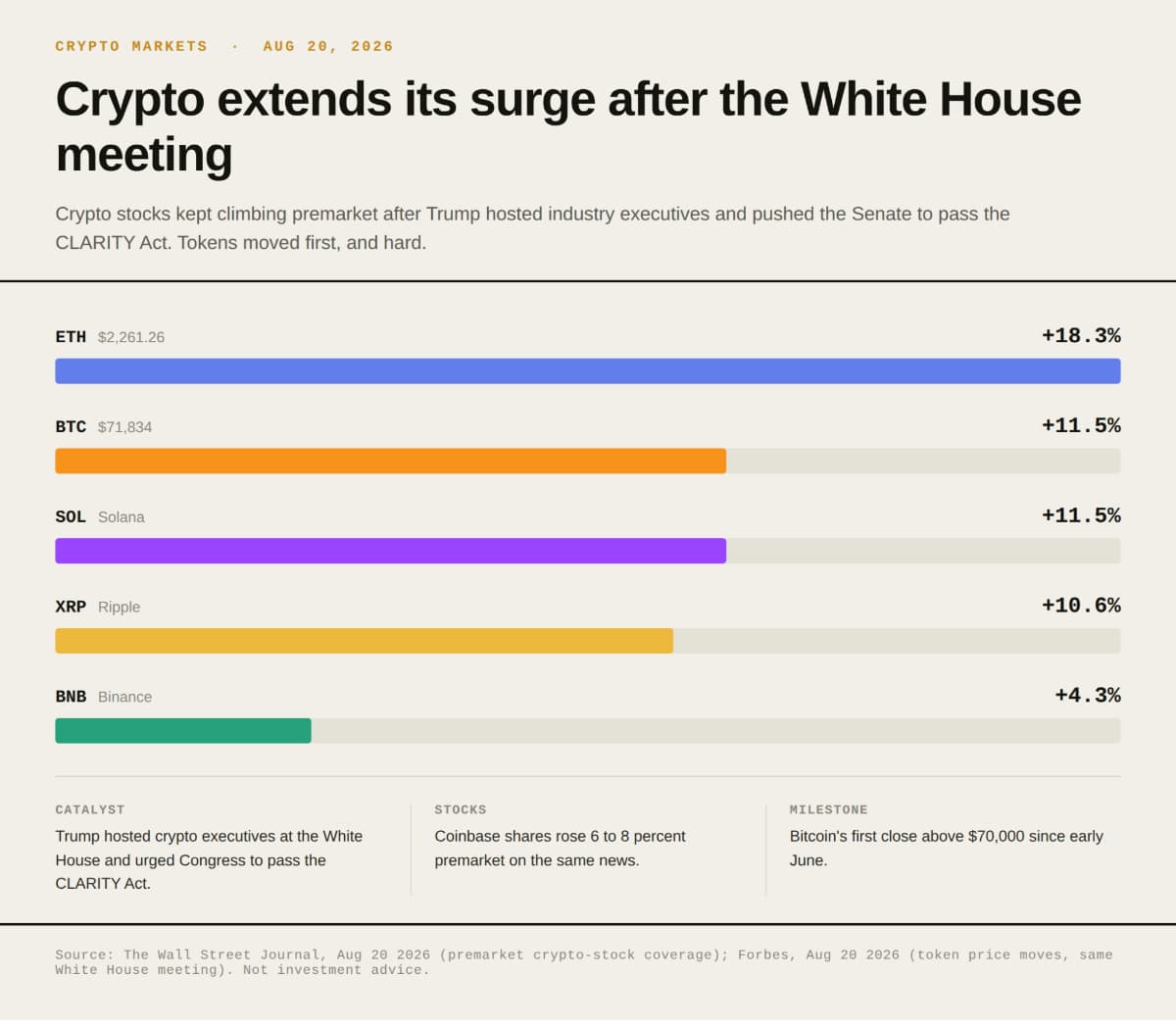
The strongest immediate effect was a shift in regulatory sentiment. Following Trump’s August 19 remarks, Bitcoin moved sharply higher and major crypto assets also rallied. Bitcoin rose back above $70,000, while Ether and several large-cap tokens posted double-digit gains during the move.
The market reaction reflected expectations rather than a change in law: Trump’s statement did not make the CLARITY Act law. Instead, traders interpreted the White House support as increasing the probability of a more crypto-friendly U.S. regulatory environment.
Crypto markets are highly sensitive to regulatory expectations. When investors believe that exchanges, token issuers and institutional participants may receive clearer rules, the perceived legal and compliance risk can fall. That can improve sentiment toward both crypto assets and publicly listed crypto-related companies.
The market also had to distinguish political support from legislative progress. The CLARITY Act still requires Senate action, and a procedural vote requires 60 votes. With the November midterm elections approaching and disagreements unresolved, the probability of passage remains uncertain.
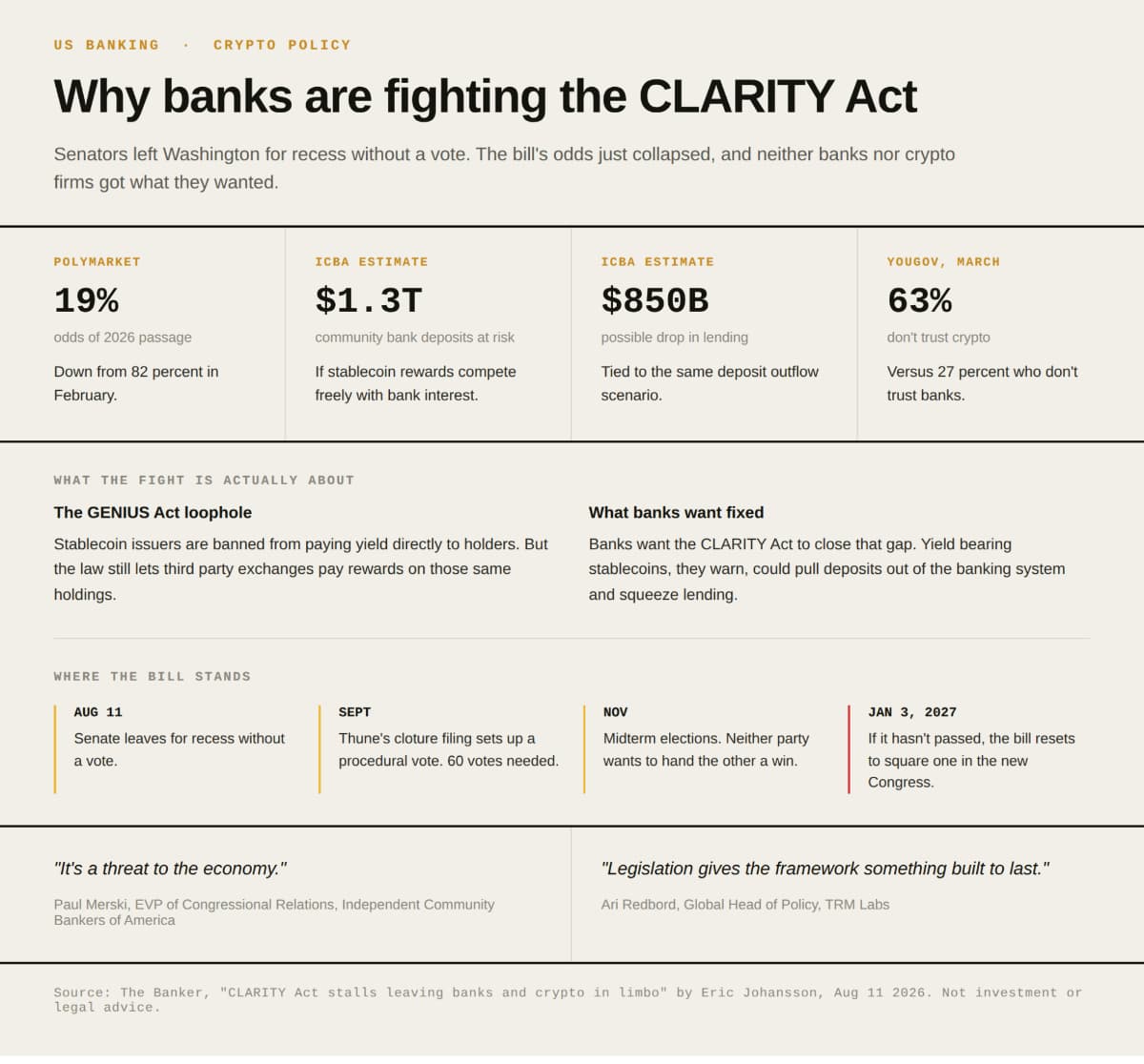
Banks have pushed back against provisions that could allow crypto firms to offer rewards on stablecoin holdings. Their concern is that higher rewards could pull deposits away from banks, reducing a source of funding for loans. Crypto firms argue that restrictions could reduce competition and innovation. This dispute is one reason the legislation has become more difficult to finalize.
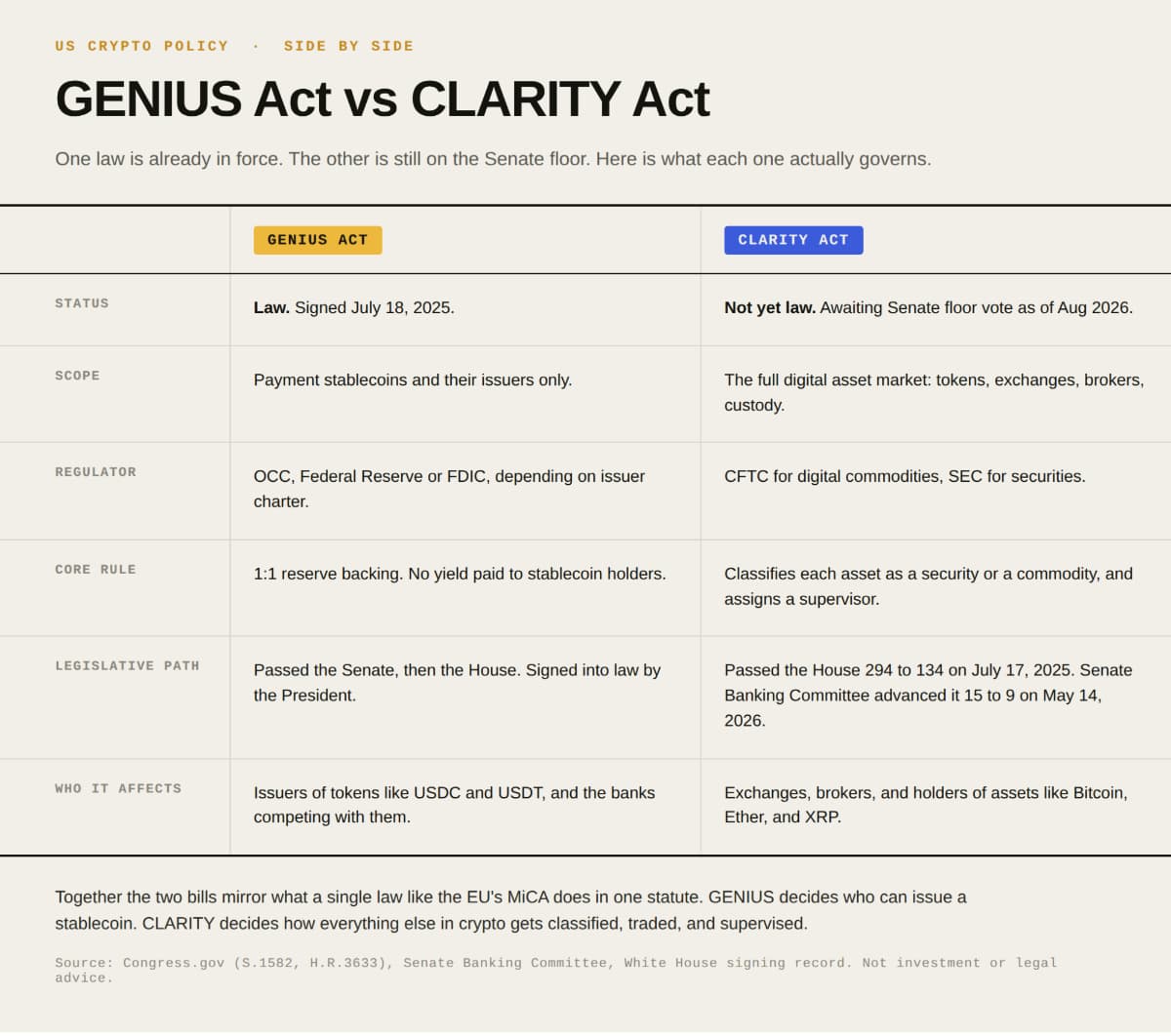
The Genius Act and Clarity act are the two most important framework regulating the US crypto market and stablecoin regulations. They are the primary structural pillars of US federal crypto policy shaping the crypto markets in the Country.
The CLARITY Act represents a potentially important turning point for U.S. crypto regulation. Its core promise is to replace regulatory uncertainty with a clearer market structure and a more defined division of responsibility between the SEC and CFTC.
The bill has already cleared two major stages i.e., the House and the Senate Banking Committee, but its most difficult stage remains ahead. Trump’s August 19 intervention gave the legislation a fresh political push and produced a positive short-term market response, yet it did not solve the underlying disagreements in Congress.
For investors and the broader digital-asset industry, the key message is therefore mixed with regulatory momentum remains alive, but the CLARITY Act is not yet law. September’s Senate vote will be the next major test and potentially one of the most important regulatory events for the U.S. crypto market in 2026.
India Crypto Research operates independently. The information presented herein is intended solely for educational and informational purposes and should not be construed as financial advice. Before making any financial decisions, it's essential to undertake your own thorough research and analysis. If you're uncertain about any financial matters, we strongly recommend seeking guidance from an impartial financial advisor.