Monday, 28 September: Alpenglow date passes
Tuesday, 29 September: the floor for the week
Wednesday, 30 September: the quarter closes, and the ETF run pauses
Thursday, 1 October: a bank stablecoin launches, along with the start of Q4
Friday, 2 October: a September jobs report sparks a spike that fades
Saturday, 3 October: a quiet climb
Where the Treasury Buyer Stands
Where Alpenglow Actually Stands
Just after the window: Solana DvP (announced 5 October)
What it means

Alpenglow did not activate on 28 September. That date came from a validator schedule entry that didn’t name it. The upgrade is live on devnet and testnet with no confirmed date for mainnet.
SOL was flat this week, losing about 0.3%. Price traded between $116.41 and $123.61. It tested $122 to $124 twice and was unable to close above $122.
ETF inflows fell from about $188 million to a net $0.8 million (Farside), with the first outflow day on 30 September. Cumulative flows are about $1.6 billion.
SOL closed Q3 up approximately 60% (some outlets quote approximately 48%). Network activity set records, with 14.2 billion non-vote transactions, and tokenised-stock trading also hit a record.
There was continued adoption, with Fiserv’s Roughrider Coin going live on Solana, DFDV’s holdings reaching approximately 2.56 million SOL and, on 5 October, the launch of Solana DvP with J.P. Morgan input.
 Part of a series
SOL started the week at about $121.97 and ended on Sunday at about $121.58, down about 0.3%, after moving between $116.41 and $123.61. There was a lot going on beneath the flat surface. Three things stood out:
● The date of 28 September for the launch of Alpenglow’s mainnet passed without any mainnet activation.
● ETF inflows dropped from about $188 million the previous week to a net $0.8 million.
● Q3 closed with about a 60% gain, record network activity and continued institutional adoption.
SOL opened at about $121.97, touched a high of $122.88 and closed at $118.87, down 2.53% on the day and touching a low of $117.28. On the same day, developers dismissed the idea that Solana’s consensus overhaul, Alpenglow, would activate on the mainnet.
The 28 September date was in Anza’s Agave v4.3 release schedule, which states that date as when “mainnet resumes feature activation”, but nowhere does the schedule reference Alpenglow. Anza’s head of research, Roger Wattenhofer, said the protocol had only entered public testing days earlier, and the headline version of his message was “No Alpenrush”. Anza and Solana co-founder Anatoly Yakovenko said there were no plans to rush the rollout.
A correction to our earlier reports that said 28 September was the target date for mainnet: that date was a misreading of the schedule.
ETFs took in $7.7 million on Monday, with BSOL adding $9.7 million and VSOL losing $2.0 million. DeFi Development Corp (DFDV) said its treasury had passed 2.5 million SOL, up about 10% in the past 6 weeks.
SOL rose 0.19% to $119.10 on Tuesday, ranging from $116.41 to $121.64. The low of $116.41 was the floor for the week. ETFs added $5.4 million, and BSOL added $5.7 million.
SOL fell 0.82% to $118.12, and closed the quarter after hitting $122.77 intraday. ETFs recorded their first daily net outflow in weeks. Farside showed about $12.5 million out, and SoSoValue showed about $11.1 million out. Bitwise’s BSOL led the outflows at about $8.9 million, and Fidelity’s FSOL showed about $2.8 million in.
SOL ended Q3 up roughly 60%, from about $74 at the end of June to about $118. Some outlets quote about 48% from early July. September added about 14.6%, and August added roughly 41%. Ether and Bitcoin gained roughly 71% and 43% respectively for the quarter. The SOL/ETH ratio closed nearly 6% lower for the quarter, per cryptonews.net.
Solana also had its busiest quarter:
● Blockworks data show a record 14.2 billion non-vote transactions, up 45% from Q2.
● On the stricter definition of successful non-vote transactions, Q3 also set a record of roughly 8.8 to 8.9 billion. September’s roughly 3.2 billion was the third straight monthly record.
● Daily active addresses averaged about 4.1 million, up 12% per CryptoBriefing.
● Solana led all chains in spot DEX volume for a fifth straight quarter. According to one metric, spot DEX volume hit $197 billion in Q3, though trackers differ sharply, with DefiLlama putting spot DEX volume for September alone at about $78 billion.
Solana’s price rose 0.27% to $118.44, with a range of $116.75 to $119.60. ETFs lost $1.1 million for a second straight day of outflows, with GSOL gaining $5.4 million and BSOL losing $6.5 million.
A digital asset platform powered by Fiserv is now live with bank clients. The first live product is Roughrider Coin, the Bank of North Dakota’s dollar-backed stablecoin. It is powered by Solana and Fireblocks, and VersaBank is the issuing bank. More than 90 North Dakota banks and credit unions can use this coin through Fiserv’s Commercial Center. It is permissioned, and not available to the public. There was no volume given.
Separately, tokenised stock trading on Solana hit a record of more than $4.4 billion in September, per Blockworks data shared by Solana, and the number of Solana wallets holding tokenised stocks passed 1.2 million.
SOL surged from $118.32 to $123.61, the high for the week. Unemployment rose to 4.2%, and non-farm payrolls only rose 29,000 for the month, against forecasts of roughly 84,000 to 90,000. Treasury yields fell and the odds of an October Fed hike dropped below 20%. SOL appeared to move in line with broader markets.
Gains faded in the afternoon as yields moved higher. SOL closed at $118.58, up just 0.12% on the day and $5.02, about 4.1%, below its daily high. ETFs added $1.3 million. The five most recent sessions added a net $0.8 million, against about $188 million the week prior.
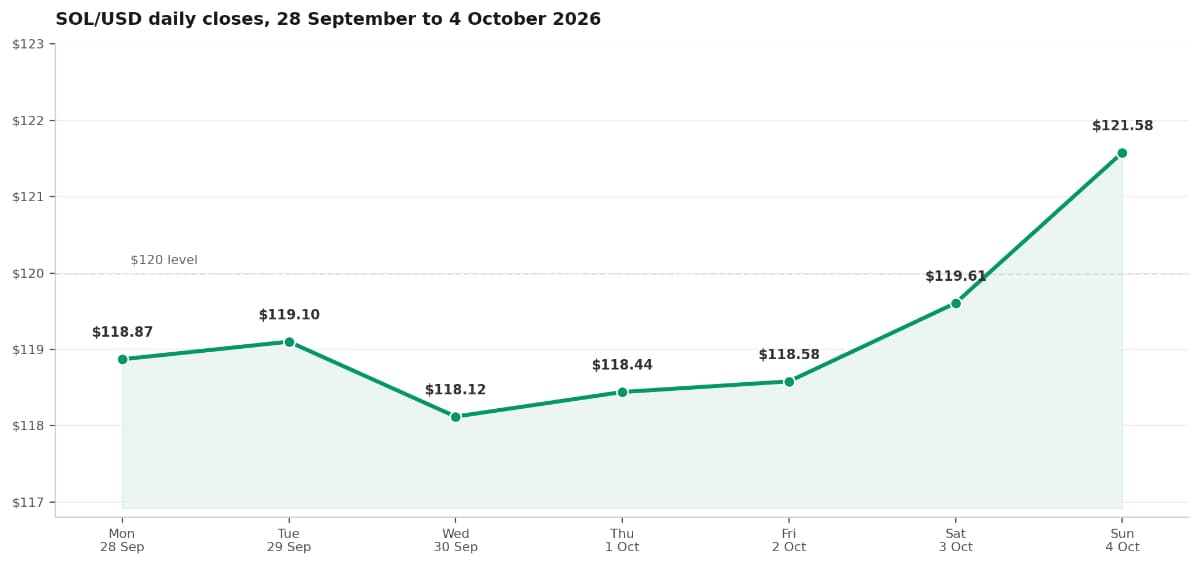
SOL/USD daily closes, 28 September to 4 October 2026
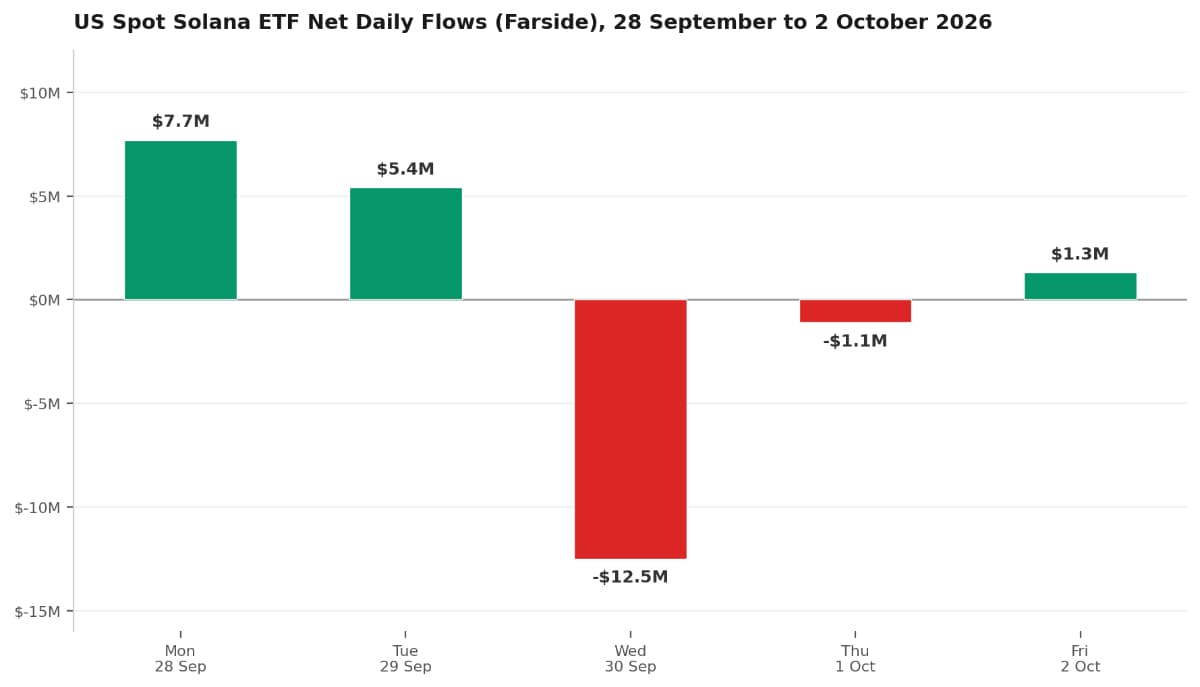
US spot Solana ETF net daily flows (Farside), 28 September to 2 October 2026
SOL rose 0.87% to $119.61 with a range of $118.53 to $120.06.
Sunday, 4 October: the week’s biggest gain
SOL gained 1.65% to approximately $121.58, with a range of approximately $119.63 to $122.24.
On Monday 5 October, DFDV reported an addition of approximately 26,203 SOL since 28 September. Holdings were approximately 2,564,212 SOL and SOL equivalents, worth approximately $302 million, a rise of about 11% since 12 August. The company also paid the first dividend on its CHAD preferred stock on 1 October, at a 13% annual rate on a $10 stated amount.
Alpenglow aims to cut finality from about 12.8 seconds to approximately 150 milliseconds. It received 98.27% approval in governance (SIMD-0326). Currently, Alpenglow is only available to run on Solana’s testnet and devnet, and not on mainnet. There is no confirmation as to when it will be deployed on Solana’s mainnet. Multiple sources still suggest an October target. Anza’s tentative v4.4 schedule suggests 9 November as the next mainnet feature-activation window. There is also no mention of Alpenglow in it.
The Solana Foundation announced an open-source escrow program for institutional delivery-versus-payment trades late on Monday 5 October (the press release is stamped 10pm ET). Both legs of a trade settle together, or neither does. Traditional trade settlement takes one to two days. With Solana DvP, settlement is almost immediate, and finality is achieved in a few seconds.
It uses the MIT licence and has support for SPL Token and Token-2022 and extensions for regulated issuers (like permanent delegates, pausable tokens, and transfer hooks). Any two parties can use it with any settlement agent (be it a bank, custodian or exchange).
J.P. Morgan’s input was limited to settlement practices of financial institutions. Their disclaimer states they have neither designed, built nor endorsed the program.
The Foundation says Solana DvP is ready for use with real funds and has undergone external security audits. It is planning for privacy features, and seeking design partners and early users ahead of the production release. 24/7 Wall St noted SOL’s role as a fee and staking asset is unchanged, and settlement volumes have not been disclosed.
$116.41, Tuesday’s intraday low, is the floor for this week. About $123.6, Friday’s intraday high, is the ceiling. SOL challenged the $122 to $124 zone on both Monday and Friday but couldn’t close above $122. The best close for the week was $121.58 on Sunday, which was also below last week’s best close of $122.16. Analysts are keeping an eye on $124 to $125 for resistance, and $116 to $119 for support.
The ETF picture went from around $188 million to a net $0.8 million, with cumulative flows still around $1.6 billion since launch. Under the hood, the fundamentals continued to strengthen.
● Q3 set a record for network activity.
● A bank’s stablecoin launched on Solana.
● A public company continued buying.
● The Foundation launched Solana DvP, an institutional settlement standard.
● Alpenglow continued development on test networks.
SOL enters the new week with the above continuing to build, under a price that still needs to clear $125.
Data as of 4 October 2026, with the DFDV and DvP announcements of 5 October noted as such. Sources: Investing.com, CoinGecko, OKX, YCharts, Farside Investors, SoSoValue, TokenPost, crypto.news, cryptonews.net, CryptoTicker, FinanceFeeds, KuCoin News, Bloomingbit, CoinCentral, BigGo Finance, CryptoBriefing, SolanaCompass, Crypto News Flash, CoinEdition, Yahoo Finance, 24/7 Wall St, Fiserv and VersaBank releases, DeFi Development Corp and Solana Foundation releases, Cointelegraph, CoinDesk and CNBC reporting.
India Crypto Research operates independently. The information presented herein is intended solely for educational and informational purposes and should not be construed as financial advice. Before making any financial decisions, it's essential to undertake your own thorough research and analysis. If you're uncertain about any financial matters, we strongly recommend seeking guidance from an impartial financial advisor.