How Crypto Is Taxed in India
What Happens When You Sell Crypto
How Ordinary Traders Miss the Tax Impact
How Liability Is Actually Calculated
Advance Tax Considerations
Consequences of Incorrect Reporting
How to Calculate Your Exact Crypto Tax Liability
Here’s How It Works


 Part of a series
In recent years, the Indian tax authorities have brought crypto under strict disclosure and taxation rules.
Tax authorities uncovered more than ₹880 crore in undisclosed crypto income during FY 2024-25. This led to the issuance of more than 44,000 compliance notices to traders who had failed to report their gains in their tax filings.
The tax department now cross-verifies exchange data, TDS filings, and income tax returns through automated systems. So if you’ve traded crypto this year, understanding your liability is essential, not optional.
The Indian crypto tax framework is different from the traditional capital gains model. Here in crypto, a flat tax applies to each profitable transfer.
Flat 30% Tax on Profits
Any gains on transferring crypto, whether through selling or swapping, are taxed at 30% + 4% cess + applicable surcharge. The holding period and your income bracket do not matter. The same flat tax rate applies to all.
In crypto, there’s no distinction between long-term and short-term gains. Both are taxed the same, unlike equities, where long-term gains have a lower tax rate.
Cost of acquisition is the only deduction allowed. No other expenses are counted, and losses from one crypto trade cannot offset gains from any other trade or anything else. They are simply not counted for tax purposes.
This is why two traders with similar net outcomes can have very different tax positions.
Under Section 194S, a 1% TDS is deducted on crypto transfers once annual transactions cross ₹50,000 for individuals and HUFs without business income, or ₹10,000 for everyone else.
This deduction is based on the gross transaction value, not just your profit. You can adjust this amount against your final tax liability when filing your return, even if your trades resulted in a loss.
In some cases, crypto is not acquired directly. You might receive it as a gift, salary, staking reward, airdrop, or through mining. In such cases, the tax rules depend on how you acquired the tokens, and you could face tax liability both when you receive them and when you eventually sell them.

Most crypto investors look at their net portfolio outcome and think, “I made ₹X overall.” But the tax system looks at each profitable transaction independently, and those two numbers may not be the same.
So, to put it simply, tax is not calculated on your final portfolio balance. It is calculated on each profitable transaction separately. That is how the current framework operates.
Let's take an example of Amit, who is a crypto trader. Amit was active all year. He booked profits on Ethereum and Bitcoin and had losses in some altcoins. By year's end, his portfolio was in profit. But when the numbers were calculated, this is what they showed.

His losses did not reduce the taxable amount. Even though his net profit was ₹1,10,000, his tax liability came to ₹1,31,040. It is important to understand the structure here. Tax is applied to every profitable trade independently, not to the final portfolio balance. What looked like a moderate year on screen translated into a higher liability on paper.
If your net tax liability from crypto gains, after adjusting TDS, exceeds ₹10,000 in a financial year, advance tax provisions apply under Section 208 of the Income Tax Act.
The final instalment is due by 15 March, and any shortfall can attract interest at 1% per month under Sections 234B and 234C.
Incorrect reporting of crypto income can have real consequences under Indian tax law.Under-Reporting of Income (Section 270A)
At this point, the difference between “I didn’t know” and “I didn’t check” can be the difference between filing cleanly or receiving a notice.
Calculating crypto tax manually is time-consuming, and there are chances of error while reconciling trades, adjusting TDS, and preparing Schedule VDA disclosure. Even a small mistake can lead to mismatches during filing.
India Crypto Research’s Tax Calculator makes this calculation process easy for you. It consolidates all your trades across various exchanges, computes tax liability and generates a report within minutes. Instead of relying on rough estimates, you get a clear transaction-level breakdown based on your actual data.
If you have traded crypto this year, the most important step is knowing your exact liability before filing.
Create your account at https://indiacryptoresearch.co.in/crypto-tax-calculator

Upload your exchange trade Statements in the CSV/XLSX format as per the instructions given on the page, or sync your wallet with read-only access.

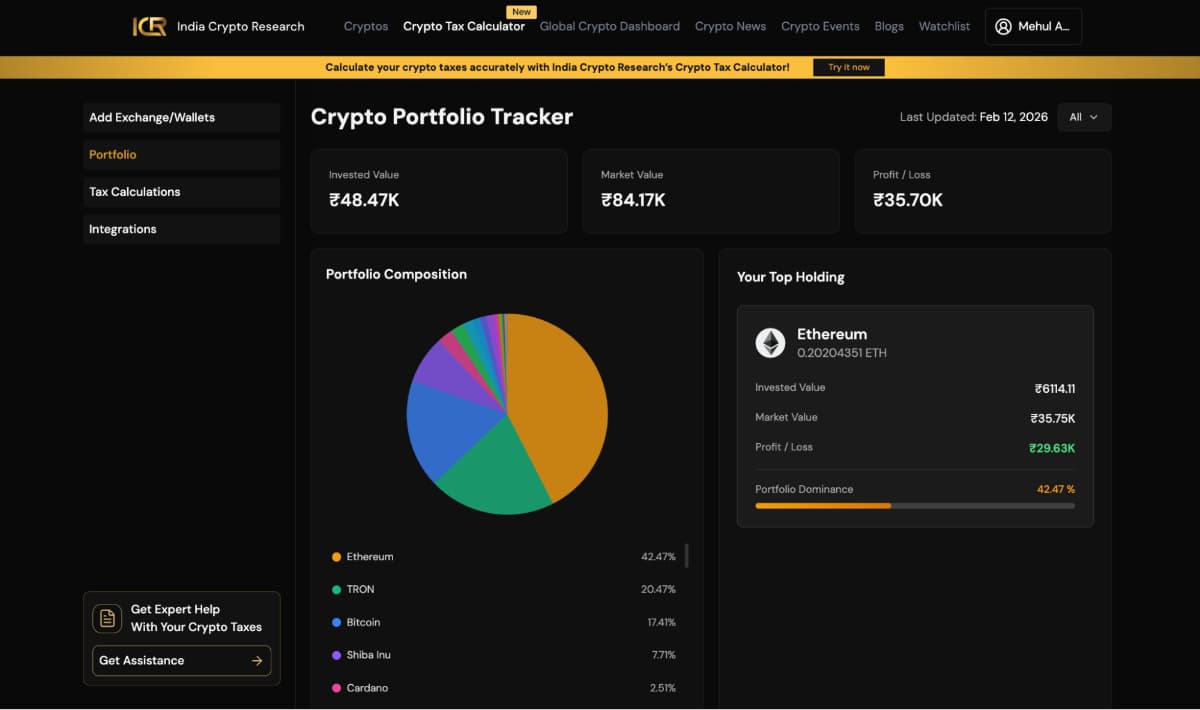
View your invested value and crypto-wise breakdown
Click “Tax Calculations” for year-wise profit, loss, tax, cess, TDS, and net payable.
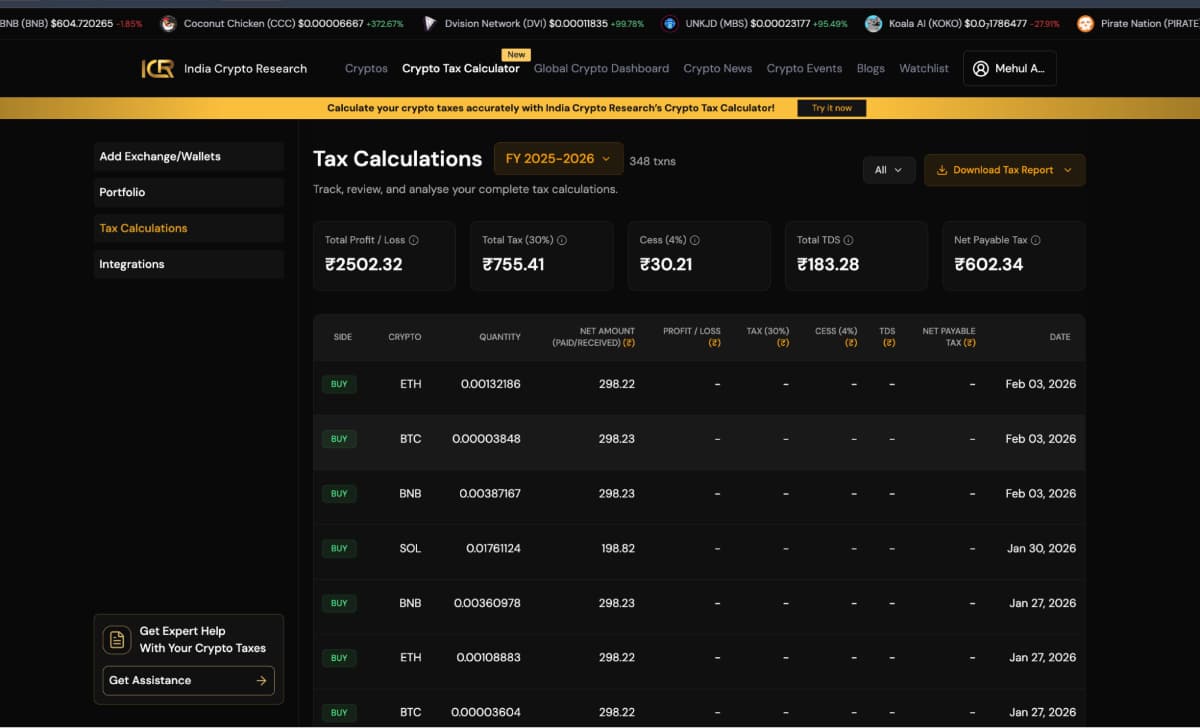
Download your ready-to-file tax report in PDF or XLSX Format as per your requirement.

Connect with our crypto tax experts for any queries.

Note: Upload one file per exchange per financial year. Do not modify exchange trade statements after download.
If you’ve traded crypto this year, now is the time to calculate your tax liability accurately.
India Crypto Research operates independently. The information presented herein is intended solely for educational and informational purposes and should not be construed as financial advice. Before making any financial decisions, it's essential to undertake your own thorough research and analysis. If you're uncertain about any financial matters, we strongly recommend seeking guidance from an impartial financial advisor.