
Australia Proposes Bank-Style Standards for Crypto Exchanges
The US: High Engagement, Pending Direction
Switzerland, the UK, Singapore and France
India: What Happens to Your Crypto if an Indian Exchange Fails?
What to Watch Next

Australia: The regulator, ASIC, has proposed more stringent standards for crypto exchanges and custodians. Feedback is open.
United States: Various industry groups have submitted comment letters on stablecoin rules and a token offering proposal, and the White House has lost its crypto chief.
Switzerland: The regulator approved the country's first spot Bitcoin ETF for ordinary investors.
Europe: French lawmakers backed a tax on crypto-to-stablecoin swaps, and USDC faces direct EU supervision.
 Part of a series
Some weeks are dominated by a single, massive headline. This week brought several smaller updates that tell a clear story: global regulators are moving quickly from asking if they should regulate crypto to determining how they will do it.
Below is a breakdown of what happened this week, stripped of the usual jargon.
On 15 October, the Australian Securities & Investments Commission (ASIC) released a consultation paper containing proposed behavioural standards for crypto exchanges and firms that hold digital assets for clients. The underlying rationale is simple: “same activity, same risk, same regulatory outcome.” If a firm offers services that mirror traditional financial services, it should face a matching set of rules.
The proposals are centred around three main areas:
• Asset Protection: Requiring platforms to protect private keys and implement strict policies to safeguard customer assets.
• Fair Trading Practices: Monitoring market manipulation, managing conflicts of interest, and banning crypto exchanges from trading against their own customers.
• Financial Resilience: Requiring platforms that hold client assets to have at least A$14 million in net tangible assets or 10% of the firm's average revenue (whichever is greater). Platforms using external custodians will face a much lower asset requirement.
Clear Timelines for Compliance
The proposed timeline offers businesses looking for regulatory certainty the following roadmap:
• 27 November 2026: Feedback period for the consultation paper ends.
• March 2027: Expected publication of finalised regulatory standards.
• 8 April 2027: New regulatory regime takes effect.
• 7 October 2027: Deadline for existing businesses to apply for a licence.
Existing businesses will be allowed to continue operations while ASIC reviews their applications. ASIC has stated it has already received more than 140 applications. This aggressive reform initiative is largely a result of the 2022 FTX collapse, which left roughly 30,000 Australian consumers locked out of their funds.
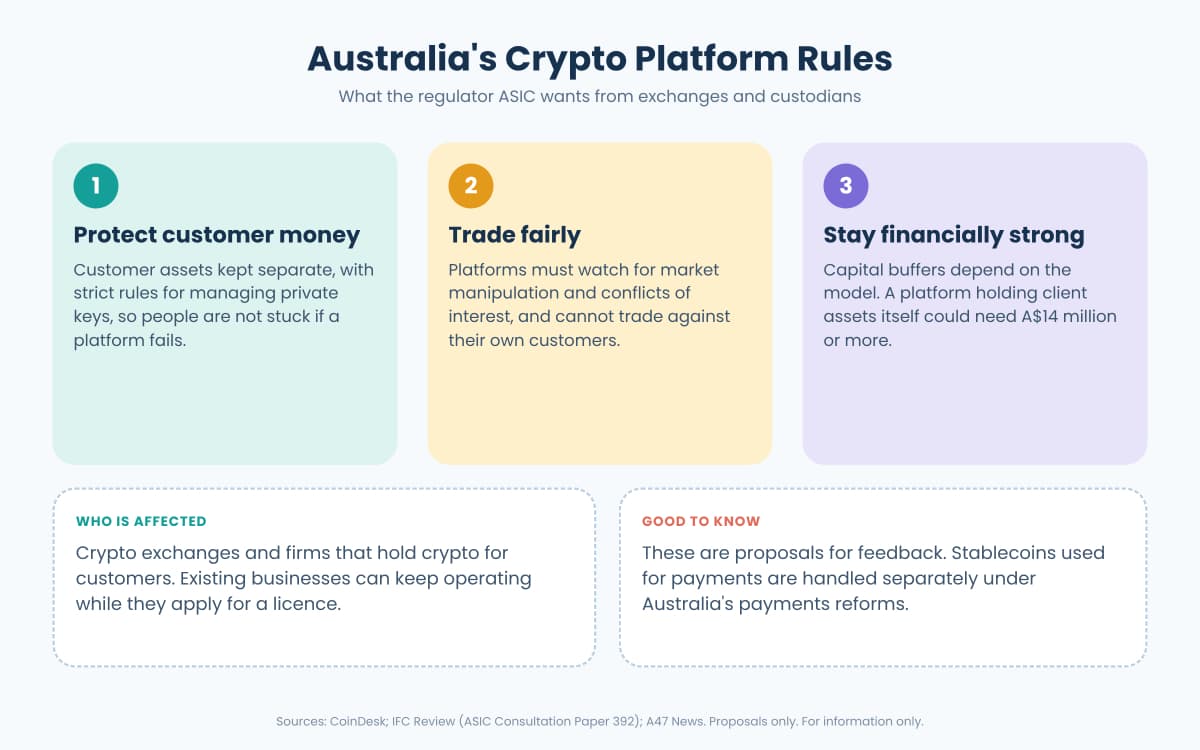
Figure 1: What ASIC wants from crypto exchanges and custodians. Sources: CoinDesk, IFC Review (ASIC Consultation Paper 392), A47 News.
This week, two important comment periods closed, drawing a lot of industry engagement with upcoming regulatory frameworks. On 19 October, the Blockchain Association submitted a 26-page response to the Treasury's proposed rule under the GENIUS Act, America's stablecoin law. The Association supports the overall objective of ensuring that regulated issuers maintain sufficient reserves, but argued that the rules should apply only to customer-facing businesses and should not unwittingly touch software such as self-custodial wallets and validators. The Association also sought clarity on what constitutes “knowing participation” in an unlawful issuance. It proposed that “knowing participation” be defined as actual knowledge and real assistance in an unlawful issuance. Firms should also be able to rely in good faith on regulators' public registries when dealing with foreign issuers.
The comment window closed on the SEC's proposed Regulation Crypto Assets on 20 October. This regulation introduces exemptions for capital raising via token offerings. The Hyperliquid Policy Center petitioned the SEC to clarify that free airdrops do not constitute securities, arguing that the currently proposed safe harbour is too restrictive. Meanwhile, SIFMA, which represents major financial institutions, urged the SEC to finalise investor protection guidelines early. AIMA, representing hedge funds, asked for more detailed disclosures about investors' rights and the risks they are taking on. Overall, 123 comments were submitted during this round.
The submitted comments show the industry's level of engagement, but in the end, these are requests for changes to the policy as opposed to changes themselves. The next step will be for regulators to consider the feedback to determine what changes to make (if any).
Elsewhere, Patrick Witt, the White House's top crypto adviser, has left the administration. According to KuCoin News, his tenure officially ended on 14 October, and no successor has been named yet. Legislative momentum also remains slow. The Digital Asset Market Clarity Act, one of the major market structure bills of the year, is still stalled following a narrow 49-to-50 Senate vote in September, falling short of the 60 votes required to advance. A White House official, however, told CoinDesk that crypto remains a priority for President Trump.
Meanwhile, in broader US markets, sixteen companies had raised formal objections by 19 October to their shares trading as tokens. The tokens were set to trade on a new venue operated by OKX and the New York Stock Exchange owner, ICE. Ledger Insights reports that the venue intends to operate under an SEC exemption issued in September. The reasons for the companies' objections have not yet been confirmed.
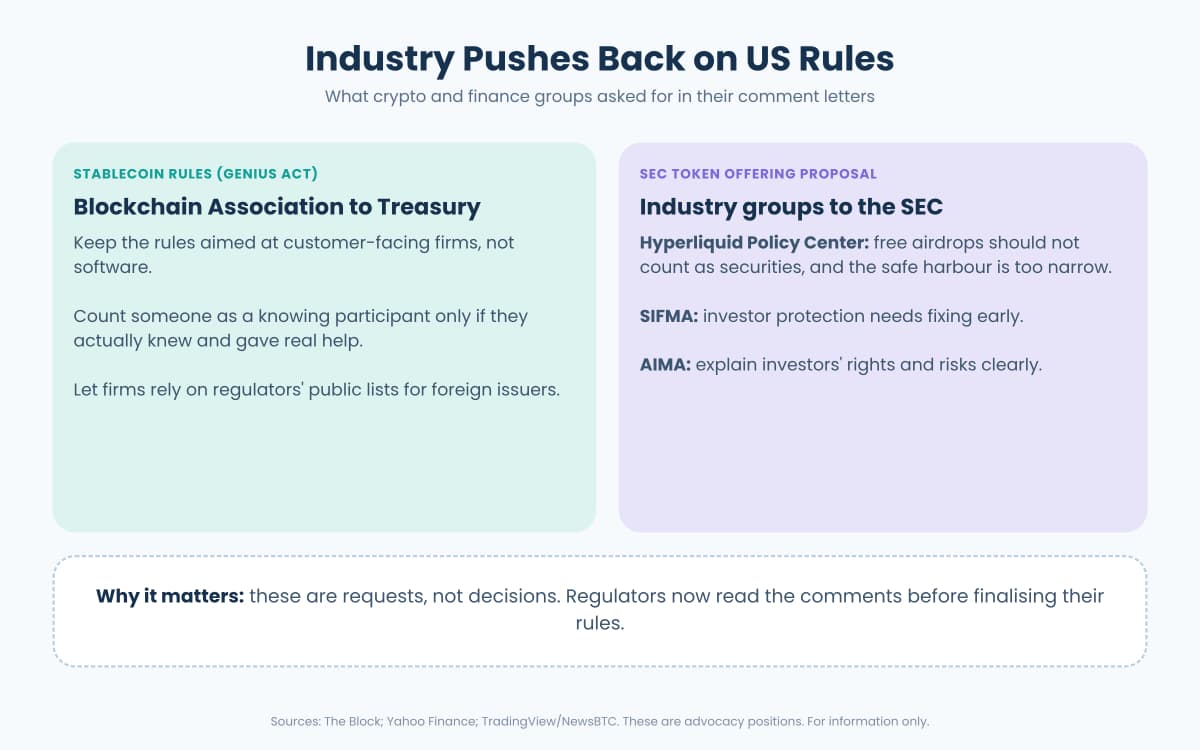
Figure 2: What crypto and finance groups asked for in their comment letters. Sources: The Block, Yahoo Finance, TradingView (NewsBTC).
On 20 October, Switzerland's financial regulator, FINMA, approved the country's first spot Bitcoin ETF for retail investors. This allows everyday investors to invest in actual Bitcoin through standard brokerage accounts. FINMA waived standard diversification rules due to Bitcoin's long trading history, but specifically warned that investors face a high risk of losing their money. Some reports name BIT Asset Management as the issuer, targeting a November launch, but these details are unconfirmed.
Also on 20 October, the 11th UK-Singapore Financial Dialogue covered digital topics such as cross-border tokenisation and stablecoins. However, there were no legally binding outcomes from the discussions.
Meanwhile, in Europe's tax debate, French lawmakers narrowly voted in favour of applying a 31.4% tax on converting crypto to stablecoins from 1 January 2027. For now, this is merely a proposal, as the French government is against it. Separately, the European Banking Authority (EBA) classified the USDC stablecoin as a “significant” e-money token under MiCA, meaning the EBA will supervise its reserves and liquidity from 12 November.
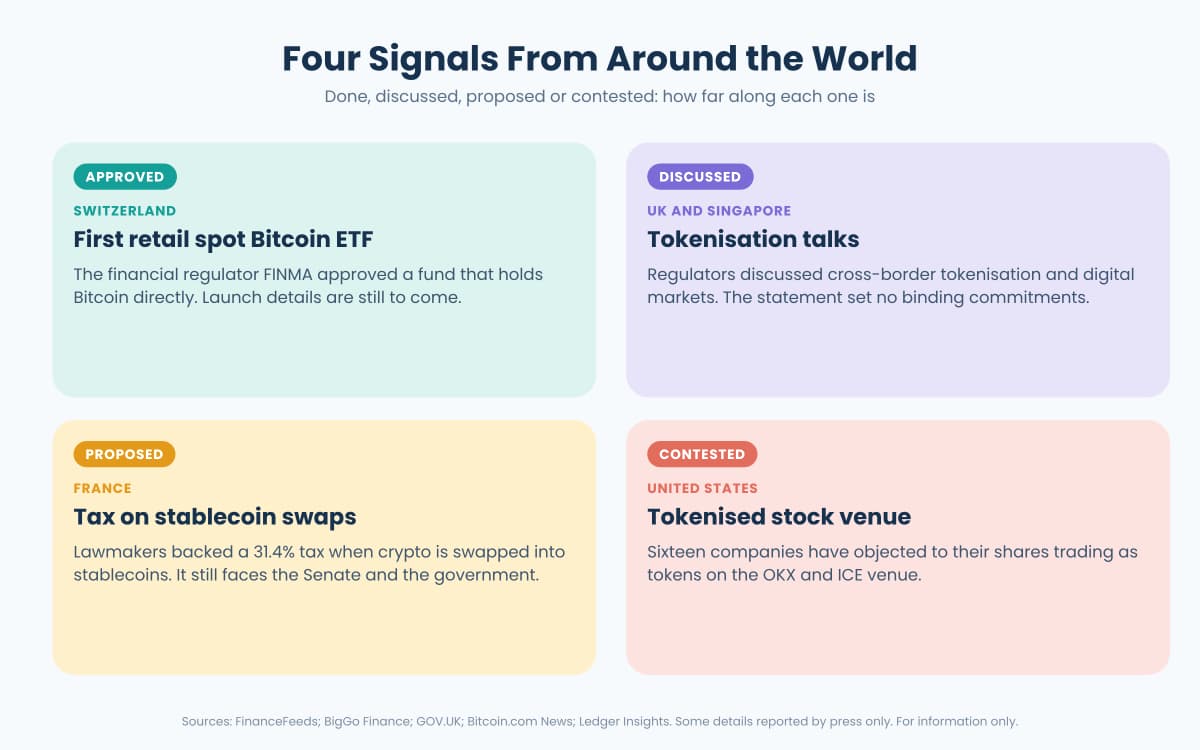
Figure 3: Four signals from around the world: approved, discussed, proposed or contested. Sources: FinanceFeeds, BigGo Finance, GOV.UK, Bitcoin.com News, Ledger Insights.
While Indian regulators didn't release new crypto rules recently, an important development is happening behind the scenes with regard to investor protection. The Insolvency and Bankruptcy Board of India (IBBI) has reportedly published a research paper that outlines major gaps in how the country's bankruptcy laws deal with Virtual Digital Assets (VDAs).
The paper outlines three main recommendations:
• Legal Recognition: Treat crypto as formal property under the Insolvency and Bankruptcy Code (IBC), giving investors legal standing to reclaim their assets.
• Asset Separation: Require exchanges to keep customer assets and corporate funds completely separate, so user coins are safeguarded if the exchange goes bankrupt.
• Cross-Border Rules: Create guidelines for valuing crypto and clawing back user assets held overseas.
When a traditional bank closes, there are clear guidelines on returning customer deposits. With crypto, the rules are still unclear. Ultimately, regulating crypto in India is no longer simply about collecting taxes; it is about protecting ordinary investors when things go wrong.
• Australia: Feedback on the consultation closes on 27 November.
• United States: What Treasury and the SEC do with the comments, and who will succeed the White House crypto adviser.
• Switzerland: The issuer and launch details of the Bitcoin ETF.
• France: Whether the stablecoin swap tax survives the rest of the budget process.
Sources: CoinDesk, IFC Review, A47 News, KuCoin News, The Block, Yahoo Finance, TradingView (NewsBTC), Ledger Insights, FinanceFeeds, BigGo Finance, Bloomingbit, GOV.UK, Fintech News Singapore, Bitcoin.com News, The Paypers, European Banking Authority, IBBI, Financial Express
India Crypto Research operates independently. The information presented herein is intended solely for educational and informational purposes and should not be construed as financial advice. Before making any financial decisions, it's essential to undertake your own thorough research and analysis. If you're uncertain about any financial matters, we strongly recommend seeking guidance from an impartial financial advisor.


