
1. The Big Picture
2. Five Stories That Shaped the Week
3. Top 10 DeFi Tokens and Most Traded
4. Major Upgrades and Launches
5. Security Watch, Last 15 Days
6. ETH Staking Rate
7. Liquid Staking Rate
8. Where the Money Moved
9. Liquidity Pool Watch
10. Hot Topic: The Banks Are Coming Onchain
11. What to Watch Next
FAQs

The OCC became the first federal banking regulator to finalise its GENIUS Act stablecoin rule, effective 18 January 2027.
JPMorgan and Ripple moved deeper onchain this week, and Standard Chartered signed a deal to buy crypto custodian Zodia.
DeFi TVL eased only about 1.5% to $89.98 billion, while bridges, DEXs and lending grew.
ETH staking rose to 36.09% of supply, and the exit queue shrank by 90%.

 Part of a series
Cryptocurrencies calmed after a hard week of falling prices. Bitcoin traded between $80,000 and $84,000 and was seen at about $83,350 on 21 October, with its 28-day volatility near its lowest level of 2026.
The real action was in the rulebooks and the banks. On 21 October, the U.S. OCC (Office of the Comptroller of the Currency) became the first federal banking regulator to finalise its rule under the GENIUS Act, America's stablecoin law. Just two days earlier, JPMorgan brought its JPM Coin deposit token to Ethereum and CME began trading Uniswap futures. On 21 October, Standard Chartered also signed an agreement to acquire Zodia Custody, a crypto custody company.
DeFi's total value locked (TVL), the money deposited in DeFi apps, eased about 1.5% to $89.98 billion, around ₹8.49 lakh crore. The five largest sectors either increased or remained steady.
| Indicator | 21 Oct 2026 | Change |
|---|---|---|
| DeFi TVL | $89.98B | −1.5% vs 14 Oct |
| Stablecoin supply | $301.48B | −0.54% in 7 days |
| DEX volume, 7 days | $47.23B | −0.67% |
| Perpetuals volume, 7 days | $155.41B | +5.41% |
| DeFi fees, 24 hours | $74.28M | — |
| ETH staked | 36.09% of supply | up from 35.78% |
Stablecoin, DEX and perpetuals changes are 7-day figures as reported by DefiLlama, which revises past data.
What it means: The week's drop was limited. Perpetual futures, which allow traders to bet on prices without an expiry date, increased again this week and now trade more than three times the volume of decentralised exchanges (DEXs). DeFi apps still earned $74.28 million in a day, approx. ₹701 crore.
The OCC's stablecoin rule has been finalised. The OCC's rule takes effect on 18 January 2027. It sets requirements for reserves, redemptions, custody and risk for bank and non-bank issuers, and for foreign issuers. Issuers still cannot pay interest directly, but the OCC dropped a proposal that would have presumed some third-party reward schemes unlawful, and will instead judge them case by case. The American Bankers Association (ABA) objected to the change.
JPMorgan's deposit token is on Ethereum. On 19 October, JPMorgan's Kinexys unit expanded JPM Coin (JPMD), a digital representation of real bank deposits, beyond Base to Ethereum for institutional clients. Kinexys said Ethereum's "established depth of onchain liquidity and tokenized assets" made it a natural next step.
CME lists Uniswap futures. On 19 October, CME launched regulated UNI futures, in standard contracts of 10,000 UNI and micro contracts of 1,000 UNI.
Solana aims for 150-millisecond finality. On 21 October, Anza's Alpenglow update went live on Solana. It aims to cut finality, the point where a transaction cannot be reversed, from about 12.8 seconds to about 150 milliseconds.
Aerodrome and Velodrome merge. The two leading exchanges on Base and OP Mainnet combined as Aero late on 21 October (US time), becoming a single exchange across seven blockchains, including Ethereum and Robinhood Chain. Holders can update to a new AERO token, with each VELO converting to 0.044 AERO.
The DeFi category, as per CoinGecko, is worth $80.54 billion. Hyperliquid's HYPE leads the list at $18.10 billion, which accounts for approximately 22% of the category's total. The list does not include stablecoins, fund tokens, staked tokens or wrapped tokens.
| Rank | Token | Price | Market value | 24h volume |
|---|---|---|---|---|
| 1 | Hyperliquid (HYPE) | $81.41 | $18.10B | $814.1M |
| 2 | Chainlink (LINK) | $12.70 | $9.74B | $263.9M |
| 3 | Rain (RAIN) | $0.0093 | $6.59B | $25.0M |
| 4 | Uniswap (UNI) | $7.58 | $4.74B | $548.2M |
| 5 | Ethena (ENA) | $0.2200 | $2.95B | $506.6M |
| 6 | Aave (AAVE) | $159.16 | $2.45B | $235.8M |
| 7 | Bitway (BTW) | $1.61 | $2.43B | $26.2M |
| 8 | Pump.fun (PUMP) | $0.0049 | $2.27B | $179.8M |
| 9 | Ondo (ONDO) | $0.4660 | $2.27B | $110.3M |
| 10 | Aster (ASTER) | $0.7200 | $1.96B | $71.7M |
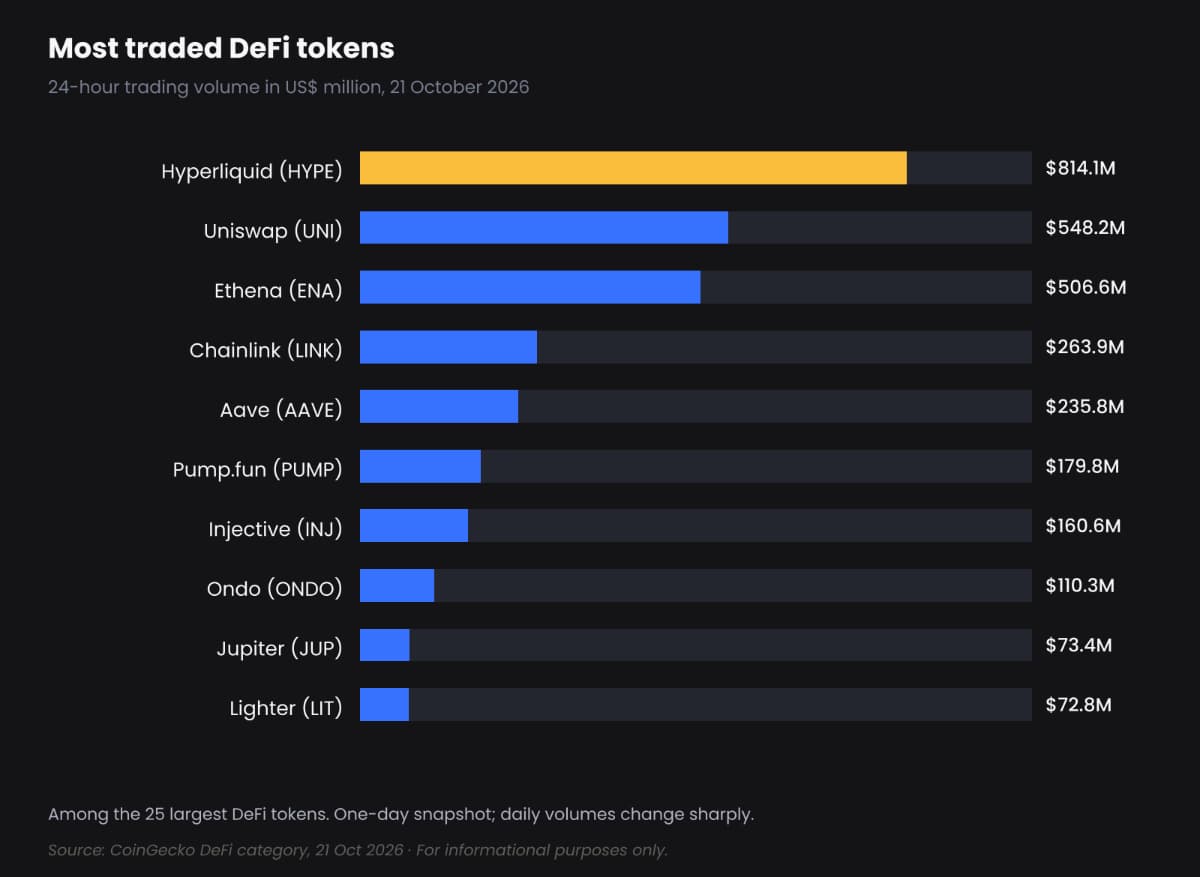
Most traded DeFi tokens by 24-hour volume, 21 October 2026. Source: CoinGecko.
What it means: Most large tokens moved less than 4%. HYPE, UNI and AAVE all moved less than 1% for the week, Ethena rose 3%, and Injective jumped about 12%. Bitway tumbled 18%, but its listed market cap dropped from $5.32 billion to $2.43 billion, a far bigger fall than its price, so its ranking should be read with caution. UNI's one-day trading volume equalled 11.6% of its market value. CME's UNI futures also launched this week. The most-traded list covers the 25 largest DeFi tokens.
This week, a number of launches closed the gap between traditional and decentralised finance. Ripple Prime began offering institutions swaps that track more than 100 real-world markets listed on Hyperliquid, with market maker Virtu already trading. Injective signed an agreement with BDACS that plans to bring KRW1, the Korean won stablecoin, to its network. Standard Chartered's Zodia deal, once authorised, would add regulated custody in Singapore, Hong Kong, Australia, the UAE and Luxembourg. Meanwhile, 16 companies, including Microsoft, Alphabet and Goldman Sachs, have now objected to having their stock listed on OKXICE's planned tokenised stock venue.
From 7 to 21 October, known losses totalled approximately $101.1 million, or ₹954 crore.
| Date | Target | Loss |
|---|---|---|
| 19 Oct | AlpsCon AI Trade Hub | $152,809 |
| 17 Oct | Qubic | $1.3M |
| 16 Oct | Affluent | $1.05M |
| 14 Oct | UNCX Network V2 | $86,000 |
| 13 Oct | Gamdom | $4.21M |
| 10 Oct | Papertrade | $1.28M |
| 9 Oct | Ledger (supply chain) | $93M |
| 7–8 Oct | Locus, BitBay, Ethervista | $51,438 |
What it means: The Ledger case accounts for 92% of the total. Devices sold by one reseller contained a hidden chip that copied recovery phrases. The $93 million figure has not been verified by Ledger. Without it, losses were around $8.1 million. This week alone, around $2.59 million was lost. Qubic halted its chain after 1,404 wallets, created with weak, predictable seeds, were drained, and about 87% of the drained funds remain stuck on the halted chain. Cysic also paused its bridge after an attacker minted 10 million fake CYS tokens and moved about $727,000 to Ethereum; Cysic has not disclosed its loss. The lesson does not change. Buy wallets only from the manufacturer, and keep wallet apps up to date.
Rising to 36.09% of supply, staking hit the highest level in our weekly readings. With a yearly reward of 2.46%, ₹1 lakh staked would yield about ₹2,460 before fees.
| Metric | 14 Oct | 21 Oct |
|---|---|---|
| ETH staked | 43.7M (35.78%) | 44.1M (36.09%) |
| Validators | 837,154 | 818,925 |
| Reward (APR) | 2.58% | 2.46% |
| Entry queue | 1.21M ETH | 1.36M ETH (about 24 days) |
| Exit queue | 967,401 ETH | 92,769 ETH (about 3 days) |
What it means: The exit queue shrank by about 90% this week, while the entry queue grew. More than 1.3 million ETH is waiting to enter, while less than 100,000 is waiting to exit. The reward rate dropped to 2.46% from 2.58%. There are fewer validators, each now holding about 54 ETH on average.
Liquid staking allows users to stake ETH and receive a receipt token that can still be used in DeFi. On 21 October, about 17.13 million ETH ($42.70 billion) was staked this way.
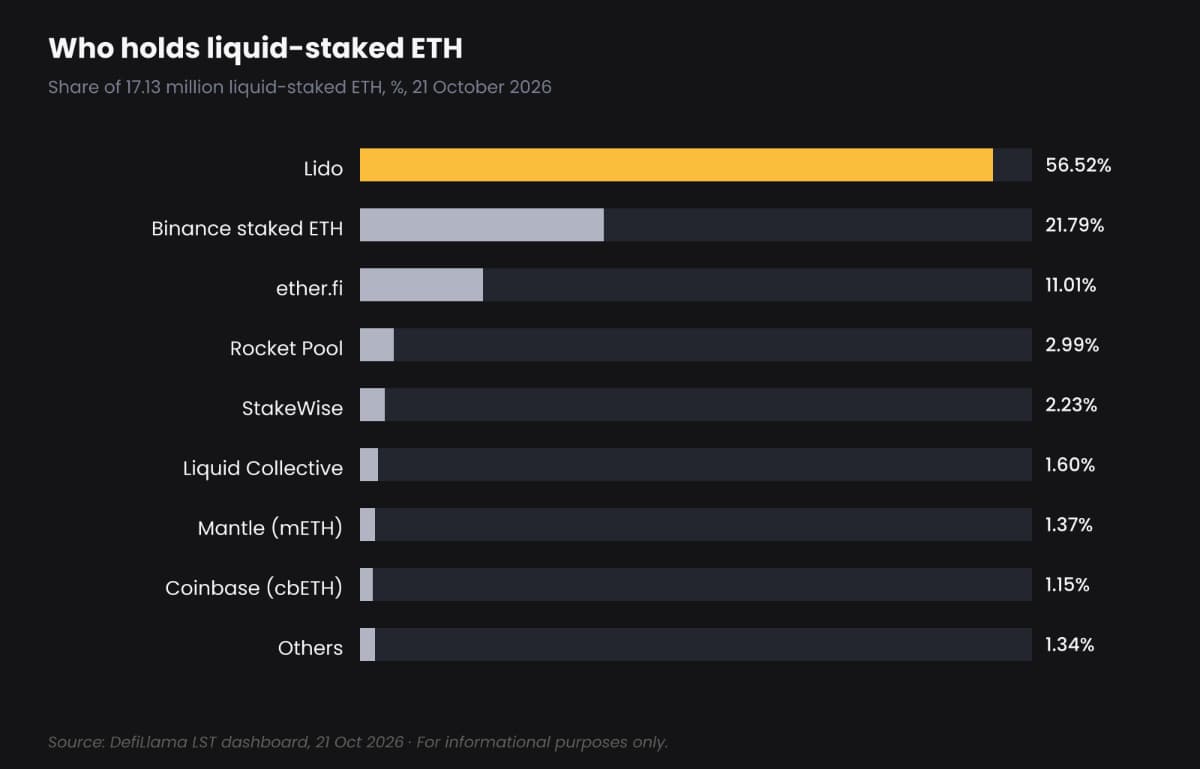
Share of liquid-staked ETH by provider, 21 October 2026. Source: DefiLlama.
What it means: The amount changed very little, dropping 0.2% in ETH terms and 0.8% in dollar terms. Lido leads with 56.5%, followed by Binance with 21.8% and ether.fi with 11.0%. StakeWise (+1.14%) and Coinbase's cbETH (+1.59%) also grew, while Stader shrank by 5.8%.
Among the large sectors, bridges, services which shuttle tokens across blockchains, led with an 8.36% rise to about $4.9 billion. Other areas which grew included DEXs, lending and derivatives.
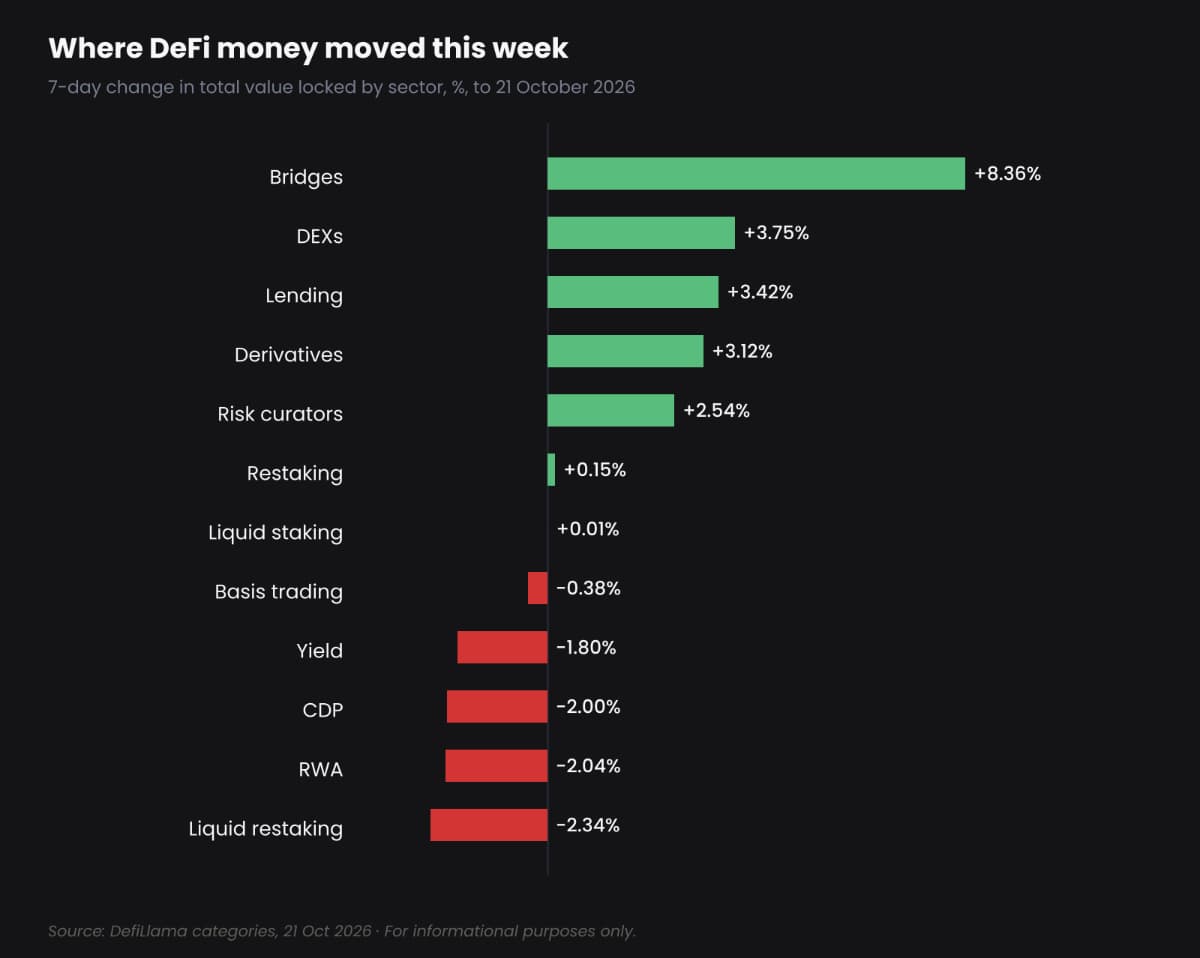
Seven-day change in DeFi TVL by sector, 21 October 2026. Source: DefiLlama.
| Chain | TVL | 7-day change |
|---|---|---|
| Ethereum | $50.20B | −1.18% |
| Base | $6.25B | +0.69% |
| Solana | $5.96B | −0.92% |
| BNB Chain | $5.84B | +8.29% |
| Arbitrum | $1.45B | +3.72% |
| Robinhood Chain | $1.15B | +8.27% |
7-day changes from DefiLlama.
What it means: BNB Chain added roughly $446 million, led by PancakeSwap, and surpassed Tron for fourth place. Robinhood Chain, which houses many tokenised stocks, increased by 8.27%, after edging up just 0.43% the previous week.
Comparing our own snapshots on 14 and 21 October (DefiLlama's daily data differ slightly), PancakeSwap increased by 18.8% to $2.40 billion and Uniswap increased by 6.2% to $4.10 billion. Falcon Finance increased by 4.6% to $1.72 billion and Morpho held steady at $11.26 billion. Lido fell 2.5% to $23.67 billion and Aave 2.1% to $18.19 billion. Balancer's pausable pools will begin moving to withdrawals-only on 30 October.
Banks have long viewed public blockchains as someone else's world. This week, that line blurred.
JPMorgan brought its deposit token to Ethereum. Standard Chartered agreed to acquire a crypto custody business. Ripple began offering institutional clients trades that track Hyperliquid markets. And the OCC, which supervises America's national banks, released the first final rule from a federal banking regulator telling stablecoin issuers how to hold reserves and pay customers back.
Rules matter because big money needs them. A bank treasurer can't use a stablecoin whose reserves are unclear. With clear standards from January 2027, more regulated dollars can flow onto the same rails DeFi uses.
India is gearing up to have similar conversations. India Blockchain Week returns on 1 and 2 November at the Fairmont in Mumbai, with a new forum focused on institutional adoption.
There are limits. Stablecoin supply fell slightly this week, and the fight over stablecoin rewards is not over. Still, the direction is clear. The banks are no longer watching from outside.
| Date | Event |
|---|---|
| Late Oct | Samsung USDC transfers go live in the US |
| 28 Oct | US Federal Reserve rate decision |
| 30 Oct | Balancer's pausable pools begin moving to withdrawals-only |
| 1–2 Nov | India Blockchain Week, Mumbai |
| 3 Nov | US midterm elections |
| 18 Jan 2027 | OCC stablecoin rule takes effect |
Main Sources - DefiLlama; CoinGecko; ValidatorQueue; The Block; Decrypt.
India Crypto Research operates independently. The information presented herein is intended solely for educational and informational purposes and should not be construed as financial advice. Before making any financial decisions, it's essential to undertake your own thorough research and analysis. If you're uncertain about any financial matters, we strongly recommend seeking guidance from an impartial financial advisor.


