US Regulation Update
India Regulation Update
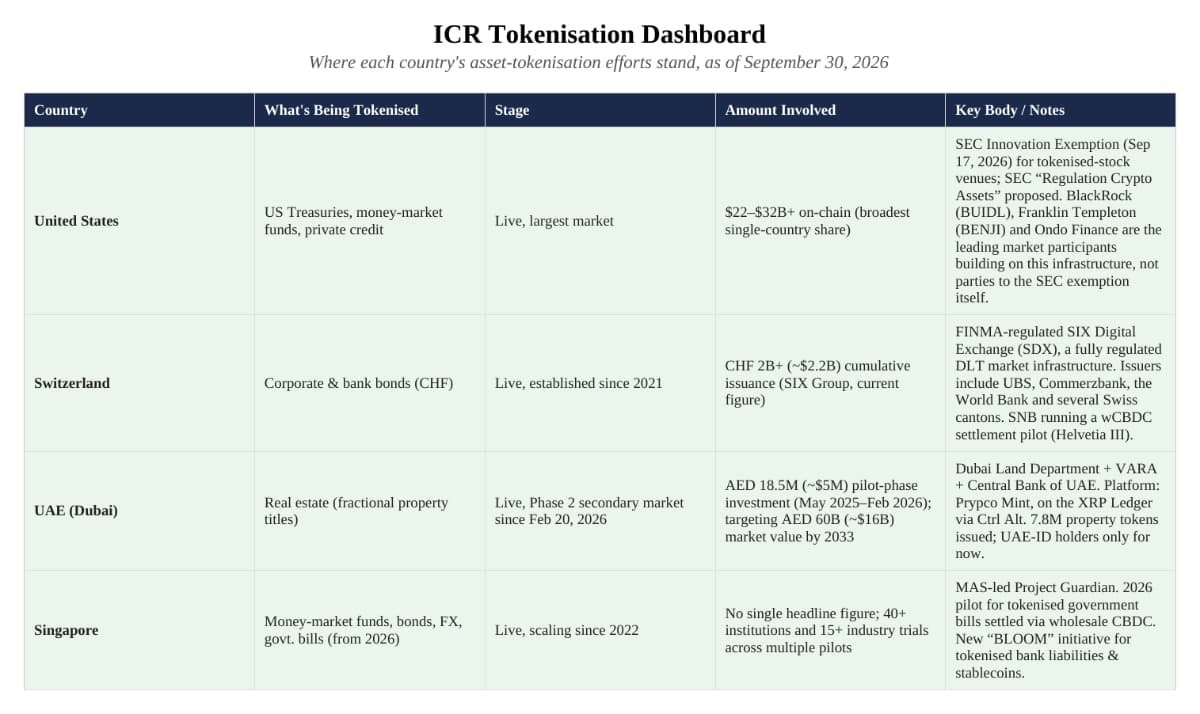
Tokenisation Regulation Update
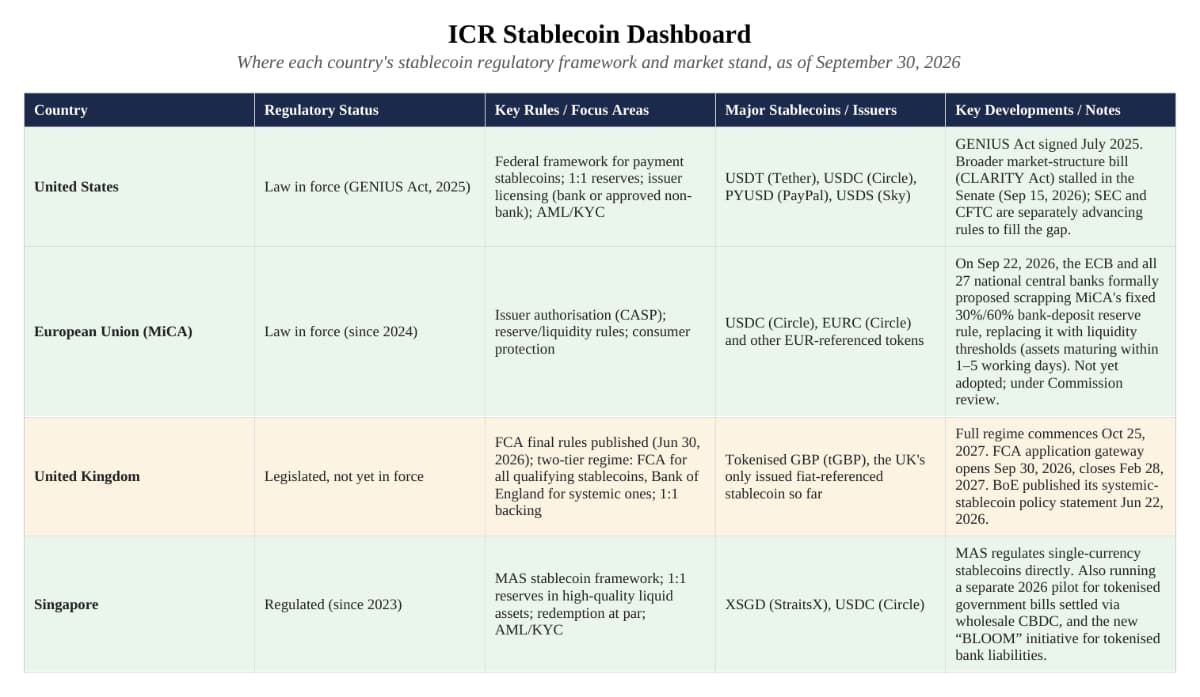
Stablecoin Regulation Update
What's Next
What This Means for You

 Part of a series
Crypto rules don't all move at the same speed. A bill can take a year to move through the US Congress, while a central bank can put a plan in motion to invest in tokenised bonds within a week.
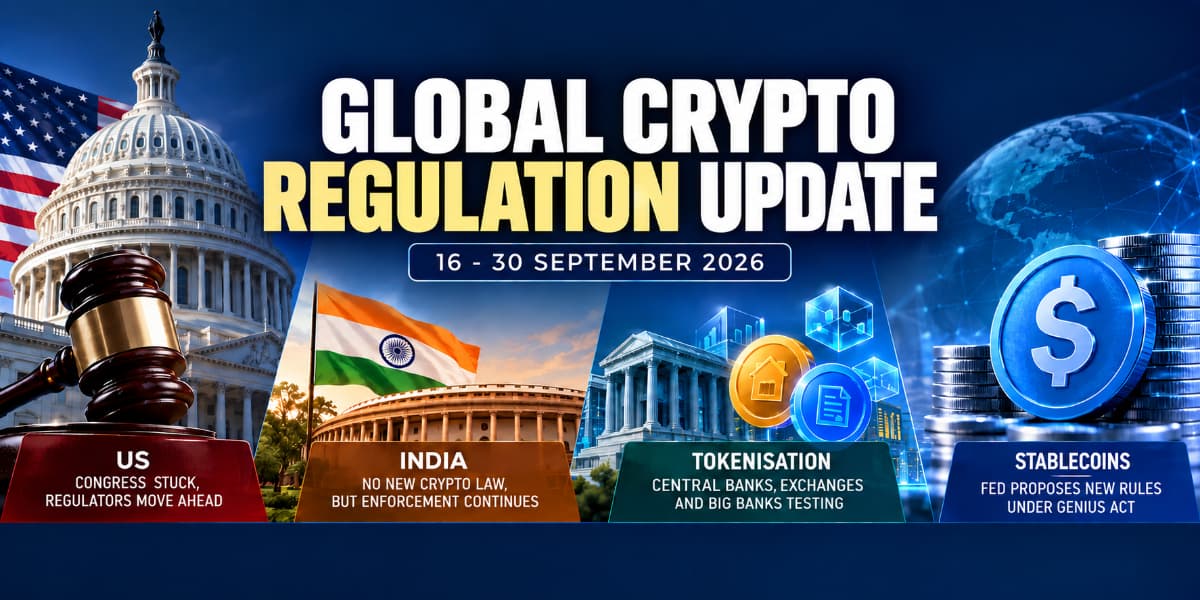
Every two weeks, we cover four sets of rules: US rules, India rules, tokenisation rules and stablecoin rules. Read it in one go, or jump straight to the part you need. Below is what happened between 16 and 30 September 2026, and what we expect to happen next.
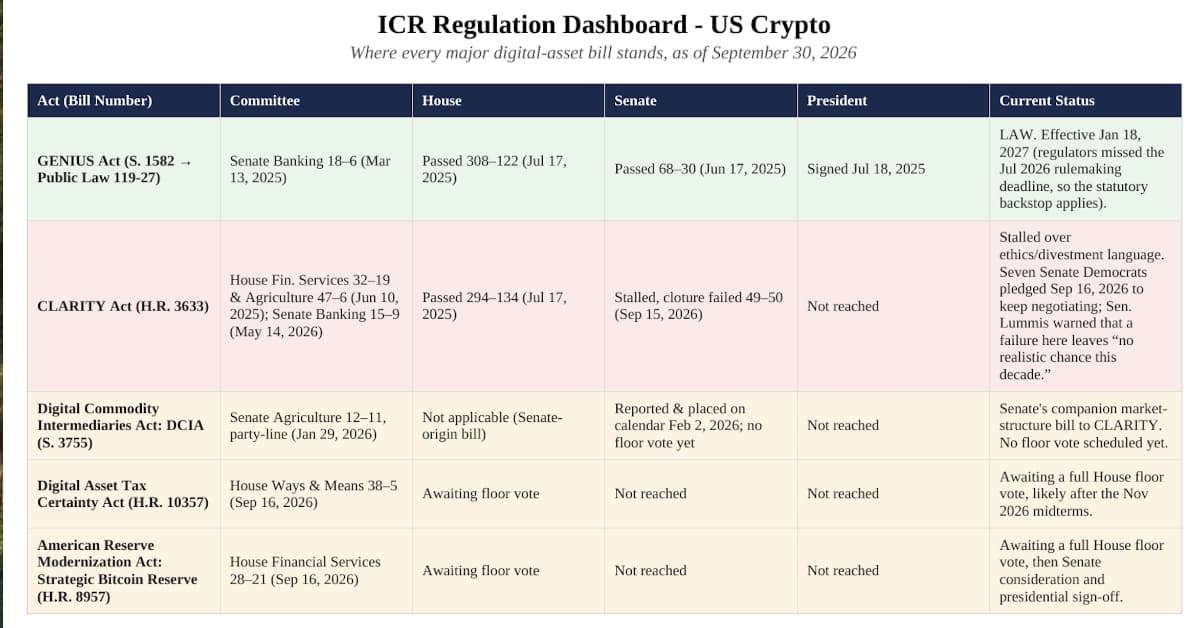
The CLARITY Act was taken up in the US Senate on 15 September 2026. The bill needed 60 votes to move forward, but it received only 49.
The bill isn’t dead yet. Some senators, including Senator Lummis, are still trying to save it. She warned that if the bill fails for good, there could be "no realistic chance" of a comprehensive crypto law being passed this decade.
With Congress stuck, regulators moved ahead on their own. On 24 September, the Commodity Futures Trading Commission (CFTC) updated its Frequently Asked Questions (FAQs) on crypto assets and blockchain, covering tokenised investments and blockchain-based recordkeeping.
On 25 September, staff at the US Securities and Exchange Commission (SEC) published their own crypto-asset FAQs. These include the staff's position on certain token buyback transactions. The SEC notes that these FAQs are staff guidance and do not create or impose any new rules or obligations.
On 28 September, Coinbase Clearing was granted registration as a derivatives clearing organisation by the CFTC. With this registration, Coinbase Clearing can clear fully collateralised futures, options on futures and swaps.
In short: Congress is stuck, but the regulators are not waiting around.
On 16 September 2026, the Lok Sabha's Standing Committee on Finance concluded its year-long inquiry into the regulation of Virtual Digital Assets (VDAs) in India.
According to media reports, the committee chairman, Bhartruhari Mahtab, stated that the government is not accepting crypto, and is not regulating it either.
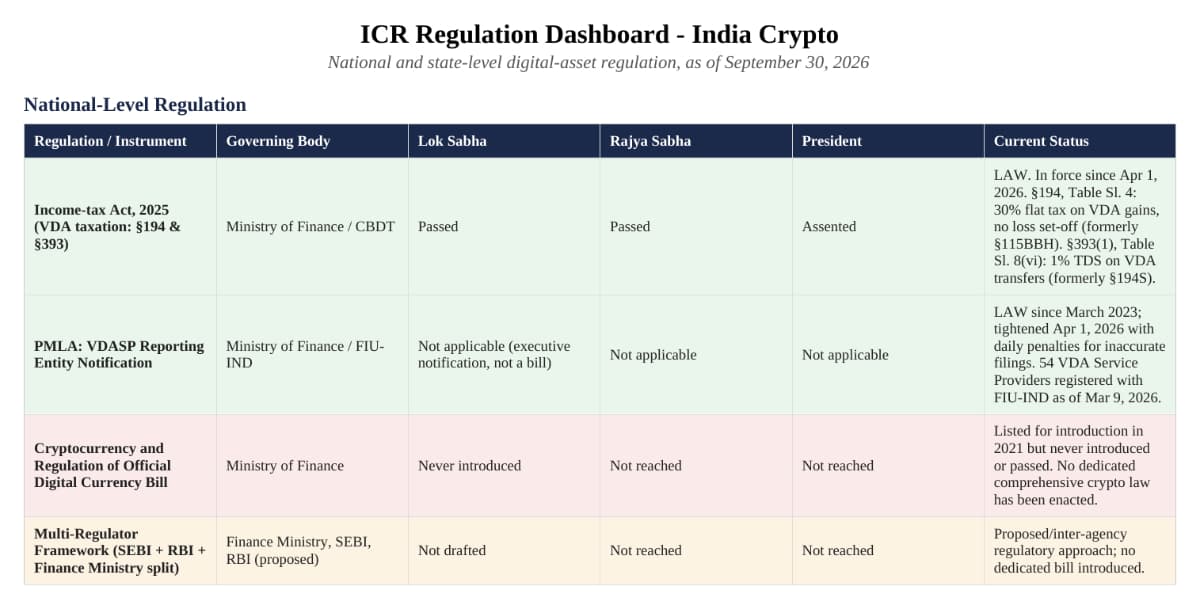
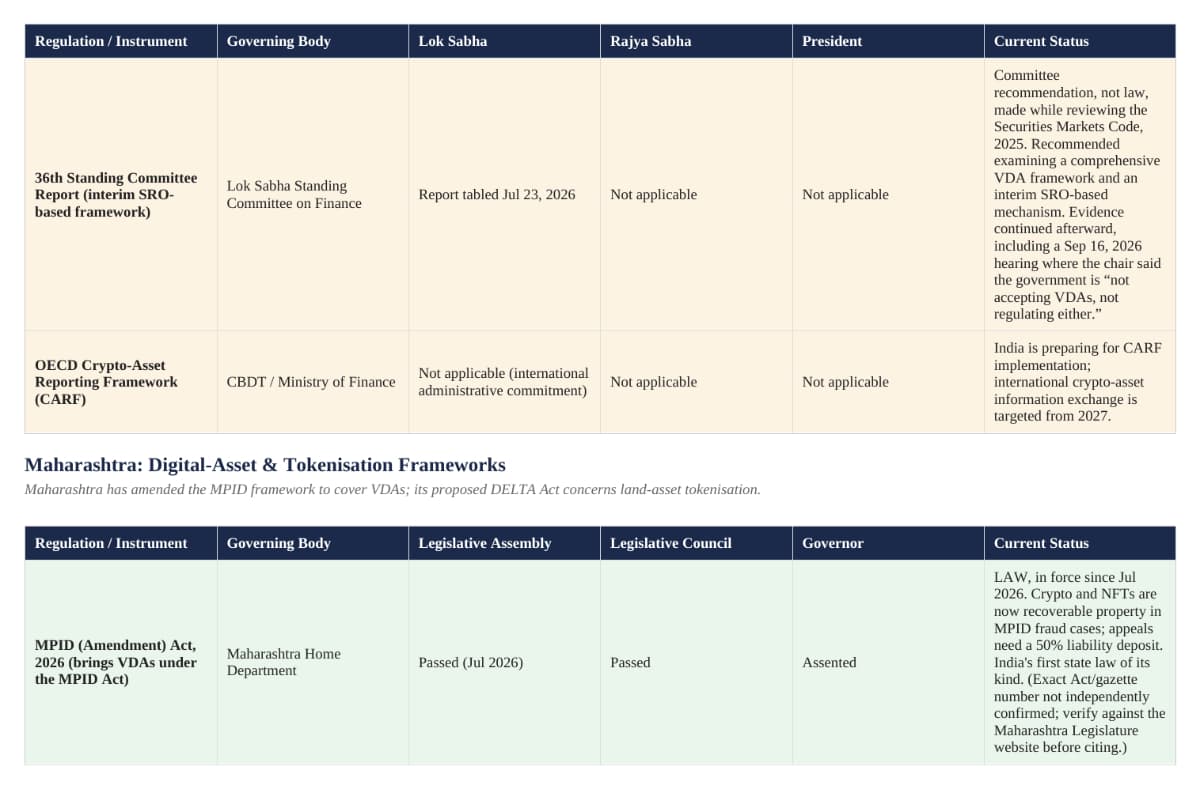
The government was expected to submit its written response to the committee the following week. By 30 September, no new crypto policy had been released. India’s crypto rules remain where they have always been: VDA gains are taxed at 30%, 1% TDS applies on transfers, and exchanges must register with FIU-IND, but there is no dedicated crypto law.
Enforcement of anti-money-laundering (AML) and combating the financing of terrorism (CFT) rules continues in India. On 9 September, the Financial Intelligence Unit-India (FIU-IND) reportedly sent notices to 15 offshore crypto exchanges, including Weex, Blofin, Bitunix and Pionex, telling them to follow India’s AML rules or risk being blocked.
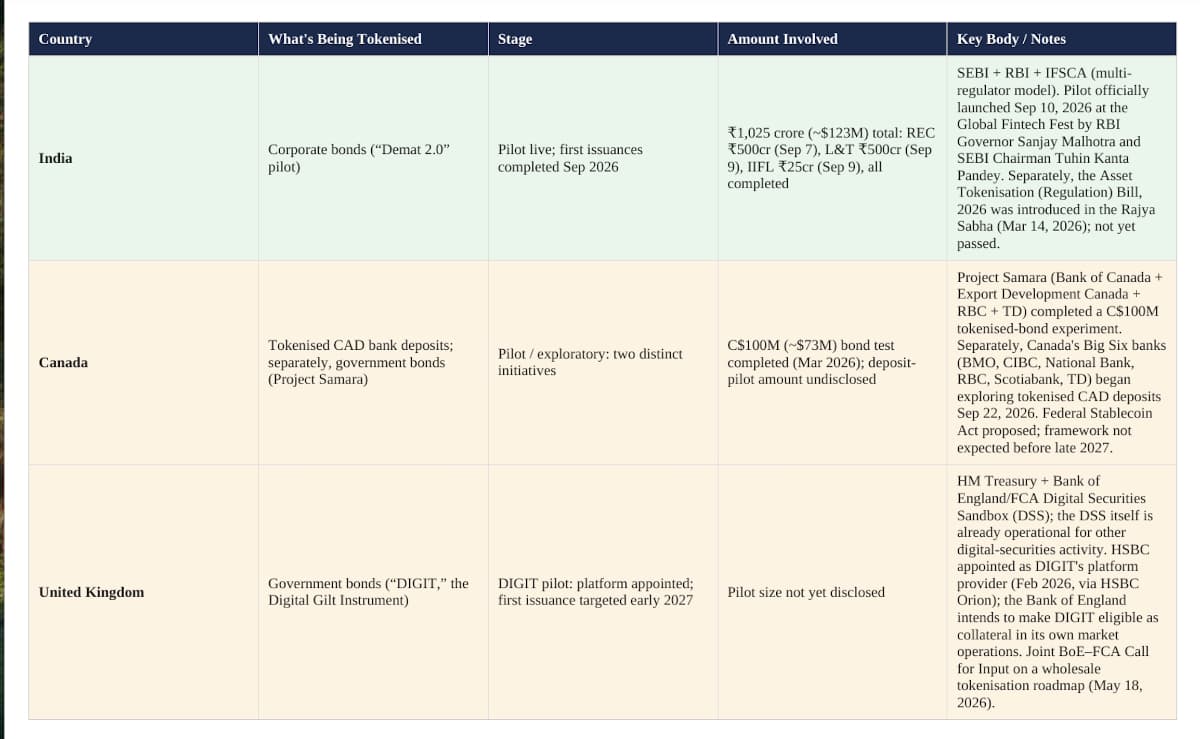
On a brighter note, India ran a successful Demat 2.0 pilot. Three companies, REC, L&T and IIFL Finance, raised a total of ₹1,025 crore through tokenised bonds, with all three deals closing within a single week.
In short: no new crypto law yet, but enforcement and pilot projects keep moving.
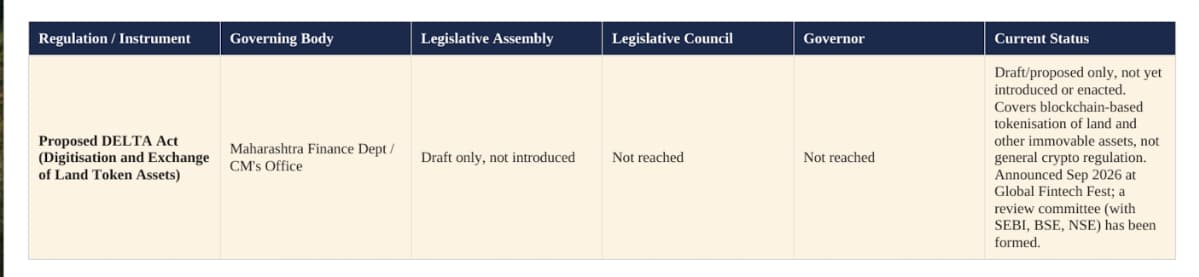
Tokenisation is the process of turning a real-world asset, such as a stock, a bond or even real estate, into a digital token that can be traded on a blockchain.
On 17 September, the SEC reportedly granted platforms a five-year exemption allowing them to trade tokenised US stocks without needing a full stock-exchange licence.
On 21 September, the European Central Bank (ECB) announced it was preparing to invest a small portion of its own money in tokenised bonds, to learn how the technology works in practice.
On 22 September, CFTC Chair Michael Selig said markets need to get ready for "mass tokenisation". In plain terms, many more assets are about to move on-chain, and trading could soon run 24 hours a day.
Also on 22 September, Canada’s six biggest banks started testing tokenised Canadian-dollar deposits. This is a separate, newer project from Project Samara, the banks’ earlier tokenised bond test.
On 23 September, the New York Stock Exchange (NYSE) signed an agreement with Blockchain.com to explore offering tokenised US stocks and Exchange Traded Funds (ETFs).
In short: central banks, stock exchanges and big banks are all testing tokenisation right now, not just talking about it.
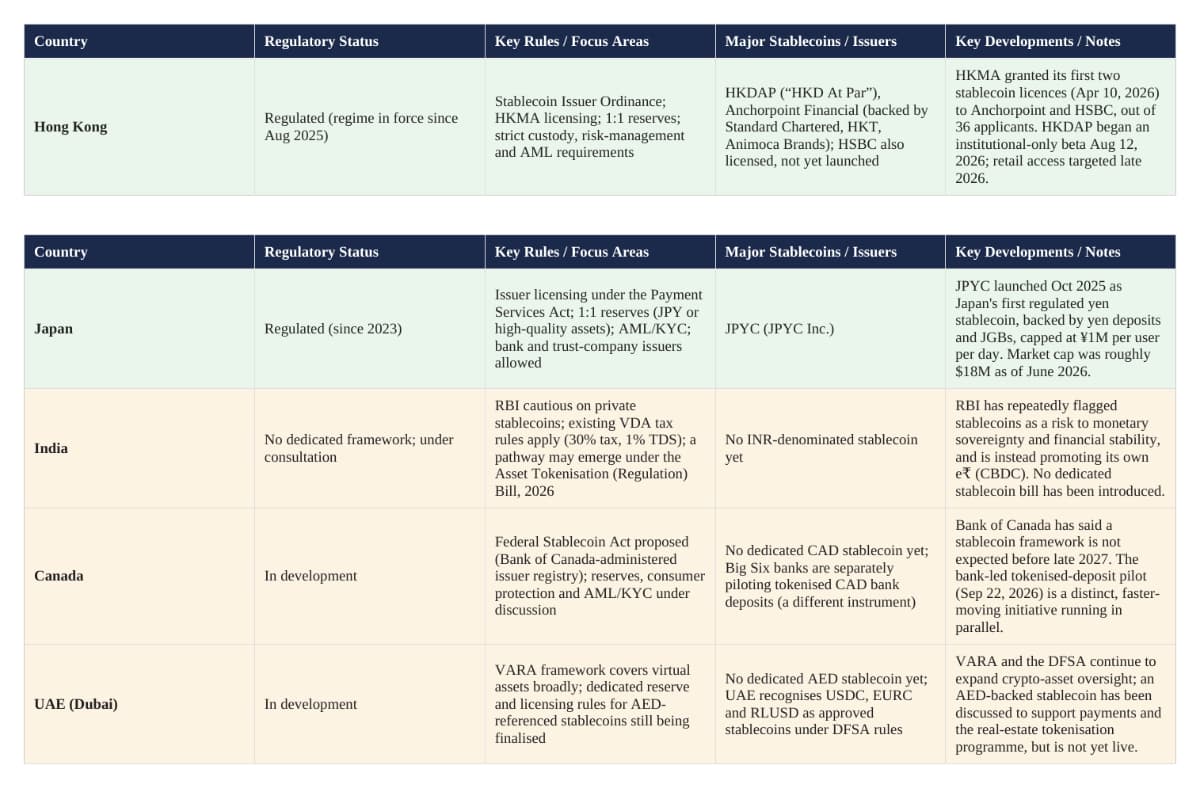
A stablecoin is a crypto token designed to hold a steady value, usually matched one-to-one with a currency like the US dollar. For example, one stablecoin may be worth $1 and be backed by $1 in reserves.
On 24 September, the US Federal Reserve proposed new rules for stablecoin issuers under the GENIUS Act. The rules cover reserves, capital and risk management, and set out a process for banks to issue stablecoins. They are proposals only, and public comments will be accepted until late November.
On 22 September, the ECB and all 27 EU national central banks urged the European Commission to loosen a MiCA rule on stablecoin reserves. Currently, stablecoin issuers must hold 30% to 60% of their reserves as bank deposits. The central banks want more flexible, liquidity-based rules instead.
On 24 September, the European Banking Authority (EBA) published its own proposals, including tighter treatment of stablecoins issued partly outside the EU and closer oversight of crypto lending.
On 28 September, Citi expanded its partnership with Coinbase. Citi’s business customers can now send and receive stablecoin payments without holding crypto themselves. Coinbase handles the conversion behind the scenes, and Citi settles the cash side.
In short: stablecoins are moving beyond the crypto space and into traditional banking, while regulators on both sides of the Atlantic are rewriting the rules at the same time.

Here's what to watch over the next few weeks and beyond, across all four areas.
| Date | Where | Regulator | What's Happening | Status | Who Should Care |
|---|---|---|---|---|---|
| 30 Sept 2026 | EU | European Commission | MiCA review consultation closes | Consultation | Stablecoin issuers |
| 30 Sept 2026 to 28 Feb 2027 | UK | FCA | Window opens for stablecoin issuers to apply for a licence | Consultation / Licensing | UK stablecoin issuers |
| 20 Oct 2026 | US | SEC | Last day for public comments on new crypto rules | Consultation | Token issuers, exchanges |
| Nov 2026 | US | Congress | Possible vote on a crypto tax bill after the midterm elections | Pending | Crypto investors, exchanges |
| Late Nov 2026 | US | Federal Reserve | Public comments close on proposed GENIUS Act stablecoin rules | Consultation | Stablecoin issuers, banks |
| 18 Jan 2027 | US | Treasury / regulators | GENIUS Act stablecoin rules take effect by default if final rules aren't in place sooner | Law takes effect | Stablecoin issuers |
| Early 2027 | UK | HM Treasury / Bank of England | UK plans to issue its first tokenised government bond | Pilot milestone | Bond market investors |
| 25 Oct 2027 | UK | FCA / Bank of England | UK's full stablecoin rulebook becomes law | Law takes effect | UK stablecoin issuers, banks |
| Late 2027 | Canada | Bank of Canada | Earliest possible date for Canada's stablecoin law | Pending | Canadian stablecoin issuers |
Institutions keep moving, whether or not politicians do. In the US, the only major federal law on digital assets is the GENIUS Act, which focuses on stablecoins, yet regulators keep writing rules anyway.
This month alone, a stock exchange founded in 1792 (the NYSE), a major central bank (the ECB) and one of the world’s biggest banks (Citi) all took real action, not just made statements.
India’s choice not to pass a new crypto law looks deliberate, not accidental. Government officials have said as much more than once.
Whichever area matters most to you, the lesson is the same: always check with the actual regulator before relying on any single line in any dashboard.
India Crypto Research operates independently. The information presented herein is intended solely for educational and informational purposes and should not be construed as financial advice. Before making any financial decisions, it's essential to undertake your own thorough research and analysis. If you're uncertain about any financial matters, we strongly recommend seeking guidance from an impartial financial advisor.