First, how Bitcoin mining works
What is hashrate hijacking?
What happened in November 2026
What is and is not at risk
How miners can protect themselves
What this means for Indian readers

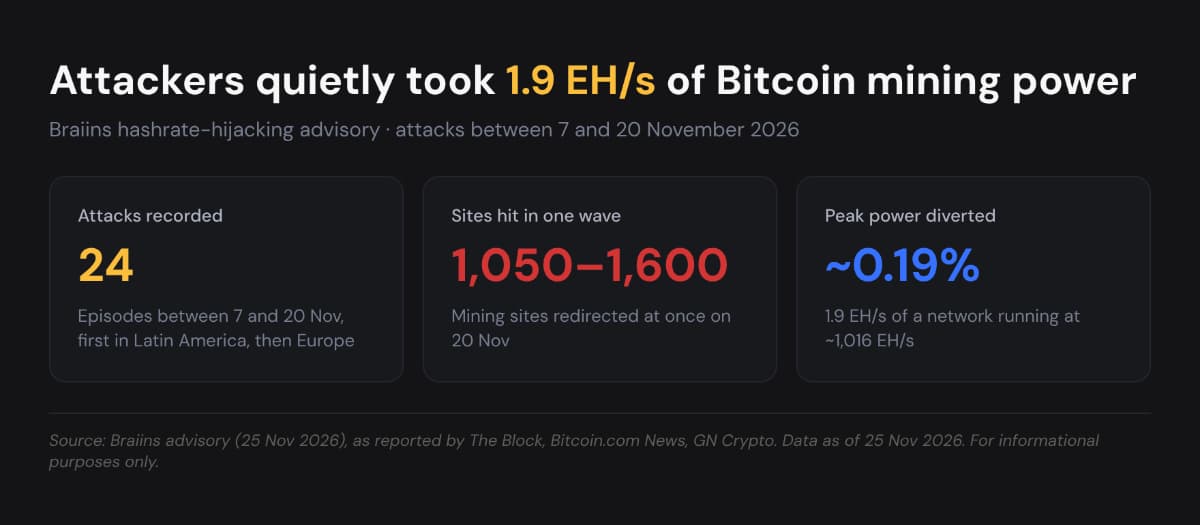
What happened: Braiins, a mining pool and software company, reported 24 hashrate-hijacking attacks between 7 and 20 November 2026. At the peak, more than 1,000 mining sites were hit at once and up to 1.9 EH/s of mining power was diverted, about 0.19% of Bitcoin’s total network.
What hashrate hijacking is: attackers redirect a miner’s internet traffic to a fake pool, so the miner keeps running machines and paying for electricity while the rewards go to the attacker.
The root cause: Stratum V1, the protocol most miners use to talk to their pools, sends data unencrypted and never checks the pool’s identity. The same weakness was used in a 2014 attack that stole about $83,000.
What’s not at risk: the Bitcoin blockchain, past transactions, and coins held in exchange accounts or wallets. Only miners’ revenue is affected.
The fix: move to Stratum V2, or use encrypted TLS connections with proper certificate checks, and compare your own hashrate with what the pool credits you every day.
 Part of a series
On 20 November 2026, more than 1,000 Bitcoin mining sites kept their machines running at full power, kept paying their electricity bills, and earned nothing. Their work was being collected by someone else. Braiins, the Prague-based mining pool and software company, disclosed on 25 November that an attacker had rerouted these miners’ internet traffic and redirected up to 1.9 EH/s of computing power to an impostor pool. Braiins says the attacks are still ongoing.
The attack doesn’t break Bitcoin itself. It exploits a weakness in how miners talk to their pools that has been around for more than ten years. To understand why it matters, start with how mining works.
Mining is the process that adds new blocks of transactions to the Bitcoin blockchain. In plain terms, miners compete to solve a maths puzzle by guessing numbers trillions of times a second. The first to find a valid answer adds the next block and earns the block reward: newly created Bitcoin plus transaction fees.
Each guess is called a hash. Hashrate is how many guesses a machine, or the whole network, makes per second, and it is the simplest measure of mining power. Think of it as the horsepower of an engine.
Unit | Hashes per second | For scale |
|---|---|---|
TH/s (terahash) | 1 trillion | One modern mining machine does roughly 100–400 TH/s |
PH/s (petahash) | 1,000 TH/s | A mid-sized mining farm |
EH/s (exahash) | 1,000 PH/s | The whole network was about 1,016 EH/s on 20 Nov 2026 |
Network figure: GN Crypto, citing estimates for 20 Nov 2026. Per-machine range is indicative.
Miners use specialised computers called ASICs (Application-Specific Integrated Circuits), chips built to do only one job: Bitcoin hashing. A single miner rarely finds a block alone, so most join a mining pool. A pool combines the hashrate of thousands of miners and shares the rewards based on how much work each one contributed.
Miners prove their work to the pool by sending “shares” over the internet, using a protocol called Stratum. Most of the industry still uses the first version, Stratum V1, which sends this data in plain text and doesn’t check that the server on the other end is really the pool. This is the gap the attackers used.
Hashrate hijacking is an attack in which a third party redirects a miner’s work to a server it controls, so the rewards for that work go to the attacker instead of the miner. Braiins describes it as stealing a miner’s proof of work before it reaches the pool.
Here’s a useful comparison. Imagine someone quietly changing the bank account on your salary slip. You still go to work every day and pay for your commute, but your salary lands in their account. For a miner, the “commute” is electricity, which makes up the bulk of mining costs.
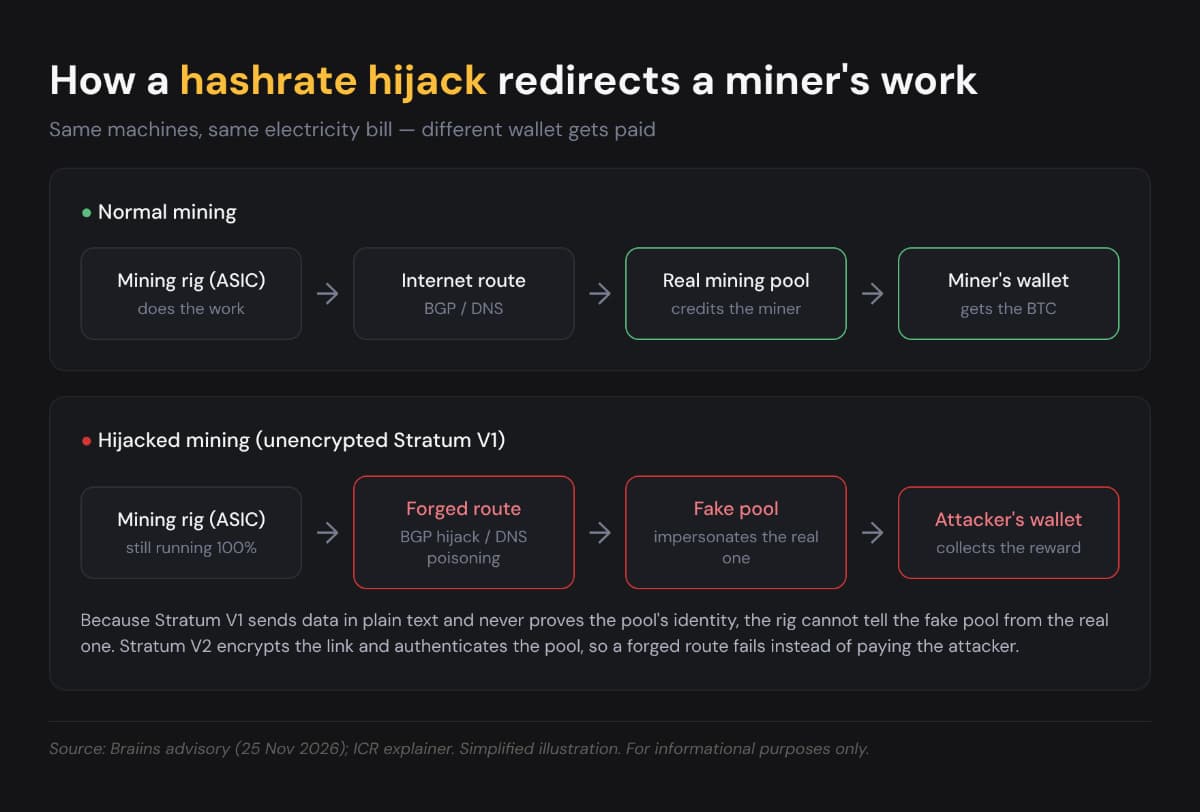
Attackers have three main ways to pull this off:
• BGP hijacking. BGP (Border Gateway Protocol) is the system internet providers use to tell each other which network owns which IP addresses, and it largely runs on trust. An attacker falsely announces that it owns the pool’s IP addresses, and traffic starts flowing to its server. Cloudflare compares this to swapping the road signs on a highway. Braiins traced the November 2026 attacks in Europe to BGP manipulation.
• DNS poisoning. DNS turns a name, such as a pool address, into an IP number. Corrupting that lookup sends mining rigs to a fake server.
• Malicious firmware. Infected mining software can quietly change the payout address on the machine itself.
Why do miners rarely notice? The rig keeps running at 100%. On the real pool’s dashboard, the miner’s hashrate simply drops, which looks like a hardware fault or a local network problem. By the time anyone checks, the rewards are gone, and Bitcoin transactions cannot be reversed.
Braiins documented 24 attacks between 7 and 20 November. The scale grew about elevenfold in two weeks, which Braiins read as the attacker “testing the waters”.
Date | Region | Sites per episode | Hashrate diverted |
|---|---|---|---|
7–12 Nov (19 episodes) | Mainly Brazil, Argentina | 120–400 | 36–174 PH/s |
20 Nov (4 episodes, 6–49 min each) | Mainly Europe | 1,050–1,600 | 0.6–1.9 EH/s |
Source: Braiins advisory, 25 Nov 2026, as reported by Bitcoin.com News and The Block.
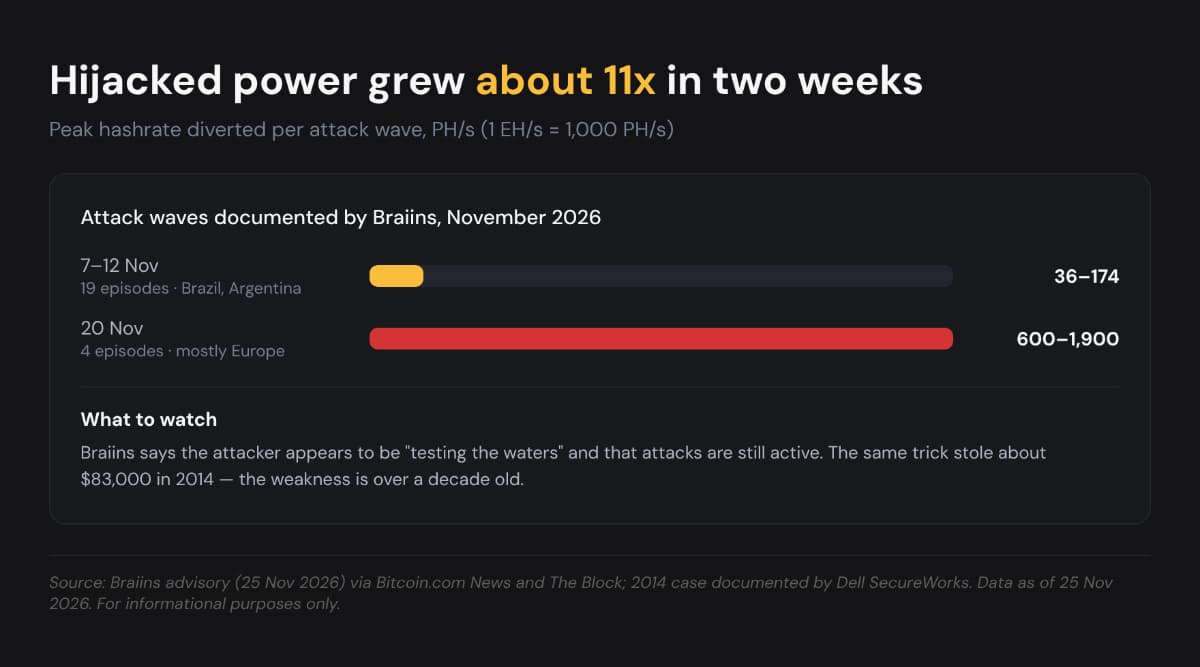
Figure 3. Peak hashrate diverted per wave. Source: Braiins; as of 25 Nov 2026.
Three further details stand out:
• Braiins’ own systems were not breached. Its pool accounts, balances and payouts were unaffected. The attack hit the network path between miners and pools.
• Encryption alone isn’t enough. When Braiins tested seven firmware implementations, two widely used ones accepted invalid security certificates even with encryption switched on. That means a fake pool could still pass as the real one.
• This is an old problem. In 2014, Dell SecureWorks documented the same BGP trick, which stole about $83,000 in mining rewards over four months. The same weakness is still there 12 years later, now with far more hashrate exposed.
A separate incident at mining firm Luxor on 15 November, involving unauthorised changes to about a dozen customer accounts, has been reported alongside this one. Braiins treats it as distinct from its own findings.
Only miners’ revenue is at risk, not Bitcoin itself. Hashrate hijacking doesn’t change the blockchain, rewrite past transactions, or let attackers spend coins they don’t own. Bitcoin held in an exchange account or a self-custody wallet is not affected by this attack.
Even at its peak, the diverted power was about 0.19% of the network, far too small to threaten consensus. Still, it is a direct loss for the affected operators, many of whom are already running on thin margins after the 2024 halving.
Braiins and security researchers point to these fixes:
1. Move to Stratum V2. It encrypts the miner–pool connection and verifies the pool’s identity, so if an attacker forges the route, the connection fails instead of paying the attacker.
2. If you stay on Stratum V1, use TLS with real certificate checks. TLS is the same encryption behind the padlock in your browser, but it only helps if the firmware rejects invalid certificates. Braiins OS 26.11, released on 25 November 2026, adds these checks and blocks fallback to unencrypted connections. Braiins also offers a free Stratum V2 proxy for older hardware.
3. Reconcile hashrate daily. Compare the hashrate your machines report locally with what the pool credits you. A persistent gap is a warning sign.
4. Use only signed firmware from trusted manufacturers, and set up failover pools.
5. Monitor BGP routes to the pool’s IP addresses with real-time routing tools.
Most Indians don’t mine Bitcoin. They hold it as a VDA (Virtual Digital Asset, the term Indian tax law uses for crypto) through an exchange or a wallet. For them, this attack poses no direct risk to their holdings, because an exchange account and a self-custody wallet are both outside the miner–pool connection the attackers targeted.
The exposure is narrower but real for three groups:
1. Indians who mine or rent hosted machines. Ask the host whether connections use Stratum V2 or verified TLS, and check payouts against reported hashrate.
2. Buyers of “cloud mining” contracts. A hijack can silently reduce the payouts you were promised, and contracts rarely say who bears that loss.
3. Investors in overseas listed mining companies, for example through the RBI’s Liberalised Remittance Scheme. Operational security is now a factor in miners’ earnings, alongside power costs and the Bitcoin price.
The wider lesson is that crypto security often fails at the edges (internet routing, firmware and old protocols) rather than in the blockchain itself. The question to ask any crypto service is how it protects the connections around the chain.
Sources: Braiins advisory and blog (25 Nov 2026), GN Crypto, Bitcoin.com News, The Block, Cloudflare and Dell SecureWorks.
India Crypto Research operates independently. The information presented herein is intended solely for educational and informational purposes and should not be construed as financial advice. Before making any financial decisions, it's essential to undertake your own thorough research and analysis. If you're uncertain about any financial matters, we strongly recommend seeking guidance from an impartial financial advisor.