1. What Is a Mining Pool?
2. What Do You Need to Join a Mining Pool?
3. Meet Foundry USA Pool
4. How to Join Foundry USA, Step by Step
5. How Foundry Pays You
6. Which Machine Should You Use for Pool Mining?
7. If You Want to Mine Solo Instead
8. Open Pools a Solo or Small Miner Can Join
9. What This Means for Miners in India
Conclusion

A mining pool lets many miners combine their computing power and share the rewards. You join by pointing your machine at the pool’s “stratum” server address.
Most pools have no entry test: you need only a Bitcoin address or a quick sign-up. Foundry USA, the world’s largest pool with about 25.6% of blocks in the month to 10 November 2026, is the exception: every member must pass KYC/AML checks first.
Foundry pays daily under FPPS, but only once a sub-account holds more than 0.01 BTC. One Antminer S21 XP would take about 79 days to reach that, and one Bitaxe about 49 years.
For pool mining, an industrial ASIC such as the Antminer S21 XP (270 TH/s, 3,645 W) is the realistic choice, and electricity cost decides profit.
Solo miners skip sign-up entirely and can switch to an open pool such as OCEAN, Braiins Pool, F2Pool or ViaBTC at any time by changing the pool address.

 Part of a series
A new Bitcoin block is added roughly every 10 minutes, and only one miner wins each one. The winner currently earns 3.125 BTC plus the transaction fees in that block. A single machine competing alone against the whole network could wait decades for a win.
A mining pool solves this by combining many miners. Speed is measured as hashrate, the number of guesses a machine makes per second, usually in TH/s (trillions per second). Because a pool has a huge combined hashrate, it wins blocks often and splits each reward among its members in proportion to the work they did.
Pools measure that work with shares: “near-miss” answers that beat an easier target the pool sets. A share doesn’t win a block, but it proves your machine is genuinely working. Your machine talks to the pool through the Stratum protocol. Think of the stratum address as the pool’s phone number, which you type into the machine once.
For most pools, nothing special. There is no minimum hashrate and no approval step. The practical requirements are a Bitcoin (SHA-256) ASIC, stable power and internet, and a Bitcoin wallet address for payouts. What differs between pools is how much they need to know about you: some ask for no personal information at all, while others need full identity checks, as the table shows.
Pool type | Examples | What you need | Approval? |
|---|---|---|---|
Open, address-login | Solo CKPool, Public Pool, OCEAN | Only your Bitcoin address as the username | None |
Open, account-based | Braiins Pool, F2Pool, ViaBTC | Email sign-up and a payout address | None, or light checks |
Institutional, KYC-based | Foundry USA | Full identity/company checks and signed pool terms | Yes — manual review |
Source: pool websites; Hashrate Index; Foundry Digital.
There is one hidden criterion: the minimum payout threshold. A pool holds your earnings until they pass a set amount. If your hashrate is small, you could wait months to get paid, which matters a lot with Foundry.
Foundry USA Pool is run by Foundry Digital LLC, a subsidiary of Digital Currency Group (DCG). It opened to the public in March 2021 after a private beta, and grew quickly as listed miners such as CleanSpark, Greenidge and HIVE moved their machines to it.
Today it is the largest Bitcoin pool. Its focus is institutional: compliance, audit-friendly reporting and US-based support.
Item | Foundry USA Pool |
|---|---|
Operator | Foundry Digital LLC (DCG subsidiary), United States |
Who it is built for | Institutional and professional mining operations |
Entry check | KYC/AML screening of every pool member before onboarding |
Payout method | FPPS (Full Pay-Per-Share) |
Earnings credited | Daily at 01:00 UTC (6:30 AM IST) for the previous UTC day |
Payout window | Daily, 09:00–17:00 UTC (2:30 PM–10:30 PM IST) |
Minimum payout | 0.01 BTC |
Pool fee | Not published; tiered by each client’s average hashrate in the prior quarter |
Stratum server | btc.foundryusapool.com:3333 (servers in the US and Europe) |
Worker name format | subaccount.workername |
Source: Foundry USA Pool Knowledge Base; Foundry USA Pool Terms of Service (SEC exhibit); D-Central pool connection matrix; mempool.space.
Unlike open pools, you can’t simply type in an address and start mining. Joining Foundry is a business onboarding, followed by a normal technical setup. The picture below shows the full path.
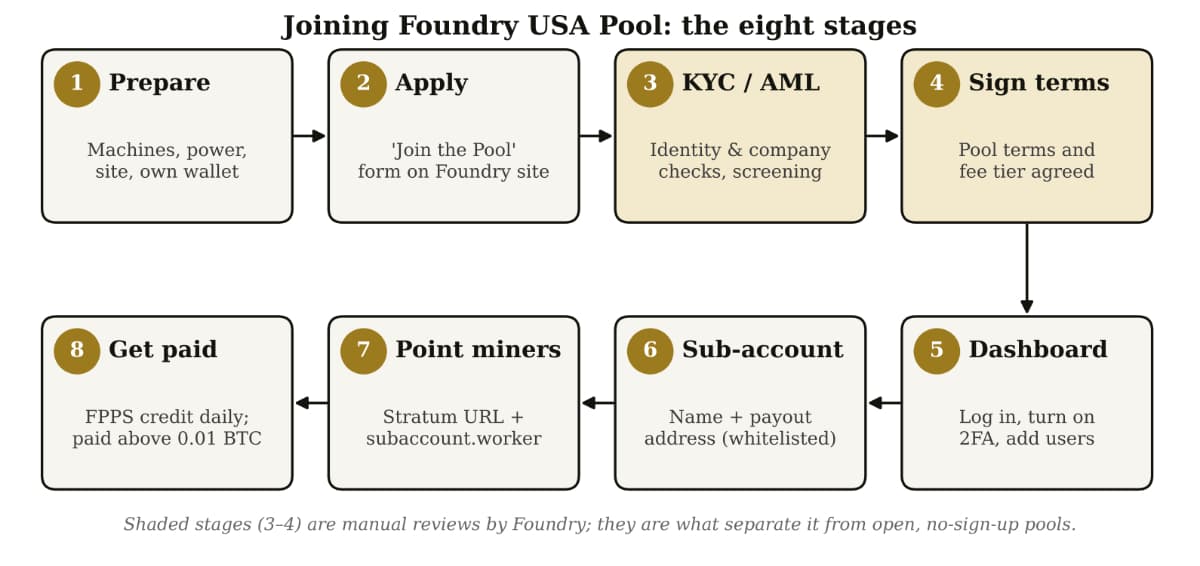
Step 1: Prepare your operation. Have your ASIC machines, power supply, cooling and site ready, and know your total hashrate. Set up a Bitcoin self-custody wallet (one where you hold the private keys) to receive payouts. Foundry doesn’t publish a minimum hashrate, but its fee tiers and 0.01 BTC payout threshold are designed around larger fleets.
Step 2: Apply. On foundrydigital.com, open the Foundry USA Pool page and use the “Join the Pool” contact form. Foundry’s team will then reach out to you directly.
Step 3: Complete KYC/KYB and AML checks. KYC (Know Your Customer) verifies a person, and KYB (Know Your Business) verifies a company and its owners. AML (anti-money-laundering) screening checks you against sanctions and risk lists. Foundry’s terms require you to finish this onboarding and give true, accurate information before using the pool. Expect to share identity and company documents.
Step 4: Sign the pool terms. You accept Foundry’s Terms of Service. Your fee tier is set from your average hashrate over the previous quarter, so larger operations pay a lower fee.
Step 5: Log in and secure your account. You get access to the dashboard at foundryusapool.com under a “group account”. Turn on two-factor authentication, and add colleagues with limited permissions if needed.
Step 6: Create a sub-account. Only a user with the “owner” role can do this. You need a sub-account name (lowercase letters and numbers only, e.g. mumbaisite1), a payout address and a label. Foundry whitelists payout addresses for security. Many miners use one sub-account per site or client.
Step 7: Point your machines at the pool. Find each machine’s IP address, using a tool such as Angry IP Scanner or your router’s list of connected devices. Open that address in a browser and enter the settings below in the pool section.
Step 8: Check and monitor. Workers usually appear in the dashboard within a few minutes. Set worker tags and alerts so you know when a machine goes offline, and create read-only “viewer links” to share your stats with partners.
Here are the settings to enter on each machine:
Field on the miner | What to enter | Example |
|---|---|---|
Pool URL | Foundry’s stratum address (copy the exact one from your dashboard) | stratum+tcp://btc.foundryusapool.com:3333 |
Worker / User | Your sub-account name, a dot, then a unique machine name | mumbaisite1.rack01-s21xp-07 |
Password | Anything, unless your dashboard says otherwise | x |
Source: Foundry USA Pool Knowledge Base; Hashrate Index.
Foundry uses FPPS (Full Pay-Per-Share). In simple terms, you’re paid a fixed expected amount for every valid share, including an estimate of transaction fees, whether or not the pool actually found a block that day. The pool absorbs the luck, and you get steady, predictable income.
Each day runs on UTC time. Shares submitted from 00:00 to 23:59 UTC are counted, earnings are credited at 01:00 UTC, and payment is sent during the 09:00–17:00 UTC window, but only if the sub-account balance is above 0.01 BTC.
Here’s what that means in practice. At the BTC hashprice of 0.00046839 BTC per PH/s per day (16 November 2026), one Antminer S21 XP earns about 0.000126 BTC a day before fees. It would take roughly 79 days to reach 0.01 BTC. A farm of 100 such machines would cross the threshold in under a day. That’s why Foundry suits large operations better than a single home machine.
Pool mining needs a Bitcoin ASIC, a machine built only to solve Bitcoin’s SHA-256 puzzle. The key number is efficiency, measured in J/TH (joules of electricity per trillion guesses). The lower the number, the better, because electricity is the main running cost. The table estimates daily income at the November 2026 hashprice against an assumed tariff of ₹8 per unit (kWh).
Machine | Speed / Power | Efficiency | Income per day | Power cost per day (₹8/unit) | Break-even tariff |
|---|---|---|---|---|---|
Antminer S21 Pro | 234 TH/s / 3,510 W | 15.0 J/TH | ~$7.13 (₹669) | 84 units = ₹674 | ~₹7.9/unit |
Antminer S21 XP | 270 TH/s / 3,645 W | 13.5 J/TH | ~$8.22 (₹772) | 88 units = ₹700 | ~₹8.8/unit |
Canaan Avalon A16 XP | 300 TH/s / 3,850 W | 12.8 J/TH | ~$9.13 (₹858) | 92 units = ₹739 | ~₹9.3/unit |
Source: India Crypto Research calculation using Hashrate Index hashprice of $30.45 per PH/s per day (16 November 2026), ₹93.92 per US$ (16 November 2026) and manufacturer specifications. Before pool fees; hashprice changes daily.
The S21 XP is the most practical choice. All of these machines are very loud (around 75 dB) and draw about 3.5 kW or more, so most Indian miners run them at a hosting facility or industrial site, not at home.
Solo mining means trying to win an entire block by yourself. If you succeed, you keep the whole reward: 3.125 BTC plus the fees. Foundry doesn’t offer solo mining, so solo miners use a dedicated solo pool or their own Bitcoin node. There is no KYC, no account and no payout threshold: the reward goes straight to your address if your machine finds a block.
Solo pool | Stratum address | Fee on a found block | Username |
|---|---|---|---|
Solo CKPool | solo.ckpool.org:3333 (Europe: eusolo.ckpool.org:3333) | 2% | Your Bitcoin address |
Public Pool (hosted) | public-pool.io:21496 | 0% | Your Bitcoin address |
AtlasPool | solo.atlaspool.io:3333 | 1.5% | Your Bitcoin address |
Your own node | Your node’s local IP, e.g. via Public Pool app on Umbrel | 0% | Your Bitcoin address |
Source: bitcoin.it wiki; D-Central; Solo Satoshi (2026). Always check the address on the pool’s own site before connecting.
Setting up a Bitaxe for solo mining takes about 10 minutes. Plug it in, connect your phone to the Wi-Fi hotspot it creates, and enter your home Wi-Fi details (2.4 GHz). Then open AxeOS, the Bitaxe’s built-in settings page, by typing the IP address shown on its screen into your browser. Enter the solo pool’s stratum URL and port, your Bitcoin address as the username and x as the password, then save and restart. Your stats will appear on the pool’s page, for example solo.ckpool.org/users/.
Machine | Speed / Power (approx.) | Chance of a block each day | Average wait |
|---|---|---|---|
Bitaxe Gamma 602 | 1.2 TH/s / 18–25 W | ~1 in 5.5 million | ~15,000 years |
NerdQAxe++ | 4.8 TH/s / 75 W | ~1 in 1.4 million | ~3,800 years |
Canaan Avalon Nano 3S | 6 TH/s / 140 W | ~1 in 1.1 million | ~3,000 years |
Antminer S21 XP | 270 TH/s / 3,645 W | ~1 in 24,500 | ~67 years |
Source: India Crypto Research calculation using network hashrate from Pickaxe.
Even a full industrial machine has poor odds when mining solo. Treat solo mining as a low-cost lottery ticket and a way to support decentralisation, not as a way to make an income.
Yes. “Solo” only describes how you mine today, not what you’re allowed to do. Any small miner, even with one Bitaxe, can switch to a shared pool by changing the pool address, username and password in the machine’s settings page. The machine and wallet stay the same, and you can switch back at any time. Once you join a shared pool, you are pool mining: you give up the chance of keeping a whole block in return for small, regular payouts.
Foundry USA is possible in theory but not in practice for a small machine. One Bitaxe earns about 0.00000056 BTC a day, so it would take roughly 49 years to reach Foundry’s 0.01 BTC payout minimum. Open pools are the better route, and Section 8 lists them with their joining steps.
These pools need no approval, no KYC and no minimum hashrate. They come in two kinds. With an address-based pool, there’s no account to create: your Bitcoin address is your login. With an account-based pool, you first sign up with an email address and then use that account to mine.
Pool | Sign-up | Stratum address | Pool fee | Minimum payout |
|---|---|---|---|---|
OCEAN | None — Bitcoin address only | mine.ocean.xyz:3334 | 2% (1% with DATUM) | 0.01048576 BTC on-chain; no minimum via Lightning |
Braiins Pool | Email account | stratum.braiins.com:3333 (backup port 443) | 2.5% | 0.0002 BTC (free from 0.005 BTC or via Lightning) |
F2Pool | Email account | btc.f2pool.com:1314 (Asia: btc-asia.f2pool.com:1314) | 4% FPPS / 2% PPLNS | 0.005 BTC (higher options available) |
ViaBTC | Email account | btc.viabtc.io:3333 | 4% PPS+ / 2% PPLNS | 0.001 BTC auto-withdrawal |
Source: OCEAN; Braiins Academy; F2Pool; ViaBTC; D-Central pool connection matrix (2026). Fees and minimums change; check each pool’s site before connecting.
Step 1: Open your miner’s settings page (AxeOS on a Bitaxe, or the web dashboard on an Antminer).
Step 2: Enter stratum+tcp://mine.ocean.xyz:3334 as the pool URL, your Bitcoin address as the username and x as the password. To name your worker, you can add .bitaxe1 to the end of your Bitcoin address.
Step 3: Save and restart. Search your Bitcoin address on ocean.xyz to see your stats.
Step 4 (optional): Set up Lightning payouts from the “Configuration” link on your stats page, proving ownership by signing a message with your wallet. This removes the minimum payout, which matters for a Bitaxe.
Step 1: Sign up on the pool’s website with an email address and choose a username.
Step 2: Turn on two-factor authentication, and add your Bitcoin payout address (and threshold, where offered) in the payout or wallet settings.
Step 3: On the miner, enter the pool’s stratum URL, your worker as username.workername (e.g. rahul.bitaxe1) and any password.
Step 4: Save and restart, then check the pool dashboard. Workers usually appear within a few minutes.
One difference matters for safety. OCEAN pays your share straight from the block reward to your wallet, so the pool never holds your coins. Account-based pools hold your earnings until they pay out, so set the lowest payout threshold that makes sense for your hashrate.
Your setup | Best fit | Why |
|---|---|---|
Bitaxe or other tiny home miner | OCEAN | No account, and no minimum via Lightning |
One to five Antminers | Braiins Pool or F2Pool | Low minimum payout, steady daily pay |
Want to switch between pool and solo | ViaBTC | Pool and solo modes in one account |
Large farm or company | Foundry USA | Worth the KYC for FPPS income at scale |
Source: India Crypto Research assessment based on the pool data above.
• Tax on selling: Mined Bitcoin is a VDA (Virtual Digital Asset, the Indian tax term for crypto). Gains on selling or swapping it are taxed at a flat 30% plus 4% cess, with no deduction except the cost of acquisition. This rule, formerly Section 115BBH, now sits in Section 194 (Table serial 4) of the Income-tax Act, 2025. Electricity and hardware cannot be deducted, and VDA losses cannot be set off.
• Tax at the time of mining: This is not settled, and advisers take different views. Some tax the market value at receipt as “income from other sources” at slab rates; others treat the cost as nil and tax the full value at sale. Take advice from a chartered accountant, especially as the new Income-tax Act, 2025 took effect from 1 April 2026.
• TDS: Selling mined BTC on an Indian exchange attracts 1% TDS (tax deducted at source), now under Section 393(1) of the new Act (formerly Section 194S). Use an exchange registered with FIU-IND, India’s anti-money-laundering reporting body.
• Electricity decides everything: At November 2026 prices, an S21 XP only breaks even below roughly ₹8.8 per unit. A ₹1 change in tariff can turn profit into loss.
Joining a mining pool is mostly simple: you need a machine, a wallet address and a stratum address. Foundry USA adds a business layer on top: an application, KYC/AML checks, signed terms and sub-accounts. In return, it offers steady FPPS income and the reliability of the world’s largest pool.
For a company running hundreds of machines, that trade is worth it. For one or two machines, an open pool pays out sooner. For hobbyists, solo mining with a Bitaxe is a cheap way to learn, with very long odds of a jackpot.
Sources: Foundry Digital (Foundry USA Pool page and Terms of Service), Hashrate Index, mempool.space, Pickaxe, D-Central, bitcoin.it, Solo Satoshi, OCEAN, Braiins Academy, F2Pool and ViaBTC.
India Crypto Research operates independently. The information presented herein is intended solely for educational and informational purposes and should not be construed as financial advice. Before making any financial decisions, it's essential to undertake your own thorough research and analysis. If you're uncertain about any financial matters, we strongly recommend seeking guidance from an impartial financial advisor.