A Comparative Snapshot of the Exchanges
CoinSwitch
CoinDCX
Mudrex
Bitbns
What Investors Should Understand

 Part of a series
When you’re investing or trading on a crypto exchange, you’re not just trusting an app. You're trusting the company, its finances, controls, security, and its willingness to be transparent if something goes wrong. Whichever exchange you trust with your funds, your gains are still taxed at a flat 30% in India, so remember to report those gains and complete your crypto tax filing before the ITR deadline.
Just brand recognition and the number of users won’t tell whether your deposits are fully backed or not. A clean interface doesn’t tell whether reserves exist. And FIU registration, while it's important, is only the legal minimum.
The key question is how transparent your exchange
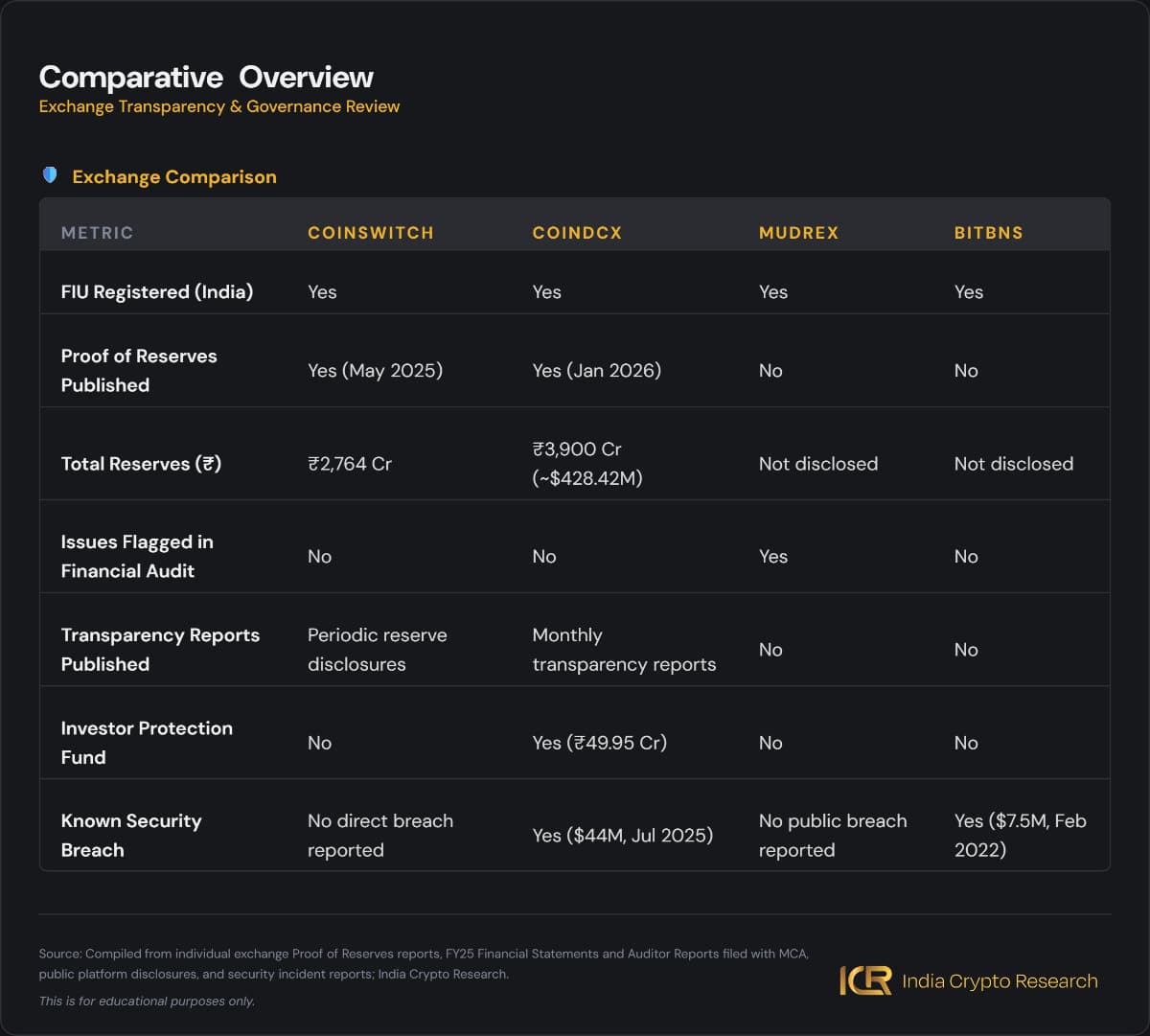
Some exchanges regularly publish reserve numbers and detailed transparency reports. Some maintain dedicated protection funds, while others just disclose only the minimum information required.
We looked at some of the major Indian crypto exchanges, their transparency disclosures, past security incidents, and company filings to understand their transparency and security practices.
And those exchanges differ notably in transparency, governance quality, and overall financial strength.
CoinSwitch is an Indian crypto trading platform founded in 2017. The company reports having more than 2.5 crore users. It operates in India through Bitcipher Labs LLP, based in Bengaluru. The company’s financial disclosures and audit reports are filed under this entity.
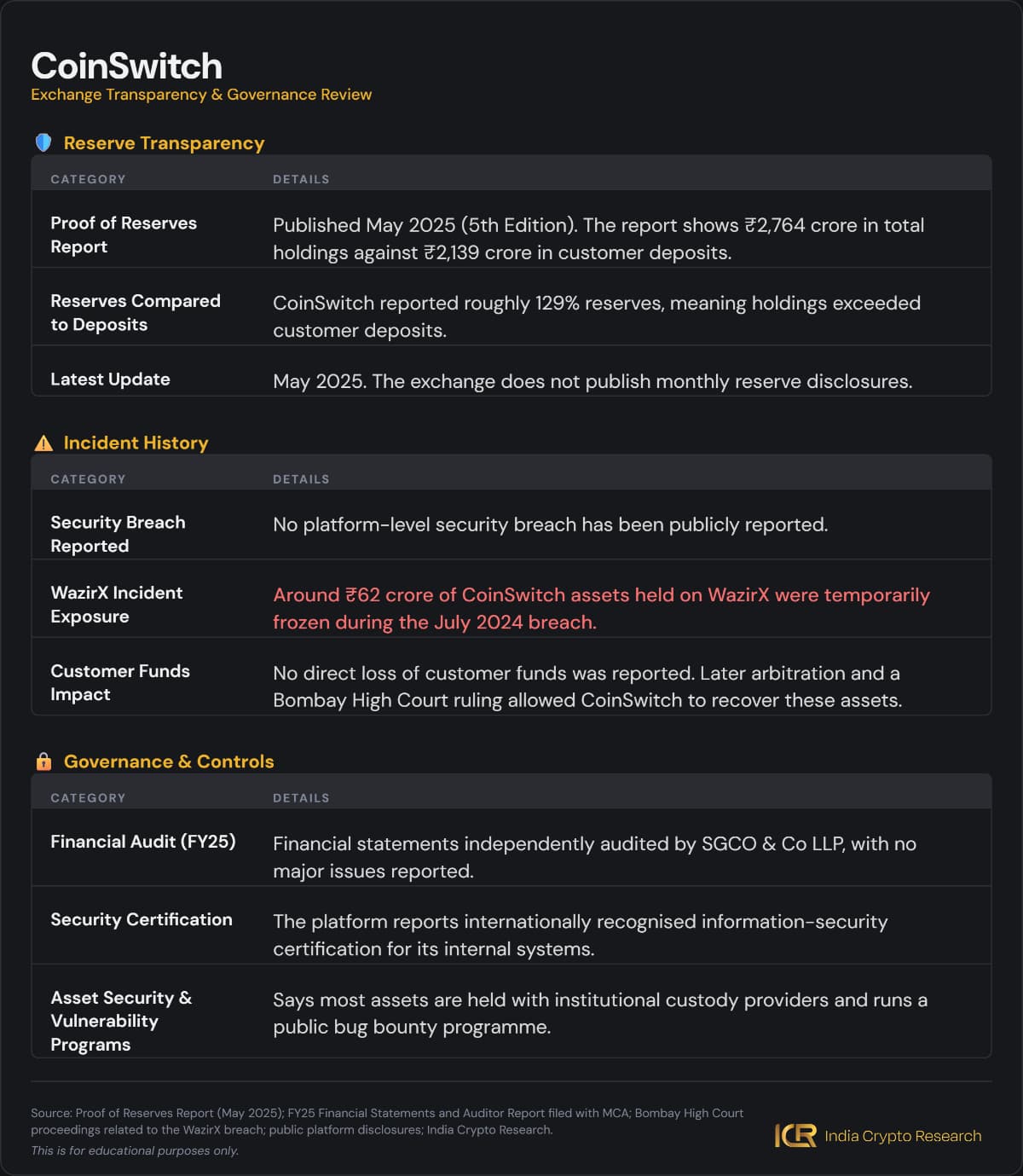
CoinSwitch’s latest Proof of Reserves report was published in May 2025 (Fifth Edition). They reported a total holdings of about ₹2,764 crore against ₹2,139 crore in customer deposits, having a surplus of roughly ₹600 crore.
Their FY25 financial audit did not report any material issues in the company’s accounts, and no direct breach affecting customer funds has been reported. Although during the WazirX incident in 2024, around ₹62 crore of CoinSwitch assets were temporarily frozen on the WazirX platform, subsequent arbitration and Bombay High Court rulings secured CoinSwitch’s right to recover these assets
CoinDCX operates through Neblio Technologies Pvt Ltd., and has roughly $2-3 million in daily trading volume according to CoinGecko data. The platform provides access to spot crypto trading and related services for Indian users.
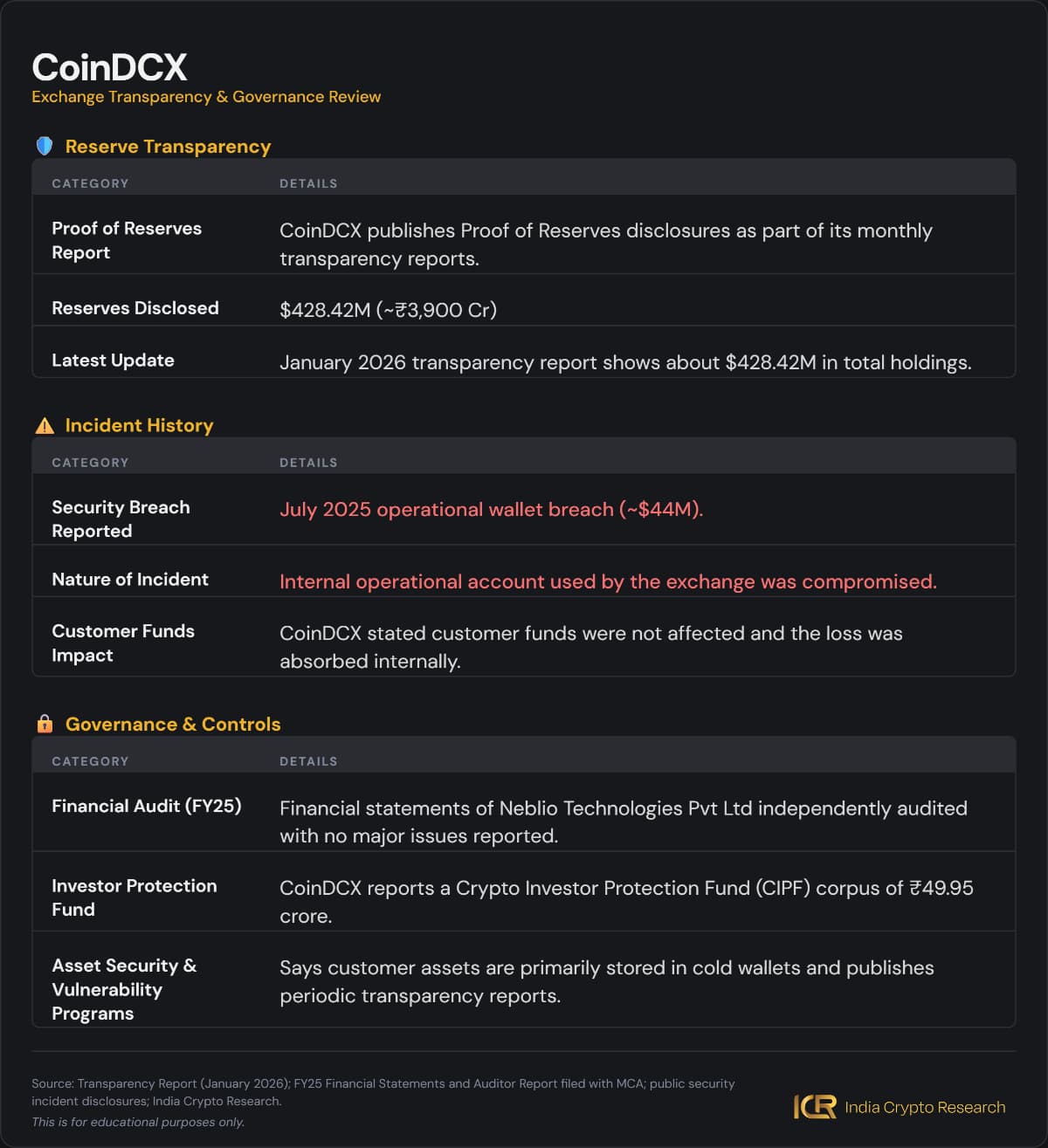
CoinDCX publishes monthly transparency reports and releases proof of reserves disclosures. Their January 2026 transparency report shows total holdings of about $428 million, and their FY25 financial statements were independently audited and did not report major issues. In July 2025, about $44 million was drained from an operational wallet; the company said customer funds were not affected and that the loss was covered from its own treasury.
Mudrex operates in India through RPFAS Technologies Pvt Ltd. The platform provides crypto trading and investment products to Indian users. It records roughly $2 million in daily trading volume according to CoinGecko.
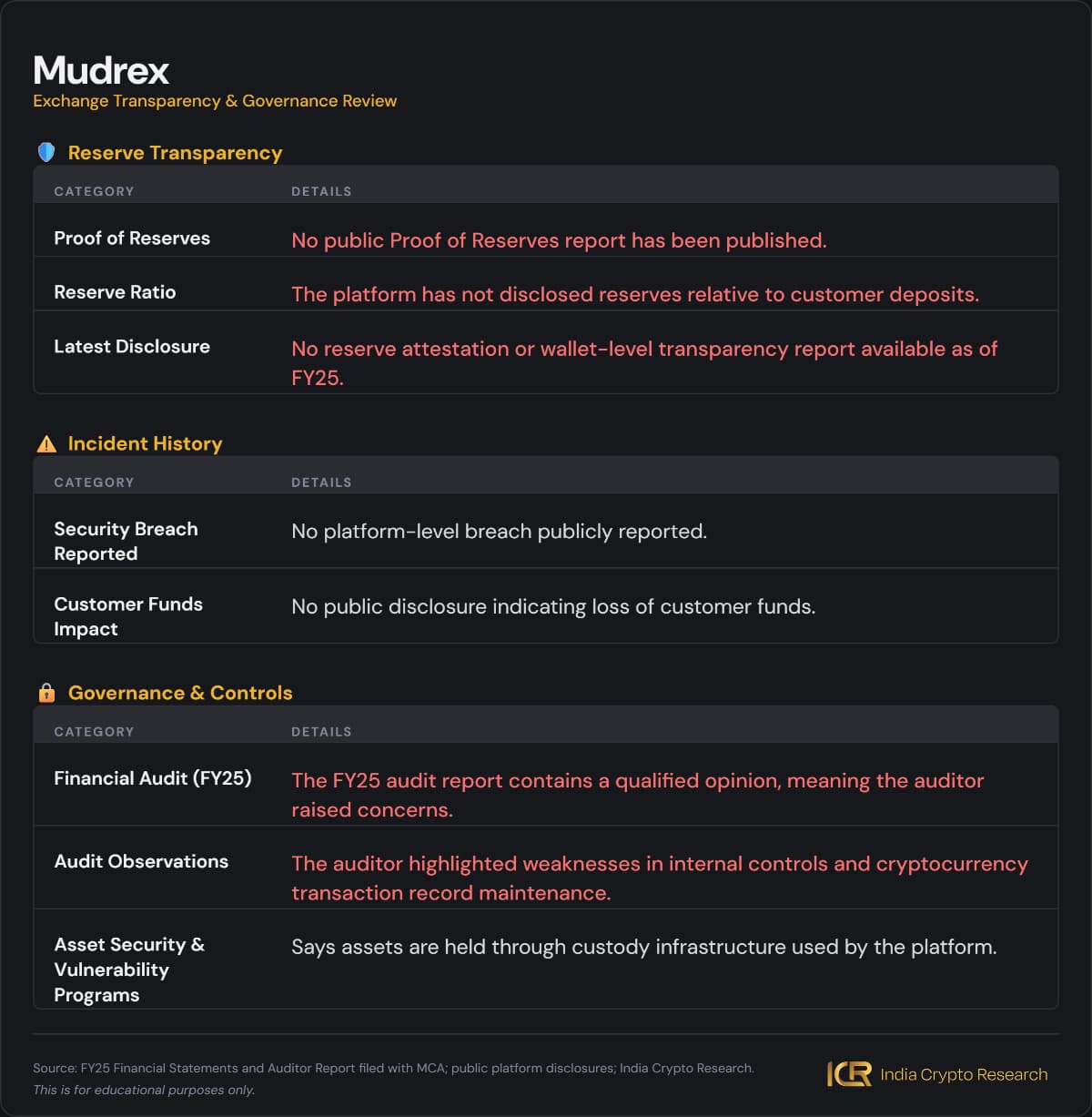
Mudrex has not published a Proof of Reserves report as of FY25, and the platform has not disclosed how its reserves compare to customer deposits. The FY25 financial audit raised concerns, with the auditor flagging weaknesses in internal controls and cryptocurrency transaction records. There has been no publicly reported breach involving customer funds.
Bitbns operates in India through Bitbns Internet Pvt Ltd, based in Bengaluru. The exchange was recently in the news following user complaints about difficulties withdrawing funds from the platform.
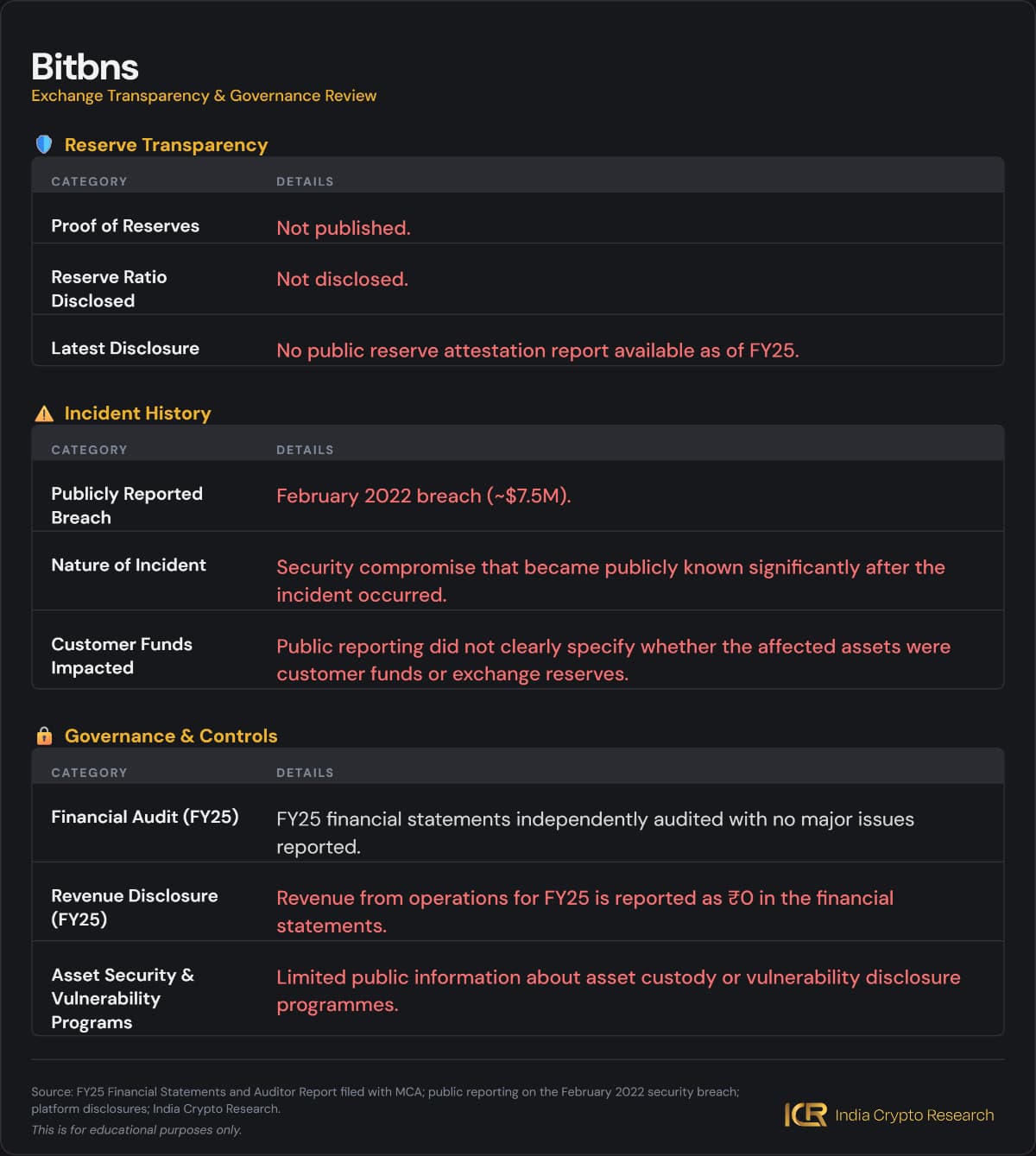
Bitbns also does not publish any proof of reserves report, which means users don’t have a transparent picture of the exchange’s balances.
Their FY25 financial audit was completed without any major red flags, although one thing is worth noting: they did report zero revenue from operations.
There is also the history of how the platform handles transparency. In February 2022, the exchange had a $7.5 million security breach, but it wasn’t made public at the time. The incident only came to light much later, after an independent researcher pointed it out. It was only then that the exchange admitted the breach had happened.
When you’re investing or trading on a centralised exchange, you should be aware of the risks associated with it. No report can guarantee that an exchange is hack-proof, and FIU registration is just the legal minimum. You should go beyond that and look for published reserves, clean audits, and financial data that actually add up.
Among the top four Indian exchanges, only CoinDCX and CoinSwitch provide proof of reserves reports. These disclosures are not legally required, but they give you a much better look at how a platform handles its holdings. Ultimately, the best test of an exchange is how quickly and honestly they communicate when something goes wrong.
Note : This writeup is intended solely for informational and educational purposes and should not be construed as investment advice or a certification of safety. All data presented has been sourced from publicly available information. India Crypto Research does not have any commercial relationship with any of the exchanges covered in this newsletter.
India Crypto Research operates independently. The information presented herein is intended solely for educational and informational purposes and should not be construed as financial advice. Before making any financial decisions, it's essential to undertake your own thorough research and analysis. If you're uncertain about any financial matters, we strongly recommend seeking guidance from an impartial financial advisor.