
1. What Does “Pause and Sell” Mean?
2. What Has Actually Happened?
3. The Canaan Case: 35% of Hashrate on Pause
4. How Much Hashrate Is at Stake?
5. The Post Effect: What Changes If the Machines Are Sold?
6. The Twist: Could Ethiopia Buy the Machines Itself?
7. Four Scenarios
8. The ICR View: India Crypto Research
FAQs

Up to ~18 EH/s could be on the move: Ethiopia ran about 23 EH/s (≈2.4% of global hashrate). At 23% of contracted power, roughly 17.7 EH/s is sitting idle, about 1.9% of the network.
Canaan is the warning sign: Canaan’s paused Ethiopian sites still made up about 35% (4.96 EH/s) of the 14.24 EH/s it reported as operating in July 2026.
Bitcoin barely notices; Ethiopia does: If the machines are sold and switched on elsewhere, the network’s hashrate simply moves. Ethiopia loses the dollar income, which reached about $220 million in FY2024/25.
The machines are cheap but picky: Ethiopia’s fleet is mostly Antminer S19-class. These rigs break even at about 5.5¢/kWh, so only buyers with very cheap power will want them.

 Part of a series
In Episode 1, we asked what happens to 30,221 BTC if SpaceX and Tesla merge. Now, the question has nothing to do with coins. It has to do with the machines that mine them. In an earlier blog, we showed how Ethiopia built a mining boom on surplus hydropower. Now, because of a drought, miners have only 23% of their power. Canaan has paused its operations, aWhat If Series · Episode 2: What Happens When Ethiopia’s Drought-Hit Miners Sell Their Machines Abroadnd BitFuFu is considering leaving. So what if Ethiopia’s miners shut down for good and sold their rigs abroad?
A miner that loses power has three options: wait for the power to return, ship its machines to another country, or sell them on the secondhand ASIC market. ASICs are specialised Bitcoin mining computers. Unlike an AI data centre, they can be unplugged, packed and switched on in a new country within a few weeks.
Table 1: Key terms used in this blog
Term | What it means | Why it matters here |
|---|---|---|
Hashrate (EH/s) | Total computing power used to mine Bitcoin; 1 EH/s = 1 million TH/s | Measures how much mining Ethiopia hosts and could lose |
Installed vs operating capacity | Machines a company owns vs machines that are switched on | Canaan counts paused Ethiopian rigs as “operating” capacity |
Curtailment | A utility cutting the power a miner was promised | EEP cut miners to 23% of contract in September 2026 |
Hashprice | What 1 PH/s of hashrate earns per day, in US$ | About $39.87/PH/day in late September 2026 |
Difficulty adjustment | Bitcoin resets mining difficulty every 2,016 blocks (~2 weeks) | If hashrate leaves, the remaining miners earn a bit more |
The “what if” is not far from reality. Over the past 15 months, Ethiopia has moved from welcoming miners to rationing them.
Table 2: Timeline of the squeeze
Date | Event |
|---|---|
Aug 2025 | EEP freezes new mining power deals as the grid reaches capacity |
Dec 2025 | New time-of-use tariff starts with a 32% rise; base price set to reach 6.5¢/kWh by year three |
Jun 2026 | One Canaan site goes offline for grid maintenance; Ethiopia runs 0.36 of 4.96 EH/s installed |
Jul 2026 | Canaan says it has paused its Ethiopia mining operations |
15 Sep 2026 | El Niño drought cuts reservoir inflows by about 20%; EEP cuts miners in stages to 75%, 50%, then 23% of contract |
28 Sep 2026 | Power supplier to BitFuFu’s 80 MW target site issues a 10-day payment notice and warns it will seize collateral |
28 Oct 2026 | BitFuFu says it is weighing ending the deal, recovering $4.1M and asking for its hardware back |
The trigger for this episode is Canaan’s July 2026 mining update. The company reported 14.24 EH/s of global operating computing power. About 35% of that, or 4.96 EH/s, was in Ethiopia, even though a footnote said Ethiopian mining had been paused.
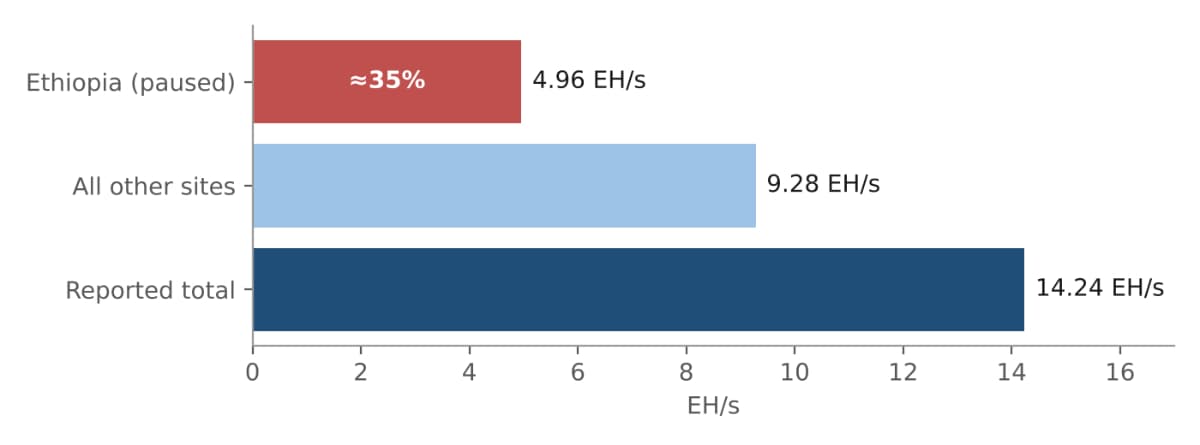
Figure 1: Canaan’s July 2026 operating hashrate, Ethiopia vs other sites (EH/s)
Canaan defines operating capacity as the “theoretical output of energized mining machines”. Taking Ethiopia out leaves about 9.28 EH/s. This is a simple subtraction, not a live figure, but it shows how much of a large miner’s headline number can sit on a grid that is no longer delivering. For investors, the lesson is to read the footnotes: “installed” and “operating” can hide machines that are not earning anything.
Before the drought, Ethiopia hosted about 23 EH/s, roughly 2.4% of the global network. At 23% of contracted power, only about 5.3 EH/s can run. The other ~17.7 EH/s is idle, and that is the pool of machines that could be sold or shipped abroad.
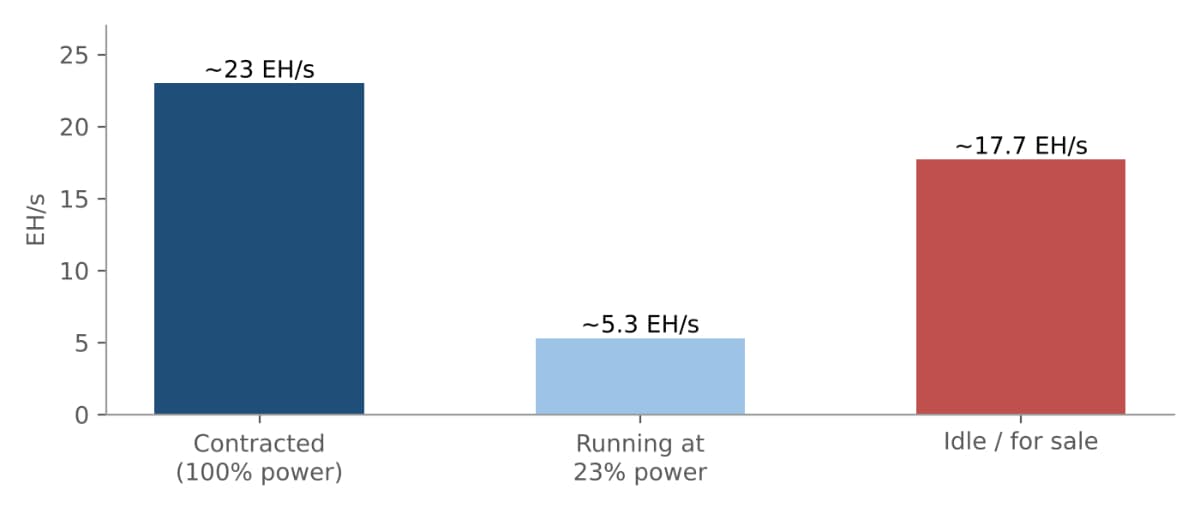
Figure 2: Ethiopia’s estimated hashrate, contracted vs running at 23% power (EH/s)
How we calculated this: we multiplied 23 EH/s by 23%, which gives about 5.3 EH/s running. Subtracting 5.3 from 23 leaves about 17.7 EH/s idle. Against a global network of around 950 EH/s (Hashrate Index, late September 2026), that idle capacity is about 1.9% of the network. These are ICR estimates; actual site-level uptime is not disclosed.
Selling machines does not destroy hashrate. It simply moves it. The real effects show up in four areas.
If 17.7 EH/s were to switch off for good, the next difficulty adjustment would fall by about 2%. The remaining miners would earn about 2% more per unit of hashrate, lifting hashprice from about $39.87 to about $40.60/PH/day. Once the machines are plugged in elsewhere, that gain would disappear.
For context, compare the two biggest migrations in Bitcoin’s history.
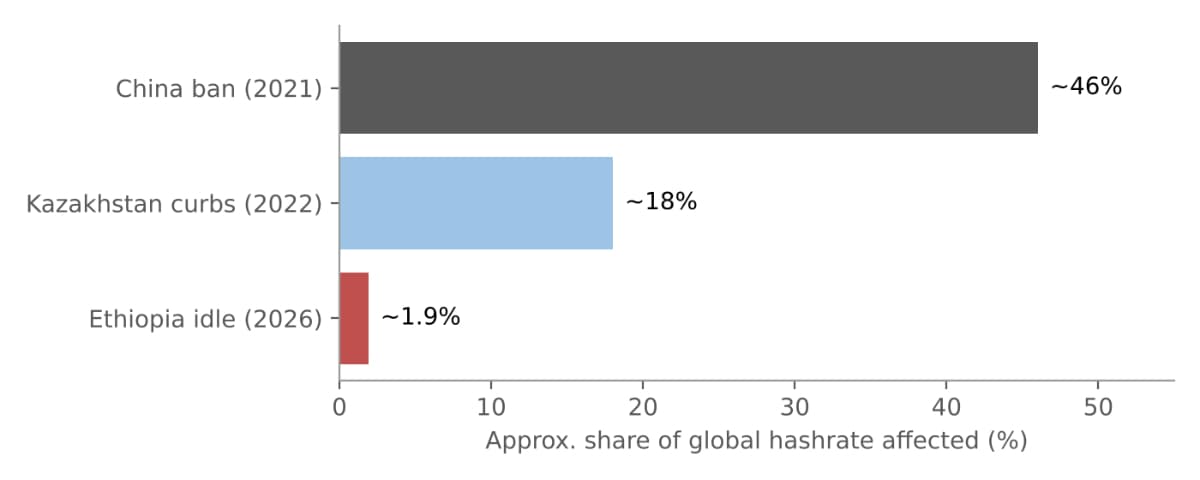
Figure 3: Approximate share of global hashrate hit by past mining shocks vs Ethiopia’s idle hashrate today
China’s 2021 ban hit roughly half of the network and caused the largest downward difficulty adjustment in Bitcoin’s history. Kazakhstan’s 2022 power curbs and internet shutdown also hit a large share. Ethiopia’s idle capacity is a small fraction of either. This is a local shock, not a network event.
Ethiopia’s fleet is mostly older Antminer S19-series rigs, the same machines that left China in 2021. BitFuFu’s 80 MW target site alone holds about 13,700 S19-series machines (≈1.57 EH/s) with a net book value of just $1.74 million. That is about $127 per machine, or around $1.11 per TH.
Cheap doesn’t mean profitable. Whether an S19 makes money depends almost entirely on the price of electricity.
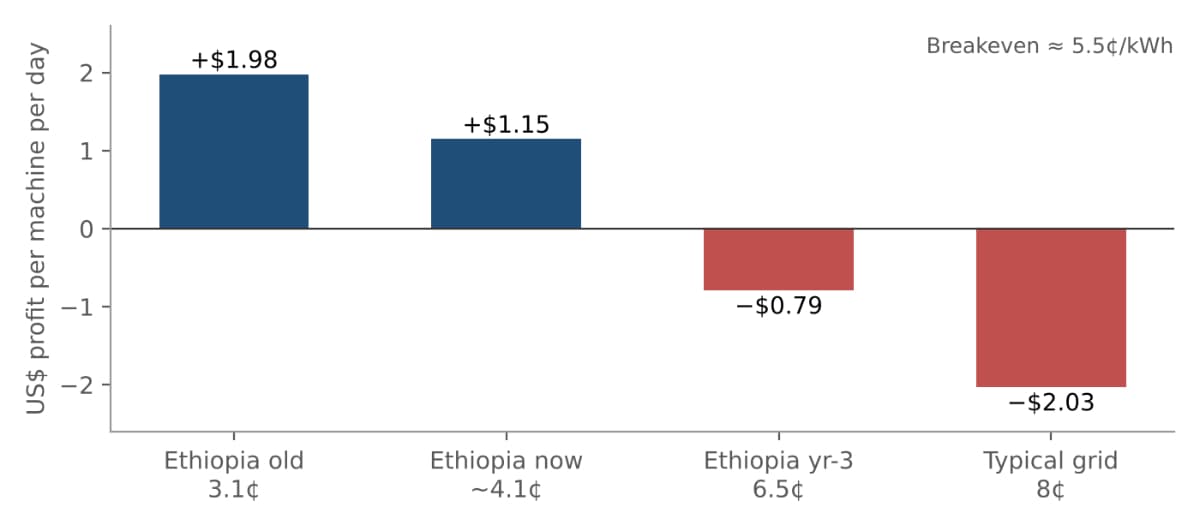
Figure 4: Estimated daily profit of one S19-class machine at different power prices
How we calculated this: a typical machine of ~115 TH at ~30 J/TH uses about 82.5 kWh a day and earns about $4.57 a day at a hashprice of $39.87/PH/day. Breakeven power cost ≈ $4.57 ÷ 82.5 kWh ≈ 5.5¢/kWh. Pool fees, hosting, staff and shipping are excluded, so real margins are thinner. ICR estimates.
This shapes who buys. Only operators with power costs below about 5.5¢/kWh can run these machines, for example in hydro- and gas-rich regions or at sites paid to soak up surplus energy. Everyone else would rather buy newer, more efficient rigs. If a wave of Ethiopian sellers hit the market at once, used S19 prices could fall further, which hurts anyone holding similar machines on their balance sheet.
Miners were EEP’s biggest customer group, paying about 35% of the utility’s revenue and using almost a third of the country’s electricity. EEP’s income from miners grew from about $55 million (ten months of FY2023/24) to about $220 million in FY2024/25, and it projected $312.5 million for FY2025/26.
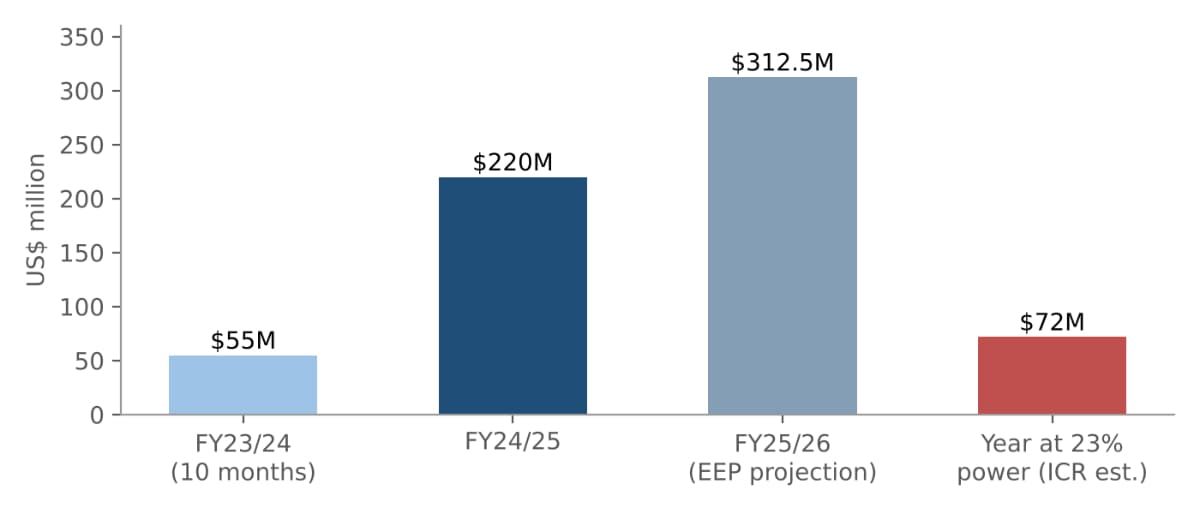
Figure 5: EEP revenue from miners and an ICR scenario for a full year at 23% power (US$ million)
If miners only ever received 23% of their power, a full year’s income would fall to around $72 million, a gap of roughly $240 million in hard currency. Miners had already warned in late 2025 that the new tariff could wipe out 90% of operations by 2027 and cost EEP over $300 million. For Ethiopia, the upside is that power goes back to households and factories in a country where about half the population still lacks reliable electricity.
For foreign operators, a pause turns productive machines into stranded assets. Exiting is not clean. The BitFuFu case shows the risks: deals that never closed, unpaid power bills, and a supplier threatening to seize the machines as collateral. Machines can be shipped out in weeks, but customs, import rules and legal disputes can hold them up for much longer. Companies with diversified sites, like Canaan with 65% of its hashrate outside Ethiopia, can absorb the blow. Single-site hosts cannot.
Here is the most interesting “what if”. In January 2026, Prime Minister Abiy Ahmed announced that Ethiopian Investment Holdings (EIH), the country’s sovereign wealth fund, wants to build a state-backed mining venture. If foreign miners were forced to sell, EIH could buy thousands of S19s at scrap-like prices.
At about $127 per machine and around $2 a day of profit at the old 3.1¢ tariff, a state miner using its own power could, in theory, earn back the purchase price within a couple of months once the rains return. And unlike the current model, where the state only sells electricity to miners, Ethiopia would keep the Bitcoin, just as Bhutan does. Ethiopia has no verified Bitcoin holdings on-chain today. A low-cost fleet could change that.
The challenge remains the same as before: in a drought, the state would face the same choice of homes vs mining, only this time with its own money at risk.
Table 3: What could happen next
Scenario | What happens | Effect on Bitcoin | Effect on Ethiopia |
|---|---|---|---|
Rains return | Power restored in 2027; most miners stay and restart | Hashrate returns to Ethiopia; no lasting effect | Dollar income recovers, but tariff rises still bite |
Slow exit | Weaker operators sell; larger players stay at reduced power | Some S19s move abroad; small dip in used rig prices | Revenue settles well below the $312.5M projection |
Kazakhstan moment | Most miners leave; machines shipped or sold abroad | ~2% of hashrate relocates; brief hashprice bump | Loses a major hard-currency earner; frees power for homes |
State takeover | EIH buys stranded rigs cheaply and mines for the state | Hashrate stays; ownership shifts to the state | Could start a sovereign Bitcoin reserve |
At India Crypto Research, we believe the pause in Ethiopia is a much bigger story for Ethiopia than for Bitcoin. About 2% of global hashrate moving country is something the network absorbs within one or two difficulty adjustments. The real lesson is about power risk. Ethiopia’s “cheap, green” hydropower turned out to depend on rainfall and on political priorities, and when both turned, miners were the first to be switched off. We expect older S19 fleets to keep drifting toward the cheapest power in the world. We think the most important thing to watch is not the hashrate but EIH: if the state ends up owning the machines, Ethiopia moves from selling electricity to holding Bitcoin.
For Indian investors, this is a lesson in reading mining stocks, not a trade on Bitcoin. Check where a miner’s hashrate actually sits, whether its power contracts can be cut, and whether “operating” capacity is really switched on. A paused site in a drought can look exactly like a working one in a headline number.
Sources: Canaan July 2026 mining update via CryptoSlate and cryptonews.net, Bloomberg via Cointelegraph, Capital Ethiopia and Hashrate Index; hashrate, profit and revenue scenarios are ICR estimates.
India Crypto Research operates independently. The information presented herein is intended solely for educational and informational purposes and should not be construed as financial advice. Before making any financial decisions, it's essential to undertake your own thorough research and analysis. If you're uncertain about any financial matters, we strongly recommend seeking guidance from an impartial financial advisor.


