1. What Tokenisation Actually Means
2. DTCC Flips the Switch on Tokenised Securities
3. Tokenised US Stocks Start Trading Around the Clock
4. The CFTC, the Fed and the OCC Draw New Lines
5. London, Singapore, Hong Kong and Seoul Race Ahead
6. India’s Tokenised Bond Pilot Waits for Its Next Act
7. The Way Forward for Tokenised Markets

 Part of a series
Tokenisation has moved well beyond the conference circuit. In less than a month, the depository that holds $114 trillion of US securities started minting tokens, the first venue for trading tokenised US shares went live, and Singapore and Hong Kong began settling tokenised assets in central bank money. India launched its own tokenised bond pilot with much fanfare in September, but no new tokens have been issued since.
So what does this mean for you? In this issue, we explain what has happened and what is likely to come next. Every fact here has been checked against official announcements from central banks, regulators and exchanges.
When shares or bonds are tokenised, the financial asset is split into many smaller units, and each unit is recorded on a blockchain as a token.
The important point is that the asset itself stays the same. Think of it as moving the ownership record of a house from a paper register to a digital one: the house does not change, only the record does. This is very different from Bitcoin, which gives you no claim on any share, bond or deposit. A tokenised bond is still a bond, with the same interest and the same legal rights.
So why bother? Official announcements this autumn point to three potential benefits. First, payment and settlement can happen at the same moment. Second, markets can stay open 24/7. Third, the back-office work of clearing and settling a trade can be done faster, so assets can be put to work sooner as collateral to fund trades.
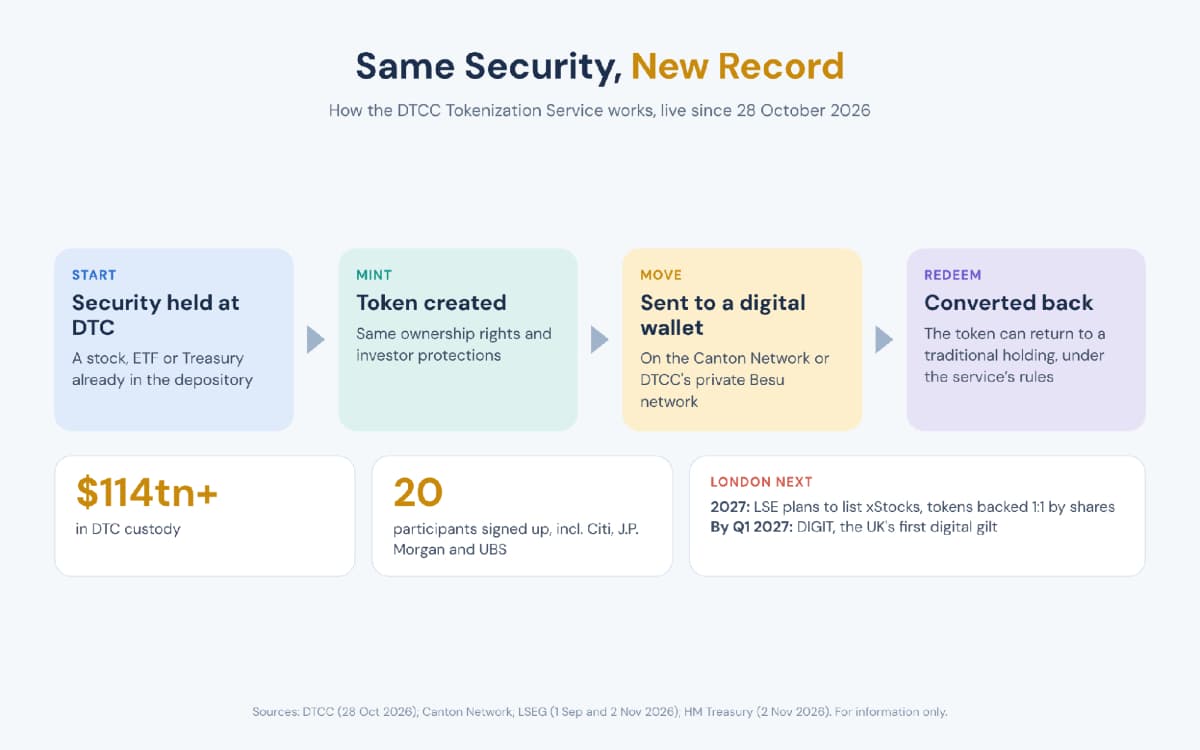
This year, the biggest headlines came from the least dramatic corner of finance: the back office of central securities depositories (CSDs). On 28 October 2026, the Depository Trust Company (DTC), a subsidiary of DTCC, launched its Tokenization Service. DTC is the central securities depository for the US and one of the largest in the world, holding more than $114 trillion of financial instruments issued by companies and governments.
The service lets eligible participants convert securities held at DTC into tokens, move those tokens into a digital wallet, and convert them back into securities, subject to the service’s terms and conditions. According to DTCC, the tokens carry the same ownership rights and protections as the original security. Under the no-action letter SEC staff issued to DTC in December 2025, only certain Russell 1000 securities, ETFs that track major US equity indexes and certain US Treasuries can be tokenised for now. The letter does not represent any opinion or view of the Commission on the legal issues raised by tokenising securities.
Barclays, Citi, J.P. Morgan, Morgan Stanley and UBS are among the current participants. The first version of the service runs on the Canton Network and DTCC’s private network, with more networks due to be added in 2027. A securities token, often called an S-Token, represents an equity interest in a company and typically carries the same ownership rights and protections as the common stock behind it. Tokenised securities are no longer science fiction. As Wall Street’s underlying pipes and rails move on-chain, tokenisation will stop being a speculative idea.
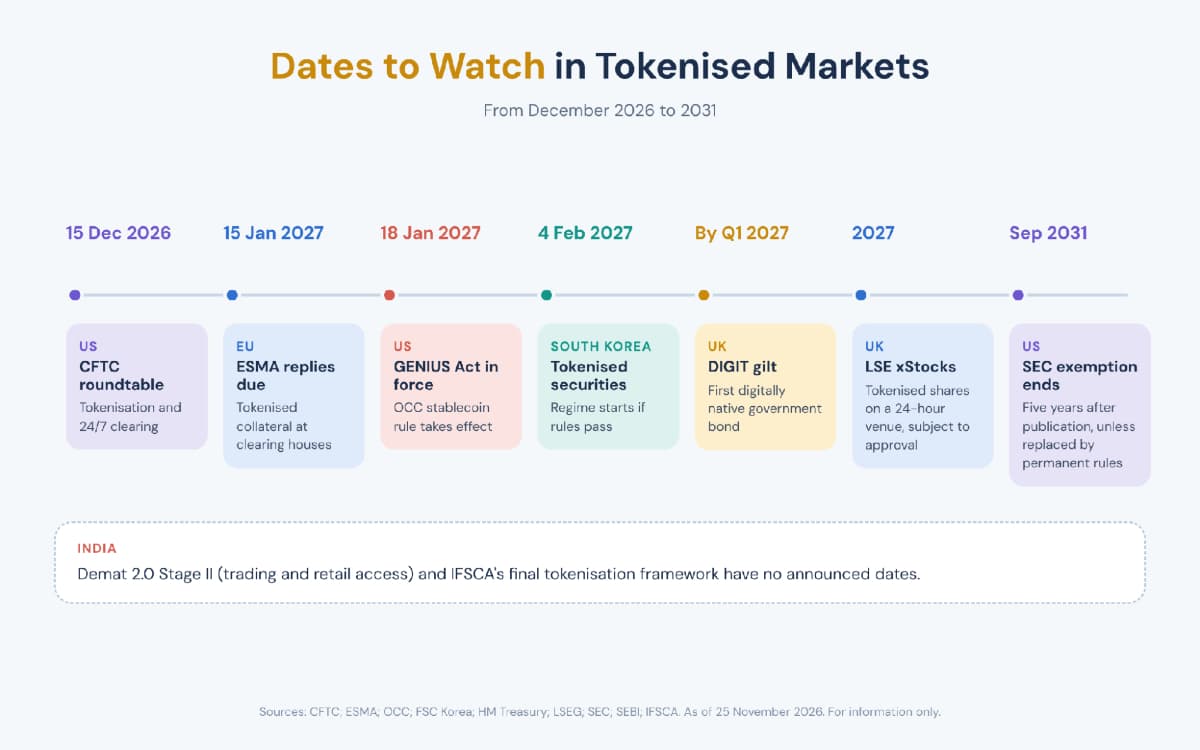
DTCC built the pipes, and the SEC opened the door. On 17 September 2026, the SEC granted an “innovation” exemption under order 34-106402. This conditional relief allows the first venues that meet its conditions to trade token representations of US-listed shares on public blockchains; other venues cannot use the order. The exemption runs for five years from its publication in the Federal Register on 22 September 2026, so it expires in September 2031. In the meantime, Tier 1 venues may list tokens of up to 75 stocks and Tier 2 venues up to 250 stocks.
There is also an important safeguard when a third party tokenises a company’s shares. Before trading those shares, the venue must notify the company, and if the company objects within 30 days, the venue cannot trade them. SEC Chair Paul Atkins said the exemption lets market participants start trading token representations of shares until permanent rules are adopted.
The first venue to trade token representations of US equities was OKXICE, a joint venture between OKX and ICE, the parent company of the NYSE, which launched on 23 November 2026. For now, OKXICE is open only to OKX customers located in the US, and OKX notes that the venue is not authorised by the SEC.
The Securities and Exchange Commission (SEC) is taking a more liberal line in its proposed Regulation Crypto Assets. The proposal would let an issuer raise up to $5 million through token offerings over a four-year period without registering, or up to $75 million a year if it provides financial statements. The comment period closed on 20 October, and the SEC has said nothing further on the proposal since it was published.
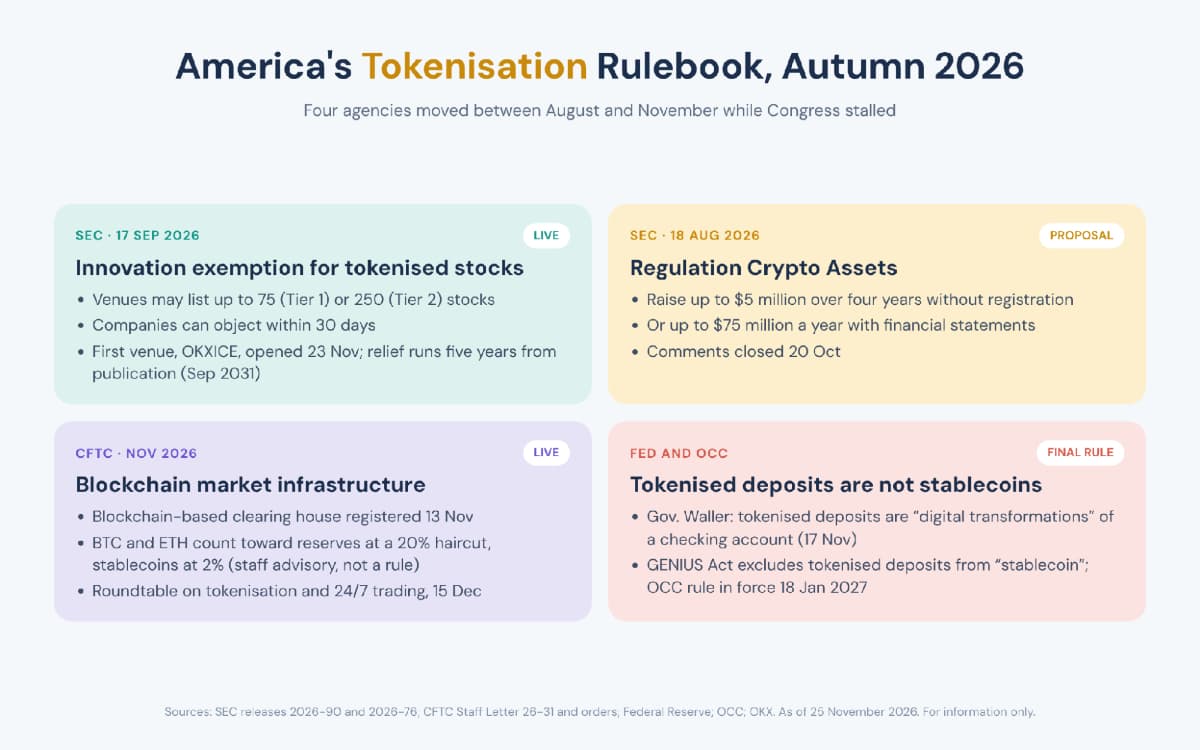
The Commodity Futures Trading Commission (CFTC) also gave an early green light to blockchain-based market infrastructure in November, when it granted a market clearing licence to Backpack Clearing, LLC. Chairman Michael Selig said at the time that the approval “provides a regulated pathway” for similar infrastructure built on blockchain technology.
In staff letter 26-31, dated 23 November, CFTC staff said they would not object if clearing houses and derivatives exchanges counted Bitcoin and Ether towards their reserves at a 20% haircut, and stablecoins at a 2% haircut. The letter gives exchanges and clearing houses comfort and direction, but it creates no legal requirements and does not change existing regulations. The CFTC will also hold a public roundtable on 15 December to discuss whether tokenisation, stablecoins and blockchain technology could help with clearing.
The Federal Reserve and the Office of the Comptroller of the Currency (OCC) are drawing a clear line between tokenised deposits and stablecoins. Federal Reserve Governor Christopher Waller said on 17 November that a tokenised deposit is simply “a digital representation of the digits in your checking account”. Stablecoins, by contrast, are private-sector tokens backed by reserves. The GENIUS Act builds in this distinction: deposits, including tokenised deposits, are explicitly excluded from the definition of a payment stablecoin, and the OCC’s final rule implementing the Act reflects the same definition. As a result, from January 2027, tokenised deposits will be governed by the OCC rule. In short, a tokenised deposit is still a bank deposit, while a stablecoin is only as safe as the reserves its issuer holds.
The US is not alone. London is building a tokenised version of its stock market. On 1 September, the London Stock Exchange announced plans to list ‘xStocks’ in 2027: tokens representing shares traded on the exchange. They would be backed one-to-one by the shares and traded on LSE24, the exchange’s 24-hour platform. Earlier this year, the LSE’s digital depository also cleared a hurdle in the UK’s Digital Securities Sandbox, and HM Treasury is expected to issue DIGIT, the first digitally native government bond, in the first quarter of 2027.
Singapore’s focus is tokenised collateral. On 19 November, the Monetary Authority of Singapore (MAS), together with industry participants, announced the Guardian Tokenized Collateral Framework, which covers the eligibility, custody, valuation and return of tokenised collateral. MAS also said $100 million of Singapore dollar-denominated MAS Bills had been issued and settled using a Singapore dollar wholesale digital currency. In Hong Kong, the central bank has launched EnsembleTX, and the securities regulator has approved round-the-clock trading of tokenised money market funds.
South Korea has set a start date. Its Financial Services Commission has said that from 4 February 2027 it will allow over-the-counter trading of tokenised stocks, bonds and funds, with a cap of KRW 100 million per retail investor per year. Europe, by comparison, is moving slowly. The EU’s markets regulator, ESMA, has asked the industry for views on clearing houses using tokenised collateral, with responses due by 15 January 2027. In Canada, OSFI, which supervises the country’s banks, has stated that tokenised deposits “are not legally distinct from traditional deposits.”
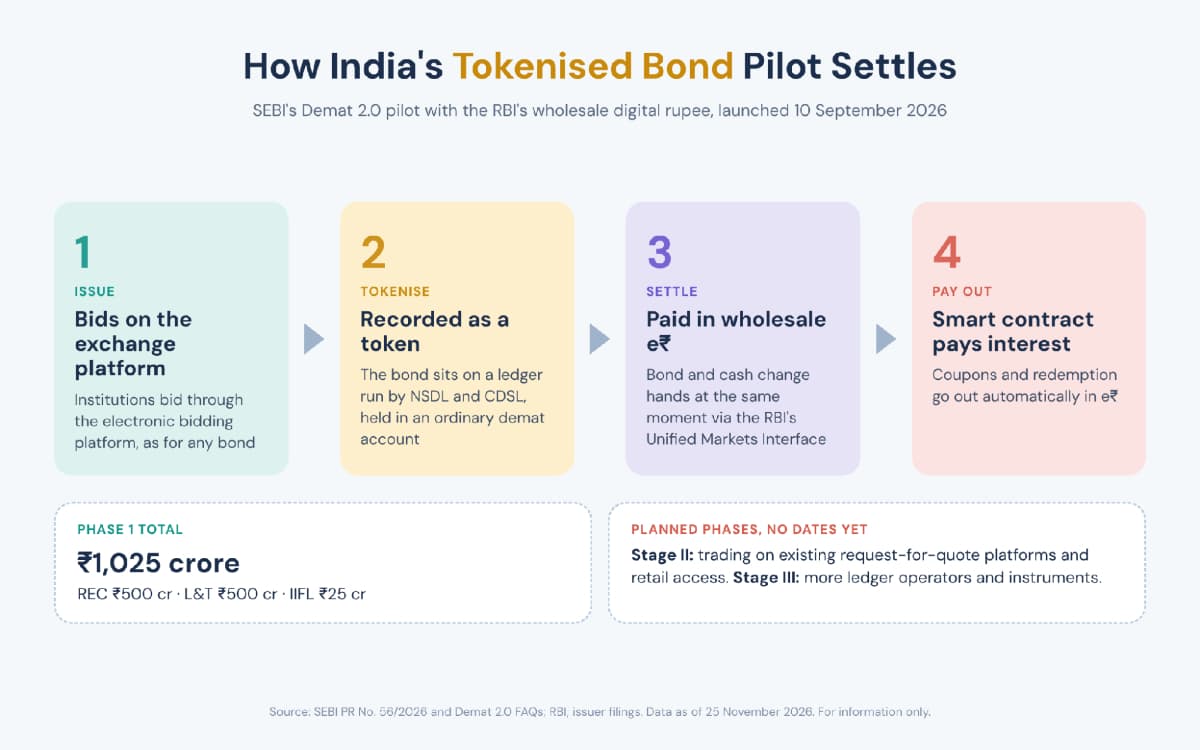
India moved early. On 10 September 2026, SEBI and the RBI announced the Demat 2.0 pilot (SEBI PR No. 56/2026). Under the pilot, corporate bonds are represented as tokens on the books of the two depositories, NSDL and CDSL. Cash and interest payments are made through a smart contract run by the depository, and the cash leg is paid in the RBI’s wholesale digital rupee, which is transferred automatically to the investor’s e₹ wallet.
The first three issuers in the pilot were REC and L&T, which raised ₹500 crore each, and IIFL, which raised ₹25 crore, for a total of ₹1,025 crore. Investors who want to take part must opt for Demat 2.0 with their depository and hold a clearing e₹ account with a bank to settle the cash leg.
Since then, information has been thin. SEBI says Phase 1 issuances are in progress, but as of 25 November we could not find any new issuances, or any SEBI consultations on tokenisation, on its official websites for October or November. According to SEBI’s FAQs, Stage 2 would allow existing securities to trade on previously restricted platforms and give retail investors the chance to trade them. Nothing has been published about Stage 3, and there appear to be no firm timelines for either stage. The RBI’s Annual Report for 2025-26 says it plans to run “additional pilots on tokenization of financial assets” in the coming year. The same report, however, shows e₹ in circulation stood at ₹771.7 crore in March 2026, down from ₹1,016.5 crore a year earlier. The IFSCA, which regulates GIFT City, published a consultation paper on tokenisation in February 2025, but as of 25 November no final version was available on its website.
There has also been no official word from the Indian government on how tokenised bonds will be taxed, which leaves many investors in the dark. Ideally, that clarity will come before retail investors are allowed into the market.
Step back and a pattern emerges. In institutional markets, tokenisation is creating new ways to issue, record, hold and settle regulated assets. SEBI, DTCC and the London Stock Exchange all leave the underlying security unchanged; only the ownership record moves. The real contest is over which kind of money settles these trades. In Hong Kong, Singapore and India, it is central bank money. In the US, the battle is between stablecoins and tokenised deposits.
For Indian readers, a few conclusions follow. First, for now, tokenised markets will remain institutional. The second phase of India’s CBDC pilot will also stay institutional. And OKXICE currently serves only eligible customers in the US.
Be cautious about any “tokenised Indian bonds” or “tokenised US stocks” offered to retail investors. A token is only as good as the legal claim on the security behind it, so always ask who holds that security and which regulator oversees them.
Keep an eye on the calendar below to see whether these become full-fledged markets over the next six months.
This newsletter is for informational purposes only and does not constitute financial, legal or investment advice. Virtual Digital Assets are highly volatile, carry regulatory uncertainty, and are not protected by the deposit-insurance or investor-protection frameworks that apply to traditional securities. Tokenised securities in pilots or exemptions may change. Readers should consult a qualified financial adviser before making any investment decisions.
India Crypto Research operates independently. The information presented herein is intended solely for educational and informational purposes and should not be construed as financial advice. Before making any financial decisions, it's essential to undertake your own thorough research and analysis. If you're uncertain about any financial matters, we strongly recommend seeking guidance from an impartial financial advisor.