
So, what is IFSCA?
What’s in it for me?
Crypto and IFSCA
What is tokenisation?
Web 3.0 and the FinTech Sandbox
What this means for you
Bottom line

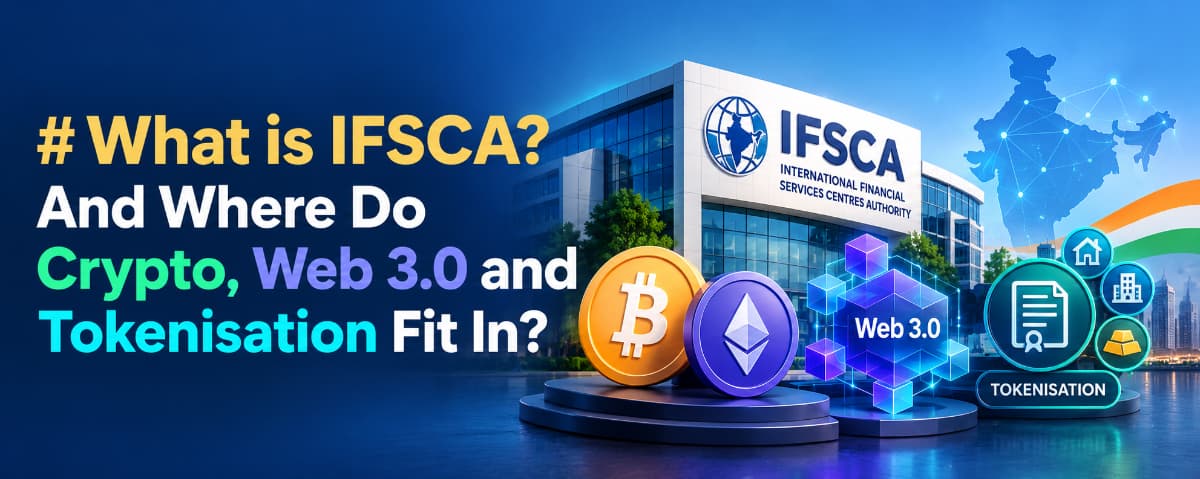
Imagine a glass-fronted part of Gujarat that houses banks, insurers and fund managers serving international clients under rules designed for global finance. That’s GIFT City, and IFSCA is the regulator for all financial activities conducted within its International Financial Services Centre (IFSC). If you follow crypto in India, you’ve likely come across IFSCA in stories about tokenisation. In this article, we cover what IFSCA is and what it has (and has not) said about crypto and Web 3.0.
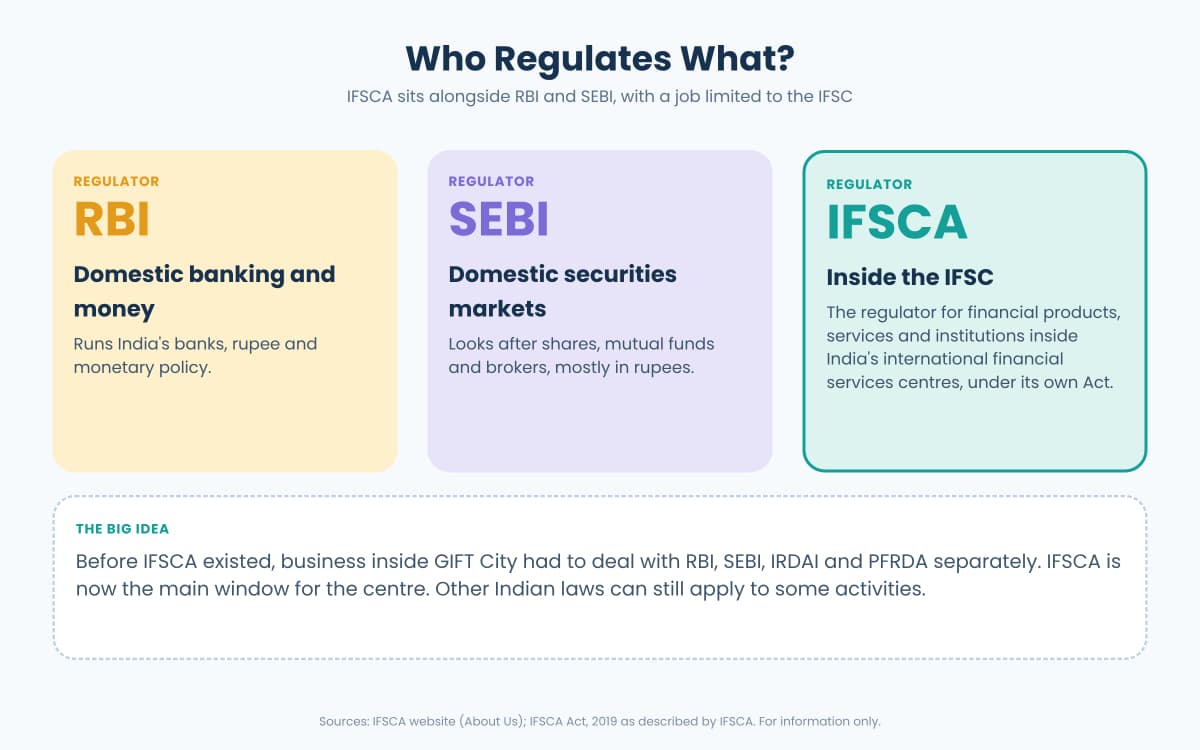
IFSCA is the International Financial Services Centres Authority. It was established under the IFSCA Act, 2019, and began work on 27 April 2020. Its headquarters are in GIFT City, Gandhinagar. Per IFSCA’s website, it is a unified authority for developing and regulating financial products, services and institutions in India’s International Financial Services Centres (IFSCs). Prior to IFSCA’s establishment, different parts of financial activity in the IFSC were regulated by the RBI, SEBI, PFRDA and IRDAI. IFSCA’s website names K. Rajaraman as its Chairperson. Media reports say his term was extended until October 2028, but we were unable to locate the official notification.
Think of IFSCA as a single-window authority. A global bank or fund setting up in GIFT City deals with one authority for licensing, regulation and supervision, rather than several. IFSCA has two roles: it regulates financial activity, and it works to develop the centre by attracting institutions and new products. Its purview is limited to the IFSC, not the whole country. Your demat account, bank account and mutual funds in India continue to be governed by the usual regulators, and other Indian laws may still apply to certain activities within the IFSC.
Within the purview of IFSCA are banking units, capital markets, insurance, fund management, fintech and bullion. As of June 2026, IFSCA’s website reported 1,260 registrations or authorisations, more than USD 120 billion in banking assets, and 127 TechFin and ancillary service providers.
GIFT City may sound like a place where crypto could find a welcoming home, but IFSCA’s official statements suggest otherwise. On 18 December 2024, IFSCA released a press statement responding to media reports that it was working on a crypto framework. It said it has no plans to regulate crypto exchanges, cryptocurrencies or related virtual assets in the IFSC.
This position is also reflected in IFSCA’s February 2025 consultation paper on tokenisation. The paper excludes cryptocurrencies and crypto-assets, and states that IFSCA does not intend to regulate them, permit their trading, or otherwise endorse them.
More specific restrictions apply to Global Access Providers, firms that help clients access overseas markets from the IFSC. Under IFSCA’s circular dated 12 August 2025, the guidance note to Clause 20 says Global Access Providers must not offer access to crypto-assets or to instruments whose underlying asset is crypto. Clause 22 separately restricts access to certain derivatives available on IFSC exchanges, including index and single-stock derivatives. For Indian residents, Clause 21 limits access to what is permitted under the Foreign Exchange Management Act and the Liberalised Remittance Scheme. These provisions restrict specified activities; they do not amount to a blanket ban on all crypto-related activities across India. A circular dated 12 September 2025 amended the clauses relating to bank accounts.
So, if someone says an offering is “approved in GIFT City,” that doesn’t automatically mean IFSCA permits or endorses crypto trading. Ask to see the specific authorisation and check exactly what it covers.
Tokenisation means representing ownership of a real-world asset, such as a bond, fund unit, commodity or building, as a digital token. IFSCA published a consultation paper on the subject on 26 February 2025. It covers physical and financial assets, excludes assets that exist only as a record on a ledger, and seeks comments on whether issuing, safekeeping and trading tokens should be regulated activities. The original deadline for comments was 20 March 2025. It was extended to 30 April 2025 by an IFSCA notice dated 19 March 2025.
A consultation paper proposes an approach; it is not a binding rule. We could not locate final tokenisation regulations on IFSCA’s website, and no such circular appeared among the recent items on its homepage. However, the circular and consultation listings did not load fully when we checked, so readers should confirm the latest position on the live website. Separately, media reports say a private member’s bill on asset tokenisation was introduced in the Rajya Sabha in March 2026. It is not a government bill, and its passage is considered unlikely.
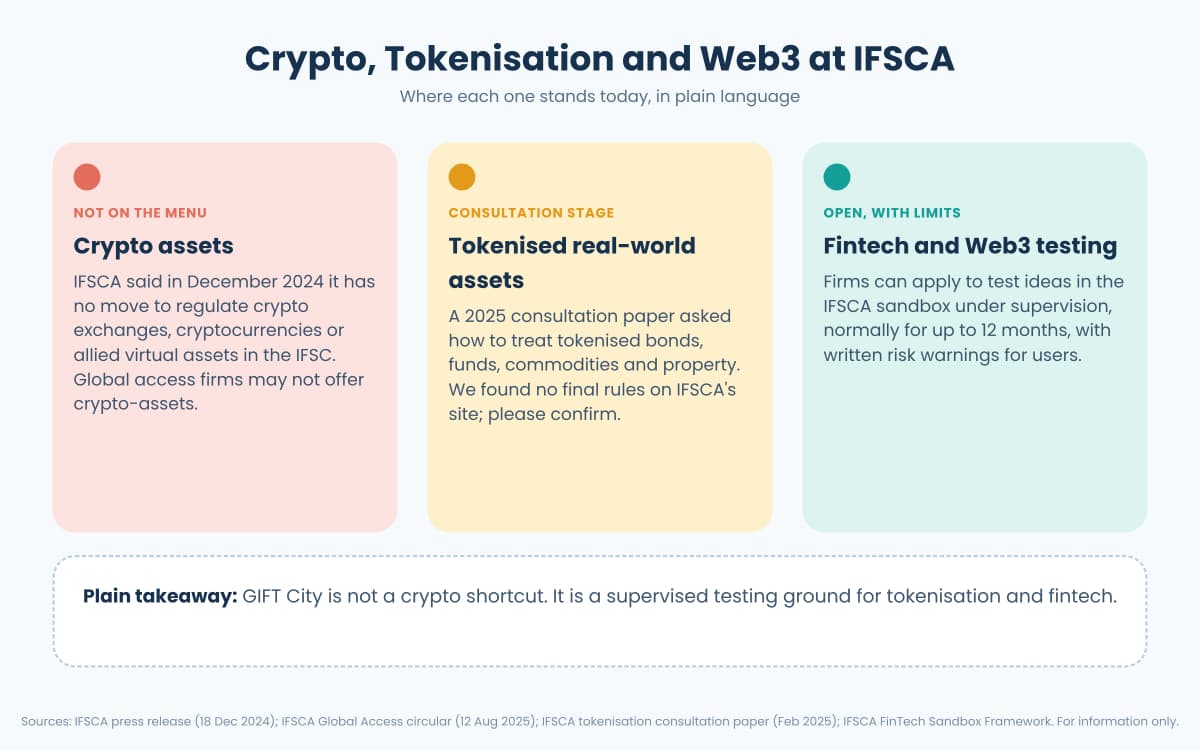
A practical route for testing new technology is the IFSCA FinTech Sandbox Framework 2026, listed on IFSCA’s FinTech page. Dated 16 March 2026, it replaces the previous sandbox and fintech-entity rules. Approved firms can receive a Limited Use Authorisation to test their ideas within set limits. Testing generally lasts up to 12 months, with a possible six-month extension. Before onboarding, users must receive written risk disclosures and give their consent, while firms must file monthly reports. Distributed Ledger Technology and Web 3.0 are listed among the framework’s TechFin services. We found these details in legal summaries, as we could not access the full framework text directly.
Shipfinex, a Dubai-based maritime tokenisation platform, has announced that it received sandbox authorisation. This comes from a sponsored press release, and we could not find the authorisation in IFSCA’s directory, so treat it as a company claim until independently confirmed. The sandbox gives a controlled environment for a potential product to be assessed, but sandbox authorisation does not mean IFSCA endorses a product or guarantees its safety.
• Crypto trading is not IFSCA’s goal. Tax and reporting rules for crypto still sit with India’s usual authorities.
• Tokenisation is the hot policy topic. But it is still at the consultation stage, on what we could verify.
• Sandbox doesn’t mean safe. A firm testing in the sandbox is not a fully licensed entity.
• Check before you trust. Ask who the firm is, what it is authorised to do, and where that authorisation is published.
IFSCA regulates financial activity within India’s International Financial Services Centre. Its position on crypto is clear, its work on tokenisation is still developing, and its sandbox offers innovators a supervised environment to test new ideas. When you hear “GIFT City” and “crypto” mentioned together, take a closer look and read the fine print.
Explore more articles from India Crypto Research on our Learn blog.
Last week on the blog: Three People, Two Agencies, One Crypto Rulebook
Sources IFSCA (website, 18 Dec 2024 press release, Global Access circulars from Aug and Sep 2025, Feb 2025 tokenisation consultation paper, FinTech Sandbox Framework 2026), indiajuris, TaxGuru, Ledger Insights, Business Standard (sponsored) and Elets eGov.
India Crypto Research operates independently. The information presented herein is intended solely for educational and informational purposes and should not be construed as financial advice. Before making any financial decisions, it's essential to undertake your own thorough research and analysis. If you're uncertain about any financial matters, we strongly recommend seeking guidance from an impartial financial advisor.


