
The 10 facts
What does this mean for Indian readers?
The bottom line

The GENIUS Act, signed on July 18, 2025, is the first US federal law written for payment stablecoins.
Every coin must be backed 1:1 by cash or short-term US Treasury bills, and holders have a legal right to redeem.
Issuers cannot pay interest just for holding a coin, and holders are paid first if an issuer goes bust.
The Act and the OCC's final rule both take effect on January 18, 2027.
 Part of a series
From January 18, 2027, any firm issuing a dollar stablecoin to US users will need a real dollar, or something nearly as safe, backing every coin. That is the core promise of the GENIUS Act, short for the Guiding and Establishing National Innovation for U.S. Stablecoins Act.
A stablecoin is a crypto token designed to hold a steady value, usually pegged 1:1 to the US dollar. Until this law, issuers in the US operated under a patchwork of state licences and federal guidance. The Act replaces that with one national rulebook covering who can issue, what must back each coin, and how holders are protected.
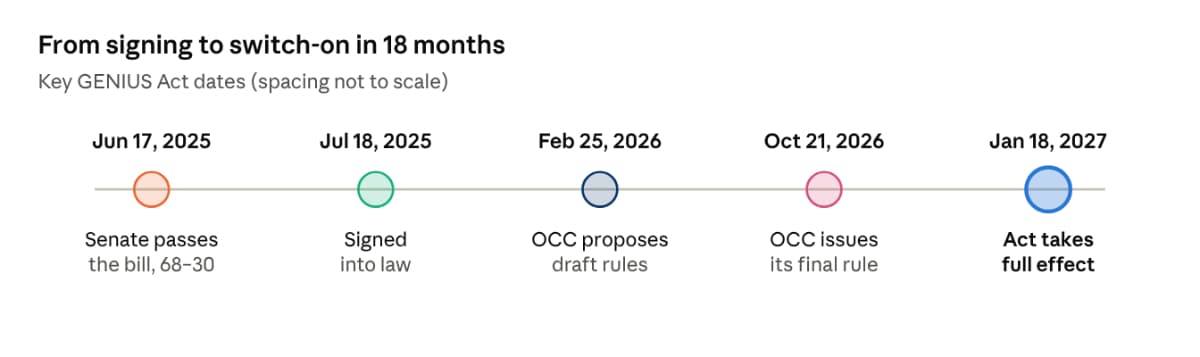
• When it happened. The Senate passed the bill 68-30 on June 17, 2025, and it was signed into law on July 18, 2025. It is the first major US federal law written specifically for a class of crypto assets.
• Why it was needed. Before it, issuers relied on state money-transmitter licences and regulatory guidance. Neither issuers nor users had a clear national answer to whose rules applied.
• What is covered. A payment stablecoin is a token designed for payments or settlement, which the issuer must redeem for a fixed amount of money. In practice, a coin that should always equal $1.
• What is not covered. Bitcoin, Ether, and algorithmic stablecoins fall outside it. An algorithmic stablecoin tries to hold its peg through trading rules rather than reserves. The Act also states that a compliant payment stablecoin is not a security or a commodity under federal law.
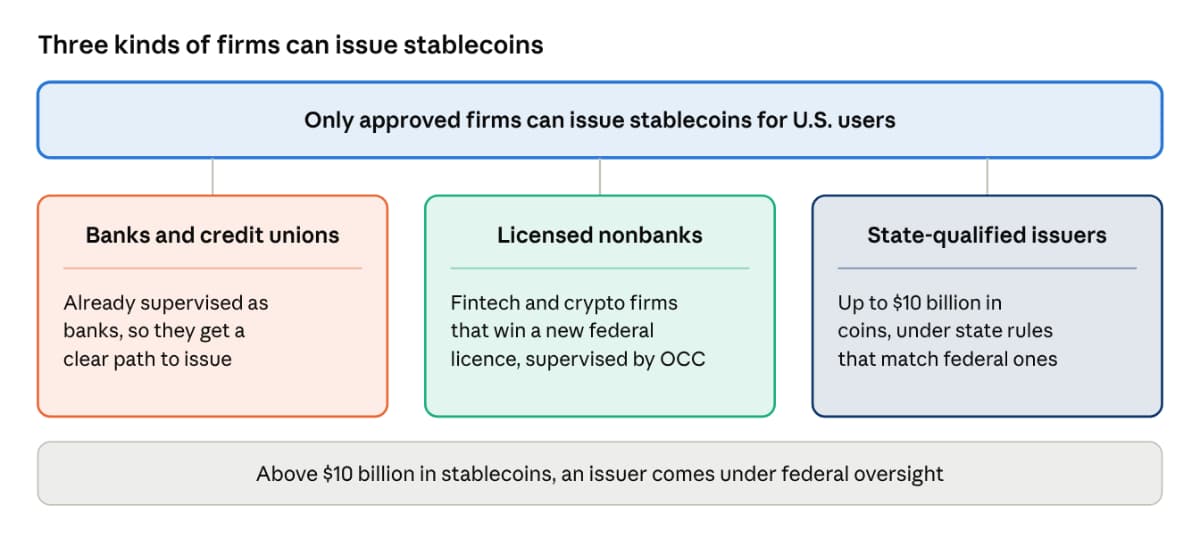
• Who qualifies? Three routes exist. Subsidiaries of federally regulated banks and credit unions, nonbank firms that win a new federal licence supervised by the OCC (Office of the Comptroller of the Currency, the main US regulator of national banks), and firms approved under a qualifying state regime.
• What it means for users. An unlicensed company can no longer launch a dollar stablecoin for US users. Every issuer must be licensed and supervised.
• The $10 billion line. An issuer with more than $10 billion of stablecoins in circulation comes under federal oversight.
• Room for smaller players. Issuers below that line can stay with a state regulator, but only if the state's rules are substantially similar to the federal framework.
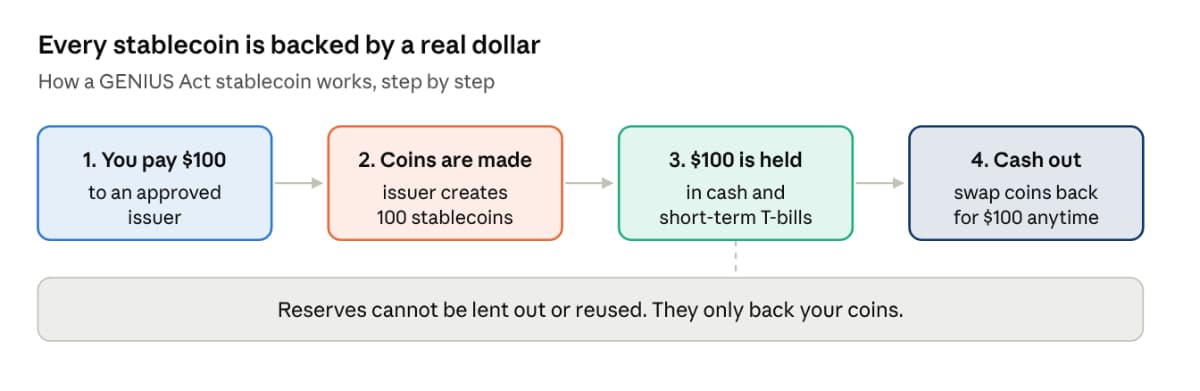
• What counts as backing. Reserves must sit in safe, liquid assets such as US dollar cash, insured bank deposits, Treasury bills maturing within 93 days, overnight repurchase agreements backed by Treasuries, and government money market funds.
• A simple example. If users hold $100 of a stablecoin, the issuer must hold at least $100 in those assets. The OCC's final rule adds that 5% of reserves must be available immediately and caps exposure to any single counterparty at 40%.
• No reusing the money. Reserves cannot be lent out, pledged, or rehypothecated. Rehypothecation means reusing customer assets as collateral for the issuer's own borrowing. The reserves exist only to back the coins.
• Your right to cash out. Holders get a legal right to redeem. Under the OCC rule, redemptions must be paid within two business days, and any fees must be disclosed upfront.
• Monthly reports. Issuers publish what their reserves hold and how many coins are outstanding every month. A registered public accounting firm examines the report, and the CEO and CFO must certify it.
• Annual audits for the largest. Issuers with more than $50 billion outstanding must also publish audited annual financial statements.
• The yield ban. Issuers cannot pay interest or yield to someone simply for holding their coin.
• How it is enforced. The OCC's final rule dropped a proposed blanket presumption and will judge yield arrangements case by case, with no safe harbours and anti-evasion powers kept. The aim is to keep stablecoins working as digital cash, not as a substitute for bank deposits.
• Priority in bankruptcy. If an issuer becomes insolvent, stablecoin holders are paid from the reserves ahead of other creditors.
• Fighting financial crime. Issuers are treated as financial institutions under the Bank Secrecy Act, the main US anti-money-laundering law. They must run identity, sanctions, and suspicious-activity checks, and be technically able to freeze tokens when a lawful order requires it.
• The start dates. The Act takes effect on the earlier of 18 months after signing or 120 days after final regulations. That makes January 18, 2027, the go-live date, with no transition period.
• The rulebook is arriving in pieces. The OCC issued its final rule on October 21, 2026, covering reserves, redemption, capital and supervision. The Federal Reserve proposed its rule on September 29, 2026; the FDIC's April 2026 proposal is not yet final, and anti-money-laundering rules will follow separately with the US Treasury.
• The next deadline. From July 18, 2028, platforms may not offer a payment stablecoin to US users unless it comes from a permitted issuer or a foreign issuer certified as comparable.
The Act changes nothing in Indian law. It governs stablecoins issued in, or offered to people in, the United States. An Indian buying USDT or USDC on a domestic exchange is still dealing in a VDA (Virtual Digital Asset, the legal term for crypto, tokens and NFTs under Indian tax law).
Indian tax treatment is unchanged. From April 1, 2026, the Income-tax Act, 2025 taxes gains on VDAs at a flat 30% under Section 194, Table serial 4 (formerly Section 115BBH), plus surcharge and 4% cess. A 1% TDS (Tax Deducted at Source, tax the exchange withholds automatically at the time of your trade) applies under Section 393(1), Table serial 8(vi) (formerly Section 194S).
A worked example. You buy ₹1,00,000 of USDT and sell it for ₹1,02,000 after the rupee weakens. Tax is 30% of the ₹2,000 gain, or ₹600, plus 4% cess, making ₹624. The exchange deducts ₹1,020 as TDS, which you claim as credit when you file. A loss on the same trade could not be set off against any other income or carried forward.
The RBI's position has not softened. Government documents reviewed by Reuters in July 2026 showed the Reserve Bank of India still leaning towards prohibition. It wants banks barred from holding or offering exposure to crypto assets and privately issued stablecoins. It is particularly wary of rupee-pegged stablecoins, which it says could erode seigniorage, the income a central bank earns from issuing currency.
For Indian users, the practical effect is indirect. Coins from US-permitted issuers will come with audited reserves and statutory redemption rights. Those rights run to holders under US law, so a user who holds through an exchange depends on that exchange to pass redemption through.
The GENIUS Act turns US dollar stablecoins from a grey-zone experiment into regulated digital dollars, with clear rules on who issues them, what backs them and who gets paid first. It makes the coins themselves safer. It does not make the wider crypto market less volatile, and it does not alter how India taxes or regulates them.
Stay tuned for the next edition of The Acts and its Facts.
Sources: OCC Bulletin 2026-50 (GENIUS Act final rule), Skadden (October 2026) and CoinDesk citing Reuters (8 July 2026).
India Crypto Research operates independently. The information presented herein is intended solely for educational and informational purposes and should not be construed as financial advice. Before making any financial decisions, it's essential to undertake your own thorough research and analysis. If you're uncertain about any financial matters, we strongly recommend seeking guidance from an impartial financial advisor.


