

Solo mining means mining Bitcoin on your own, without joining a group (called a pool). This is how all Bitcoin mining started.
A solo miner runs their own copy of Bitcoin's software (a "full node") and builds their own blocks.
If a solo miner finds a block, they keep the whole reward: 3.125 BTC plus all the transaction fees in that block.
There are no pool fees, but there is also no regular income. It is all or nothing, much like a lottery.
Small home machines like the Bitaxe Gamma 602 (about 1.2 TH/s, using about 18–25 watts) make solo mining cheap to try.
The chances are very small. With today's network, one Bitaxe has about a 1 in 5.5 million chance of finding a block on any given day.
 Part of a series
1. What Is Solo Mining?
Bitcoin mining is how new Bitcoin transactions get checked and added to the blockchain. Miners use special computers to solve a guessing puzzle. The first miner to solve it adds the next "block" of transactions and earns a reward.
Solo mining means doing this on your own. You don't team up with anyone, and you don't share your reward. If you find a block, everything is yours.
This is how Bitcoin mining began. In the early days, anyone could mine on a normal home computer. Bitcoin's creator, Satoshi Nakamoto, described this idea as "one CPU, one vote". As more people joined, finding a block alone became harder. So in November 2010, miners formed the first mining pool, where many miners combine their power and share the rewards.
A solo miner runs their own full node. A node is a computer running Bitcoin's software that keeps a full copy of the blockchain and talks directly to the network. One person can connect many mining machines to the same node and still be a solo miner.
2. Solo Mining vs Pool Mining
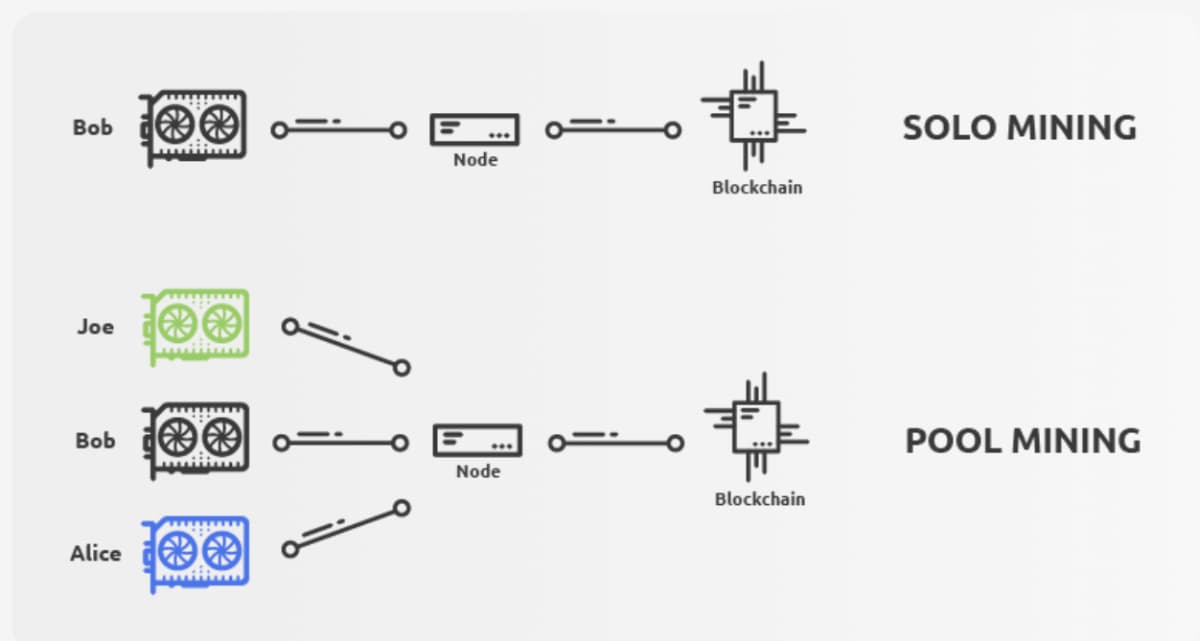
The picture below shows the difference. In solo mining, Bob connects his machine to his own node, which talks to the blockchain. In pool mining, Bob, Joe and Alice all connect to one shared node run by the pool, and they split whatever the pool earns.
Think of it like a lottery. A new Bitcoin block is found about every 10 minutes, and there is only one winner each time. The more miners there are, the less often each one wins. NiceHash gives a simple example. If there were one million miners with equal machines, each would wait about one million blocks to win, which is roughly 6,944 days (about 19 years).
A pool is like a group of friends buying lottery tickets together. They win more often, but they share the prize. A solo miner holds one ticket alone. Wins are rare, but the whole prize is theirs.
| Feature | Solo Mining | Pool Mining |
|---|---|---|
| Pool fees | None | Yes, the pool takes a small cut |
| How you get paid | Rarely, but in one big amount | Often, in small amounts |
| Transaction fees | You keep all of them | Depends on the pool |
| Reward for a block | 3.125 BTC + all fees, all yours | Shared among all members |
| Who builds the block | You, on your own node | The pool operator |
| Feels like | A lottery ticket | A small regular salary |
Source: NiceHash; The Solo Mining Co.
There is also a bigger reason solo miners matter. Some large pools control more than a quarter of all mining power. If one group ever controlled more than half (51%), it could cause serious problems for the network. Many small solo miners help spread that power out.
3. How Solo Bitcoin Mining Works
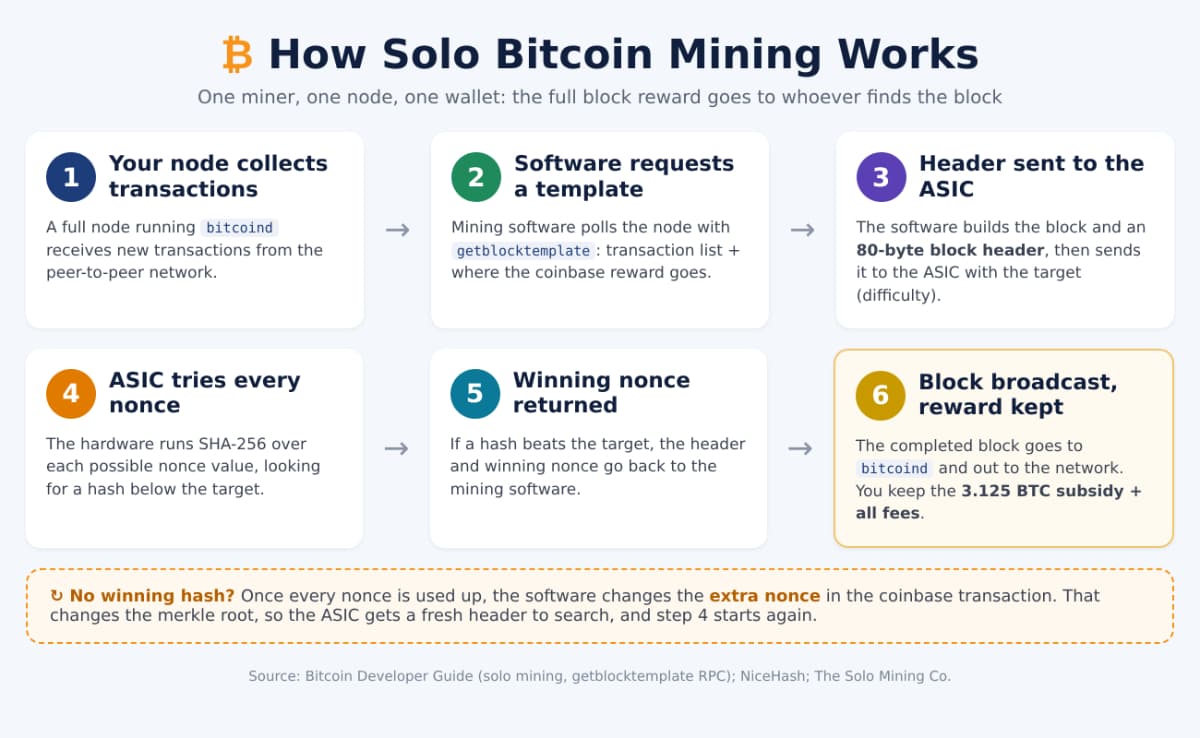
Solo miners usually run bitcoind, Bitcoin's main node software. Here is what happens, step by step:
Step 1: Your node collects new transactions from the Bitcoin network.
Step 2: Your mining software asks the node for a "block template" using a command called getblocktemplate. The template lists the transactions to include and the address where your reward should go.
Step 3: The software builds a block and a short summary of it, called the block header (just 80 bytes). It sends this to your mining machine (an ASIC), along with the target number it needs to beat.
Step 4: The machine changes one small number in the header, called the nonce, over and over. Each time, it creates a new code (a hash) and checks whether it is lower than the target.
Step 5: If no guess wins, the software changes a little extra data (the "extra nonce") in the reward transaction. This creates a fresh header, and the machine keeps guessing.
Step 6: When a guess wins, the machine sends it back. The software completes the block and your node shares it with the whole network. Once other nodes check and accept it, the reward is yours.
4. Why Do People Solo Mine?
Most people don't solo mine to earn a steady income. They do it for other reasons:
• A chance at a big win: A small home miner costs little to run but gives a real, if tiny, chance of winning a full block worth 3.125 BTC plus fees.
• Keeping Bitcoin fair: The Solo Mining Co. calls solo mining "the backbone of Bitcoin's integrity". When you run your own node, you decide which transactions go into your block, not a big pool.
• Learning: Small open-source miners like the Bitaxe are a hands-on way to see how mining really works.
• Privacy and independence: With your own machine, node and pool setup, you don't need an account with any company.
• Useful heat: Some small miners also work as heaters or fun desk gadgets, such as GekkoScience's USB cup-warmer miner and AltairTech's BitChimney heater.
5. Which Machine Should You Use?
Today, Bitcoin mining needs an ASIC, a machine built only for Bitcoin's type of puzzle (SHA-256). Normal computers and gaming graphics cards are far too slow to be useful. Mining speed is measured in TH/s (trillions of guesses per second). More TH/s means better chances, but usually more electricity and noise.
| Machine | Speed (approx.) | Power Use (approx.) | Good For |
|---|---|---|---|
| GekkoScience Compac F (USB) | ~0.3 TH/s | A few watts | Cheapest way to start; plugs into a USB port |
| Bitaxe Gamma 602 | ~1.2 TH/s (up to ~1.6 TH/s) | ~18–25 W | Most popular home miner; quiet, easy Wi-Fi setup |
| NerdQAxe++ | ~4.8 TH/s | ~75 W | More power for your desk |
| Canaan Avalon Nano 3S | ~6 TH/s | ~140 W | Mining plus room heating |
| Antminer S21 (industrial) | ~200 TH/s | ~3,500 W | Serious mining; very loud, needs special power and cooling |
Source: The Solo Mining Co.; manufacturer and retailer specifications. Figures are approximate.
For most beginners, the Bitaxe Gamma 602 is the best place to start. It uses the BM1370 chip, the same type of chip used in Bitmain's big Antminer S21 machines. It is small, quiet and uses very little power, and you set it up from a web page on your phone. The Solo Mining Co. sells its "Black Ice Edition" for £159.99, and a ready-made Bitcoin node (the Rebel Node) for £359.99.
6. What You Need to Get Started
• A mining machine and its power supply
• An internet connection (a cable is best, but Wi-Fi usually works)
• A Bitcoin wallet address to receive your reward
• A phone or computer to open the miner's settings page
• Optional: your own Bitcoin node, for full independence and privacy
Setting up a Bitaxe takes only a few minutes. Plug it in, connect your phone to the Bitaxe's Wi-Fi, and enter your home Wi-Fi details. Then open the settings page and type in a solo pool address (or your own node's address) and your wallet address. To switch between solo and pool mining later, you only need to change that address.
7. What Are Your Real Chances?
Solo mining is all about luck. As NiceHash explains, a miner who should win once every 10 years might win next month, or might wait 20 years. The table below shows rough odds for each machine, based on the Bitcoin network's total mining power on 2 November 2026 (about 954 EH/s).
| Machine | Chance of Finding a Block Each Day | Average Wait for One Block |
|---|---|---|
| GekkoScience Compac F (~0.3 TH/s) | ~1 in 19 million | ~58,000 years |
| Bitaxe Gamma 602 (1.2 TH/s) | ~1 in 5.5 million | ~16,800 years |
| NerdQAxe++ (4.8 TH/s) | ~1 in 1.4 million | ~4,200 years |
| Avalon Nano 3S (6 TH/s) | ~1 in 1.1 million | ~3,400 years |
| Antminer S21 (200 TH/s) | ~1 in 33,000 | ~100 years |
Source: India Crypto Research calculation using network data from Pickaxe (2 November 2026). Odds change as the network grows.
Small home miners do win full blocks now and then, which keeps solo mining exciting. But for most people, it is best to think of the electricity bill as the price of a lottery ticket, not as an investment.
8. Pros and Cons
Pros: no pool fees; you keep the full reward and all fees if you win; you control your own blocks; no minimum payout limits; and you help keep Bitcoin decentralised.
Cons: income is very unpredictable; small miners may never find a block; you pay for electricity and hardware even if you earn nothing; and running your own node takes some extra effort.
Conclusion
Solo mining takes Bitcoin back to where it started: one person, one machine, competing for a block. The idea is simple. Get a block template from your node, let your machine guess again and again, and share the winning block with the network.
Low-cost devices like the Bitaxe now let almost anyone with a power socket and Wi-Fi take part. But the odds are tiny when competing against the whole world. For people who enjoy learning, value independence and want to support Bitcoin's decentralisation, solo mining can still be a rewarding hobby.
Research Sources - NiceHash, The Solo Mining Co., homepage, "What is Bitcoin mining" guide, and Bitaxe Gamma 602 product
India Crypto Research operates independently. The information presented herein is intended solely for educational and informational purposes and should not be construed as financial advice. Before making any financial decisions, it's essential to undertake your own thorough research and analysis. If you're uncertain about any financial matters, we strongly recommend seeking guidance from an impartial financial advisor.


