
Price closed below the break-even point for active buyers
Funds are still leaving
The Binance hack hit an exchange, not Bitcoin
The profit cushion is the thinnest since mid August
Traders are borrowing to buy the dip and paying up for insurance
The network is strong; the market mood is not
Where are the levels to watch?
What this means for Indian readers

Bitcoin closed the week to 1 November at $78,248, down 4.6% in two weeks and below the True Market Mean of about $79,300.
Binance lost $6.3 billion to a hack on 29 October, the largest crypto theft on record.
US spot Bitcoin ETFs bought for four days, then sold $643 million on 30 October.
Only 63.5% of Bitcoin supply is now held at a profit, the thinnest cushion since mid August.
Options traders are paying more for protection than at any point in our weekly series.

 Part of a series
Bitcoin closed the week of 26 October to 1 November at $78,248. Two weeks ago, buyers defended the True Market Mean, the average price paid by investors whose coins actually trade. This week, they couldn’t. A record exchange hack and a crash in chip stocks pushed the price straight through it.
Each part of this report gives our take on the data, then two straightforward lines on what it means for the rest of us. All comparisons are with the week ending 18 October, when our last weekly report was published.
The weekly close of $78,248 is 1.4% below the True Market Mean of $79,337 (latest reading, 27 October). The price traded between $76,190 and $81,890 during the week. The short-term holder cost basis, the average price paid by people who bought in the last 155 days, rose to $75,809. So the market now sits between two cost levels, with only a 3% gap to the lower one.
That gap matters. When the price falls below what a group of holders paid, some of them sell to get out near break-even, and that selling can feed on itself.
In simple words. The typical active Bitcoin buyer is now slightly in the red. Another 3% fall would put recent buyers in the red too, which is often when selling picks up.
US spot Bitcoin ETFs took in $440 million from Monday to Thursday, only to lose $643 million on Friday, 30 October, the largest single-day outflow in four months. The week closed a net $203 million lower, against $228 million in week 42, and another $399 million left on 2 November.
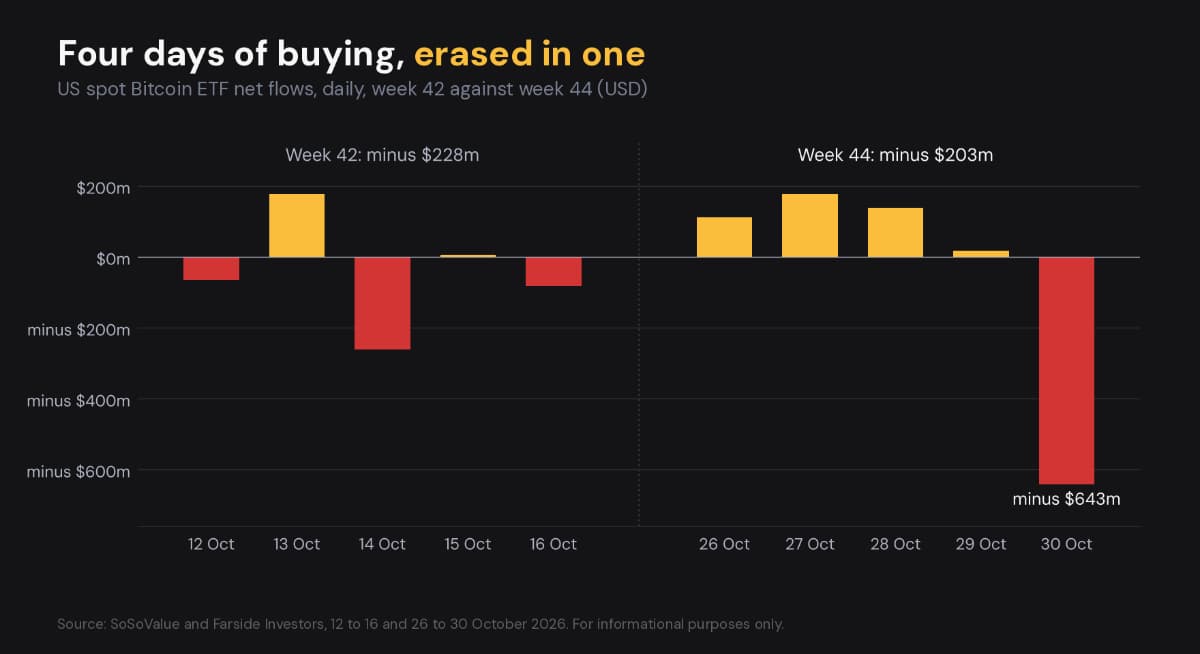
Daily US spot Bitcoin ETF net flows, week 42 against week 44
The on-chain data agrees. Realised cap, the value of every coin at the price it last moved, fell $3.1 billion to $1,082.9 billion. Realised cap falls only when coins move at prices below where they last moved, so on balance the coins that changed hands this week were sold at a loss. Meanwhile, stablecoin supply, the dollar cash parked on crypto rails, fell 2.1% to $300.1 billion.
In simple words. Big funds bought early in the week, then sold more on Friday than they had bought. The spare cash waiting to buy crypto is also shrinking.
On 29 October, attackers drained about $6.3 billion from Binance’s hot wallets across ten blockchains in roughly 20 minutes. A hot wallet is one connected to the internet, convenient for trading but more exposed to attack. The haul included 18,270 Bitcoin, worth about $1.5 billion. The FBI has attributed the attack to North Korea’s TraderTraitor group.
Binance says it will cover all losses and has already replaced 90% of them, and partners have frozen about $3 billion of stolen stablecoins. Withdrawals reopened on 1 November. The biggest issue was the timing: the hack landed in the same 48 hours as the chip stock rout, and CoinDesk counted $1.57 billion of crypto liquidations in the 24 hours after it. The stolen Bitcoin itself is a risk to watch. If the attackers move or sell those 18,270 coins, that is extra supply in a market already short of buyers.
In simple words. The Bitcoin network was not hacked; one exchange’s wallets were. Coins you keep on an exchange carry that exchange’s risk as well as Bitcoin’s.
The share of all Bitcoin held at a profit dropped from 69.3% to 63.5%, and touched 61.2% on 30 October, its lowest since 18 August. MVRV, market value divided by the price every coin last moved at, eased from 1.52 to 1.45. NUPL, the share of market value that is unrealised profit, dropped from 0.341 to 0.312. Both sit in the middle of their historical ranges, so this is a thinning cushion, not a capitulation.
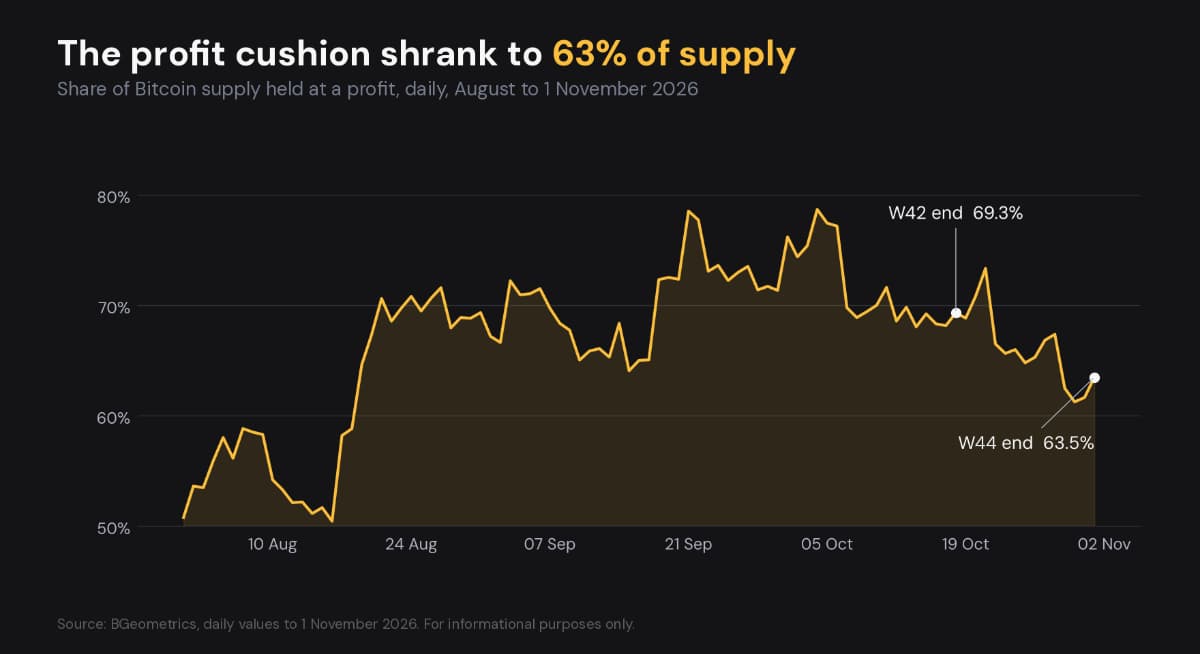
Share of Bitcoin supply held at a profit, daily
The holders tell the same story. Long-term holders, whose coins have not moved for about 155 days, cut their supply by 16,000 Bitcoin to 14.43 million. Short-term holders added 24,000 Bitcoin to reach 5.67 million.
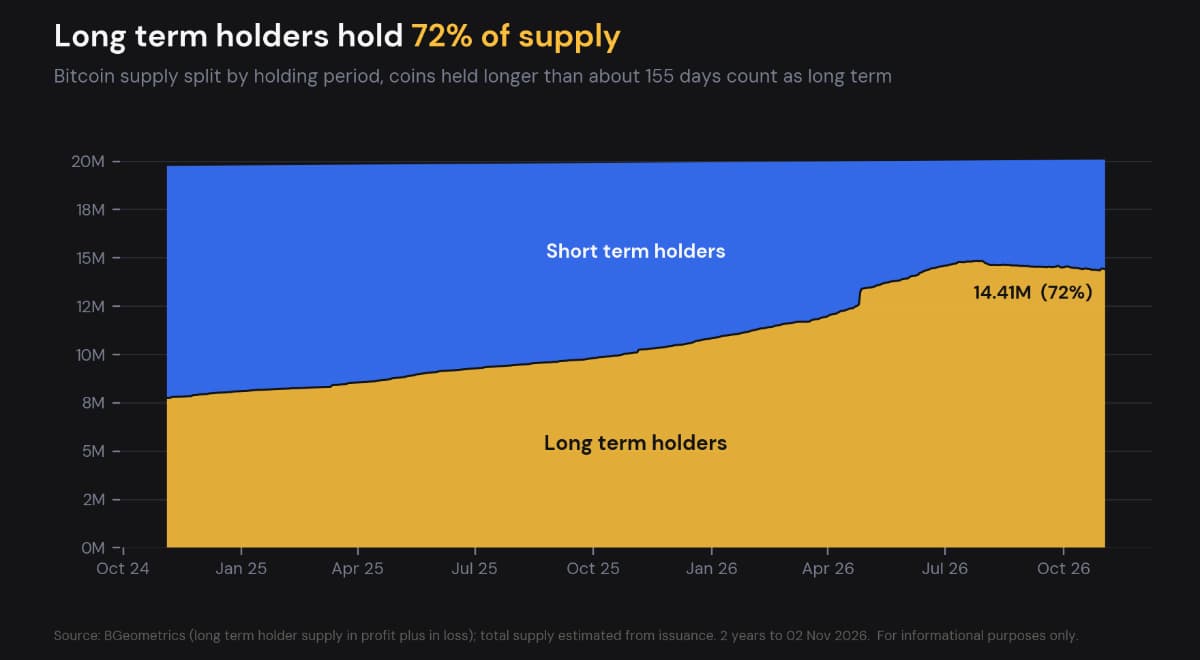
Bitcoin supply split between long-term and short-term holders
SOPR, the selling price of coins moved on-chain divided by what they cost, has data only to 27 October. Its 7-day average was 1.006 and its last daily reading exactly 1.000, so sellers were already at break-even before the hack.
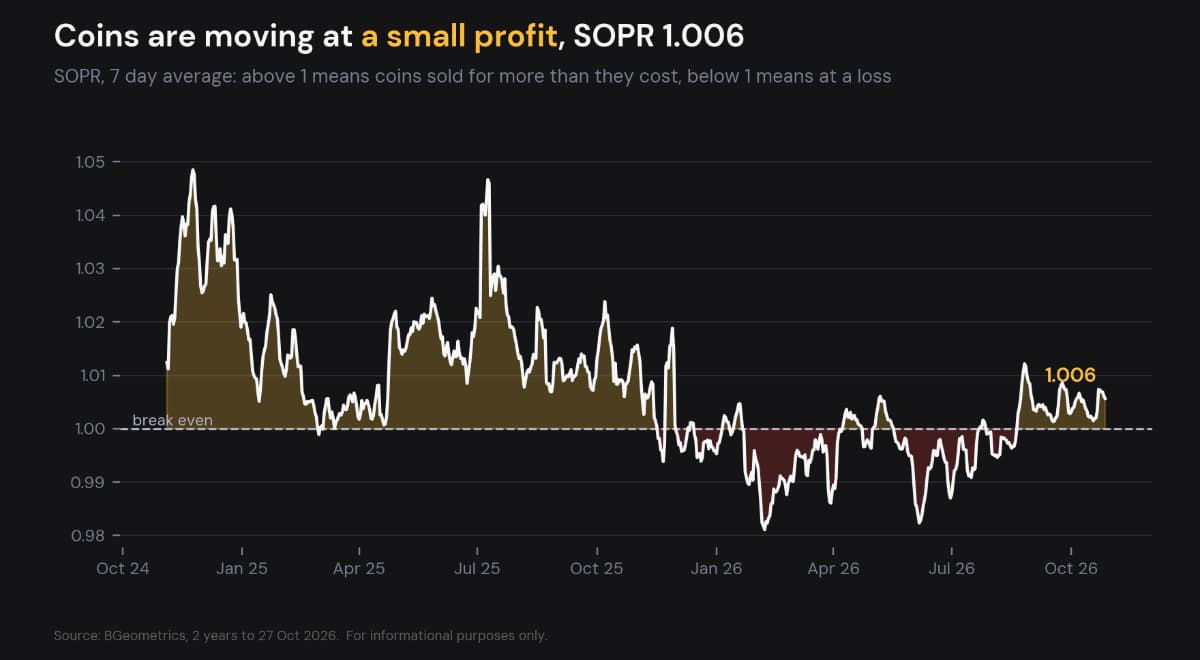
SOPR, 7-day average
In simple words. About a third of all Bitcoin is now worth less than its owner paid for it. Most holders are still in the green overall, but by less than at any point since August.
A liquidation is an exchange force-closing a borrowed position after losses eat the trader’s collateral. Long liquidations rose to $241 million against $97 million of shorts, up from $213 million and $79 million in week 42. Yet the funding rate, the fee traders on perpetual futures pay every 8 hours to keep a position open, rose from 0.0038% to 0.009%, close to the 0.01% neutral level.
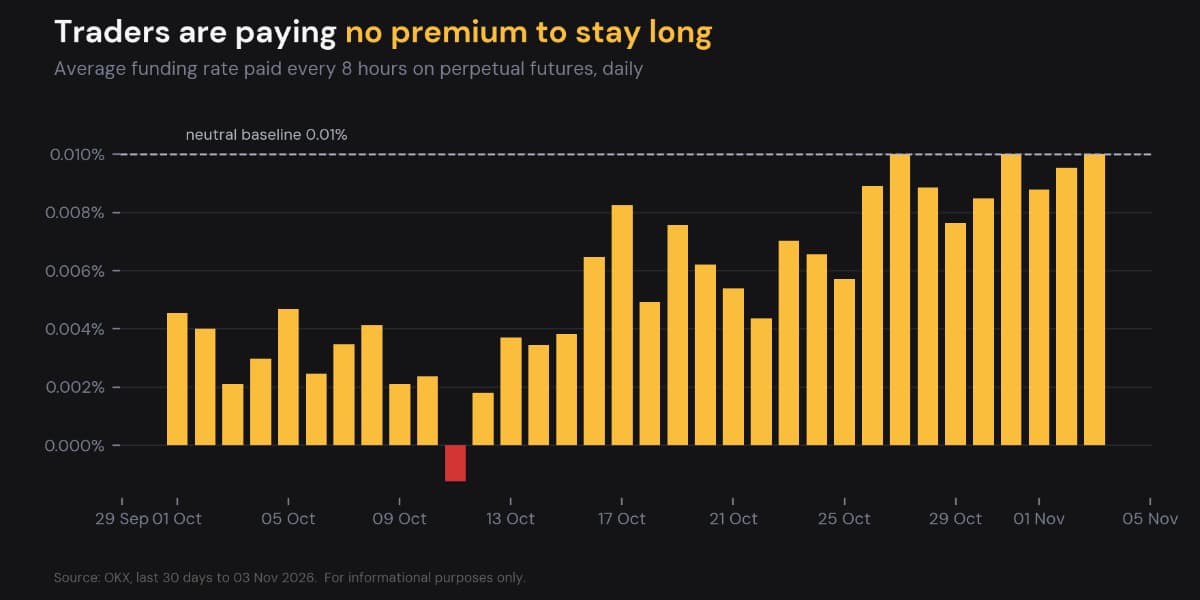
Average funding rate on perpetual futures, daily
Futures open interest rose 2.3% to $33.4 billion on the BGeometrics measure, and 14% over 30 days on OKX alone. Leveraged buyers were flushed out, and new ones stepped straight back in.
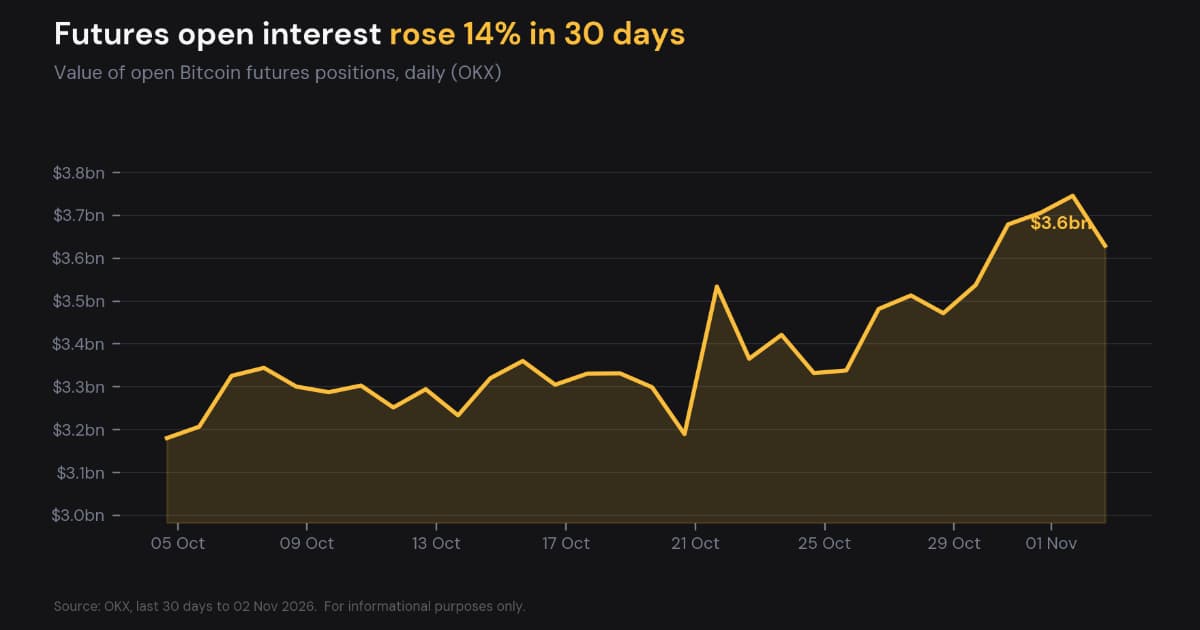
Bitcoin futures open interest on OKX, last 30 days
The options market is far more nervous. The one-week 25-delta skew, the extra price of a put over an equivalent call, jumped from 1.17 to 4.57, the highest in our series. Implied volatility rose from 31.9% to 37.6%. The 30 October monthly expiry, about $10.9 billion of contracts, settled near $78,100, almost exactly on its $78,000 max pain.
For the 25 December expiry, the largest call block sits at $80,000, just above the market.
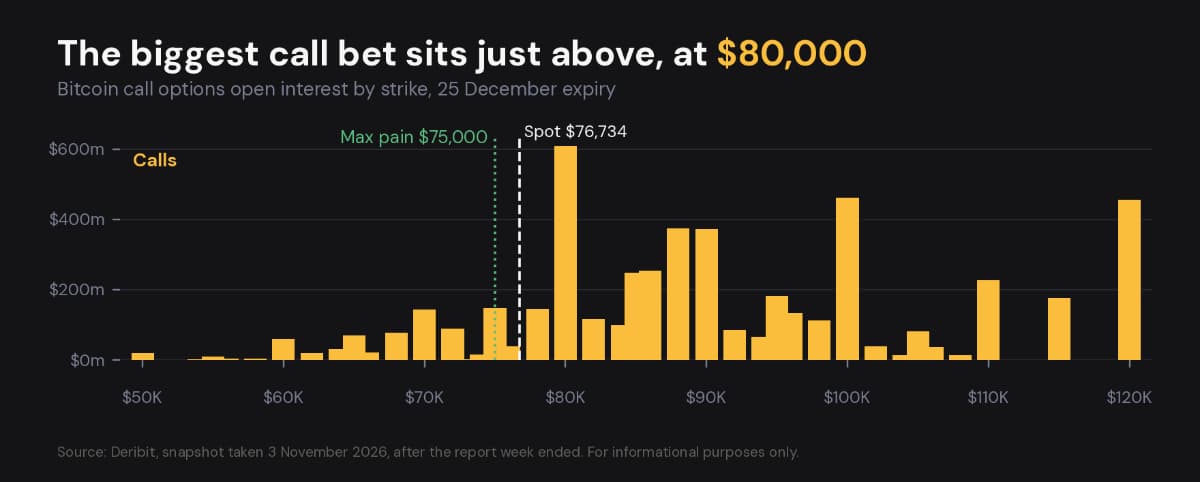
Bitcoin call options open interest by strike, 25 December expiry
Put protection is stacked lower, with the largest block at $60,000, and max pain sits at $75,000.
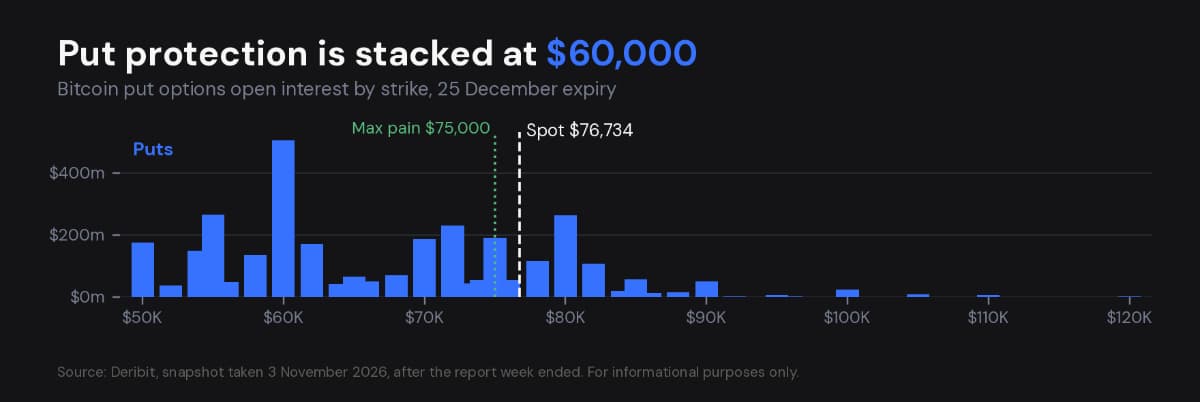
Bitcoin put options open interest by strike, 25 December expiry
In simple words. Some traders are borrowing to bet on a bounce, which can backfire badly if prices keep falling. Others are paying well above normal to insure against a deeper drop.
Hash rate, the computing power securing Bitcoin, averaged a record 1,064.5 EH/s, and mining difficulty rose 5.54%, making it harder for miners to earn coins. Miner revenue fell 6.6% to $258.4 million, so miners are working harder for less. The NVT Signal, market value divided by the value moving on-chain, fell to 23.4 by 27 October, just above the bottom of its usual two-year range of 23.0 to 34.7. Price is not stretched against network use.
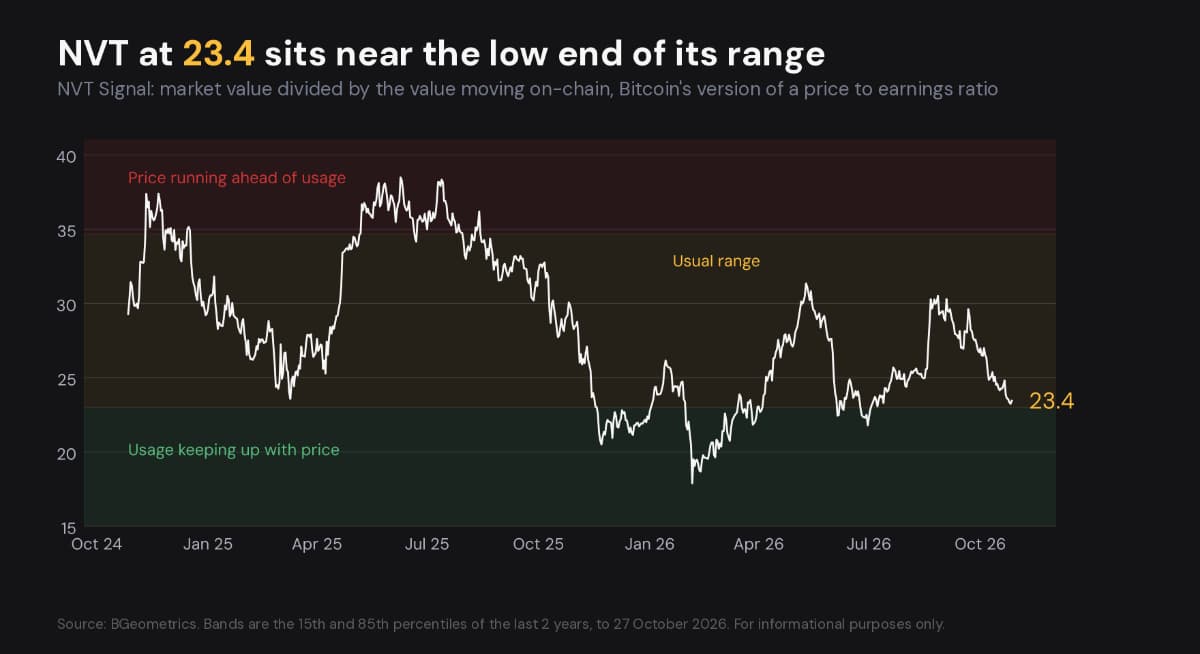
NVT Signal with usual range bands
The pressure came from outside. The US Federal Reserve held rates at 3.75% to 4.00% on 28 October in a 10-to-2 vote, with two members wanting a hike, and markets still expect one in December. Core inflation sits at 2.6%. Then on 30 October, Intel fell nearly 29%, its worst day on record, and the Nasdaq dropped more than 2%. Bitcoin hit its weekly low the same day, trading like a tech stock rather than a hedge.
In simple words. The Bitcoin network has never had more computing power protecting it. The price is being pushed around by stock market fear, not by a problem with Bitcoin itself.
The old floor is now the first ceiling, and the next floor is only 3% below the close.
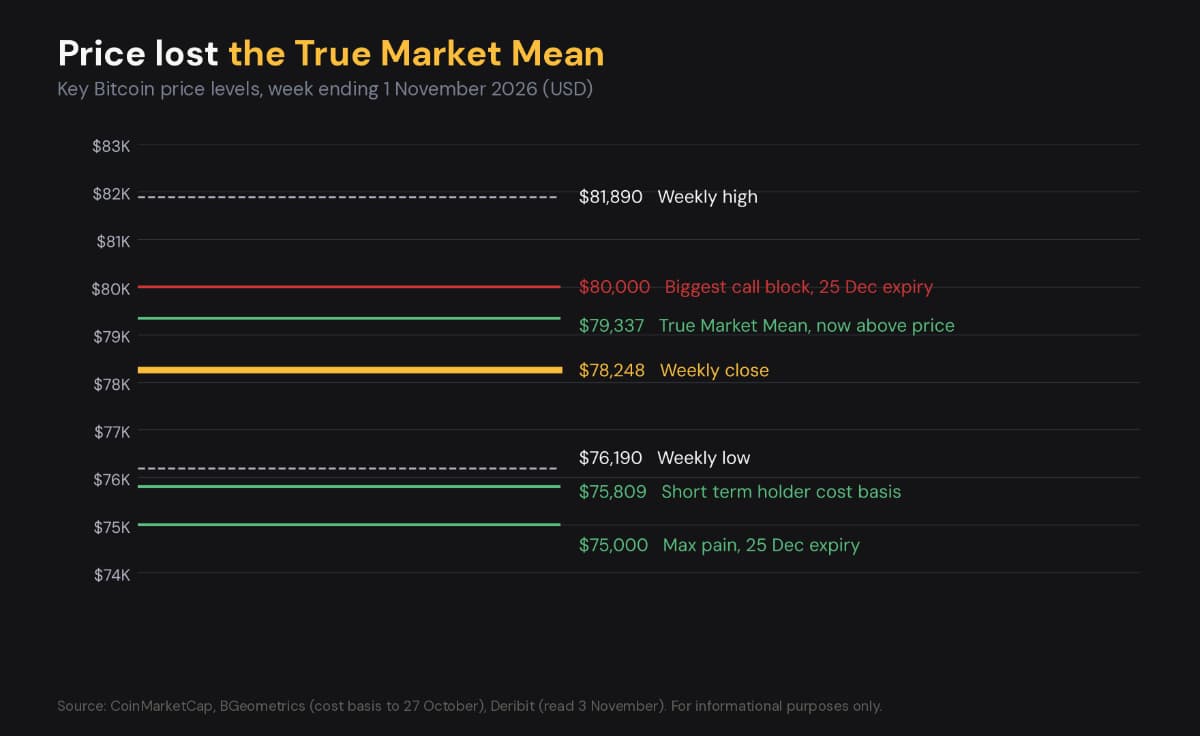
Key Bitcoin price levels, week ending 1 November 2026
Level | Price (USD) | Why it matters |
|---|---|---|
Resistance | $81,890 | This week’s high |
Resistance | $80,000 | Largest call block for the 25 December expiry |
Resistance | $79,337 | True Market Mean, lost this week |
Weekly close | $78,248 |
|
Support | $76,190 | This week’s low, set on 30 October |
Support | $75,809 | Short-term holder cost basis |
Support | $75,000 | Max pain for the 25 December expiry |
Scenario | Trigger | Next level |
|---|---|---|
Bull case | ETF buying returns and a weekly close back above $79,337 | $81,890, then the week 42 high of $84,249 |
Base case | Price holds between $75,809 and $79,337 while fund flows stay negative | A choppy range around the cost levels |
Bear case | A weekly close under $75,809 | $72,000, the next large put block, as recent buyers fall into loss |
In simple words. Buyers need to win back about $79,300 to repair the damage. Sellers will test about $75,800, and below that the next real support is some way down.
At about ₹94.9 to the dollar, Bitcoin’s close equals roughly ₹74.3 lakh, down from ₹77.9 lakh at the end of week 42. The rupee hardly moved, so Indian holders lost about the same 4.6% as dollar holders.
The Binance hack is a reminder that an exchange account and a wallet are not the same thing. An exchange holds the keys to your coins for you, so your coins are only as safe as its security. With a self-custody wallet, you hold the keys yourself, so the risk is keeping them safe. Exchanges serving Indian users must register with FIU-IND, the Financial Intelligence Unit, under the Prevention of Money Laundering Act, but that registration covers anti-money-laundering checks, not protection against hacks.
Tax is unchanged. VDAs (Virtual Digital Assets, the legal term for crypto, tokens and NFTs) continue to be taxed at a flat 30% plus 4% cess on gains, the rule formerly in Section 115BBH, now carried into the Income-tax Act, 2025. The 1% TDS (tax deducted at source, withheld automatically on each transfer), formerly Section 194S, now sits in Section 393(1) of the new Act from 1 April 2026, for most payers above ₹10,000 a year. Crypto losses cannot be set off against any other income, not even other crypto gains, and cannot be carried forward. Someone who bought one Bitcoin at the week 42 close and sold at this week’s close would be down about ₹3.6 lakh, with no tax benefit from that loss.
In simple words. Indian holders lost about 4.6% in two weeks, the same as in dollar terms. A crypto loss in India cannot cut your tax on any other gain.
Sources: BGeometrics, CoinMarketCap, Token Terminal, mempool.space, OKX, Deribit, SoSoValue and KuCoin, CryptoSlate, CoinCentral, CoinDesk, Wikipedia, Bitcoin News Digest, HackerNoon, Political.org, CoinAlertNews, Candour Legal, TDSMAN and MTFX.
India Crypto Research operates independently. The information presented herein is intended solely for educational and informational purposes and should not be construed as financial advice. Before making any financial decisions, it's essential to undertake your own thorough research and analysis. If you're uncertain about any financial matters, we strongly recommend seeking guidance from an impartial financial advisor.


