1. What Is Dogecoin Mining?
2. How Is a Dogecoin Block Created?
3. How Long Does It Take?
4. What Is the Reward?
5. How Much Electricity Does It Use?
6. Is Dogecoin Mining a Lottery?
7. Where Does Mining Pay?
8. Where Does Dogecoin Mining Go From Here?

A new block every minute: Dogecoin targets one block every 60 seconds, ten times faster than Bitcoin, and re-tunes its difficulty after every single block.
Fixed pay, no halving: each block pays 10,000 DOGE plus fees, forever. That adds about 14.4 million DOGE a day and 5.26 billion a year, with no supply cap.
It really is a lottery: every hash is a ticket. A single top machine mining alone would wait about 86 days on average for one block, which is why almost everyone joins a pool.
Power price decides profit: at today’s DOGE price of $0.0553, one modern miner covers its electricity only where power costs less than about 8.4 US cents (≈ ₹7.4) per kWh.

 Part of a series
Dogecoin was created in December 2013 as a joke based on the Shiba Inu “Doge” meme. Thirteen years later, its network runs on industrial machines that together make about 2.5 quadrillion guesses every second, and it produces a block roughly once a minute. It works much like Bitcoin, but it uses a different algorithm, so it needs different mining hardware. How those blocks are made, what they cost and who gets paid decides whether mining Dogecoin makes sense anywhere.
Dogecoin, like Bitcoin, uses Proof of Work (PoW). Miners compete to solve a puzzle that can only be solved by brute-force guessing, and the first to solve it adds the next block of transactions to the chain. This does three jobs at once: it confirms payments, it secures the ledger (rewriting history would mean redoing all that work), and it creates new coins, because the block reward is the only way new DOGE comes into existence.
Dogecoin’s puzzle uses the Scrypt algorithm, which it inherited from Litecoin via an earlier coin called Luckycoin. Scrypt is memory-hard: every guess must read and write a block of memory, rather than just doing arithmetic as Bitcoin’s SHA-256 algorithm does. Because the two algorithms are different, Bitcoin mining machines cannot mine Dogecoin.
Table 1: Dogecoin mining at a glance
Feature | Detail | What it means |
|---|---|---|
Algorithm | Scrypt (N=1024, r=1, p=1) | Only Scrypt machines can mine it |
Target block time | 60 seconds | About 1,440 blocks a day |
Block reward | 10,000 DOGE + fees | Fixed since block 600,000 (2015) |
Difficulty change | Every block (DigiShield) | Speed stays steady as miners come and go |
Merged mining | With Litecoin, since Sep 2014 | One machine earns both coins |
Network hash rate | ≈ 2.47 PH/s (23 Nov 2026) | Down from a record 8.72 PH/s in Feb 2026 |
Supply cap | None | Dogecoin is never “mined out” |
Since September 2014, Dogecoin has accepted merged mining, technically called AuxPoW (Auxiliary Proof of Work). A miner works on a Litecoin block that also carries a reference to a Dogecoin block. Dogecoin’s target is easier to hit, so many guesses that fail for Litecoin still win a Dogecoin block. The same electricity earns both coins, and today Dogecoin supplies roughly 87% of a Scrypt miner’s income.
Every block goes through the same cycle, roughly once a minute:
1. Collect. The miner gathers pending transactions and checks that each one is validly signed and not spent twice.
2. Pay yourself. The first transaction, called the coinbase, pays the 10,000 DOGE reward and all fees to the miner’s own address.
3. Fingerprint. All the transactions are hashed together into a single 32-byte summary called the Merkle root. Changing any transaction changes it.
4. Build the header. An 80-byte header holds the previous block’s hash (the link that makes it a chain), the Merkle root, a timestamp, the difficulty target and a counter called the nonce.
5. Guess. The machine runs the header through Scrypt. If the result is below the target, it wins. If not, it changes the nonce and tries again, billions of times a second.
6. Broadcast. The winner sends out the block, every node checks it independently, and the race restarts on top of it.
Blocks are capped at 1 MB. With an average transaction of about 250 bytes, one block can hold around 4,000 payments, far more than the network usually needs, which keeps fees very low.
Dogecoin aims for one block every 60 seconds, compared with 10 minutes for Bitcoin and 2.5 minutes for Litecoin. In practice, the long-run average runs slightly slow, at about 63 seconds.
To hold that pace, the network adjusts its difficulty, meaning how hard the puzzle is, after every block, using an algorithm called DigiShield. It has been in place since block 145,000 in March 2014. Bitcoin adjusts only every 2,016 blocks. Per-block tuning matters for Dogecoin because miners switch between Scrypt coins often: hash rate fell by more than 70% between February and November 2026, yet blocks still kept arriving close to once a minute.
Individual blocks vary widely, because finding one is a matter of chance (see Section 6). Figure 1 shows how often a block arrives within each time window.
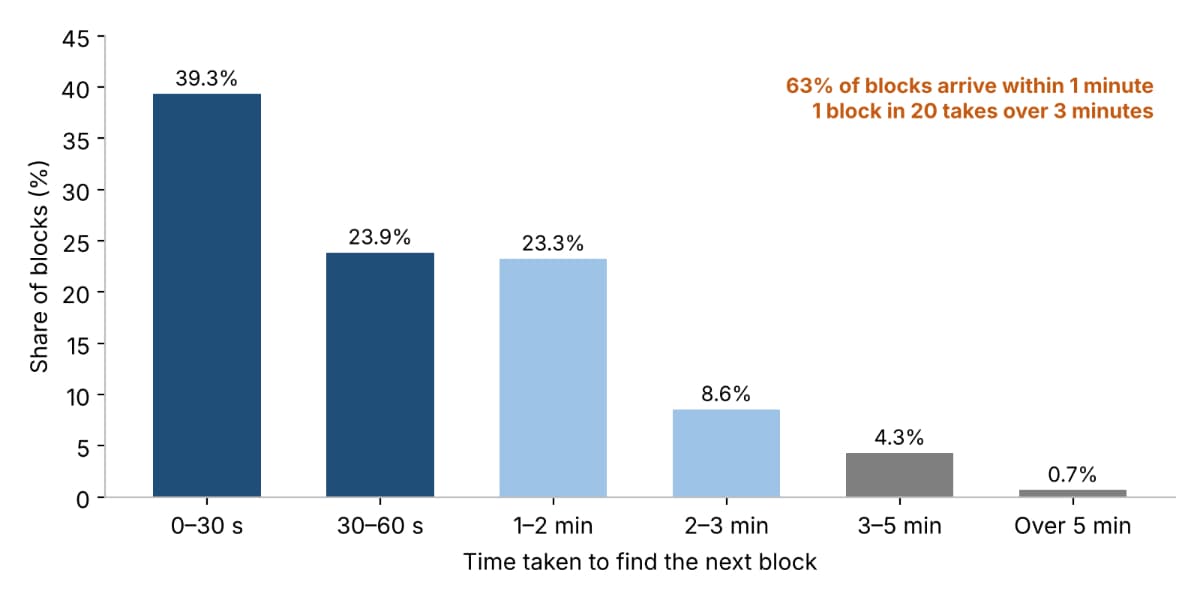
Figure 1: Share of Dogecoin blocks found within each time window, at a 60-second average
Newly mined coins can’t be spent straight away. A mined reward must wait 240 further blocks, about four hours, before it can be moved. This rule, called coinbase maturity, protects against blocks that are later dropped from the chain.
Every valid block pays its finder 10,000 newly created DOGE plus the transaction fees inside it. Fees are tiny, well under 1% of most miners’ income. Unlike Bitcoin, there is no halving, so the reward will not shrink. At 1,440 blocks a day, that’s about 14.4 million DOGE a day and 5.26 billion a year. Because the number of new coins is fixed, the percentage inflation rate falls slowly each year as total supply grows.
It wasn’t always this way. For its first 145,000 blocks, Dogecoin paid a random reward, chosen by a random-number generator between zero and a set maximum. Large pools gamed this by mining only when high rewards were likely, so the developers switched to fixed rewards that halved every 100,000 blocks, then settled on a permanent 10,000 DOGE from block 600,000 in 2015. The original cap of 100 billion coins was dropped in 2014.
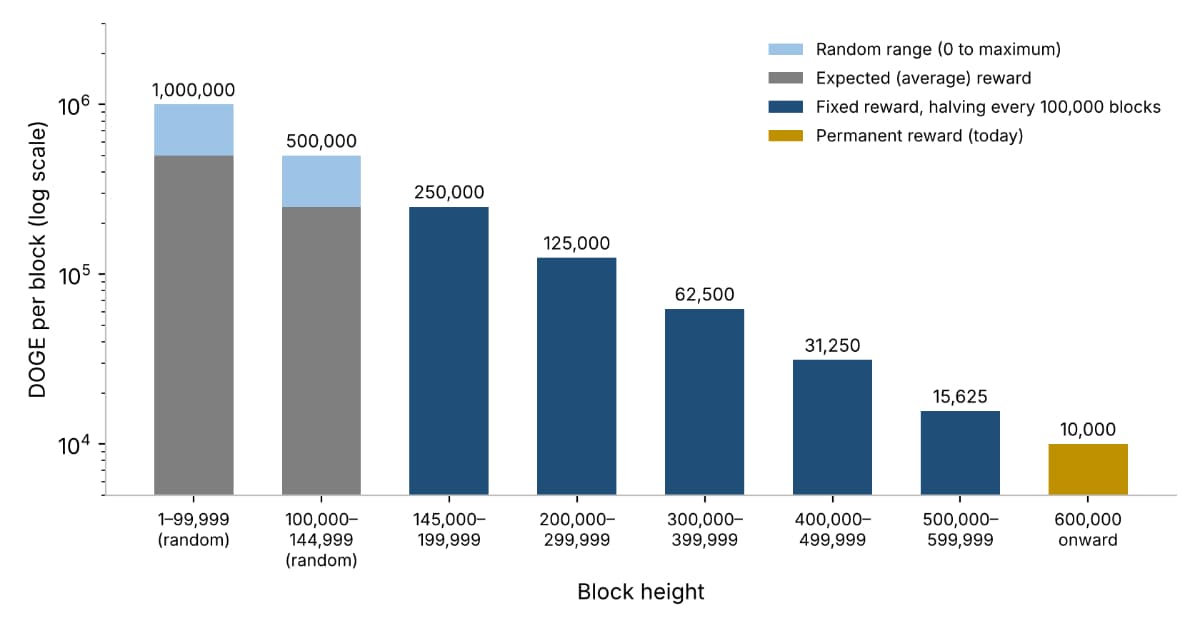
Figure 2: Dogecoin block reward by block height, 2013 to today (log scale)
Only purpose-built Scrypt ASICs (application-specific chips designed to do one job) can mine Dogecoin profitably. Graphics cards can technically join in, but they earn close to nothing after power costs. Table 2 compares current Bitmain models.
Table 2: Current Scrypt mining machines
Machine | Hash rate | Power | Efficiency | Cooling |
|---|---|---|---|---|
Antminer L9 | 17 GH/s | 3,570 W | 0.210 J/MH | Air |
Antminer L11 | 20 GH/s | 3,680 W | 0.184 J/MH | Air, single-phase |
Antminer L11 Hyd 6U | 33 GH/s | 5,676 W | 0.172 J/MH | Water |
Antminer L11 Hyd 2U | 35 GH/s | 5,775 W | 0.165 J/MH | Water, three-phase |
One air-cooled L11 running all day uses about 88 kWh, several times a typical Indian household’s daily use. Scaled up to the whole network, that gives an upper estimate of about 455 MW of continuous power, or about 7,600 kWh per block.
How we calculated this: network power = 2,470,000 GH/s × 184 W per GH/s (L11 efficiency) ≈ 455 MW. Energy per block = 455 MW × 60 s ≈ 7,600 kWh, or about 0.76 kWh per DOGE. Per year ≈ 4 TWh. This assumes every machine is an L11. Older machines use more, so treat it as an upper bound. Because of merged mining, the same power also secures Litecoin.
Independent estimates land in the same range. Digiconomist puts Dogecoin at about 2.9 TWh a year, similar to the electricity use of Mauritius. That is tiny next to Bitcoin’s roughly 190 TWh (Figure 3). Per-transaction figures are far less reliable, with published estimates ranging from 0.12 kWh to about 100 kWh, because miners burn the same power whether a block holds 10 payments or 4,000.
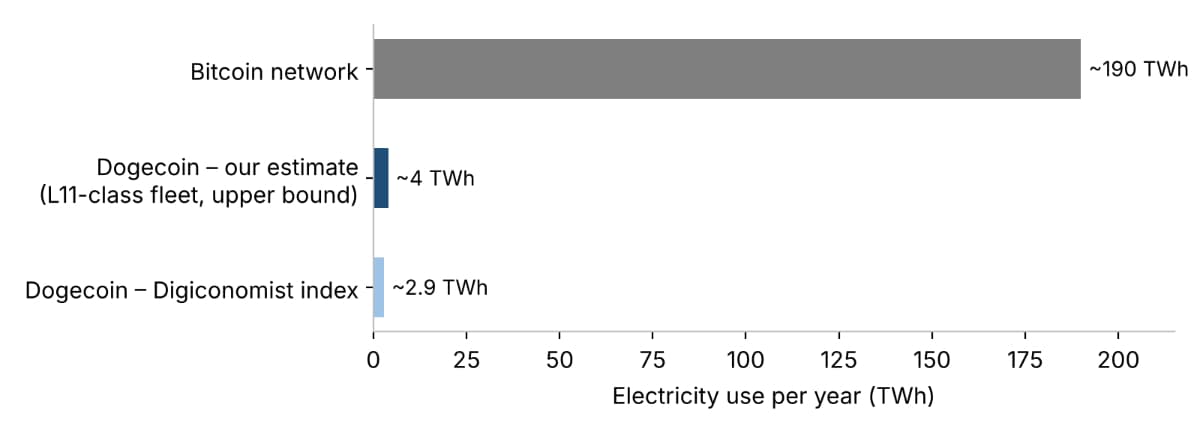
Figure 3: Estimated annual electricity use, Dogecoin vs Bitcoin
Yes. A Scrypt hash is effectively unpredictable, so there is no way to work out the winning nonce or get closer to it. Every guess has the same tiny chance, and failed guesses build no progress. A miner’s odds therefore equal its share of the total hash rate: control 1% of it and you’ll win about 1% of blocks over time, but never any particular block.
For one Antminer L11 mining alone, the chance of winning any given block is about 1 in 123,500. That works out to an average wait of 86 days, or a 1.2% chance on any single day. Figure 4 shows how slowly that certainty builds.
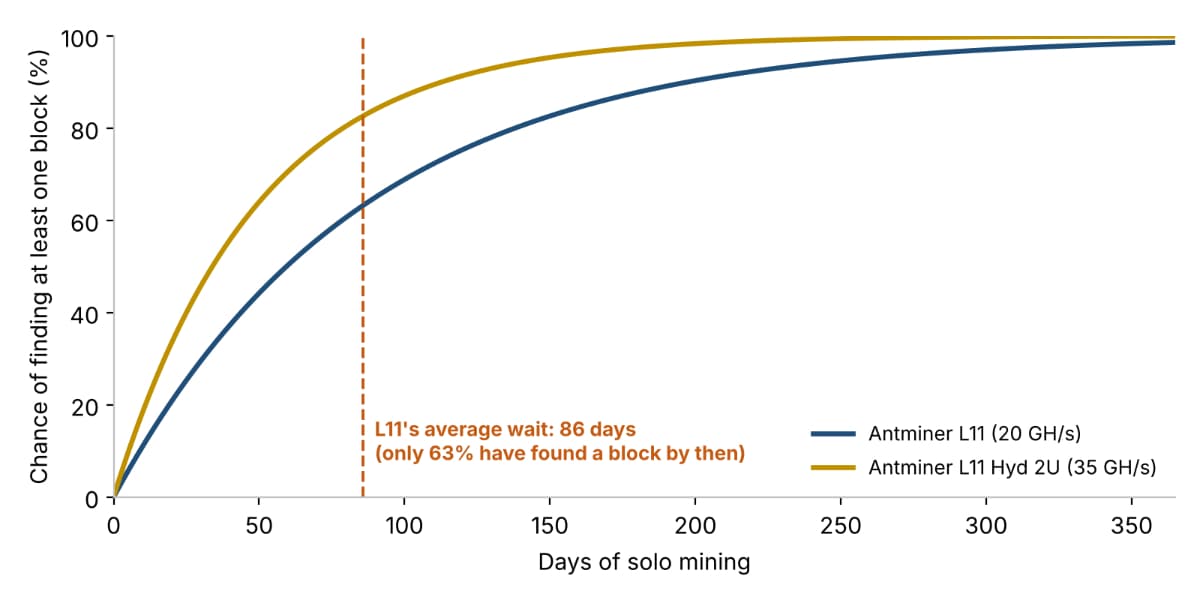
Figure 4: Chance a solo miner finds at least one Dogecoin block, by days mined (network at 2.47 PH/s)
Mining pools turn this lottery into a wage. Thousands of miners combine their machines and submit “shares”, easier partial solutions that prove how much work each one has done. When anyone in the pool finds a block, the reward is split according to shares. Pools usually charge 1–2% and pay out directly to the miner’s Dogecoin address.
Revenue is the same everywhere, but electricity costs are not. At today’s numbers, one L11 earns about 116.6 DOGE a day (about $6.45), or about $7.45 including merged-mined Litecoin. It uses 88.3 kWh of power to do this, so it breaks even at around 8.4 US cents per kWh. Figure 5 applies the same power prices used in our Bitcoin country report.
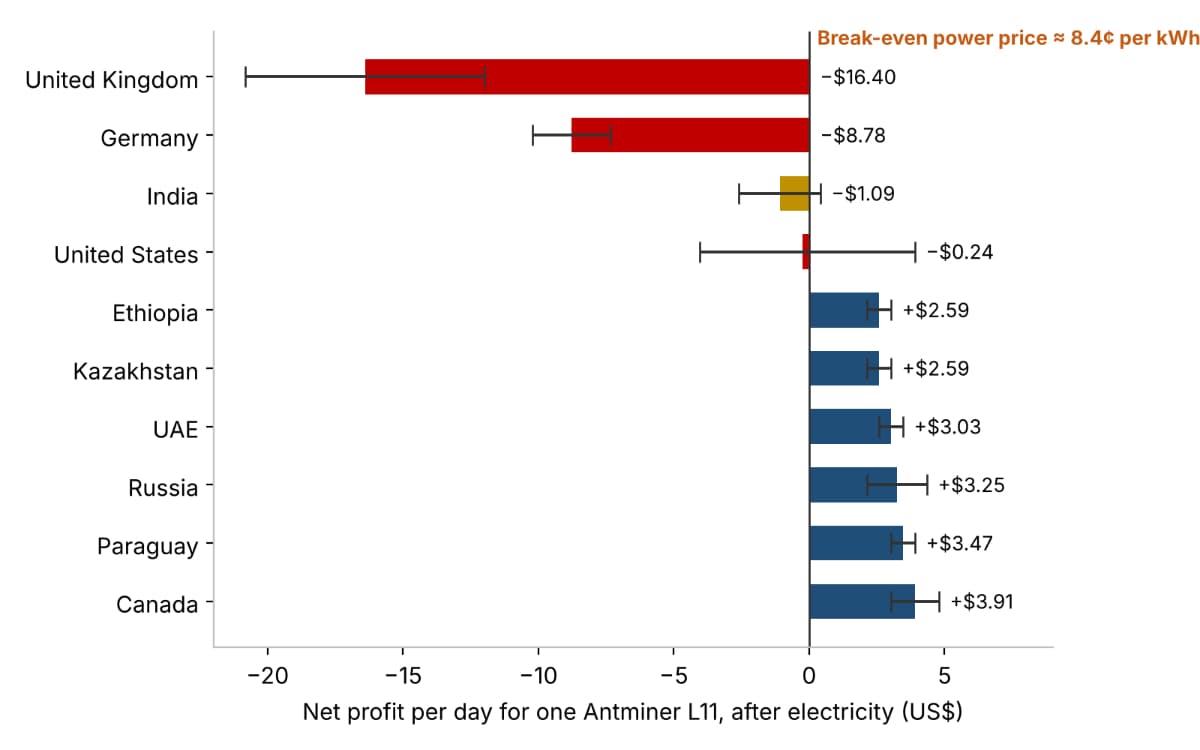
Figure 5: Daily net profit of one Antminer L11 after electricity, by country (bars show mid-range; lines show full range)
How we calculated this: income = 20 GH/s ÷ 2,470,000 GH/s × 14.4 million DOGE × $0.0553, grossed up for Litecoin (DOGE ≈ 86.6% of merged-mining income). Electricity = 88.3 kWh × local price. Excludes pool fees, machine cost, cooling and depreciation. Power prices and conversion (US$1 = ₹88) as in ICR’s Country Mining report, October 2026.
Miners in Canada, Paraguay, Russia, the UAE, Kazakhstan and Ethiopia clear the bar comfortably. US miners need below-average private power deals, while miners in Germany and the UK are priced out. Even the winners earn only $2.50–4 a day per machine, before paying off hardware that costs $3,000–16,000.
Margins are thin. DOGE trades at about $0.055, down from about $0.125 in January 2026, and hash rate has fallen from its record 8.72 PH/s in February to about 2.47 PH/s as weaker miners switched off. A lower hash rate means more coins for those who stay, but the price drop has outweighed that gain. New income sources, such as the Qubic network’s Dogecoin mining integration launched in April 2026, add competition rather than relief.
Keep an eye on three numbers: the price of DOGE, the network hash rate and your power tariff. The 10,000 DOGE reward will not change, so those three decide everything. For most Indian miners, the arithmetic does not work today.
Sources: Dogecoin Foundation (Dogepedia), EBSCO Research Starters, Dogecoin Core FAQ, CoinWarz (23 Nov 2026), Digiconomist, Bitmain and ICR Country Mining report (October 2026).
India Crypto Research operates independently. The information presented herein is intended solely for educational and informational purposes and should not be construed as financial advice. Before making any financial decisions, it's essential to undertake your own thorough research and analysis. If you're uncertain about any financial matters, we strongly recommend seeking guidance from an impartial financial advisor.