Why Isn’t Bitcoin Really Digital Gold Yet?
Why Doesn’t Scarcity Alone Decide How Markets Behave?
How Do Bitcoin and Gold Differ in Price Behaviour?
How Does Bitcoin’s Value Move Relative to Gold?
Why Don’t Bitcoin and Gold Move Together Consistently?
What Triggers Drive Bitcoin and Gold Differently?
How Do Different Market Environments Affect Bitcoin and Gold?
What Does the Bitcoin-Gold Relationship Really Tell Us?
FAQs

 Part of a series
People often call Bitcoin 'digital gold' because, like real gold, there is a limited supply and no government controls it. Both are seen as ways to protect against the weaknesses of fiat money.
However, Bitcoin and gold rarely behave in the same way. In recent times, gold has proven to be the ultimate 'financial bunker' during world conflicts, while Bitcoin has behaved more like a high-risk tech investment. They might share the same narrative, but they do not respond to market stress in the same way.
A useful companion read inside the crypto market itself is the Bitcoin dominance chart, which shows how investor risk appetite rotates between BTC and altcoins during exactly these kinds of stress events.
Both gold and Bitcoin have strictly limited supplies. Gold's limit comes from Earth's geology. Bitcoin’s limit comes from its digital code.
But markets care about demand too, not just supply. Because people buy gold for different purposes than they do with Bitcoin, the two assets end up behaving very differently when things get rocky in the economy.
Bitcoin and gold don't always move against each other. Over the long term, both have gained value historically, but their paths have differed sharply.
The key difference is in how they move. Gold is like a steady staircase, climbing slowly and calmly. Bitcoin is more like a rollercoaster, with steep climbs and sharp drops. Even when both gain value, they rarely do it together. This tells us that the two assets are not responding to the same forces at the same time.
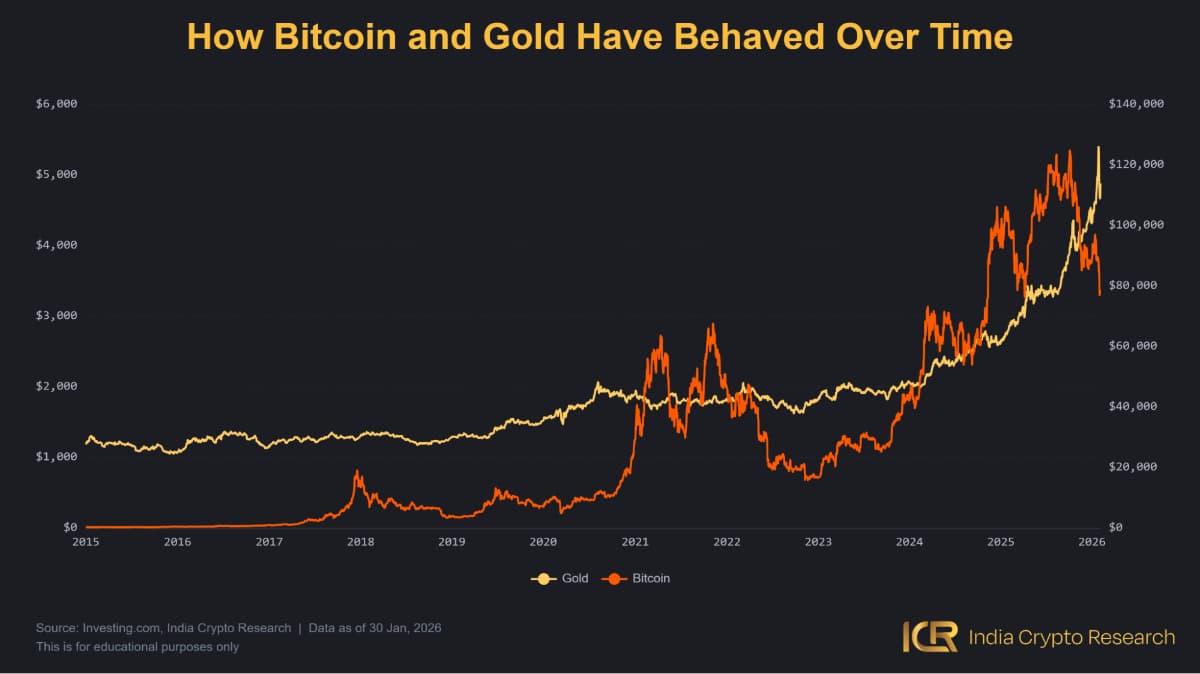
However, price charts only show outcomes. They do not explain the relationship itself. To understand that relationship, the comparison needs to be more direct.
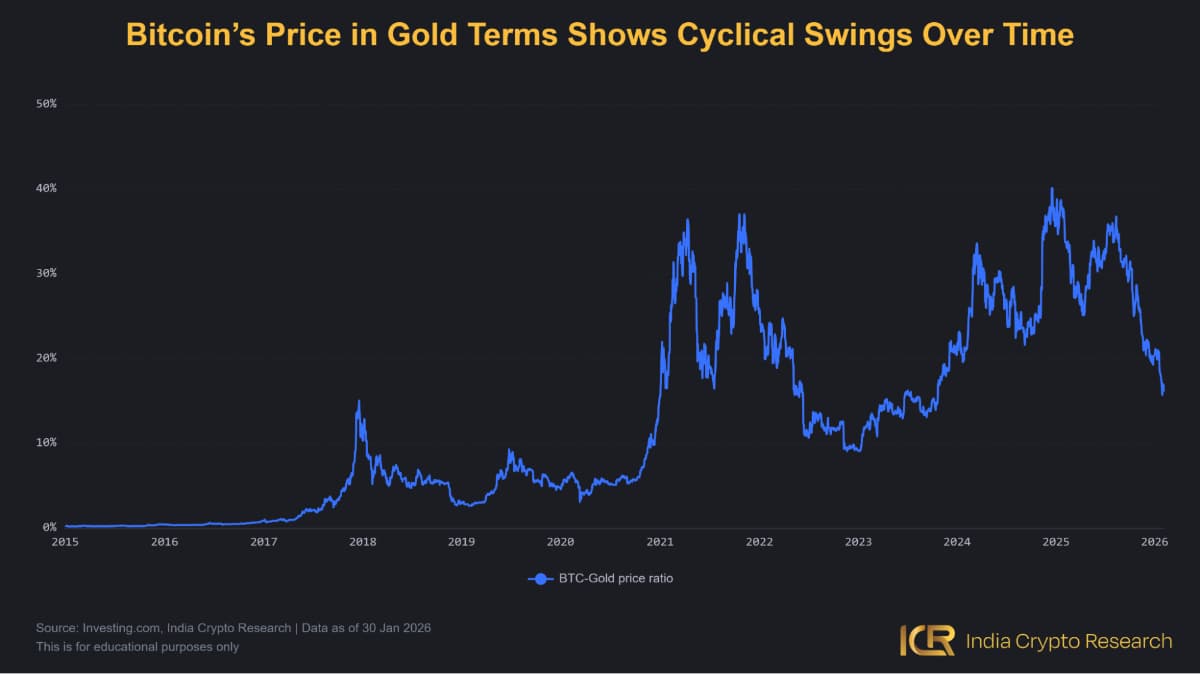
When we price Bitcoin in gold, we see how two of the world's rarest assets trade against each other, free from US dollar influence.
Bitcoin doesn't show a steady upward trend. Instead, it moves in cycles. It dramatically outperforms gold in short, intense bursts, then cools off for long stretches.
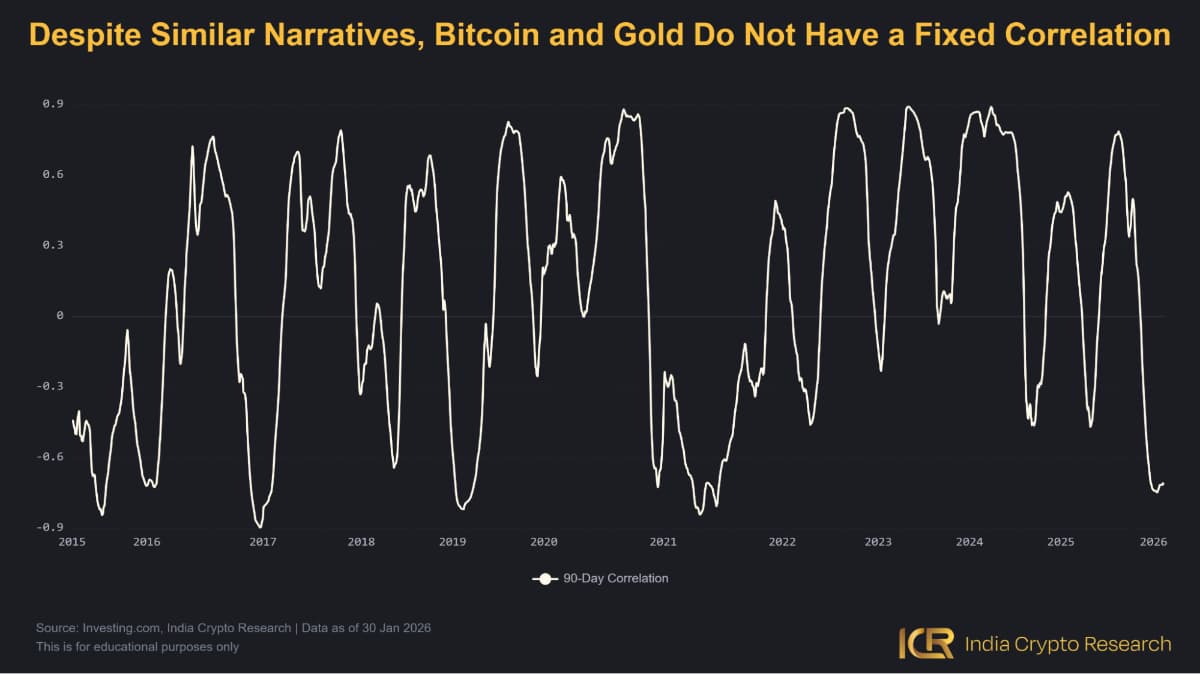
If Bitcoin were just digital gold, their prices would move steadily together. They don't. The 90-day rolling correlation between Bitcoin and gold goes up and down over time. Times when they align are short and uneven. Long periods of weak or negative correlation happen often.
The natural next question is why.
Bitcoin and gold respond differently to stress. Gold shines when people lose faith in currencies, institutions, or the money system. Its buyers focus on the long term and ignore short-term price swings.
Bitcoin reacts more to market shifts. Things like liquidity, capital access, regulations, and risk appetite matter most. These can change fast, and Bitcoin's price shows it.
When both types of concerns hit at once, Bitcoin and gold can move together for a while. When they don't, correlation drops. That's why any alignment is temporary.
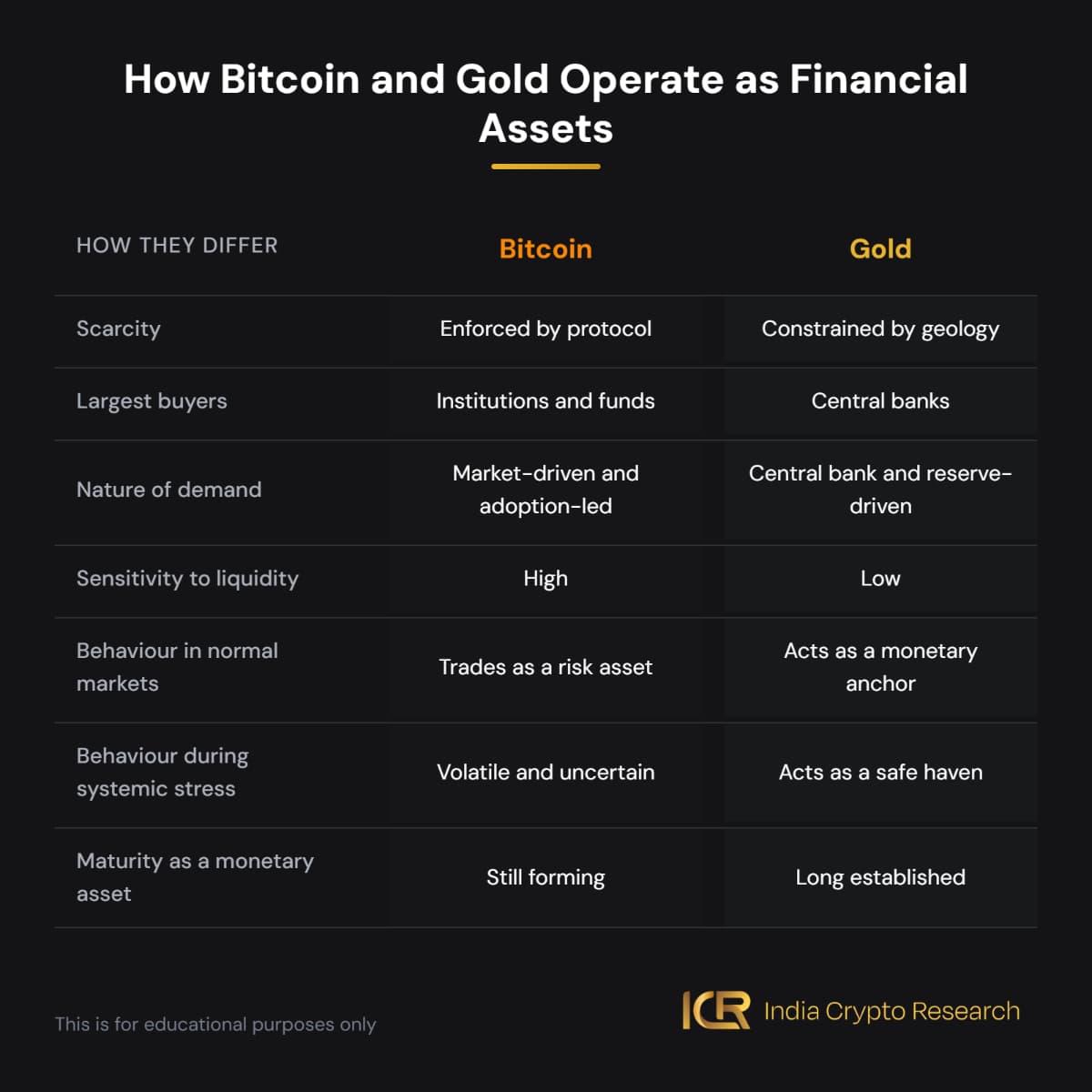
Instead of seeing Bitcoin and gold as fixed substitutes or opposites, think in terms of market environments.In normal times, gold acts like a steady monetary anchor. Bitcoin acts like a risk-sensitive asset. Their prices drift apart.
When liquidity expands and risk appetite grows, Bitcoin often outperforms sharply. Gold moves more slowly. Performance shifts, but Bitcoin isn't replacing gold.
When confidence in the financial system is tested, gold's role stands out. Bitcoin gets more volatile and unpredictable. It might align briefly sometimes. Often it doesn't. As market environments change, the relationship between Bitcoin and gold shifts with them.
Bitcoin and gold don't always move together because they respond to different pressures. Gold’s demand is embedded in central banks that already exist. Bitcoin’s demand is still forming, shaped by adoption, regulation, and market structure.
Until those forces stabilise, Bitcoin’s price behaviour will remain more cyclical than gold’s, even though their narratives overlap.
India Crypto Research operates independently. The information presented herein is intended solely for educational and informational purposes and should not be construed as financial advice. Before making any financial decisions, it's essential to undertake your own thorough research and analysis. If you're uncertain about any financial matters, we strongly recommend seeking guidance from an impartial financial advisor.