
What actually happened?
What are the Fed, inflation and jobs data doing to Bitcoin?
How did Bitcoin move around each IPO?
Why does a stock market listing pull money out of crypto?
Why did Nvidia’s CEO exit hit crypto so hard?
Crypto found its own way to trade the IPOs
What does this mean for Indian investors?
Dates to watch

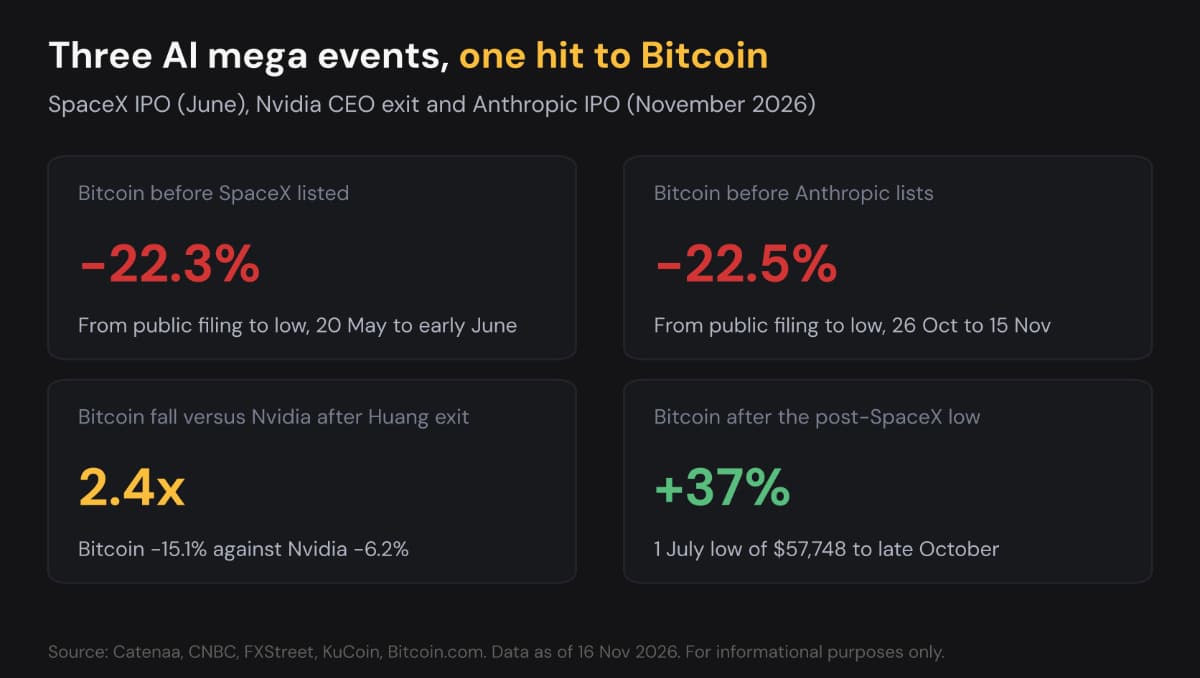
The US Federal Reserve is raising rates again. It hiked in September, and markets see a 77% to 90% chance of another hike on 9 December.
Bitcoin fell about 22% in the weeks before SpaceX listed in June, and about 22% again before Anthropic lists this week.
The selling peaks in the final weeks before a listing, when big investors place orders and need cash. Most of it left through Bitcoin ETFs.
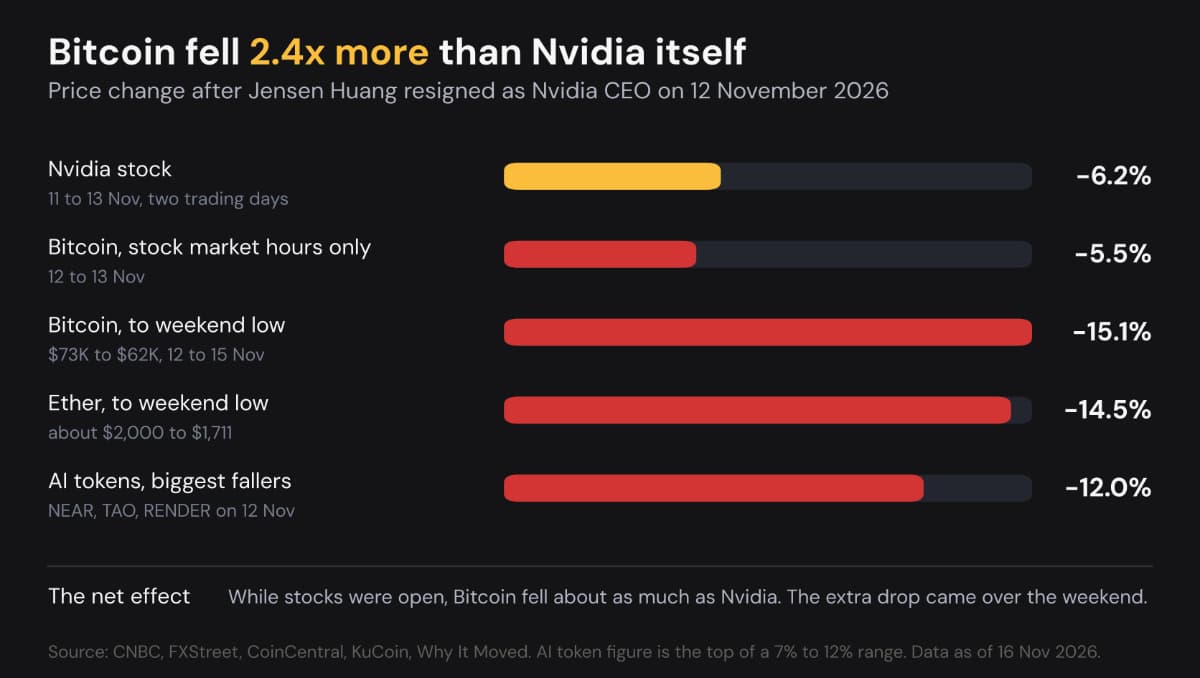
Nvidia CEO Jensen Huang resigned on 12 November. Nvidia stock fell about 6% over two days, while Bitcoin fell 15% by the weekend.
After SpaceX listed, Bitcoin hit its low 19 days later and then rose about 37%.

 Part of a series
Bitcoin is trading around $65,000, about 46% below its October 2025 all-time high of $126,000. Most explanations blame panic. That may be partly true, but the bigger picture is rising US interest rates, plus three events on Wall Street that happened at the same time and pulled money out of crypto.
The four numbers that sum up the story:
SpaceX went public in June. Elon Musk’s rocket and AI company raised about $75 billion at $135 a share in its IPO (initial public offering, the first time a company sells shares to the public), the biggest IPO in history.
Anthropic is going public this week. The company behind Claude made its filing public on 26 October and set a price range of $70 to $78 a share on 10 November. It plans to raise up to $64.4 billion, price the shares on 18 November and start trading on Nasdaq under the ticker ANT on 19 November.
Nvidia lost its founder CEO. Jensen Huang resigned on 12 November after a board investigation into his links with an alleged Chinese spy. Nvidia makes the chips that power the AI boom, so its stock is the market’s main AI barometer.
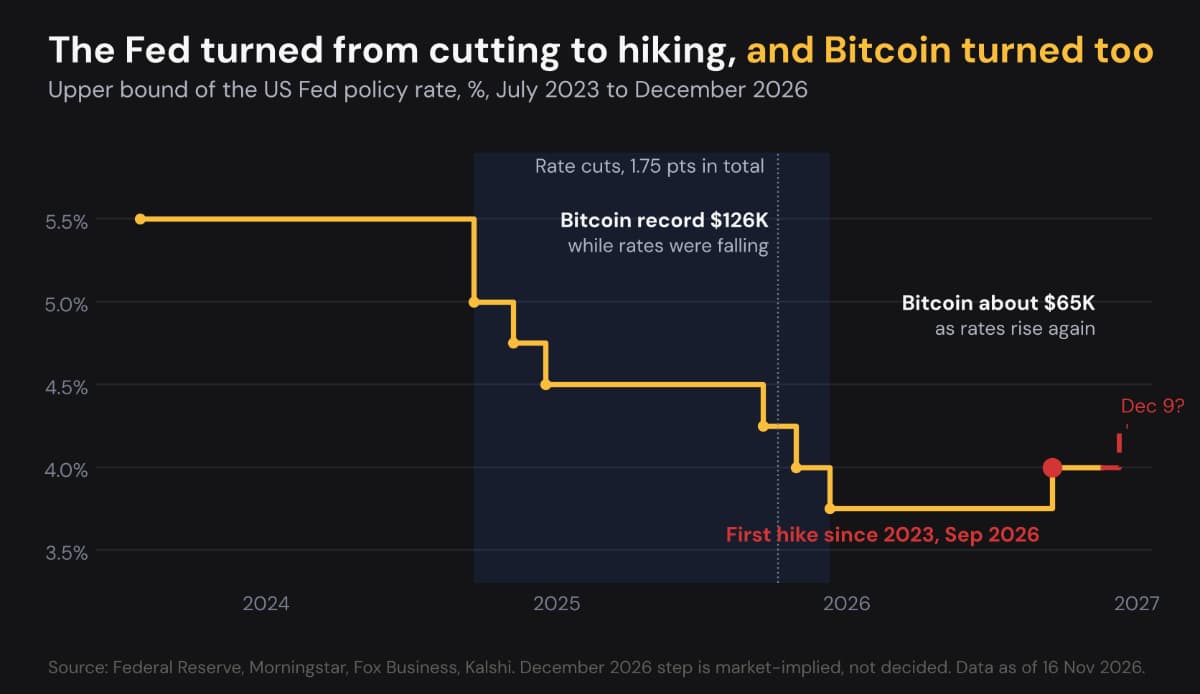
Before any IPO or CEO headline, the biggest weight on Bitcoin is US interest rates. The Federal Reserve (the Fed, America’s central bank) cut rates in 2025 as Bitcoin hit record highs, and is raising them again in 2026.
The Fed cut its policy rate by 1.75 percentage points between September 2024 and December 2025, to a range of 3.50% to 3.75%. It held there at its first five meetings of 2026. On 16 September, under new Chair Kevin Warsh, it raised rates to 3.75% to 4.00%, its first hike since July 2023. Fed officials project about 4.1% by the end of 2026, which implies one more hike. The chart shows how the direction of rates and Bitcoin turned together.
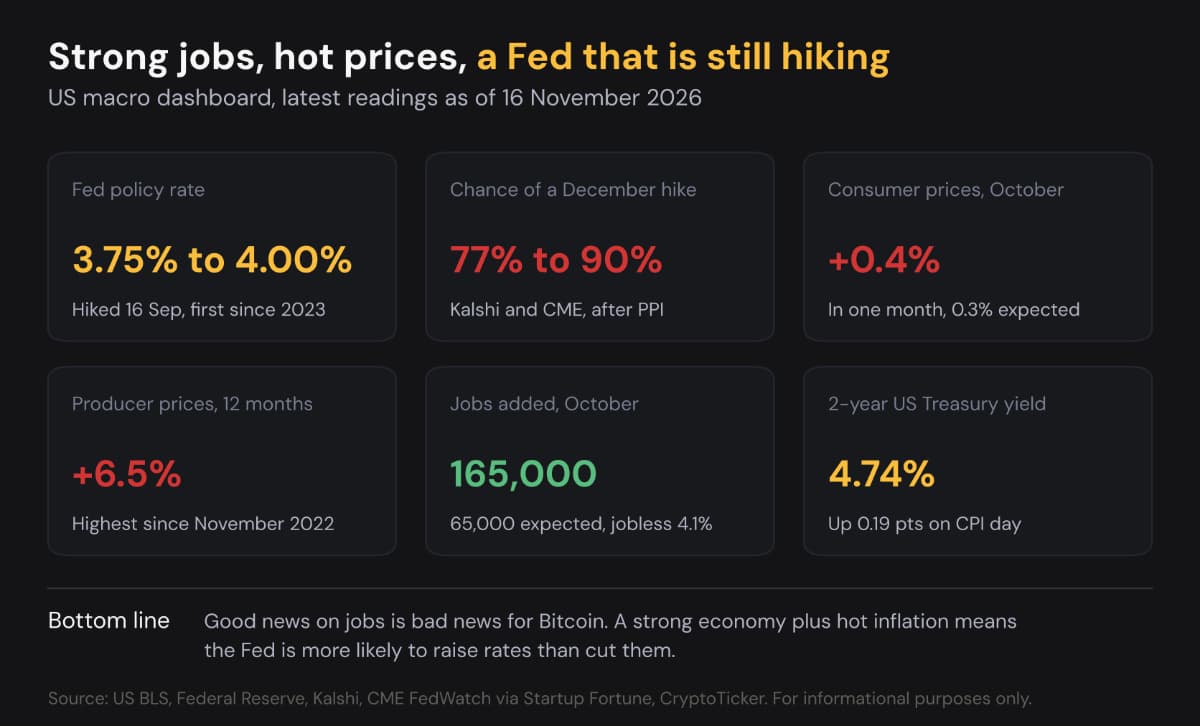
Inflation means rising prices across the economy. US consumer prices (CPI) rose 0.4% in October, above the 0.3% expected, and core prices, which leave out food and fuel, rose 0.3% against 0.2% expected. There is no official yearly figure for October, because the 2025 government shutdown stopped data collection. The last yearly reading was 3.7% in September, almost double the Fed’s 2% target.
Producer prices (PPI), what businesses pay before goods reach shops, rose 6.5% over the 12 months to October, the biggest jump since November 2022. Producer prices tend to reach shop prices a few months later. After that report, CME FedWatch put the chance of a December hike near 90%.
The US added 165,000 jobs in October against 65,000 expected, and unemployment fell to 4.1%. For the Fed, strong jobs mean the economy can handle higher rates, so there is no need to cut rates to protect jobs. Wages rose only 3.1% over the year, slower than prices, so families are still squeezed.
1. Bitcoin pays nothing, while bonds now pay a lot. After the CPI report, the 2-year US Treasury yield jumped 0.19 points to 4.74%, its biggest one-day rise since April 2025, and the 10-year sits near 5%. A safe 5% makes a zero-interest asset harder to justify.
2. Borrowing gets more expensive. Many crypto traders use borrowed money. Higher rates raise that cost, so bets get smaller or are forced shut sooner.
3. Less spare cash in crypto. Stablecoins are tokens pegged to the US dollar and act as crypto’s cash. Their supply shrank by $14.2 billion in 30 days, leaving fewer dollars on exchanges waiting to buy.
When news of an IPO first breaks, Bitcoin doesn’t usually fall. The final weeks before the listing are what hurt. When SpaceX IPO talk began in December 2025, Bitcoin was near $90,000. When Anthropic IPO talk began in March 2026, it was near $66,600. Both times, the damage came between the public filing and the listing.
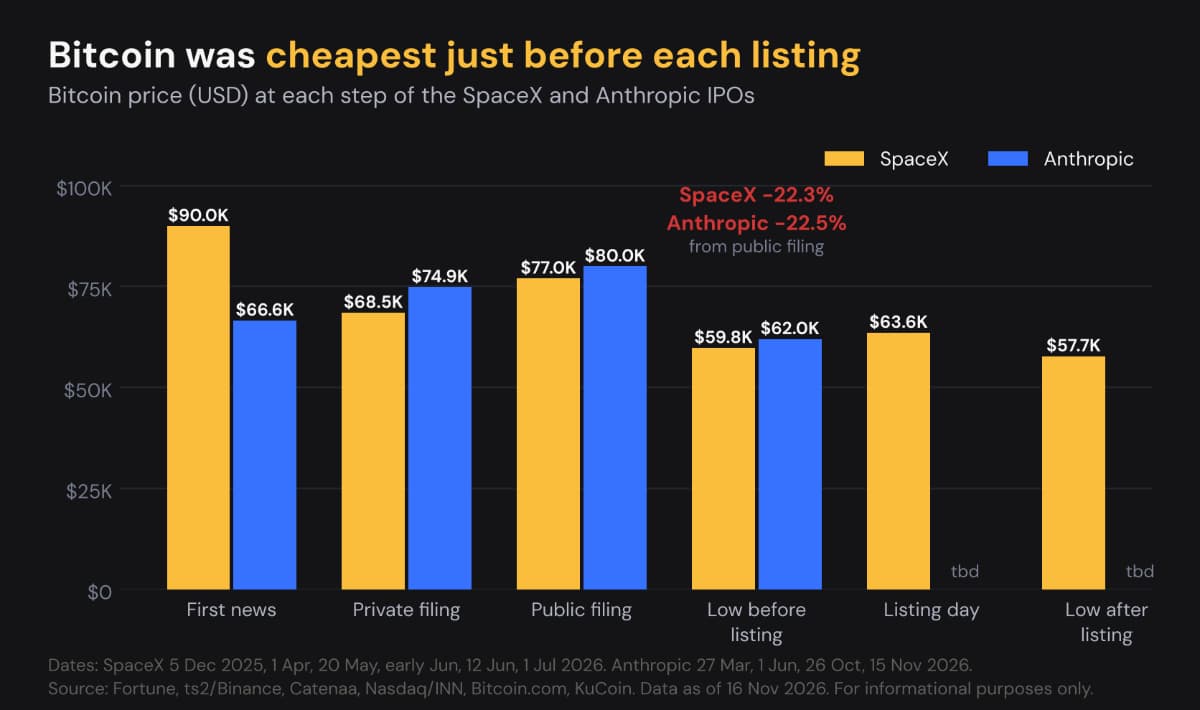
The public filing (the S-1, the document a company files with the US regulator, the SEC, to sell shares) is the moment an IPO becomes real, and banks start collecting orders soon after. The next chart lines up both IPOs from their filing day, using actual dollar prices.
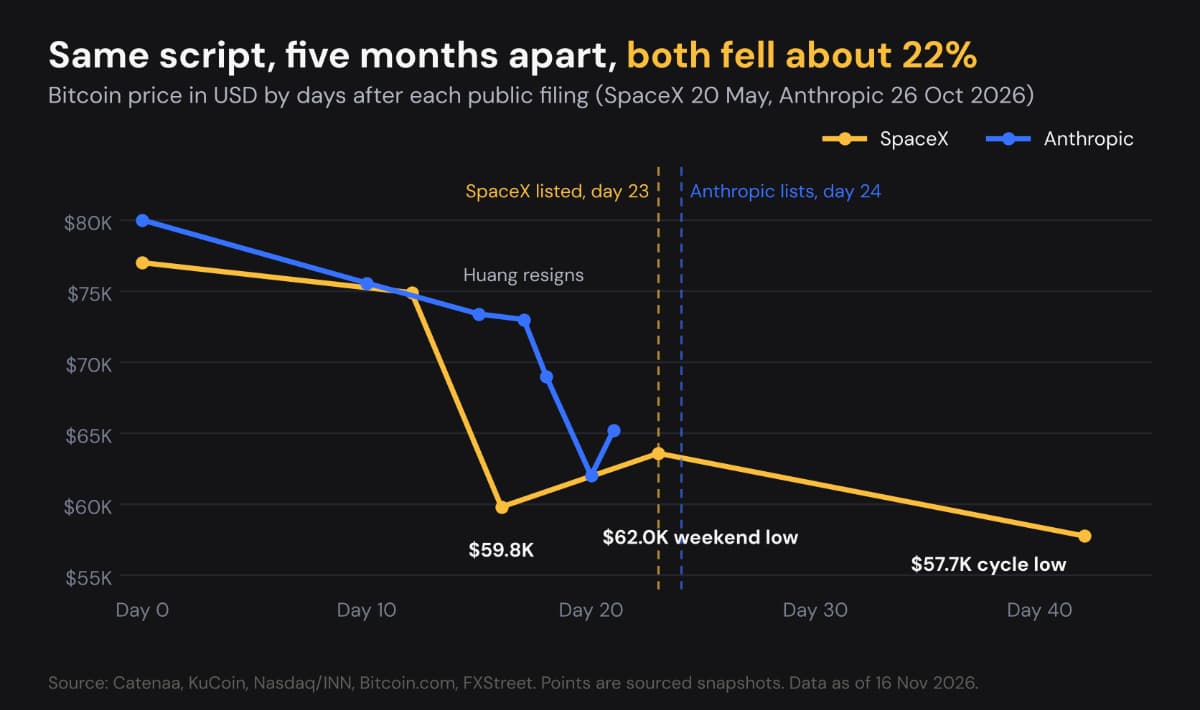
The two paths nearly match. Bitcoin fell from $77,000 to $59,800 in the 16 days after SpaceX filed, and from $80,000 to $62,000 in the 20 days after Anthropic filed. For SpaceX, Bitcoin’s final low came 19 days after the listing, at $57,748 on 1 July. It then climbed about 37% by late October.
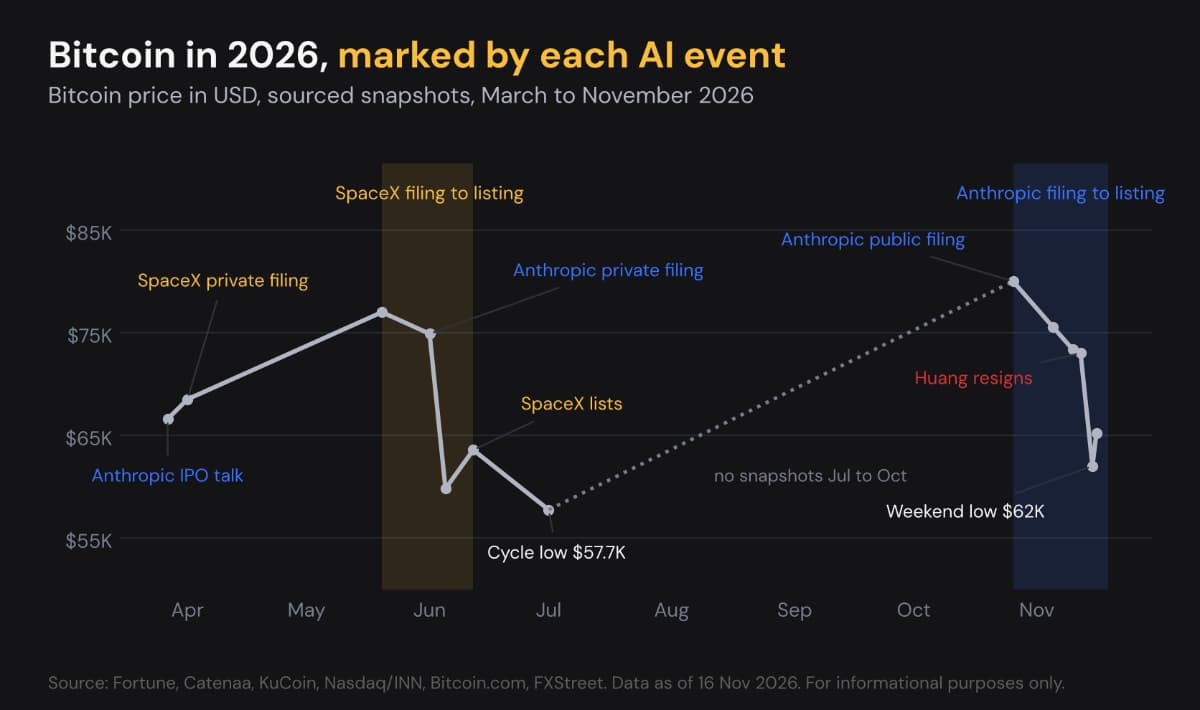
The Anthropic window is only 21 days old. If it follows the SpaceX script, Bitcoin’s bottom may still be ahead, close to the Fed meeting on 9 December.
In the short run, the money available for risky bets is limited. A giant IPO needs tens of billions of dollars within a few weeks, and some of it comes out of Bitcoin. The flow below shows how.
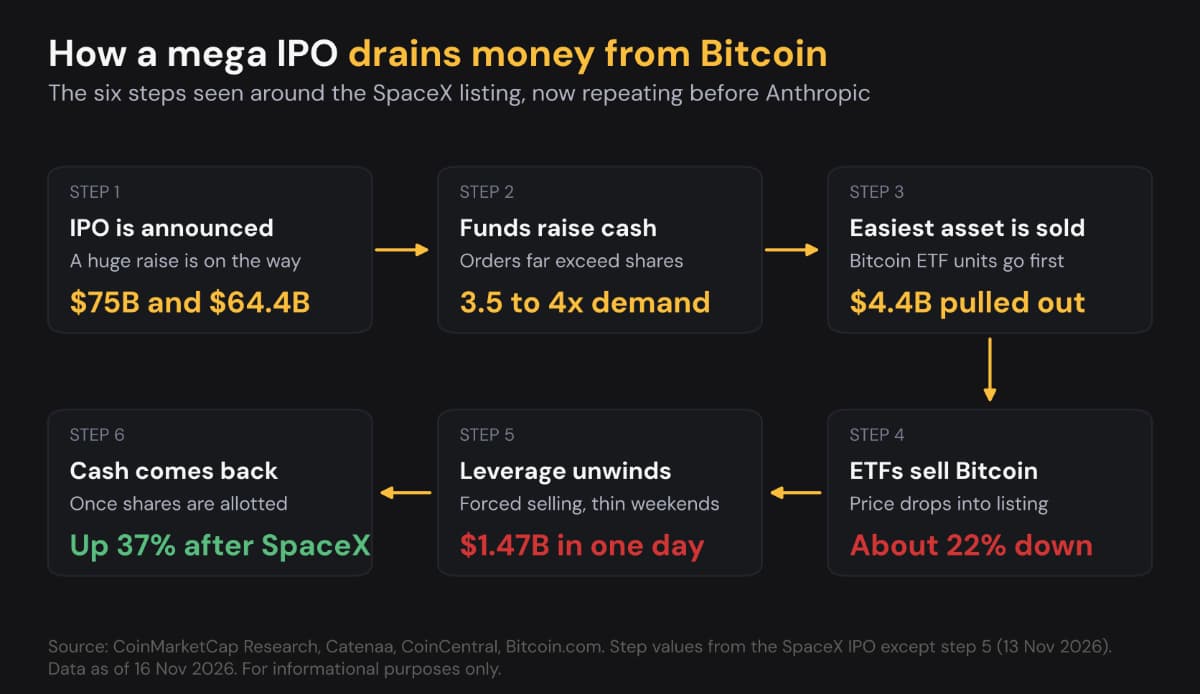
Demand for SpaceX shares topped $250 billion for a $75 billion offer, and order books were 3.5 to 4 times oversubscribed. When a deal is that popular, investors ask for far more shares than they expect to get, and they need cash ready for every order. Selling other risky holdings, Bitcoin included, provides it.
Orders are collected during the roadshow, the two or three weeks when a company pitches to big investors. Anthropic’s roadshow began on 10 November, and pricing is set for 18 November.
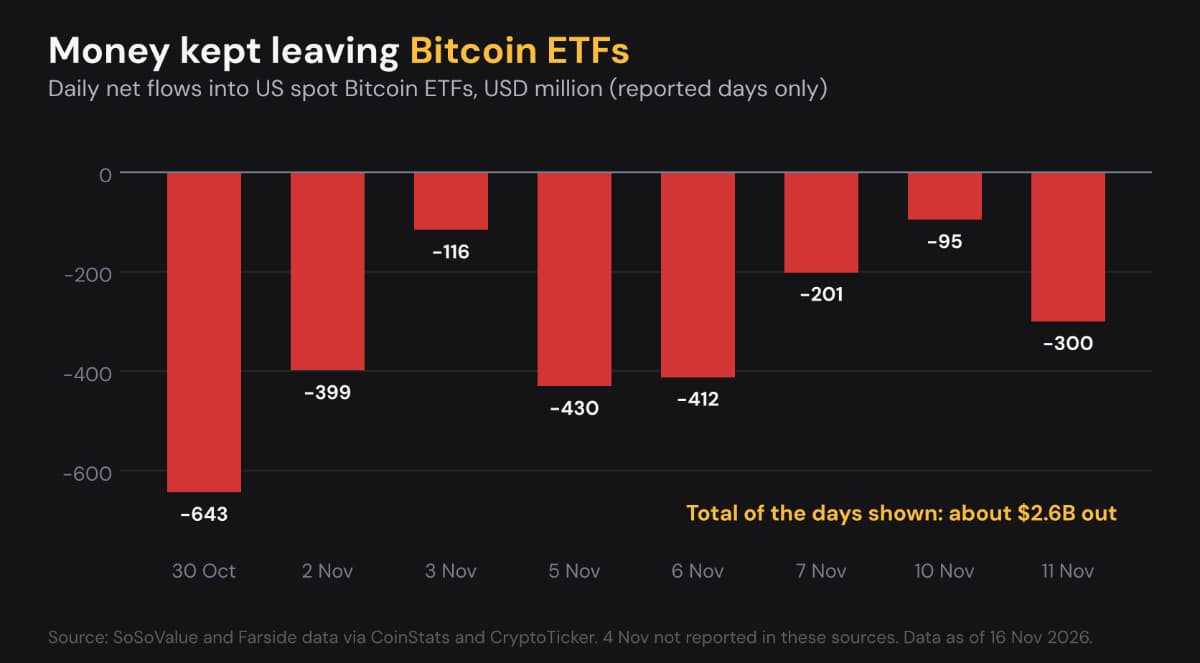
A Bitcoin ETF (exchange-traded fund) lets an investor hold Bitcoin through a normal brokerage account. Before SpaceX listed, US spot Bitcoin ETFs saw 13 straight days of outflows worth about $4.4 billion, while on-chain data showed no rush of people selling from their own wallets. When investors redeem ETF units, the fund must sell real Bitcoin. The same outflows are back this month.
Bitcoin used to be one of the few ways everyday investors could bet on a big tech future. Now they can buy the AI giants directly. SpaceX set aside about 30% of its shares for retail investors through apps like Robinhood, Fidelity and Schwab.
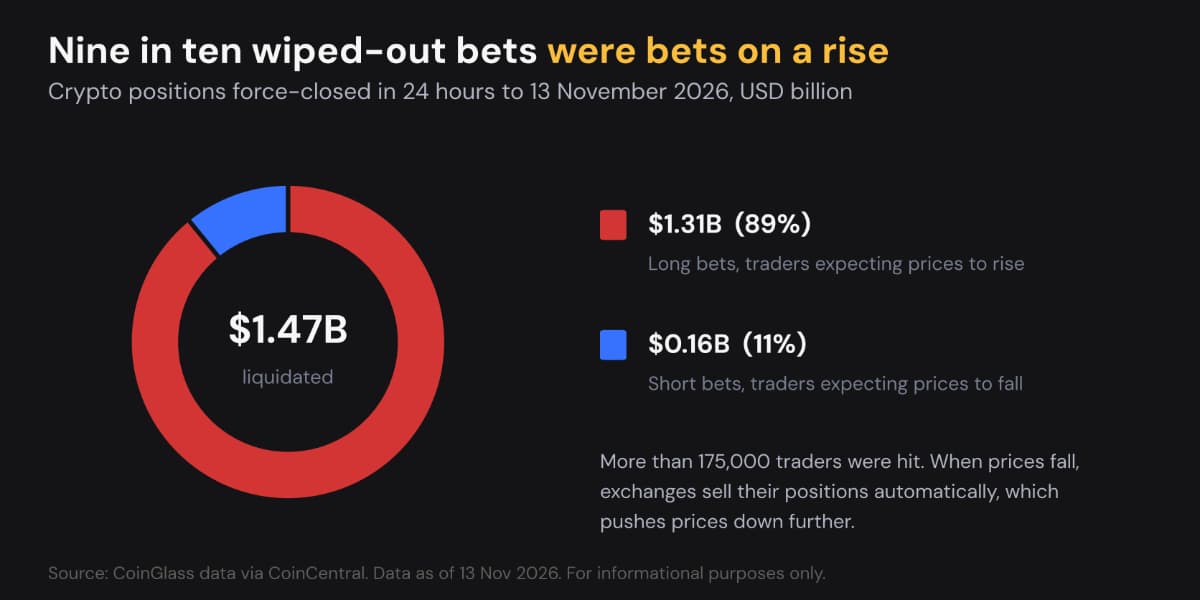
Leverage means borrowing money to make bigger bets. When prices fall, exchanges close those bets automatically, which pushes prices even lower. On 13 November alone, $1.47 billion of positions were wiped out.
Once shares are allotted, the cash that wasn’t used looks for a new home, and ETF selling eases. After SpaceX, Bitcoin bottomed at $57,748 on 1 July and then rose about 37% by late October.
Nvidia is a chipmaker, not a crypto company, yet Bitcoin fell far more than Nvidia’s own stock. Nvidia fell as much as 13% during the day but closed 4% lower, then lost another 2% on Friday. Bitcoin slid from about $73,000 to a weekend low near $62,000.
1. Nvidia is the thermometer of the AI boom. When the founder who led it for 33 years leaves with no named successor, investors ask whether the whole AI story is overpriced. Wedbush had estimated Nvidia could be worth 25% to 30% less without Huang.
2. The same big investors own both. Large funds hold tech stocks and Bitcoin ETFs side by side. When they cut risk, they cut both, and the more volatile one gets cut harder.
3. AI tokens are a direct bet on the same story. NEAR, Bittensor (TAO) and Render fell 7% to 12% on the day.
4. Crypto never closes. Stock markets shut on weekends, so a fund that needs cash on a Saturday can only sell crypto. During stock market hours, Bitcoin fell about as much as Nvidia. Most of the extra drop came over the weekend.
While money was leaving Bitcoin, crypto exchanges launched a new product to bet on these listings. A pre-IPO perp (perpetual futures contract) tracks the expected share price of a company that has not listed yet. It gives no ownership, and traders can borrow to bet many times their money.
The winners. The SpaceX perp on Hyperliquid, a crypto trading platform, traded $1.3 to $1.4 billion on listing day. Hyperliquid’s token HYPE rose 7% on the day the SpaceX contract launched, while Bitcoin fell, and hit a record high of $76.70 on 16 June. Dogecoin, the coin Musk often promotes, rose 5% on SpaceX’s listing day.
The losers. Unofficial tokens tracking Anthropic’s private value fell about 40% in May. PreStocks tokens fell 34% to 45% after Anthropic warned that such products may have no value.
The perps were right on direction but too high on price, as the chart shows.
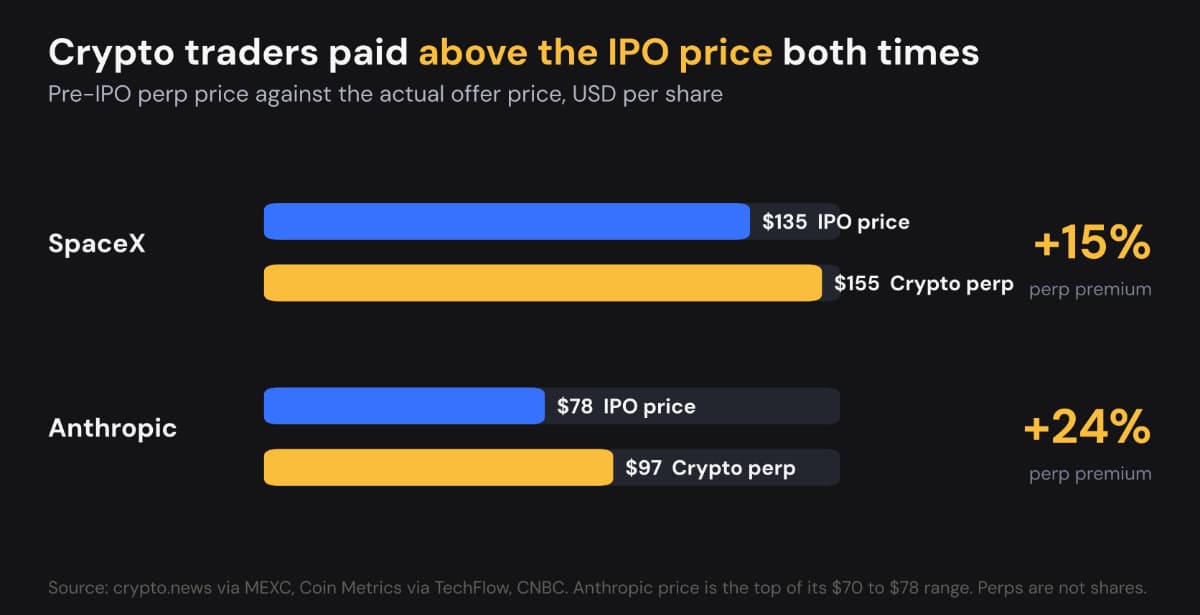
SpaceX’s first-day jump justified its perp premium. If ANT does not jump about 24% on day one, traders who bought the perp with borrowed money will be forced to sell as the contract lines up with the real share price.
India’s tax rules make trading every swing costly. VDAs (Virtual Digital Assets, the legal term for crypto in Indian tax law) face the rules below, and Budget 2026 left them unchanged. The 30% rule sat in Section 115BBH and the TDS rule in Section 194S of the Income Tax Act, 1961, and both carry into the new Income-tax Act, 2025, effective 1 April 2026.
Rule | What it says | What it means for you |
|---|---|---|
Tax on gains | Flat 30% plus surcharge and 4% cess | Short-term or long-term, the rate is the same |
TDS (Tax Deducted at Source) | 1% on each sale once yearly trades cross ₹10,000 (₹50,000 for specified persons) | The exchange keeps 1% every time you sell |
Losses | Cannot be set off against gains or carried forward | Gain ₹20,000 on one trade and lose ₹20,000 on another, and you still owe about ₹6,000 plus cess |
Source: Income Tax Department via Analytics Insight, Business Today, Coingape. Rules as of November 2026.
Trading every headline means TDS on each sale and tax on each win, with no relief for losses.
Date | Event | Why it matters |
|---|---|---|
17 Nov 2026 | Nvidia quarterly results | First report without Huang, a test for the AI trade |
18 Nov 2026 | Anthropic final IPO price | Inside or above $70 to $78 signals healthy demand for AI risk |
19 Nov 2026 | ANT starts trading on Nasdaq | Watch Bitcoin ETF flows and the gap to the $97 perp |
9 Dec 2026 | US Fed rate decision | A hike with more signalled would extend the pressure |
If the SpaceX pattern repeats, Bitcoin’s low could come up to three weeks after the Anthropic listing, with a recovery starting once IPO cash and ETF flows settle.
Sources: Fox Business, Morningstar, Greenleaf Trust, Quartz, Startup Fortune, Kalshi, CryptoTicker, CoinStats, Catenaa, Herald Corp, CoinMarketCap Research, KuCoin, Bitcoin.com, CNBC, FXStreet, CoinCentral, Coin Metrics via TechFlow, Crowdfund Insider, CoinDesk, Fortune and Coingape.
India Crypto Research operates independently. The information presented herein is intended solely for educational and informational purposes and should not be construed as financial advice. Before making any financial decisions, it's essential to undertake your own thorough research and analysis. If you're uncertain about any financial matters, we strongly recommend seeking guidance from an impartial financial advisor.


