What Makes a Crypto Basket More Than Just Five Coins?
What goes inside? And how much of each asset goes inside?
Meet the Idea Behind 5 Crypto Coin Baskets
Can investors get exposure to some of crypto’s major assets through one structured basket rather than making a separate bet on each coin?
Why Weighting Matters More Than It Looks
A Basket Doesn’t Need to Find the One Winner
Then Comes Rebalancing
Why We Think This Conversation Matters
Where We Go From Here

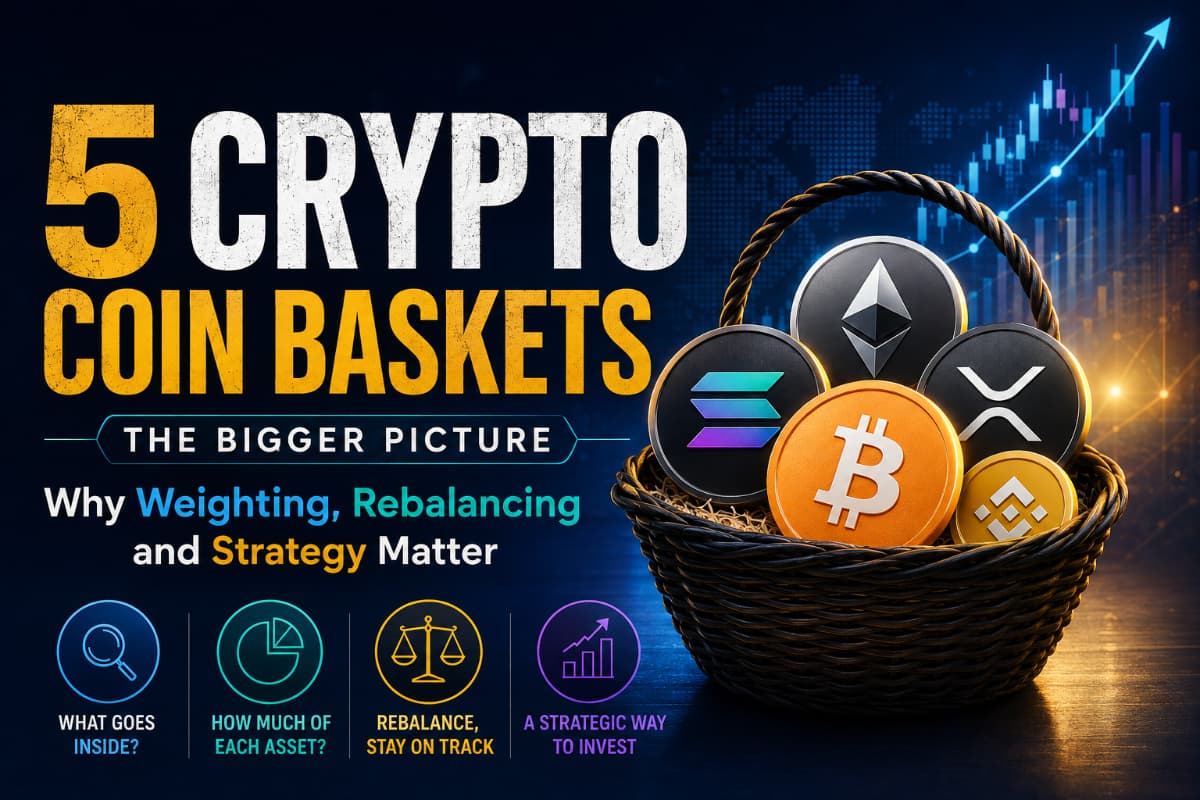
Until now, we have talked about the reasons for which a basket can be an easier option when dealing with crypto investments. However, the selection of coins is not everything; it is the next steps that actually define the portfolio. These steps include allocation of the weight, dynamic changes of this weight and rebalancing of the basket itself.
This is where it gets fun. Let’s say that we select five crypto assets.
Do we just assign each one 20%? Do we assign Bitcoin more since it is bigger? Do less volatile assets get assigned more? Should the weights change depending on the market?
This is where the building of a portfolio begins. There are two major decisions underlying any basket
Some of the baskets in the market similarly describes crypto baskets as bundles of multiple digital assets designed around ideas such as diversification and easier portfolio management, with baskets potentially built around themes or market-cap characteristics.
The second decision weighting is particularly important.
Imagine a five coin basket. Giving every asset 20% creates a very different portfolio from one where the larger, more established assets receive a bigger share. Both contain the same five coins. But they are not the same portfolio. And that is something we will explore much more deeply throughout this series.
We start from the simplest definition.
As opposed to attempting to map the entire crypto space, the concept of 5 Crypto Coin Baskets is centered around creating a portfolio of a few dominant crypto currencies. The goal here is neither to identify the token of the future nor follow the coin that is trending right now.
The idea is to ask a more portfolio oriented question:
This is to view crypto not as a lottery ticket, but as an asset allocation problem.
What should be included in the portfolio? How should it be allocated? How does the portfolio react when one of the coins moves strongly in one direction? How about when it moves in the other direction? Is there an allocation strategy that smooths out the portfolio better?
Those are the questions we seek to answer.
We don’t intend to reveal all of the portfolio approach in our introductory article. There would also be no point in doing so. The important thing for now is understanding the philosophy
select → allocate → combine → monitor

Let me give you a highly simplified example.
Let’s say there is a basket with five coins.
Then, if each coin gets 20%, an exceptionally strong shift in the smallest asset can affect the whole basket.
Now, let’s imagine that the basket weights larger assets more. This means that they will have more influence on the basket’s movement.
Neither option is automatically right. Both act differently.
According Some issuers of basket, there are two possible ways of building the basket equally weighted and larger market cap-weighted. The firm also mentions that the natural drifting of weights takes place due to different movements of various cryptos. This is why the process of rebalancing may start occurring.
This is when the basket of cryptocurrencies becomes way more complicated than let’s buy five coins.
There is an actual portfolio strategy underneath it.
This might just be the most critical point in the whole piece. Portfolio investments aren’t necessarily about picking the asset that will end up number one.
They’re about creating a framework where your complete return isn’t hinged on being right about number one.
Here’s how to think about it.
When five runners are in a race and you’re forced to bet on one, you must get that one right. Basket allows you to invest in several runners, but in different amounts based on your approach. That’s because while one might perform better than all the others, another might fail. The portfolio takes into account both these factors.
For people who don't wish to spend every day choosing which token to buy, sell or move to, it can make a lot more sense.
Here is another concept that is worth mentioning before proceeding with this series. Now, let us assume that you begin with some allocation. One day, one particular coin grows much faster than other coins. Obviously, it makes up a greater share of your portfolio. Your initial basket had a specific structure, but the market made it change to another one. This phenomenon is known as weight drift. Rebalancing can be explained as returning the portfolio to its intended allocation.
According to some of the crypto basket issuers, there are two general methods of rebalancing: regular rebalancing, or rebalancing based on going beyond predefined levels.
This is all we need for now.
Choosing the coins builds the basket. Weighting shapes the basket. Rebalancing helps maintain the strategy.
The crypto space has been sold as a treasure hunt for the next big thing. Where are the next pumpers? The next trends? The next Bitcoin? The next 10x coin?
It makes for an exhilarating discussion. It does not always make it easy to build your portfolio. There is another way of looking at this investment class. Instead of asking yourself, Which coin do I need to buy?
What should my crypto portfolio consist of? It changes everything. It makes you think about diversification. It makes you think about allocation. It makes you think about risk. But above all, it takes the discussion away from coin selection and towards portfolio construction. That is precisely what this article series will be all about.
This is only the starting point.
In the next articles, India Crypto Research will provide you with a model portfolio, and we’ll start opening the basket piece by piece.
We’ll look at why certain assets make the cut, how different weighting methods change the outcome, what happens when we alter those weights, how the basket behaves through market cycles, and whether rebalancing improves the structure.
We’ll also use real historical data instead of keeping the discussion theoretical.
Because building a crypto basket is easy.
India Crypto Research operates independently. The information presented herein is intended solely for educational and informational purposes and should not be construed as financial advice. Before making any financial decisions, it's essential to undertake your own thorough research and analysis. If you're uncertain about any financial matters, we strongly recommend seeking guidance from an impartial financial advisor.