A Bot That Looked Unbeatable on Paper
Why One Number Never Tells the Whole Story
The Trap of Tuning a Strategy to Its Own Test
What to Actually Check Before Going Live

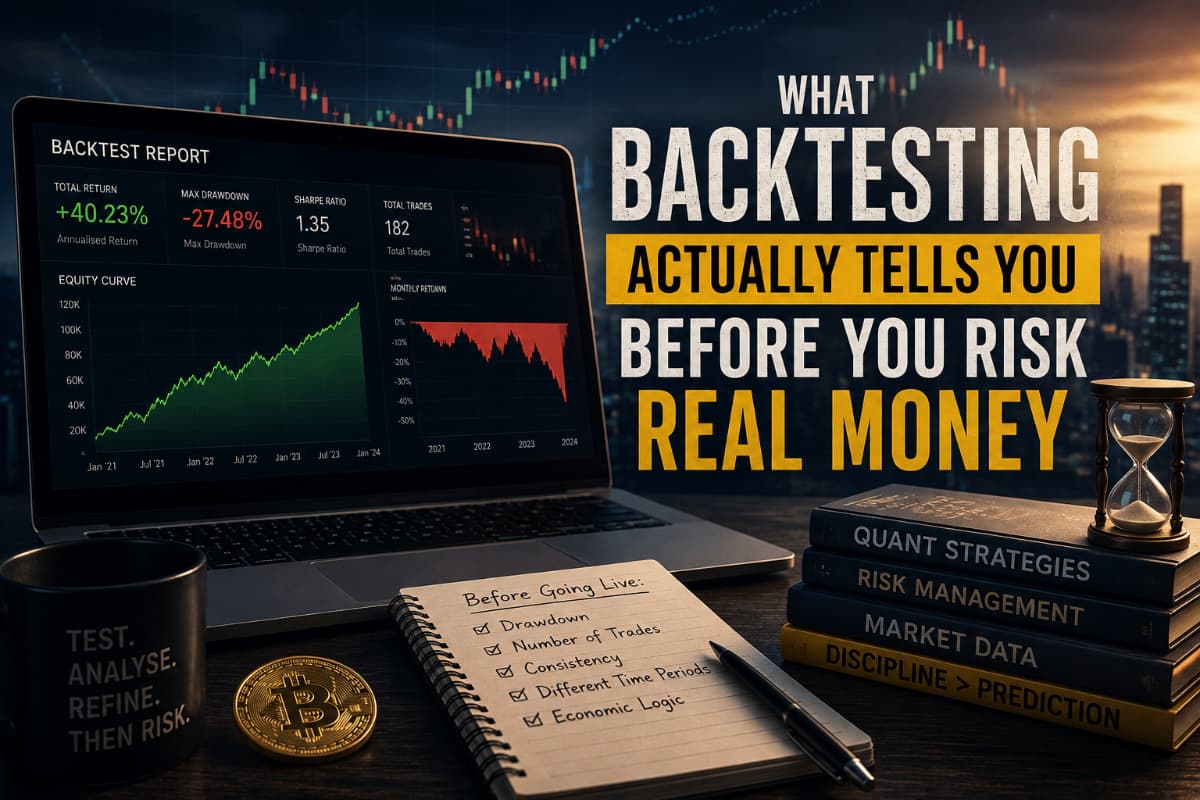
Picture a simple crypto trading bot built to buy on dips and sell into rallies. Run it against three years of Bitcoin price data, and it comes back with a 40% annualised return. Turn 1 lakh rupees into 1.4 lakh a year, repeat it, and do it for three years straight. Good enough to quit a day job over, at least on the spreadsheet.
That number alone says almost nothing.
Backtesting is the process of running a set of trading rules against historical price data to see how they would have performed before a single rupee goes into the market for real. Nearly every trader does some version of it. Most people stop the moment the return number looks good.
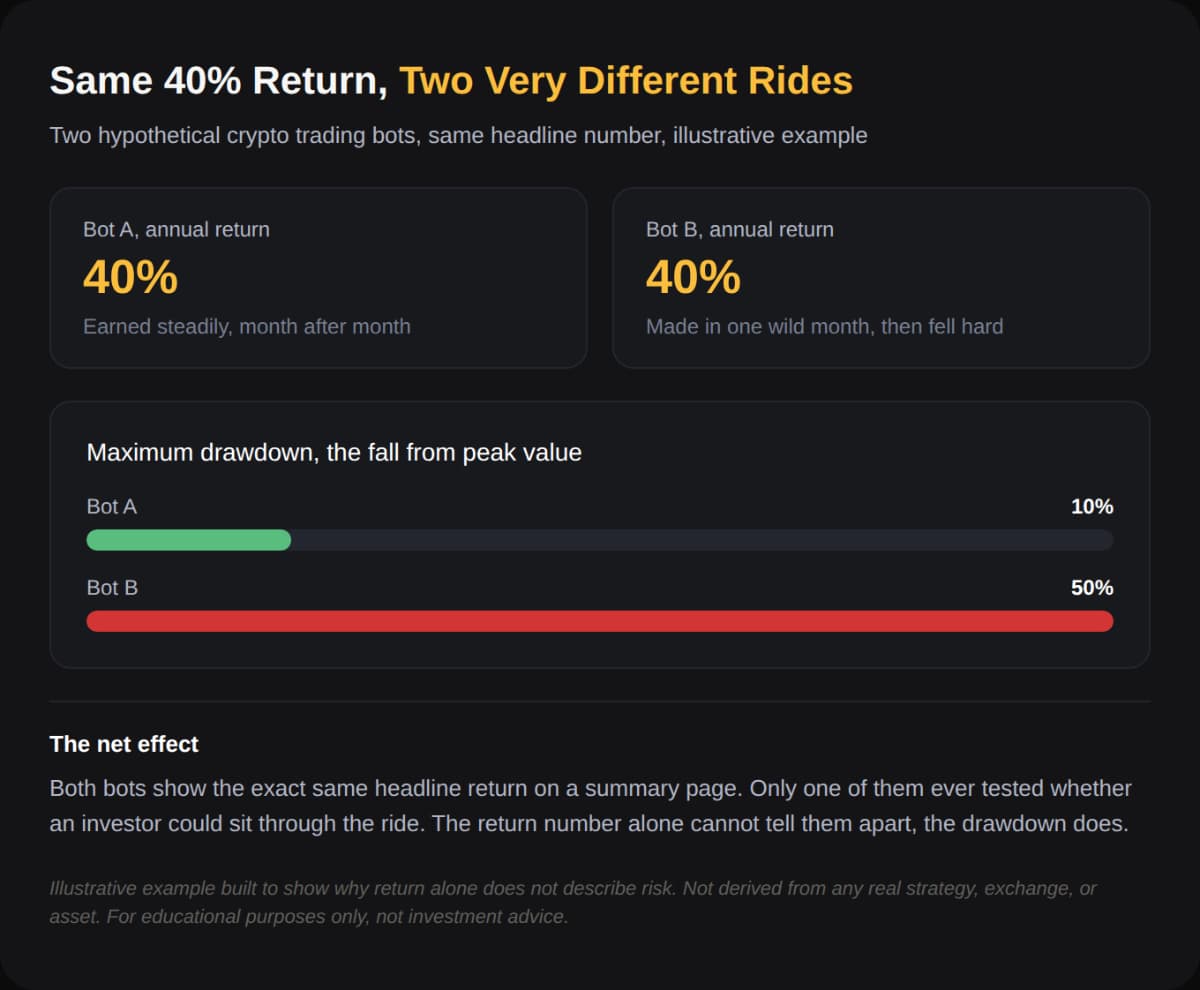
Two bots can post the same 40% return and be nothing alike underneath. One might earn it steadily, month after month, never falling more than 10% from its peak. The other might make most of its money in one wild month, then spend the next six down 50% before clawing back. Both show 40% on the summary page. Only one of them is a strategy a person can actually sit through.
That 50% dip has a name: drawdown, the distance between a strategy's peak value and its lowest point before it recovers. Alongside it, traders look at how many trades the strategy actually made (a return built on four lucky trades means almost nothing), how steady the swings were from week to week, and whether the strategy performed about as well in year one as it did in year three, rather than living off one unusually good stretch.
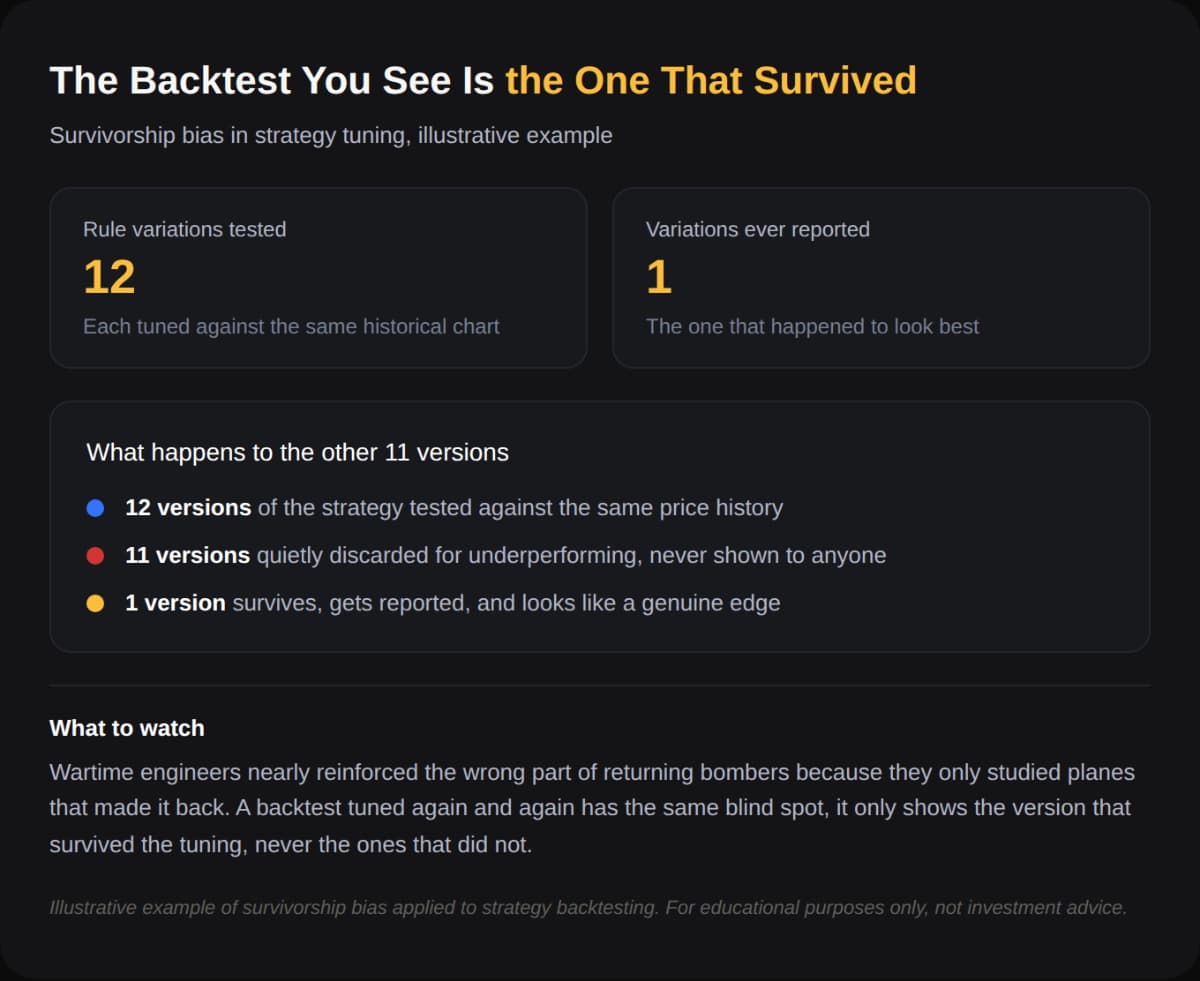
Here is where most homemade strategies quietly go wrong. A trader gets a mediocre backtest, so the rules get tweaked, say, waiting for a slightly bigger dip before buying. The return improves. Tweak again, and it improves again. After a dozen rounds of this, the return looks incredible.
What has actually happened, more often than not, is that the strategy has been reshaped to fit the exact ups and downs of that one historical chart, rather than any lasting pattern in how markets behave. Statisticians have a name for this kind of blind spot, and one of the clearest illustrations of it comes from an unlikely place: World War II bomber repair.
The military noticed that planes coming back from missions had the most bullet holes in the wings and tail, so engineers wanted to reinforce those spots. A statistician named Abraham Wald pointed out the flaw. Those were the planes that survived. The bombers hit in the engine or the cockpit never made it back to be studied at all. The real weak points were exactly where the surviving planes showed no damage.
A backtest tuned again and again on the same historical data has a similar blind spot. It only shows the version of the strategy that survived enough rounds of tweaking to look good. It says nothing about the dozens of versions quietly discarded along the way, or how the surviving version would fare on a market it was never shaped around.
Before putting real money behind any backtested strategy, the return number is the least useful thing to stare at. Far more telling are how deep the worst drawdown was, how many trades the results are based on, whether performance held up across different stretches of time rather than one favourable window, and whether the strategy still makes basic economic sense when explained out loud, independent of how well it happens to fit the chart it was built on.
None of this means backtesting is pointless. It means a backtest is a starting point for asking better questions, not a finish line. A good one does not try to prove the future will look like the past. It helps map out what could plausibly happen once a strategy meets a market it has never seen before, which is the only kind of market that actually exists once real money is on the table.
Virtual Digital Assets are highly volatile, carry regulatory uncertainty, and are not protected by the deposit insurance or investor protection frameworks that apply to traditional securities. This article is for informational purposes only and does not constitute investment advice. Readers should consult a qualified financial advisor before making any decisions involving VDAs.
India Crypto Research operates independently. The information presented herein is intended solely for educational and informational purposes and should not be construed as financial advice. Before making any financial decisions, it's essential to undertake your own thorough research and analysis. If you're uncertain about any financial matters, we strongly recommend seeking guidance from an impartial financial advisor.