
Bitcoin Mining Dashboard
Daily Network Data (24 – 29 October 2026)
BTC Production & Miner Revenue
Bitcoin Mining Pools
Top 5 Bitcoin Mining Countries
Top 5 Mineable Proof-of-Work Coins
Mining Cost & Profitability
ASIC Economics
ICR View: Last Week’s Calls, Outcomes & Next Week’s Outlook
ICR prediction & conclusion

Hashrate held steady at 1,080–1,088 EH/s (average ~1,084 EH/s), up ~3% week over week and still running ahead of difficulty.
Blocks arrived ~9% faster than target (940 blocks in six days, ~157/day), so miners earned 2,937.5 BTC (~$237M), about 490 BTC/day versus ~472 last week.
Difficulty rose 5.54% to 148.36T late on 29 October (block 973,728), within our +5% to +7% forecast and about 5% below the 155.97T record.
Pool concentration rose: the top three pools found 64.0% of blocks (62.6% last week); Luxor jumped to fifth, and Binance Pool slipped to 0.85% ahead of its 10 November closure.

 Part of a series
This was the last week at the 140.58T difficulty set on 16 October. Hashrate stayed between 1,080 and 1,088 EH/s and averaged about 1,084 EH/s, a 3% increase from ~1,050 EH/s the previous week. That is about 8% above the ~1,006 EH/s needed to mine one block every 10 minutes at 140.58T, so blocks kept arriving ahead of schedule. A total of 940 blocks were mined in the six-day period (~157 blocks a day, a ~9.2-minute average block time), 8.8% above the 864-block target. That produced 2,937.5 BTC of block subsidy, worth around $237 million.
The faster pace triggered the expected retarget late on 29 October at block 973,728. Difficulty increased by 5.54% to 148.36T, in line with our forecast of +5% to +7%. The timing was poor for miners, because BTC fell about 4.6%, from $81.9K on 29 October to ~$78.1K on 30 October. Hashprice averaged ~$36.47/PH/day during the week, then dropped to $33.48 on Hashrate Index after the adjustment, the lowest level in this series of reports.
Metric | This week (24–29 Oct) | Comment |
|---|---|---|
BTC price | ~$80.7K avg. (~$78.1K on 30 Oct) | Average of daily closes, $80.0K–$81.9K; fell ~4.6% on 30 Oct |
Network hashrate | ~1,084 EH/s avg. | Daily range 1,080–1,088 EH/s; up ~3.2% from ~1,050 last week |
Mining difficulty | 140.58T → 148.36T | +5.54% at block 973,728, late on 29 Oct |
Hashprice | ~$36.47 avg. → $33.48/PH/day | Weekly realised average; Hashrate Index on 30 Oct after the retarget |
Blocks found | 940 (~157/day) | 8.8% above the 864-block target; ~9.2-min average block time |
BTC block subsidy mined | 2,937.5 BTC (6 days) | Blocks found × 3.125 BTC; ~490 BTC/day |
Transaction fees (est.) | ~15 BTC | ~0.50% of block reward (Hashrate Index pool data) |
Next difficulty adjustment | ~+4.8% to ~155.6T (early) | Block 975,744, est. ~12 Nov; only 54 of 2,016 blocks mined (CoinWarz) |
Estimated production cost | ~$61.2K/BTC | At 148.36T; 18 J/TH and $0.06/kWh |
Date | Day | Hashrate (EH/s) | BTC price ($) | Hashprice ($/PH/day) | Difficulty (T) | Blocks | Subsidy (BTC) | BTC mined |
|---|---|---|---|---|---|---|---|---|
24-Oct-26 | Saturday | 1,080 | 81,064.59 | 40.81 | 140.58 | 174 | 3.125 | 543.75 |
25-Oct-26 | Sunday | 1,082 | 80,744.32 | 34.05 | 140.58 | 146 | 3.125 | 456.25 |
26-Oct-26 | Monday | 1,087 | 80,060.24 | 35.91 | 140.58 | 156 | 3.125 | 487.50 |
27-Oct-26 | Tuesday | 1,081 | 79,996.33 | 37.46 | 140.58 | 162 | 3.125 | 506.25 |
28-Oct-26 | Wednesday | 1,085 | 80,740.11 | 36.74 | 140.58 | 158 | 3.125 | 493.75 |
29-Oct-26* | Thursday | 1,088 | 81,889.95 | 33.87 | 140.58 | 144 | 3.125 | 450.00 |
Week | Total / avg. | 1,084 avg. | 80,749 avg. | 36.47 avg. | 140.58 | 940 | 3.125 | 2,937.50 |
Hashrate, BTC price, blocks and BTC mined are from ICR’s daily tracking sheet; blocks are the actual blocks found each day. Hashprice is realised subsidy revenue per PH/s (BTC mined × BTC price ÷ hashrate in PH/s) and excludes fees. * Difficulty is the level at the start of each day: it rose to 148.36T late on 29 October (block 973,728), so the new level applies from 30 October.
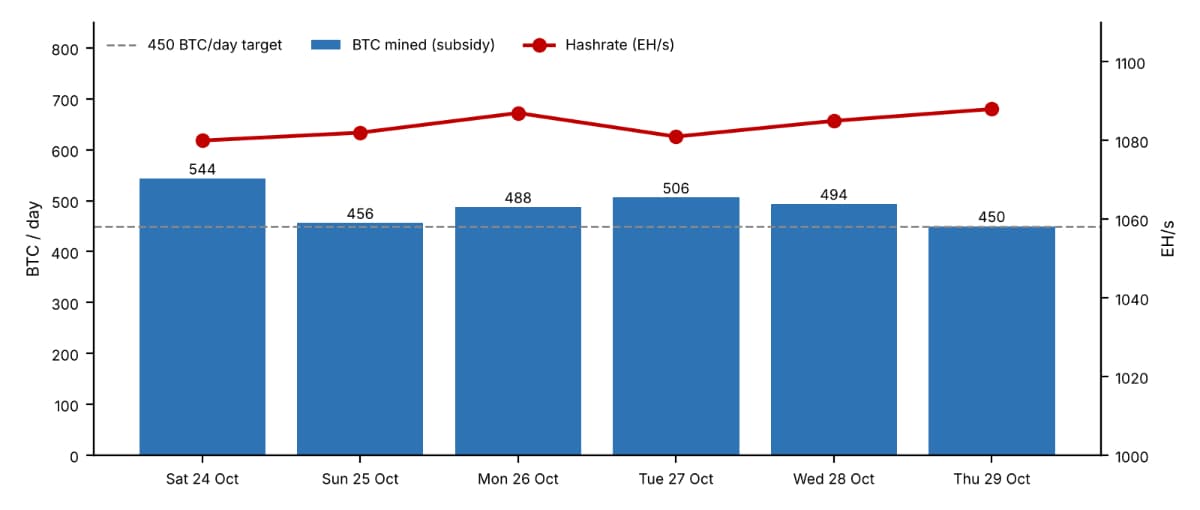
Daily BTC mined (bars) against network hashrate (line). The dashed line marks the 450 BTC/day target at 144 blocks/day.
Hashrate barely moved during the week (1,080–1,088 EH/s), so the daily swings in output came from normal block-finding luck. Saturday 24 October was the strongest day, with 174 blocks and 543.75 BTC (21% above target) and a realised hashprice of $40.81. Every day met or beat the 450 BTC target. Thursday 29 October landed exactly on it (144 blocks), and its $33.87 hashprice was the week’s lowest.
Production over the six days came to 2,937.5 BTC, or about 490 BTC per day. That is ~3.7% more per day than last week (~472 BTC/day), because hashrate kept rising while difficulty stayed at 140.58T until late on 29 October. At this pace, a full seven days would produce roughly 3,430 BTC. Fees stayed small, at about 0.5% of the block reward.
Component | Weekly BTC (6 days) | Approx. share of block subsidy |
|---|---|---|
Block subsidy | 2,937.5 BTC | 100% |
Transaction fees (est.) | ~15 BTC | ~0.50% |
Approx. USD value of subsidy | ~$237M | At each day’s BTC price (avg. ~$80.7K) |
Rank | Mining pool | Blocks | Approx. hashrate (EH/s) | Approx. share |
|---|---|---|---|---|
1 | Foundry USA | 278 | 277.98 | 26.33% |
2 | AntPool | 218 | 217.98 | 20.64% |
3 | F2Pool | 180 | 179.98 | 17.05% |
4 | ViaBTC | 94 | 93.99 | 8.90% |
5 | Luxor | 59 | 58.99 | 5.59% |
6 | SpiderPool | 47 | 47.00 | 4.45% |
7 | MARA Pool | 47 | 47.00 | 4.45% |
8 | OCEAN | 39 | 39.00 | 3.69% |
9 | SECPOOL | 37 | 37.00 | 3.50% |
10 | Braiins Pool | 17 | 17.00 | 1.61% |
11 | BTC.com | 14 | 14.00 | 1.33% |
12 | Unknown | 12 | 12.00 | 1.14% |
13 | Binance Pool | 9 | 9.00 | 0.85% |
14 | Poolin | 2 | 2.00 | 0.19% |
15 | Solo CK | 1 | 1.00 | 0.09% |
16 | WhitePool | 1 | 1.00 | 0.09% |
17 | FutureBit Apollo Solo | 1 | 1.00 | 0.09% |
| Total (listed pools) | 1,056 | 1,055.92 | 100% |
Pool block counts, hashrate and shares as compiled by ICR from block-attribution data on 30 October 2026 (1,056-block sample).
Total pool hashrate was flat compared with last week, at ~1,056 EH/s (+0.1%), but concentration rose. The top three pools found 64.0% of blocks (62.6% last week), and the top five found 78.5% (77.8%). AntPool and F2Pool each gained 0.7 points, to 20.6% and 17.1%, while Foundry USA held at 26.3%. Luxor jumped to fifth at 5.6% (+1.5 points), pushing SpiderPool (4.5%, −2.2 points) and MARA Pool (4.5%, −0.8 points) into a tie for sixth. SECPOOL fell to 3.5% (−1.4 points). Binance Pool slipped to 0.85% ahead of its 10 November shutdown, and AntPool and ViaBTC each mined one empty block.
Concentration is moving the way we expected. The top five currently stand at 78.5% and are on track to reach 79–80% over the next two weeks. Binance Pool closes on 10 November, and its remaining ~9 EH/s will most likely move to large FPPS pools such as AntPool, F2Pool and ViaBTC, which would lift the top three toward ~65%. Fifth place is now a three-way contest between Luxor (5.6%), SpiderPool and MARA Pool (4.5% each), so it can change hands from week to week on normal block luck. In positive news for decentralisation, two solo miners, Solo CK and a FutureBit Apollo home miner, each found a block this week.
Rank | Country | Approx. share | Approx. hashrate |
|---|---|---|---|
1 | United States | 35.6% | ~386 EH/s |
2 | Russia | 18.1% | ~196 EH/s |
3 | China | 11.7% | ~127 EH/s |
4 | Paraguay | 4.8% | ~52 EH/s |
5 | Oman | 3.0% | ~33 EH/s |
Shares from the Hashrate Index Q4 2026 Global Hashrate Heatmap (unchanged).
Coin | Algorithm | Price | Difficulty | Network hashrate | Key mining characteristic |
|---|---|---|---|---|---|
BTC | SHA-256 | $78,172.42 | 148.36T | 944 EH/s | Largest PoW network; halving-driven subsidy |
ZEC | Equihash | $1,250.41 | 275.00M | 29.96 GH/s | Privacy-focused PoW asset |
DOGE | Scrypt | $0.08 | 41.07M | 2.8 PH/s | High issuance; merged-mined with LTC |
XMR | RandomX | $585.63 | 740.62B | 6.172 GH/s | CPU-friendly, ASIC-resistant privacy coin |
BCH | SHA-256 | $282.39 | 530.33B | 3.982 EH/s | Shares SHA-256 mining ecosystem with BTC |
Compared with the 23 October snapshot, BTC fell ~4.1% to ~$78.2K and XMR eased ~3.8% to ~$586, while ZEC rose ~2.7% to ~$1,250. DOGE network hashrate was steady at ~2.8 PH/s (+1.6%), and BCH hashrate and difficulty both rose ~4%, to ~3.98 EH/s and ~530B respectively.
The table below shows illustrative electricity-only production costs at the new 148.36T difficulty, and at the ~155.6T early estimate for the 12 November retarget.
Scenario | Electricity / efficiency | Cost at 148.36T (now) | Cost at ~155.6T (est.) |
|---|---|---|---|
Efficient operation | $0.05/kWh, ~12 J/TH | ~$34K | ~$36K |
Mid-case | $0.06/kWh, ~18 J/TH | ~$61K | ~$64K |
Older fleet | $0.06/kWh, ~35 J/TH | ~$119K | ~$125K |
The retarget lifted the mid-case cost per BTC from ~$58.0K to ~$61.2K. At ~$78.1K BTC, the mid-case gross spread is ~$16.9K per BTC, or ~22% of price. That is down from ~29% a week ago and slightly below the ~24% we expected, because BTC fell further than we assumed. If the next retarget lands near +4.8% with BTC flat, the spread would narrow to ~18%. This is not corporate net profit: debt service, depreciation, hosting, staff, maintenance, SG&A and financing costs are all excluded.
Indicator | What to track each week |
|---|---|
ASIC hashrate | TH/s per machine |
Energy efficiency | J/TH |
Power consumption | kW per machine |
Revenue | BTC/US$ per day (≈0.000424 BTC per PH/s/day at 148.36T) |
Electricity expense | US$/day at selected tariff |
Gross mining margin | Revenue less electricity |
ASIC payback | Months at current economics |
Our call (17–23 Oct report) | What happened (24–29 Oct) |
|---|---|
Difficulty: retarget around 29 Oct, +5% to +7% (base case +6.6% to ~149.9T) | +5.54% to 148.36T at block 973,728, late on 29 Oct |
Hashprice: ~$34–35/PH/day after the retarget if BTC stayed at $81–82K | $33.48 on 30 Oct, but BTC fell to ~$78.1K; at $81.5K it would have been ~$34.9 |
Hashrate: growth to slow, holding in a 1,030–1,070 EH/s range | 1,080–1,088 EH/s (avg ~1,084), +3% WoW; growth did not slow |
Pools: top five to edge up toward 79–80% | Top five 78.5% (from 77.8%); top three 64.0% |
Scorecard: four of five calls held. The miss was hashrate. Miners kept adding capacity despite the 16 October difficulty increase, and hashrate finished about 1–2% above our range, so we are less confident that rising difficulty alone will cap hashrate in the short term.
• Difficulty: No adjustment is due next week, so difficulty stays at 148.36T. The next retarget is around 12 November (block 975,744). Our own range is +2% to +5%: at ~1,084 EH/s, the network is ~2% above the ~1,062 EH/s needed for 10-minute blocks at the new difficulty.
• Hashprice: Each $1,000 move in BTC now shifts hashprice by about $0.42/PH/day. With BTC between $76K and $82K, we expect hashprice of roughly $32–35/PH/day. Our base case is ~$33–34/PH/day with BTC near $78K.
• Hashrate: We expect hashrate to level off at about 1,060–1,100 EH/s. At $33.48/PH/day, machines less efficient than about 23 J/TH at $0.06/kWh no longer cover their electricity costs, which should slow additions.
Miners have entered a squeeze. Hashrate is at the highest level in this report series (~1,084 EH/s), difficulty has risen twice in two weeks (+5.92% and +5.54%), and BTC has slipped to ~$78K, leaving hashprice at $33.48, the lowest in the series. Our prediction for next week is unchanged difficulty, hash price of ~$33–34, hashrate levelling off near 1,060–1,100 EH/s, and about 3,200 BTC of issuance.
On pools, concentration is rising again (top three 64.0%, top five 78.5%), and the Binance Pool closure on 10 November should push it higher as its miners move to AntPool, F2Pool and ViaBTC. For the network, more hashrate means more security, but more of it now sits with fewer pools.
Sources: ICR daily tracking sheet (24–29 Oct 2026), Hashrate Index (30 Oct), ICR pool data (30 Oct), CoinWarz and Minerstat.
India Crypto Research operates independently. The information presented herein is intended solely for educational and informational purposes and should not be construed as financial advice. Before making any financial decisions, it's essential to undertake your own thorough research and analysis. If you're uncertain about any financial matters, we strongly recommend seeking guidance from an impartial financial advisor.


