
Mining
This week's numbers (14–26 October)
Where the world mines
El Salvador: The Reserve Keeps Growing, the IMF Keeps Watching
Ethiopia: Bitcoin Boom Meets Drought
United States: Still Number One, but Trading Bitcoin for AI
Bhutan: The Quiet State Miner That Is Running Low on Coins
Our View
FAQs


 Part of a series
Bitcoin mining is a race. Specialised computers called Application-Specific Integrated Circuits (ASICs) guess numbers billions of times a second, trying to solve a mathematical puzzle. The first computer to solve it wins, adds the next block of transactions to the blockchain, and earns 3.125 new Bitcoin plus the transaction fees. On average, it takes about 10 minutes for the computers to come up with the answer. That means about 450 new Bitcoin are added every day, split among everyone racing.
Four terms explain almost every mining headline:
| Term | What it means in plain words | Why it matters |
|---|---|---|
| Hashrate (EH/s) | Total computing power racing on the network | More hashrate = more competitors for the same reward |
| Difficulty (T) | How hard the puzzle is; resets every 2,016 blocks (~2 weeks) | Rises when hashrate rises, so blocks stay near 10 minutes |
| Hashprice ($/PH/day) | What 1 PH/s of computing power earns in a day | The miner's paycheck; falls when difficulty rises or BTC drops |
| Block reward | 3.125 BTC subsidy + transaction fees per block | Fixed until the next halving in 2028 |
The simple rule of thumb in Bitcoin mining: miners earn more when Bitcoin's price rises and less when more machines join. The major cost for a Bitcoin mine is electricity, often 60–80% of running costs. This is why miners chase the cheapest power on earth, and why countries matter.
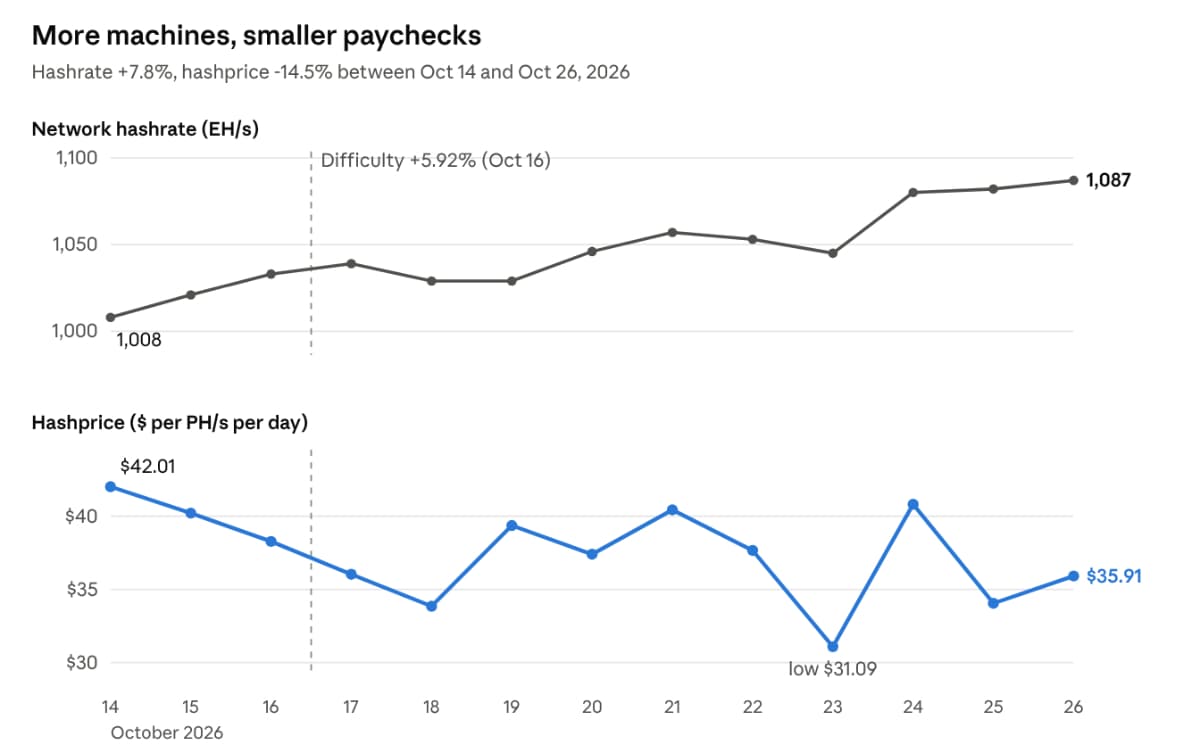
Computing power on the network rose almost every day, but what each unit of it earned fell. On 16 October, the network's difficulty level was adjusted upwards, meaning it took more computing power to solve the puzzle and earn the block reward.
Daily Network Data (20–26 October 2026)
| Date | Day | Hashrate (EH/s) | Difficulty (T) | Blocks | Subsidy (BTC) | BTC mined |
|---|---|---|---|---|---|---|
| 20-Oct-26 | Tuesday | 1,046 | 140.58 | 153.00 | 3.125 | 478.13 |
| 21-Oct-26 | Wednesday | 1,057 | 140.58 | 165.00 | 3.125 | 515.63 |
| 22-Oct-26 | Thursday | 1,053 | 140.58 | 151.00 | 3.125 | 471.88 |
| 23-Oct-26 | Friday | 1,045 | 140.58 | 128.00 | 3.125 | 400.00 |
| 24-Oct-26 | Saturday | 1,080 | 140.58 | 174.00 | 3.125 | 543.75 |
| 25-Oct-26 | Sunday | 1,082 | 140.58 | 146.00 | 3.125 | 456.25 |
| 26-Oct-26 | Monday | 1,087 | 140.58 | 156.00 | 3.125 | 487.50 |
| Week | Total / avg. | 1,064 avg. | 140.58 | 1,073.00 | 3.125 | 3,353.13 |
Hashprice is influenced by a number of variables, including transaction fees and luck in finding a block, but the trend is clearly down. Each coin is worth less, as Bitcoin is currently trading at $80,060, down 3.7% from 14 October. Difficulty is 140.58T after a 5.92% rise on 16 October, and another rise is expected around 28 October. Blocks are arriving at about 153 per day, roughly 6% faster than the target of 144, a sign more machines joined. Approximately 6,228 BTC (~479 per day) have been mined in the past 13 days, with transaction fees adding only ~0.5% to that total. The hashprice this week is around $35.91 per PH/s per day, about 9% below the $39.33 average in September.
| Metric | Latest | What it tells you |
|---|---|---|
| Bitcoin price | $80,060 (−3.7% since 14 Oct) | Each mined coin is worth a little less |
| Difficulty | 140.58T (+5.92% on 16 Oct) | The puzzle got harder; another rise is expected around 28 Oct |
| Blocks per day | 153 on average vs a target of 144 | Blocks are arriving ~6% too fast, a sign more machines joined |
| New BTC mined | ~6,228 BTC in 13 days (~479 a day) | Fees add only ~0.5% on top of this |
| September average hashprice | $39.33 | This week's $35.91 is ~9% below it |
Three countries account for about two-thirds of global Bitcoin mining: the United States, Russia and China. The two we highlight below are #1, the US, and #8, Ethiopia.
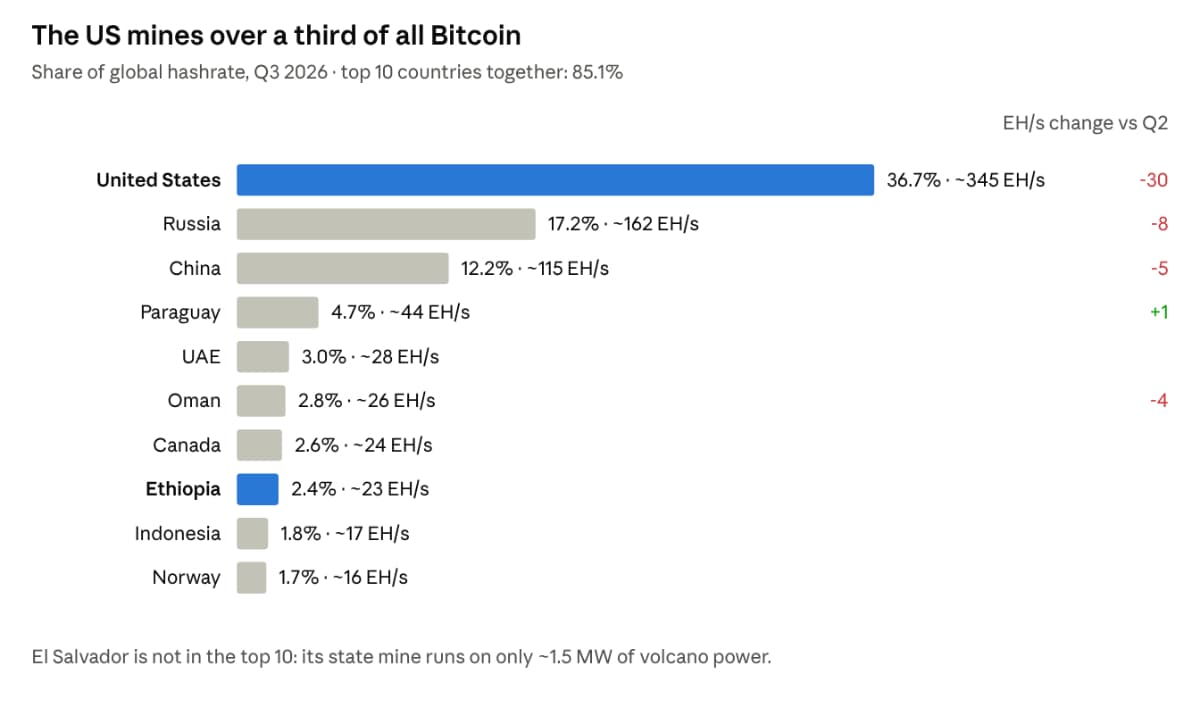
The big three all lost some hashrate in the last quarter, while cheap-hydro Paraguay grew. Ethiopia is up around 35% on a year ago, but its mid-September power cuts are barely showing in these numbers yet. Country data is published quarterly, so treat it as a snapshot.
As of 16 October, El Salvador's Bitcoin reserve was at 7,807 BTC (worth about $625 million). When the IMF programme began in early 2025, the reserve was at about 6,070 BTC. In the time the IMF has been watching, El Salvador's Bitcoin reserve has grown by over 1,700 BTC.
The IMF released $138 million from El Salvador's $1.4 billion loan on 1 October. This release happened even though El Salvador missed a target limiting public-sector Bitcoin purchases. The IMF waived this breach after new promises from the government. Currently, the IMF expects no more government-led Bitcoin purchases beyond documented private donations. The government, however, continues to describe its “1 BTC a day” policy as ongoing. Both statements cannot be fully true, and that gap is the story to watch.
Mining itself is small. The state rig near the Tecapa volcano runs about 300 ASICs on roughly 1.5 MW of geothermal power, and mined an estimated 473.5 BTC between 2021 and May 2024. That is a showcase, not a business: Ethiopia's mines use hundreds of times more power.
In one line: El Salvador is a Bitcoin holder that also mines, not a mining country.
Ethiopia's miners are running on 23% of the power they signed for, even though their contracts promised a minimum supply of 98%. On 15 September, Ethiopian Electric Power (EEP) cut their supply from 75% to 50% and then to 23%. The cut is due to an El Niño-linked drought, which has reduced inflows to Ethiopian reservoirs by approximately 20%.
Why it hurts: Ethiopia's grid is about 95% hydropower, so less rain means less electricity. Miners use about a third of Ethiopia's power and pay about 35% of EEP's revenue, at around 3.2 US cents per kWh. EEP has 39 mining customers, and 31 of those are operational. Most are foreign companies like BitFuFu, BIT Mining, Bitdeer and Phoenix Group.
In Q3, Ethiopia was ranked 8th in the world with about 23 EH/s, or 2.4% of the world's hashrate. That figure mostly reflects the months before the power cuts, so the real number today is probably lower. EEP said it would reassess in October. As of 26 October, we couldn't find any public update. If the rains don't improve, miners could lose even more power.
In one line: Ethiopia sells its cheap dam power to miners for dollars, and the weather just showed how fragile that deal is.
The US mines more Bitcoin than any other country: about 345 EH/s in Q3, or 36.7% of the world's hashrate. However, the US also lost the most in one quarter. In Q2, the US was at 375 EH/s and in Q3 it was at 345 EH/s, a loss of 30 EH/s, or about 8% of its own hashrate. Thin margins and the boom in artificial intelligence probably explain the loss.
Many US-listed mining firms are now renting out their power and facilities to AI companies instead of mining. Five of these (IREN, Core Scientific, Bitfarms, TeraWulf and Cipher) mined 47% less Bitcoin this year to 19 October than a year earlier (7,075 BTC vs 13,263 BTC). Bitfarms has totally closed down its US Bitcoin mining operations. IREN plans to shut down another 23.2 EH/s of mining power by 31 December.
Not everyone is leaving. MARA, Riot, CleanSpark and American Bitcoin all increased their output over the past year. Investors are nervous regardless. CleanSpark and MARA fell by 7% and 5% respectively on 8 October, and both are down by 40–51% over the last year. AI hosting promises steadier revenue, but building such data centres requires cash, which often means issuing new shares that dilute existing shareholders.
In one line: America still dominates mining, but its biggest players are quietly becoming data-centre companies.
Bhutan built one of the world's largest state Bitcoin stacks by mining with surplus hydropower through its sovereign wealth fund, Druk Holding & Investments (DHI). At the peak in October 2024, DHI-linked wallets held about 13,000 BTC.
After that, the coins started leaving. By 17 June 2026, wallets tracked by the analytics firm Arkham held about 1,750 BTC, or about 13% of the peak. In 2026 alone, outflows exceeded $230 million, much of it sent to cryptocurrency exchanges and trading firms, including QCP Capital. Newer balances have not been published.
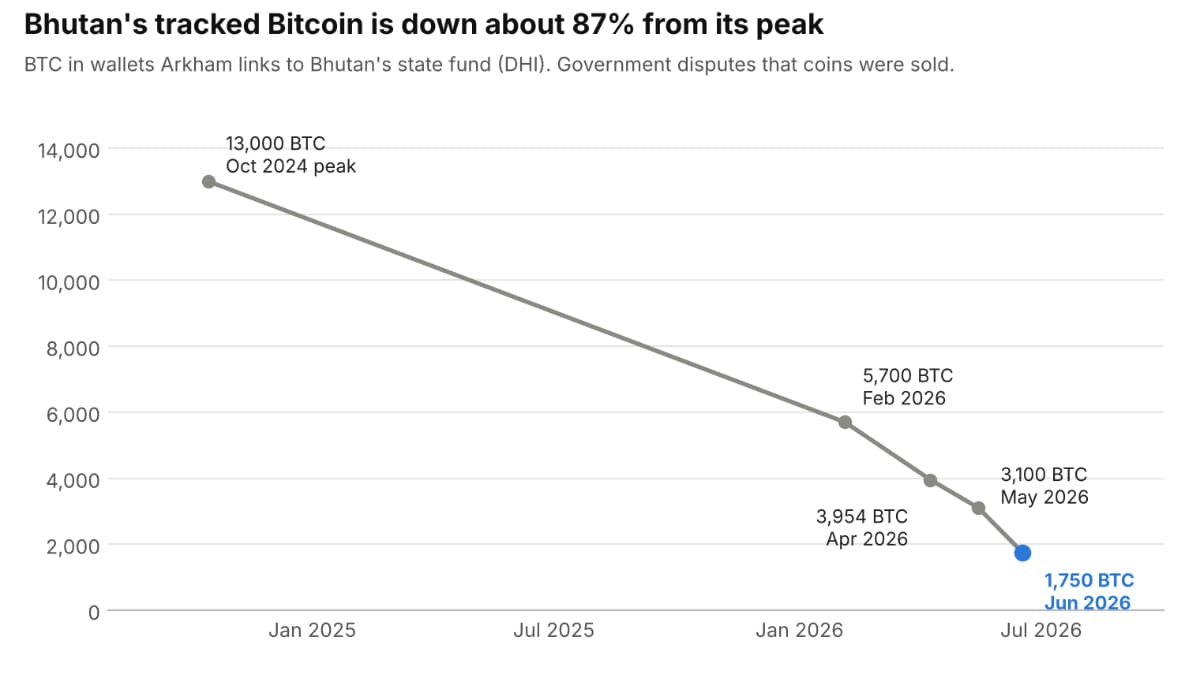
It is becoming increasingly difficult to believe the government will be able to fulfil its December 2025 pledge of up to 10,000 BTC for the Gelephu Mindfulness City project.
It's important to note that since the 2024 halving, each coin costs roughly twice as much to mine, and blockchain trackers have seen almost no newly mined coins arrive in Bhutan's known wallets for over a year. Selling the same hydropower to India may now generate more revenue.
In one line: Bhutan seems to treat its mined Bitcoin as cash to be spent, not as a reserve to be held.
As the year comes to a close, we'll likely see a margin squeeze. Hashrate keeps climbing, and Bitcoin is trading sideways around $80,000. Estimates point to another large difficulty increase around 28 October, making it even more challenging for miners to turn a profit. At $35–36 per PH/day, older machines like the Antminer S19 (around 30–34 J/TH) only break even with power costs below roughly 4.5–5 US cents/kWh. We will likely see less efficient miners shutting down older machines and/or selling a portion of their Bitcoin.
The AI shift is the biggest change to Bitcoin mining since China's 2021 ban. US miners aren't failing; they're shifting to steadier clients. As they leave, we expect Bitcoin hashrate to move towards countries with surplus or stranded power, such as Paraguay, the Middle East, Russia and parts of Africa, making the network more geographically dispersed, which is healthy for Bitcoin. The US will still lead the pack for years to come.
The four countries are four separate bets:
Our summary for a new reader: mining is no longer just “computers making Bitcoin.” It is an energy business, a geopolitical story and, increasingly, an AI infrastructure story.
What to look out for: the difficulty adjustment around 28 October; Ethiopian Electric Power's (EEP) decision on Ethiopian power allocation; possible new Bhutan wallet movements; whether El Salvador's Bitcoin reserve keeps going up under IMF rules; and US miners' Q3 earnings in early November.
India Crypto Research operates independently. The information presented herein is intended solely for educational and informational purposes and should not be construed as financial advice. Before making any financial decisions, it's essential to undertake your own thorough research and analysis. If you're uncertain about any financial matters, we strongly recommend seeking guidance from an impartial financial advisor.


