United States: the pens are busy
United Kingdom: the front door opens
EU's MiCA being Reviewed
South Korea and Hong Kong: Laying Tracks Across Asia
India: yes to tech, no to coins
The main story from the week

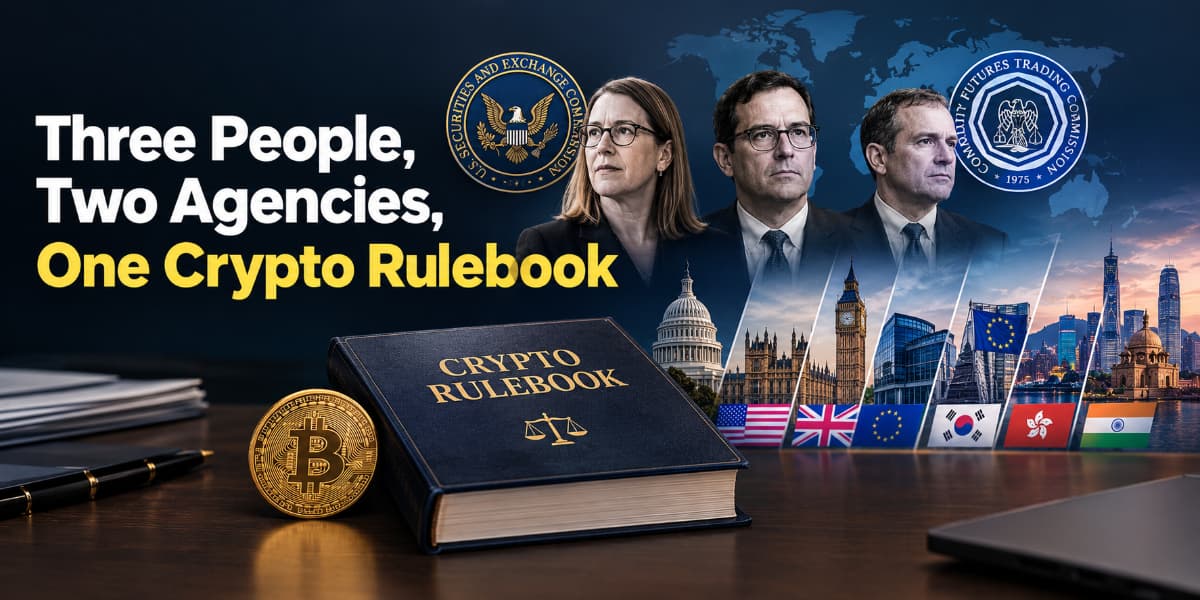
Just three people are shaping the US’s crypto rule book. In the meantime, the SEC and CFTC released proposals this week on crypto custodianship, leverage for retail trading, and exchange rules.
FinCEN withdrew its proposed rules on crypto mixers and self-custodial wallets, removing two of the larger, longer-term overhangs on self-custody.
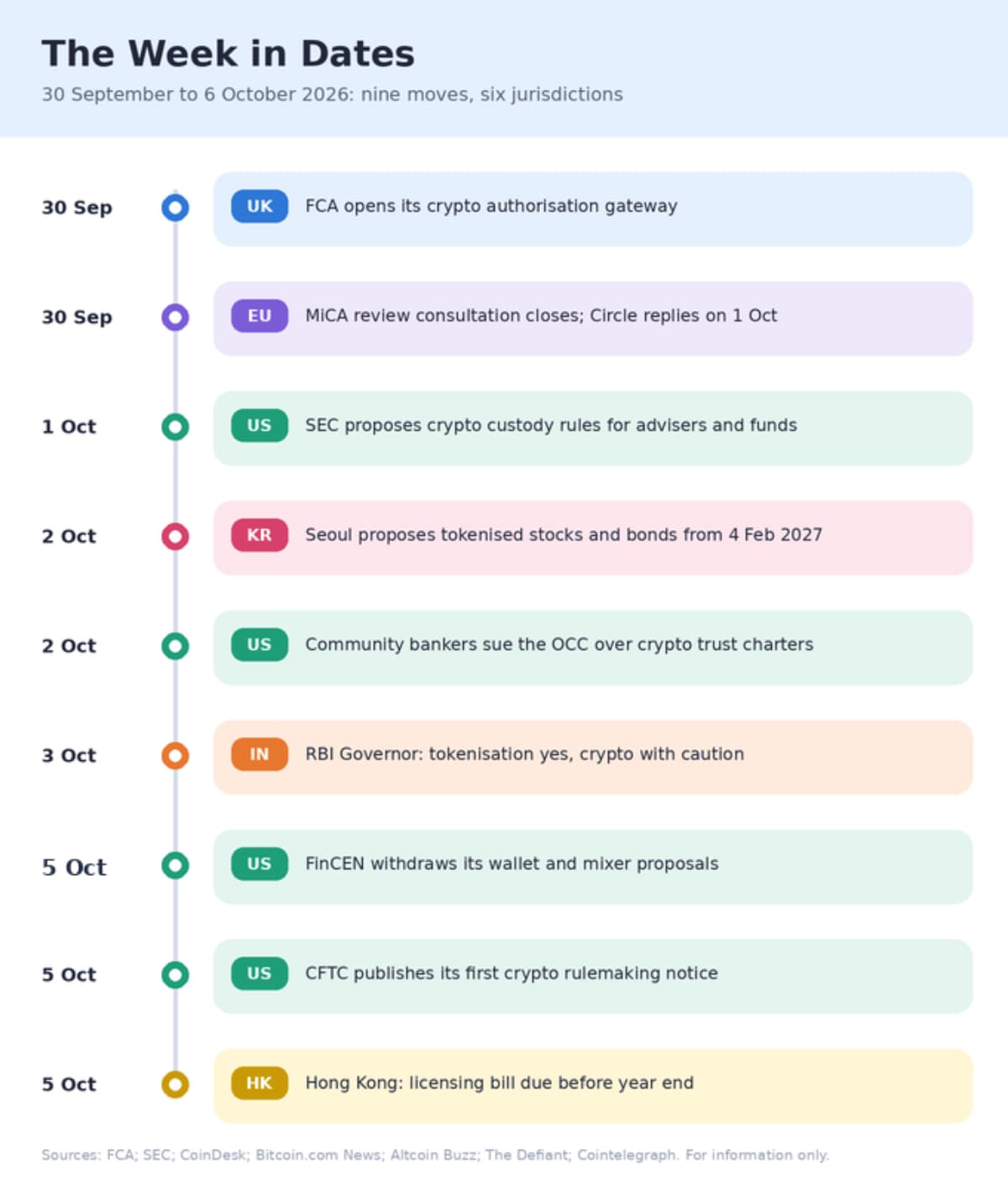
The UK FCA began accepting crypto firm applications on 30 September. Firms should apply by 28 February 2027, ahead of the regulatory framework becoming effective on 25 October 2027.
South Korea plans to allow tokenized securities from 4 February 2027, and Hong Kong is expected to submit a digital asset licensing bill this year.
 Part of a series
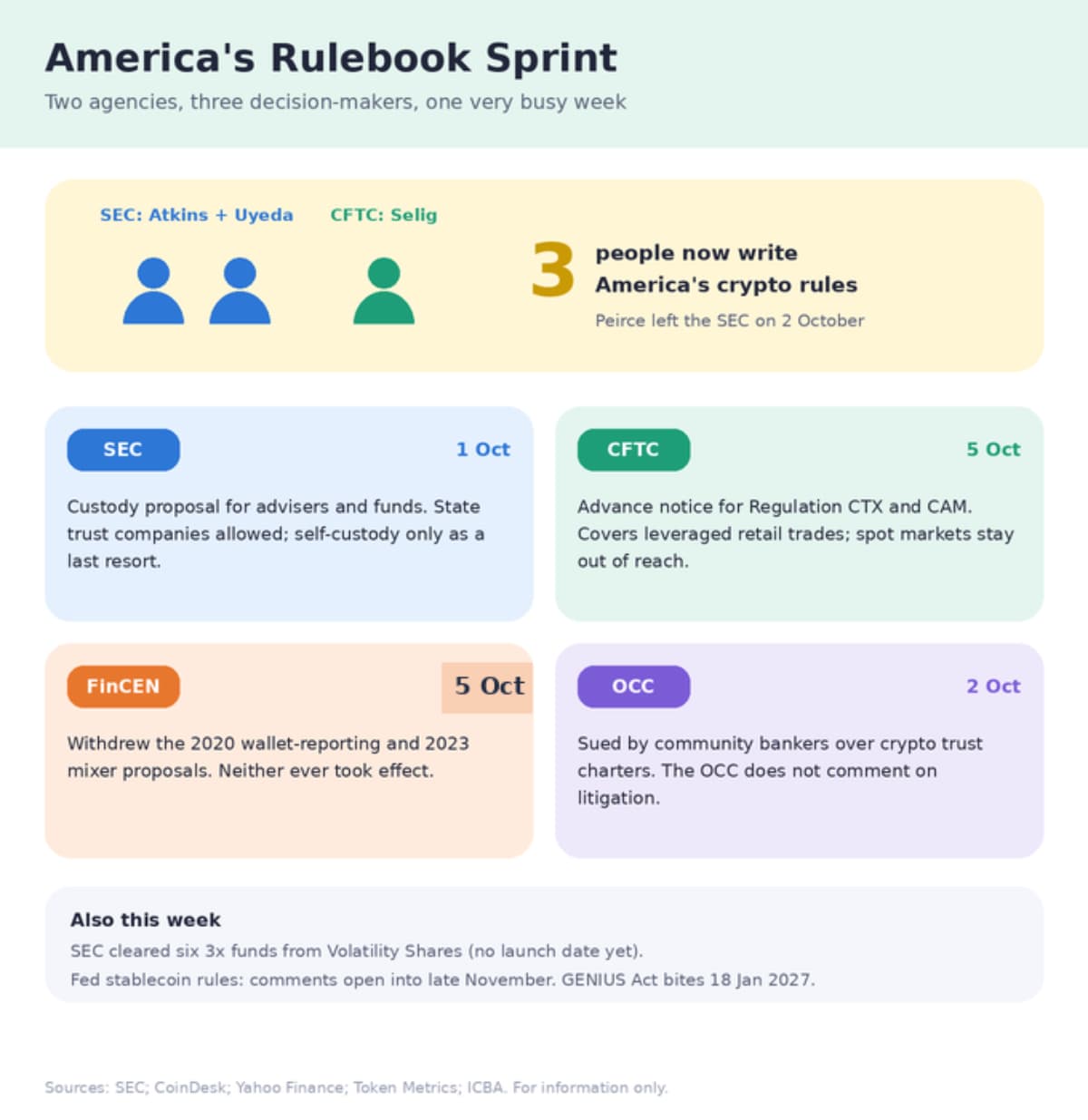
Here's a number to consider during your morning coffee: 3. Currently, just 3 people are in charge of writing the rules concerning crypto in the U.S. Hester Peirce, better known as "Crypto Mom" and a commissioner at the SEC, left on October 2, leaving the SEC with two commissioners. The CFTC is also run by a single commissioner, Mike Selig. And yet, between them, they have put out a mountain of paperwork.
There has been lots of crypto-related action elsewhere this week. London welcomed crypto firms, Seoul released a framework to tokenize shares, Hong Kong promised a licensing bill, and India's central bank drew a careful line on cryptocurrencies, saying "yes to the tech, no thanks to the coins."
Here is the week: nine moves in one glance and then the details.
The SEC's recent custody proposal (on Oct. 1) creates a new pathway that will enable registered investment advisers (RIAs) and regulated funds to hold Bitcoin and other digital assets for clients.
Custody decides whether big institutions can touch crypto at all. Under the proposal, state-chartered trust companies could act as custodians, and, for the first time, an adviser could self-custody an asset, but only if no eligible custodian will hold it, and the position must be reassessed every quarter. Chairman Paul Atkins called it "a compliant pathway where none existed before". Peirce, in a separate statement, stressed that "self-custody" here means the adviser acting as custodian, not ordinary investors holding their own keys. Comments stay open for 60 days once the proposal appears in the Federal Register.
On October 5, the CFTC issued an advance notice of proposed rulemaking (ANPR) to solicit public comments on potential regulation of retail cryptocurrency trading.
The CFTC’s ANPR seeks comment on two regulatory frameworks. The first, Regulation CTX, will create oversight of retail trading of cryptocurrency with leverage, margin, or financing. The second, Regulation CAM, will create a purpose-built category for the exchanges that would list these trades. The CFTC, however, acknowledged the catch, admitted by Selig himself, that without new legislation, the CFTC cannot compel spot trading on registered markets. Therefore, the CFTC’s frameworks focus on creating a protective framework for the derivatives trading market and leave the spot trading market where it was.
Selig also floated a safe harbor for developers, whereby developers will not be considered brokers merely for publishing code, a point many builders will be watching closely.
There are a few other moves that deserve quick mention. On October 2, the Independent Community Bankers of America (ICBA) filed a complaint against the Office of the Comptroller of the Currency (OCC) for overreach in the granting of national trust charters to crypto firms Coinbase, Circle, and Crypto.com. The OCC does not comment on litigation. Expect this one to run. Also, on October 5, the Financial Crimes Enforcement Network (FinCEN) withdrew two proposed rules that had created uncertainty for self-custody and hung over the crypto industry for years. FinCEN withdrew a 2020 proposal requiring reporting of transfers above $10,000 to self-hosted wallets and a 2023 proposed rule targeting cryptocurrency mixers. Neither ever took effect, but both provided years of uncertainty for self-custody.
Two other bits of news complete the picture. The SEC gave Cboe the green light to list six 3x leveraged funds from Volatility Shares, including both bitcoin and ether. Daily resetting means they are not appropriate for buy-and-hold, and more for short-term traders. There is also no date set for listing. And there are a few bills working their way through Congress that, if passed, would let banks and credit unions hold digital assets and issue stablecoins.
It may not be as flashy, but arguably more important: on September 30th, the FCA opened its authorization gateway. For the first time, crypto firms in the UK could apply for full authorization from the FCA. The authorization will cover firms’ consumer protection, market integrity, financial resilience and safeguarding. According to the FCA, firms have until February 28th, 2027 to apply to be authorized, and the regime is set to go live on 25 October 2027. The FCA said authorization will not be automatic, and firms already operating that apply in time will have the right to continue to operate and take on new clients if a decision has not been made by October 2027. The FCA also said it will consult this month on tweaks to its perimeter guidance, and firms should watch for that.
The EU's consultation on MiCA closed on 30 September, and the lobbying process has now been out in the open. Circle, issuer of USDC and EURC, published its response to the EU consultation on October 1st. According to Circle, e-money token issuers should not be required to maintain a 30% reserve in bank deposits (or 60% for significant issuers). Instead, in line with the direction the ECB backed in late September, there should be a more flexible minimum liquidity requirement. Further, Circle wishes for two concentration limits to be eliminated, and for multi-issuance, where an EU entity and a foreign counterpart co-issue a stablecoin, to be preserved. Restricting multi-issuance would push users offshore, according to Circle. Elsewhere in the same consultation, the Hyperliquid Policy Center asked that crypto perpetual futures be handled under MiFID II rather than invented rules. The EU Commission now has its hands full with a lengthy to-do list.
From February 4, 2027, the South Korean Financial Services Commission plans to permit the issuance and trading of tokenized securities, and is accepting feedback from October 2 through November 11, 2026. It intends to start slow. The proposed framework will initially allow private money market funds and bonds for institutional investors, trust-based tokenization of unlisted shares, and publicly offered fractional-investment securities. Constraints will be in place. The ledger must be shared among at least two account-management entities as well as the Korea Securities Depository. The equity capital requirement for firms that issue tokenized securities and manage client accounts directly will be approximately 4 billion won (about $3 million). Retail investors will be capped at approximately $74,000 (100 million won) of annual net purchases per over-the-counter exchange. Stablecoin settlement will be phased in later, based on the results of the initial stages and on stablecoin legislation still to come. With South Korean listed securities worth close to $5 trillion, the market has a lot of potential.
Hong Kong also continues to move rapidly. On Monday (5 October), Christopher Hui, Hong Kong's Secretary for Financial Services and the Treasury, said an amendment bill to create licensing regimes for digital asset trading, custody, advisory and management will be submitted within this year. Stablecoins are already a step ahead there. In April, the Hong Kong Monetary Authority (HKMA) granted the first two stablecoin issuer licenses to Anchorpoint Financial and HSBC.
Speaking at the Kautilya Economic Conclave in New Delhi on October 3, 2026, the Governor of the RBI, Shri. Sanjay Malhotra, said India’s approach to crypto "remains cautious", considering the implications for monetary sovereignty, monetary policy and capital flows. In the same speech, however, he listed tokenization among innovations that can make finance more efficient, provided there are sound institutions, finality of settlement, the “singleness of money” and financial integrity. Malhotra also said that domestic payment systems in India are already swift and inexpensive, and the more pressing need is for a better system for cross-border payments, where central bank digital currencies can be explored. No new circular accompanied the speech.
On the other hand, the Parliamentary Standing Committee on Finance, headed by Bhartruhari Mahtab, is in the process of finalizing its report on virtual digital assets for the Speaker of the Lok Sabha. Based on an article by PTI, the report may recommend an improvement in the monitoring of crypto asset transactions, wider consultation on the legal treatment of digital assets, and utilization of modern-day technology to ensure strict oversight. This report is expected to be a recommendation, and not a piece of legislation.
A minor addition to this week’s outlook: India has updated its guidelines for blacklisting of foreign nationals to include “crypto-related racketeering”.
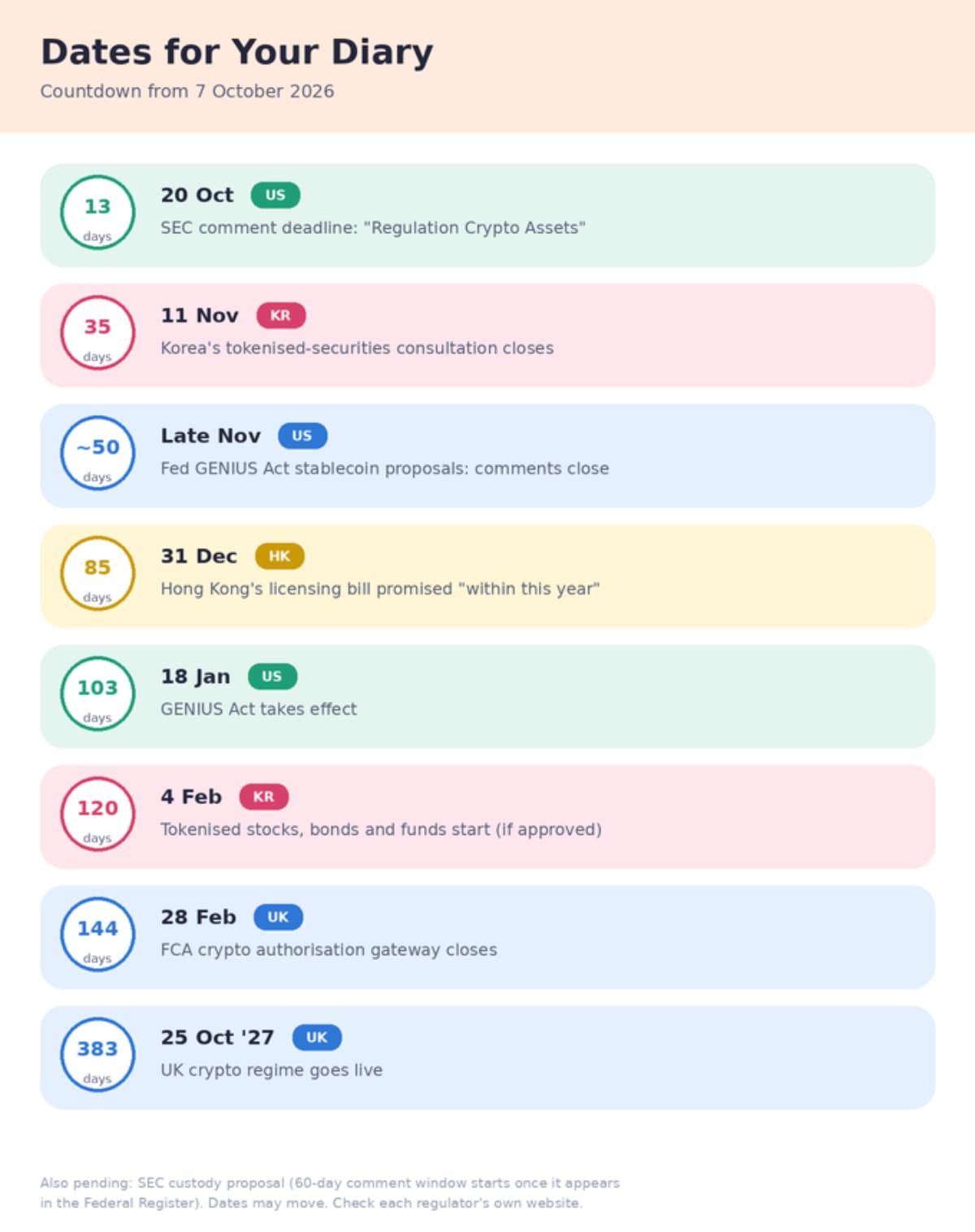
Take a step back, and you can see the pattern. Nearly every story this week was plumbing: who can hold crypto, where it can trade, how a tokenized bond is tracked, what license a firm needs. Regulators are no longer having the argument “is crypto in” the financial system. They are currently focused on drafting how it fits. In the US especially, this is being done by an extremely small group of people, which is why the next few months, with comment windows closing and an 18th January 2027 clock ticking for the GENIUS Act, will be very important. Keep the diary below close at hand.
Sources: FCA press releases (30 September 2026); SEC statements and proposal coverage via Yahoo Finance, National Law Review and Croke Fairchild; Yahoo Finance (CFTC ANPRM); CoinDesk (OCC lawsuit); FinCEN official release (5 October 2026); Token Metrics (3x funds); FinanceFeeds (Congress bank bills); Cointelegraph via TradingView and The Defiant (Circle and the MiCA review; Hong Kong); Bitcoin.com News (South Korea); Altcoin Buzz and PTI via ThePrint (India); NewsBytes (India blacklist rules); AI-CIO and CoinDesk via KuCoin (Peirce departure). Data as of 7 October 2026.
India Crypto Research operates independently. The information presented herein is intended solely for educational and informational purposes and should not be construed as financial advice. Before making any financial decisions, it's essential to undertake your own thorough research and analysis. If you're uncertain about any financial matters, we strongly recommend seeking guidance from an impartial financial advisor.