How Tether transformed crypto's biggest weakness into the foundation of digital finance
When Crypto Needed a Dollar
The First Generation of Stablecoins
Tether and the Birth of Digital Liquidity
The Rise of Stablecoins as Market Infrastructure
Growth Brings Greater Scrutiny
Competition, Regulation and the Next Phase of Stablecoins

 Part of a series
Stablecoins have transformed from a niche cryptocurrency innovation into one of the fastest-growing segments of digital finance. First developed to address the operational limitations of highly volatile cryptocurrencies, they now ease cross-border payments, support decentralised finance (DeFi), enable tokenised financial products and increasingly bridge traditional financial systems with blockchain networks. Among the various models introduced over the past decade, Tether (USDT) has played the defining role in this transformation, evolving from a settlement asset for cryptocurrency traders into the largest and most widely adopted stablecoin in the digital asset ecosystem
Bitcoin's introduction in 2009 fundamentally changed how value could be transferred across the internet by displaying those financial transactions could occur without banks or central authorities. Whereas this innovation laid the foundation for an entirely new digital asset ecosystem, it also exposed a significant shortcoming. Cryptocurrencies such as Bitcoin and Ethereum derived their value entirely from market demand, resulting in significant price volatility that restricted their effectiveness as mediums of exchange despite their growing popularity acceptance as investment assets. As cryptocurrency adoption accelerated, this volatility formed practical challenges for traders, businesses and exchanges alike. Investors seeking to protect capital between trades often had to convert digital assets back into fiat currencies, while businesses battled to price goods and services using assets whose value could fluctuate significantly within short periods. At the same time, cryptocurrency exchanges remained dependent on conventional banking systems for fiat deposits and
withdrawals, creating hurdles between continuously operating blockchain networks and comparatively slower financial infrastructure. The ecosystem thus required a stable digital settlement asset capable of preserving purchasing power while moving with the speed and efficiency of blockchain technology. This requirement ultimately laid the foundation for the emergence of stablecoins.
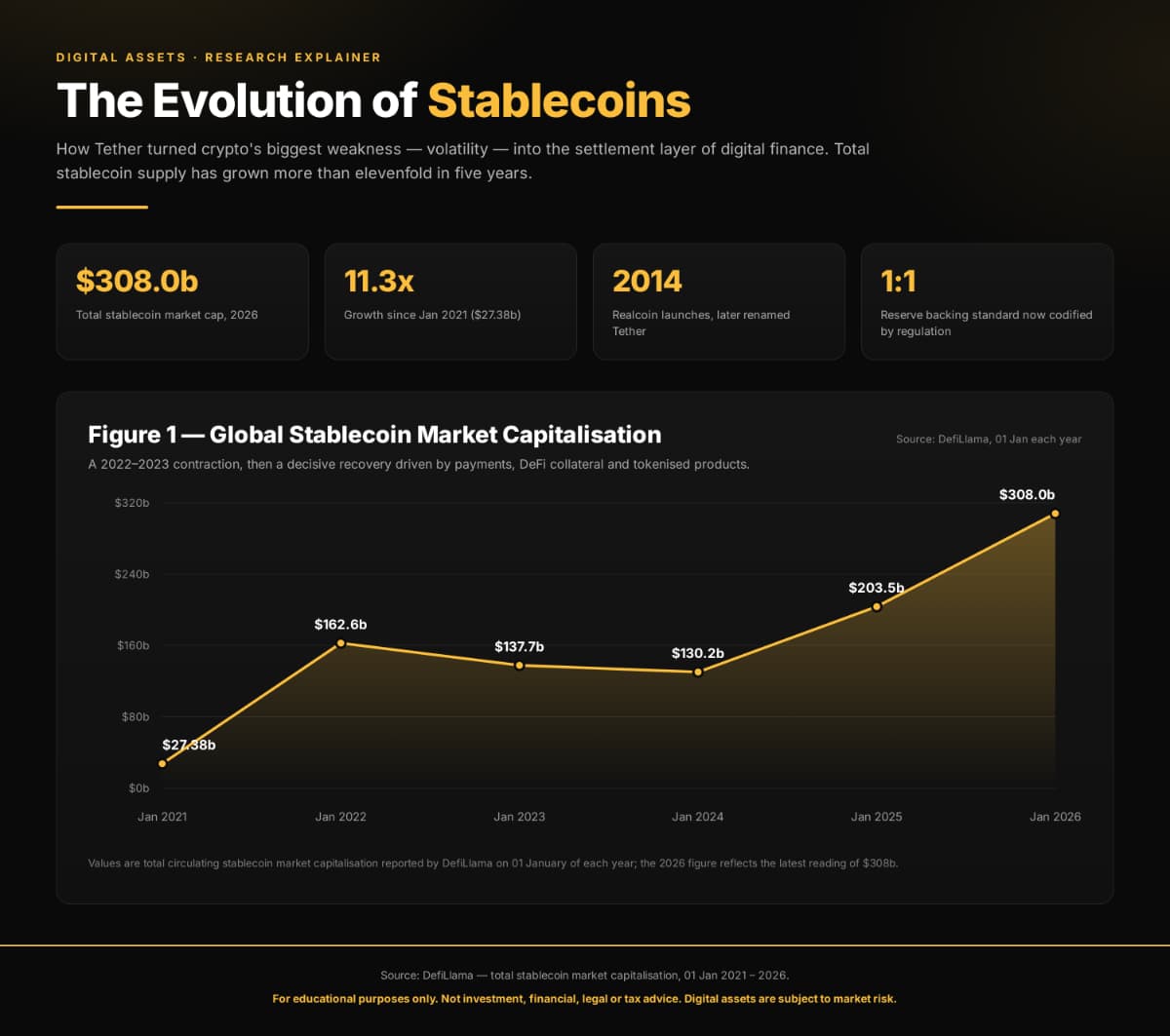
The first serious attempts to develop stablecoins emerged during 2014 as developers explored mechanisms capable of maintaining a stable value against the U.S. dollar while functioning entirely on blockchain framework. The objective extended beyond reducing cryptocurrency volatility; it involved creating a digital representation of fiat currency that would allow users to protect value without leaving the cryptocurrency ecosystem.
Among the initial projects were BitUSD, which relied on crypto-collateralisation, and NuBits, which tried to maintain stability through algorithmic supply adjustments. Although both represented essential technological innovations, neither achieved sustainable long-term adoption. Their experiences demonstrated that retaining a stable exchange rate required more than protocol design. During periods of market uncertainty, confidence ultimately depended on liquidity, collateral quality, governance and the ability of each system to preserve value under stress.
These early experiments however established an important lesson. Demand for a blockchain-based representation of the U.S. dollar clearly existed, but long-term adoption required a model that prioritised simplicity, liquidity and confidence over increasingly complex monetary mechanisms.
Later that same year, another project entered the market with a markedly different philosophy. First launched as Realcoin before being renamed Tether, it introduced a simple proposition whereby digital tokens would be issued against reserve assets linked to the U.S. dollar (pegged$1:1). Rather than attempting to restructure monetary policy, Tether focused on solving a far more immediate challenge
facing cryptocurrency markets the absence of a reliable settlement asset capable of supporting a rapidly expanding global trading ecosystem.
Tether represented a structural turning point in cryptocurrency markets because it resolved a challenge that earlier stablecoin projects had been unable to solve at scale. Rather than concentrating solely on maintaining price stability, it improved market efficiency by catering a blockchain-based settlement asset that closely mirrored the value of the U.S. dollar. This proved particularly critical during a period when cryptocurrency markets were expanding rapidly but continued to rely on scattered banking infrastructure that was poorly suited to twenty-four-hour global trading.
As exchanges extended across multiple jurisdictions, the movement of fiat currency remained slow and operationally difficult. Deposits and withdrawals frequently depended on international wire transfers, settlement periods often extended across several business days, and banking relationships varied significantly between regions. These constraints reduced market efficiency by forcing participants to repeatedly transition between blockchain networks and traditional financial infrastructure whenever they wished to protect the value of their holdings.
Tether fundamentally changed this process by permitting users to remain entirely within the blockchain ecosystem while maintaining exposure to a dollar-denominated asset. Instead of repeatedly converting cryptocurrency into fiat currency, traders could move into USDT before re- entering the market when opportunities emerged. This reduced settlement delays, improved capital efficiency and enabled liquidity to move efficiently between exchanges. As adoption increased, USDT evolved from a settlement token into the favoured quote currency across a substantial proportion of cryptocurrency markets.
The widespread adoption of Tether also generated strong network effects. As more exchanges merged USDT trading pairs, liquidity naturally concentrated around the stablecoin, encouraging market makers, arbitrage traders and institutional participants to utilise the same settlement asset. Higher liquidity attracted additional users, reinforcing Tether's position as the dominant source of liquidity within cryptocurrency markets.
Beyond easing trading, Tether supported the wider development of blockchain-based financial services. Stablecoins became the preferred collateral within decentralised finance protocols, supported lending markets, enabled cross-border transfers and provided a stable settlement asset for an expanding range of blockchain applications. What initially appeared as a practical solution to cryptocurrency volatility gradually evolved into one of the foundational layers supporting the digital asset economy.
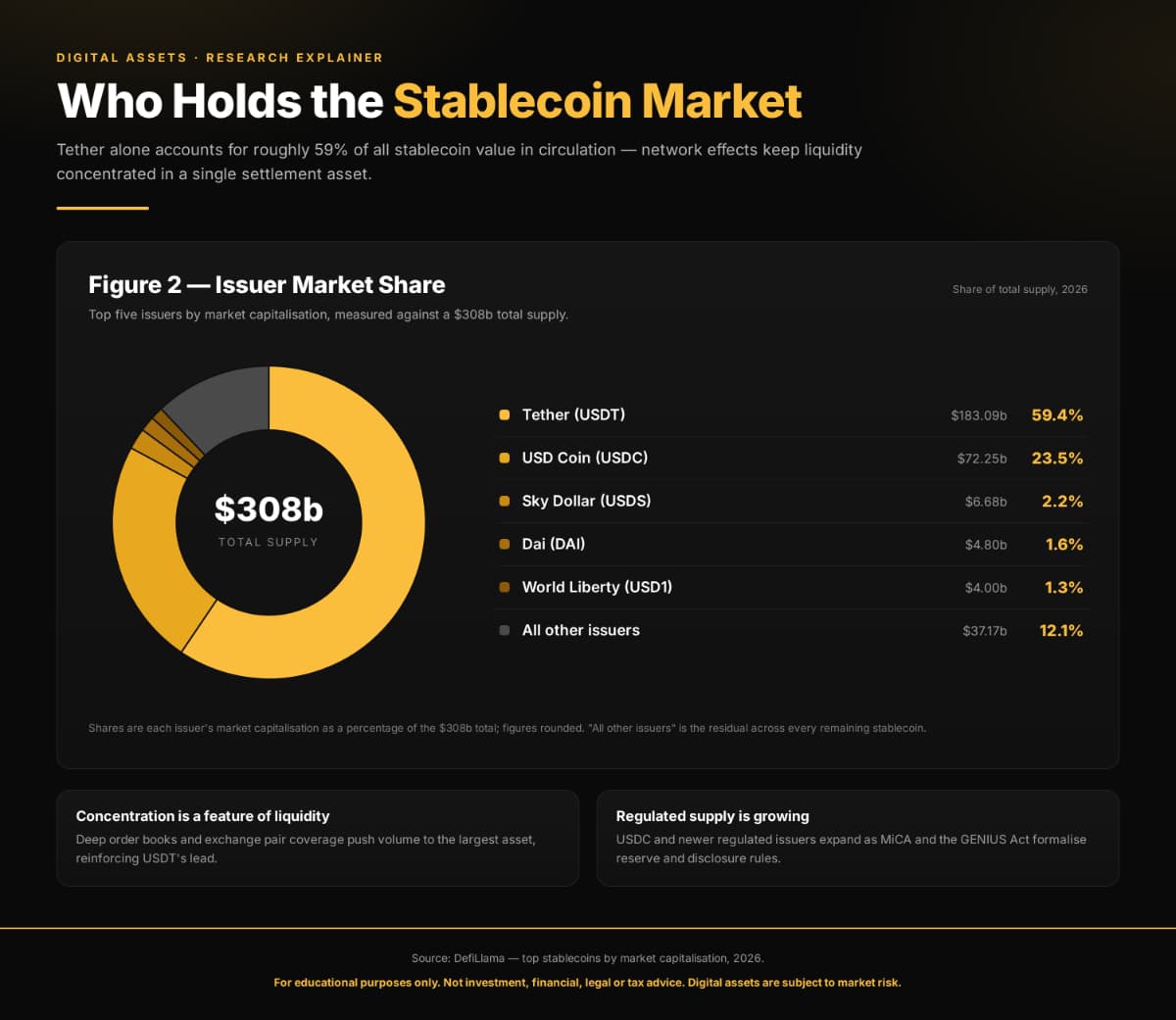
The rapid adoption of Tether overlapped with a structural expansion of the broader stablecoin market. According to DeFiLlama, total stablecoin market capitalisation increased from approximately US$27.38 billion at the beginning of 2021 to more than US$302 billion by early 2026, representing an increase of more than tenfold within five years. Although the market experienced a temporary contraction during the cryptocurrency downturn of 2022 and 2023, the subsequent recovery highlighted the growing importance of stablecoins beyond speculative trading. Their increasing use across decentralised finance, payments, remittances and tokenised financial products demonstrated that they had evolved into an important settlement layer within the digital asset ecosystem.
Tether remained the main driver of this expansion. Its circulation continued to increase across multiple market cycles, reinforcing its position as the dominant reserve-backed stablecoin and the preferred source of liquidity across cryptocurrency exchanges. By allowing users to preserve dollar
exposure without leaving blockchain networks, USDT became deeply unified into both centralised exchanges and decentralised finance protocols, portraying how a stable settlement asset could support an increasingly interconnected financial ecosystem.
As Tether's circulation expanded into the tens of billions of dollars, attention increasingly moved towards the quality and transparency of the reserves supporting every USDT in circulation. Unlike traditional cryptocurrencies, reserve-backed stablecoins depend on confidence that issued tokens can be redeemed against assets of equivalent value. Consequently, reserve management became central to discussions surrounding financial stability, governance and investor protection.
Regulatory scrutiny accelerated improvements across the industry. Tether gradually eliminated commercial paper from its reserve portfolio, increased its allocation to highly liquid U.S. Treasury Bills and strengthened reserve disclosures through regular confirmations. These developments reflected a broader industry shift in which transparency and reserve quality became as important as technological innovation in establishing long-term credibility.
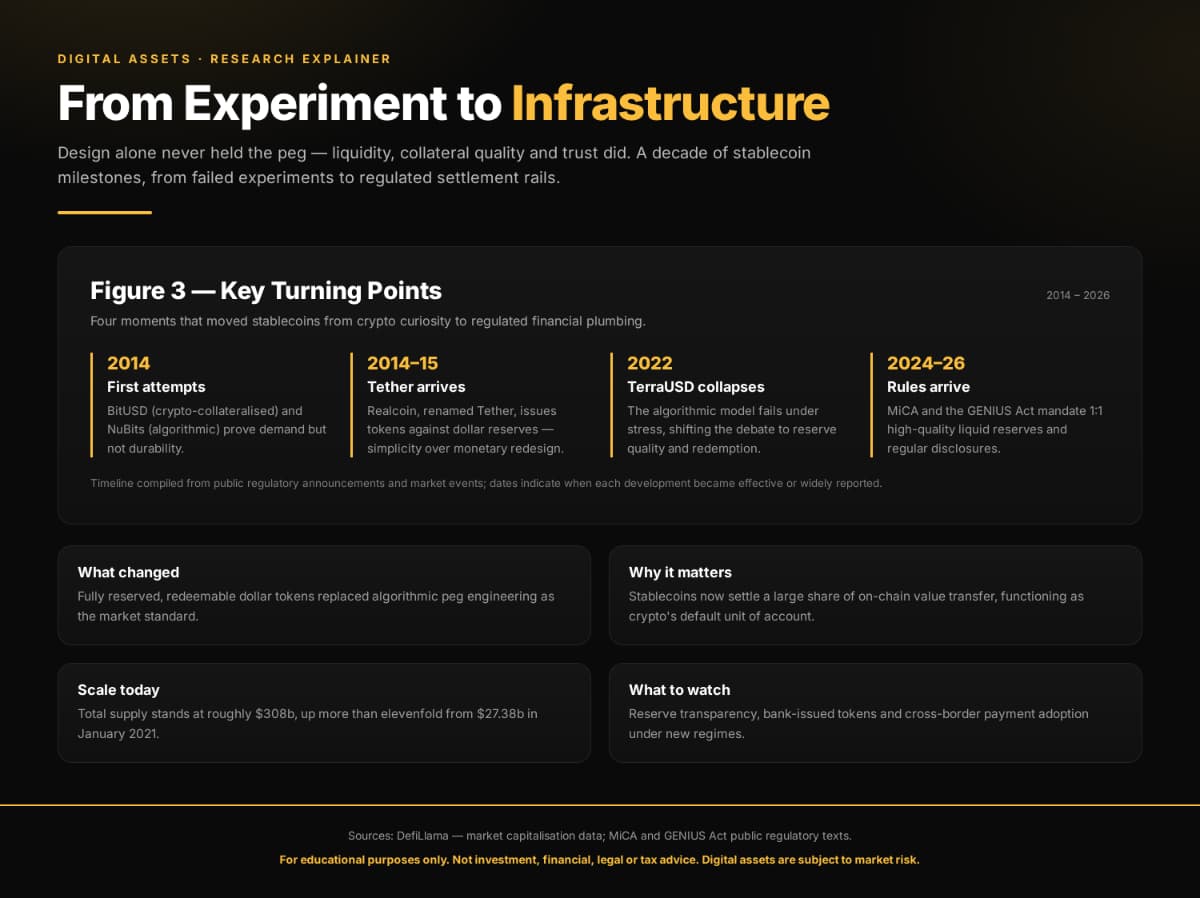
While Tether established itself as the dominant market leader, competing stablecoin models contributed to the industry's progression by addressing different market requirements. USDC placed itself around regulatory compliance, institutional adoption and transparent reserve reporting, while DAI demonstrated that decentralised collateral mechanisms could support relatively stable digital assets within the rapidly expanding decentralised finance ecosystem. In contrast, the collapse of TerraUSD (UST) in 2022 showed the limitations of algorithmic stablecoin models during periods of severe market stress, surging global discussions surrounding reserve quality, redemption mechanisms and systemic risk.
The continued expansion of stablecoins has also encouraged governments to develop dedicated regulatory frameworks. measures such as the European Union's Markets in Crypto-Assets (MiCA) Regulation explain the growing recognition of stablecoins as an emerging component of financial infrastructure rather than simply another category of digital assets. The GENIUS Act introduced the first comprehensive U.S. regulatory framework for payment stablecoins, requiring 1:1 reserve backing with high-quality liquid assets and enhanced transparency through regular reserve disclosures and regulatory oversight. Related discussions are underway across the United States and Asia, reflecting broader efforts to establish common standards for reserve management, governance and consumer protection. In India, developments such as Polygon's proposed ARC, an INR-backed stablecoin initiative, indicate that domestic blockchain ecosystems are also exploring stablecoins as potential instruments for digital payments and tokenised financial services.
Over little more than a decade, stablecoins have progressed from experimental blockchain projects into a market exceeding US$300 billion in circulation. Early initiatives such as BitUSD and NuBits proven the demand for digital representations of fiat currency, but it was Tether that successfully combined simplicity, liquidity and scalability to create the first stablecoin capable of supporting a rapidly expanding cryptocurrency ecosystem. Its success not only reformed trading infrastructure but also established the foundation upon which decentralised finance, blockchain-based payments and tokenised financial products continue to develop. The evolution of stablecoins demonstrates that technological innovation alone is insufficient to create lasting financial infrastructure. As the industry matured, long-term credibility increasingly depended upon reserve quality, governance, regulatory oversight and market confidence. Today, stablecoins are no longer viewed solely as instruments supporting cryptocurrency trading but as an increasingly important bridge between blockchain networks and traditional financial systems. Their future will undoubtedly continue to evolve alongside regulation and technological innovation, yet their long-term adoption will remain dependent upon the same principle that has underpinned every successful monetary system throughout history trust.
India Crypto Research operates independently. The information presented herein is intended solely for educational and informational purposes and should not be construed as financial advice. Before making any financial decisions, it's essential to undertake your own thorough research and analysis. If you're uncertain about any financial matters, we strongly recommend seeking guidance from an impartial financial advisor.