Stablecoins are moving beyond trading and becoming part of everyday payments, payroll, lending and business operations.
USDT and USDC may dominate the market, but their use cases and position within the financial ecosystem are increasingly different.
A growing lending and yield market is turning stablecoins from idle assets into an important part of on chain financial activity.
Banks, payment companies and governments are no longer just observing the space and are actively building stablecoin, tokenised deposit and digital currency infrastructure.
As adoption accelerates, Tether’s reserve composition and recent financial performance show why transparency and issuer risk remain just as important as growth.
Part of a series
India Crypto Research Brief
Current Article
The Dollar That Never Sleeps: Inside the Global Stablecoin Boom
1. The Issue
2. Real-World Uses, Beyond Trading
3. Why USDT Specifically Dominates
4. Stablecoin Lending and the Businesses Built Around It
5. What Countries and Banks Are Planning
6. Future Scope
7. What This Means for Readers
Why Crypto Stocks Are Exploding While Bitcoin Barely Moves?
1. What Exactly Are Crypto Stocks
2. Why These Stocks Move 2-5x Faster Than Bitcoin
3. What Breaks The Rally
4. How To Play This As An Investor
5. Conclusion
How 100x Leverage Turns a Crypto Dip Into a Huge Crash
1. Borrowing Big Is Normal in Crypto, and That's the Problem
2. At 100x, Even a Tiny Price Move Wipes You Out
3. How One Trader Getting Wiped Out Drags Everyone Else Down
4. Small Triggers Keep Causing Massive Crashes
5. For Indian Holders, Panic Selling Adds a 30% Tax Hit
6. Watch the Borrowing, Not the Headlines
What Tokenisation Is Quietly Opening Up Across the Four Largest Asset Classes
1. First, What Does Tokenisation Actually Look Like?
2.
3. Why BlackRock Is Moving Its Safest Product to Crypto Rails
4.
5. Why Retail Investors Miss the Biggest Wealth Creation of Every Decade
6.
7. You Can Spread Your Stock Portfolio Across 50 Companies. Real Estate Does Not Work Like That.
8.
9. Gold Is Becoming More Than Just a Store of Value
10.
11. Three Major Shifts Are Happening at the Same Time
12.
India's Crypto Policy Reset: From Taxation to Regulation
1. From Taxation to Compliance: The First Two Pillars of India's Crypto Regulation
2. Financial Stability and Investor Protection: India's Next Regulatory Priorities
3. The Road Ahead: What India's Regulatory Evolution Means for the Crypto Ecosystem
Contrary to Popular Belief, Bitcoin Isn’t Gold Yet
1. Why Isn’t Bitcoin Really Digital Gold Yet?
2. Why Doesn’t Scarcity Alone Decide How Markets Behave?
3. How Do Bitcoin and Gold Differ in Price Behaviour?
4. How Does Bitcoin’s Value Move Relative to Gold?
5. Why Don’t Bitcoin and Gold Move Together Consistently?
6. What Triggers Drive Bitcoin and Gold Differently?
7. How Do Different Market Environments Affect Bitcoin and Gold?
8. What Does the Bitcoin-Gold Relationship Really Tell Us?
The Evolution of Stablecoins
1. How Tether transformed crypto's biggest weakness into the foundation of digital finance
2. When Crypto Needed a Dollar
3. The First Generation of Stablecoins
4. Tether and the Birth of Digital Liquidity
5. The Rise of Stablecoins as Market Infrastructure
6. Growth Brings Greater Scrutiny
7. Competition, Regulation and the Next Phase of Stablecoins
If You’ve Traded Crypto This Year, You Need to Know Your Tax Liability
1. How Crypto Is Taxed in India
2. What Happens When You Sell Crypto
3. How Ordinary Traders Miss the Tax Impact
4. How Liability Is Actually Calculated
5. Advance Tax Considerations
6. Consequences of Incorrect Reporting
7. How to Calculate Your Exact Crypto Tax Liability
8. Here’s How It Works
Where Do Indian Crypto Exchanges Really Stand on Transparency and Safety?
1. A Comparative Snapshot of the Exchanges
2. CoinSwitch
3. CoinDCX
4. Mudrex
5. Bitbns
6. What Investors Should Understand
66 Percent of India's Civil Cases Are Land Disputes, and Blockchain Could Solve This Problem
1. Two Out of Every Three Civil Cases in India Trace Back to a Land Dispute
2. India’s MSME Credit Gap Is ₹30 Lakh Crore, and Disputed Land Records Are Making It Worse
3. Blockchain Could Be the Fix India's Land Records Problem Has Been Waiting For
4. Better Land Records Have the Potential to Change How Fast Things Move in India
5. India Has the Talent and the Use Case, What It Does Not Have Is Regulatory Clarity
If You Only Track Crypto Prices, You Are Missing the Real
Story
1. Digital Currencies Are Not Behaving the Way You Would Expect
2. Smart Contract Platforms Are Being Used More, But Earning Less
3. DeFi Lending Had a Strong Run and Is in a Healthy Place Despite the Recent Dip
4. Decentralised Trading Is Growing, But Margins Are Thin
5. CEX Tokens Are One to Watch as Regulations Get Clearer
6. What All of This Is Actually Telling Us
The CLARITY Act: U.S. Crypto Regulation At a Critical Turning Point
1. What is the CLARITY Act?
2. What would the framework change?
3. Why does the CLARITY Act matter?
4. Current status and legislative progress
5. Legislative timeline at a glance
6. What happened at Trump’s August 19, 2026 crypto meeting?
7. Impact of Trump’s CLARITY push on the crypto market
8. A Comparative table: GENIUS vs Clarity Act
9. What should the crypto market watch next?
10. Conclusion
11. Sources & further reading
Where Does Aave Stand in 2026
1. When Borrowing Slows, Fees Follow
2. Why Price and Fees Do Not Always Move Together
3. How Aave Compares to the Rest of the Market
4. What This All Adds Up To
US Crypto Regulation: From Uncertainty to Clarity
1.
2. Size of the US Crypto Market & The Need for Regulation
3.
4. What Is the CLARITY Act & Why did it Fail?
5.
6. It’s not over for the Clarity act: Democrats Pledge Bipartisan Support
7.
8. Crypto Tax Bill Advances After Collapse of CLARITY Act
9.
10. Strategic Bitcoin Reserve Bill Advances
11.
12. Fed Interest Rate Hike and its Impact on the Crypto Market
13.
14. The Way Forward for Crypto Regulation in the US
Crypto Regulation in Flux: US Gridlock, India's Stance & the Tokenisation Boom
1. US Regulation Update
2. India Regulation Update
3. Tokenisation Regulation Update
4. Stablecoin Regulation Update
5. What's Next
6. What This Means for You
Six On-Chain indicators Give Their Verdict on Bitcoin
1. In a nutshell
2. 1. MVRV shows Bitcoin is fairly valued, not overvalued
3. 2. Optimism in the market, per NUPL
4. 3. SOPR shows sellers are breaking even again
5. 4. Exchange flows favour holding over the long run
6. 5. Short-term holders are back in profit
7. 6. Long-term holders have started selling a little
8. All six signals in one view
9. What this means for readers
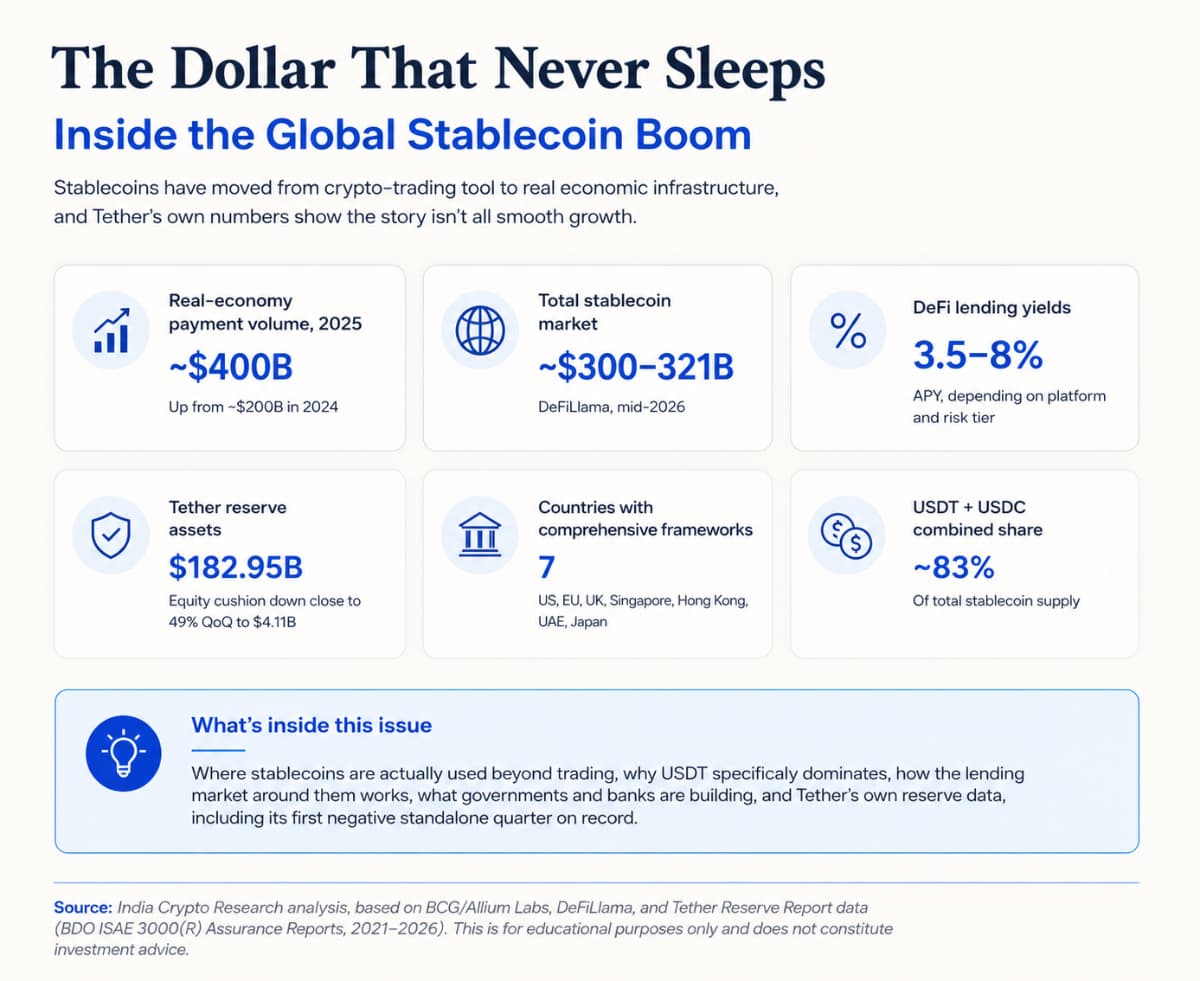
Stablecoins have quietly become bigger business than most people realize, and Tether's own numbers show why. Real-economy stablecoin payments doubled to roughly $400 billion in 2025, a growing lending market now pays 3.5–8% APY on parked stablecoins, and Tether alone sits on $187.75 billion in reserves as of June 2026, reserves that just posted their first-ever quarterly loss. Part 1 of this series covered how stablecoins evolved. This piece covers where they're actually used, why USDT specifically dominates, how the lending business around them works, what governments and banks are building, and where this heads next.
The Issue
Real-economy stablecoin payment volume, 2025: ~$400 billion, up from ~$200 billion in 2024 (BCG/Allium Labs)
Total stablecoin market: ~$300–321 billion (DeFiLlama, mid-2026)
Tether's reserve assets: $182.95 billion, equity cushion down close to 49% quarter-on-quarter to $4.11 billion; H1 2026 cumulative net result was –$3.17 billion, implying a standalone Q2 loss of roughly –$4.21 billion, Tether's first negative standalone quarter on record
DeFi stablecoin lending yields: 3.5–9% APY depending on platform and risk tier (Aave, Morpho, Compound, Spark)
Countries with comprehensive stablecoin regulatory frameworks: 7 (US, EU, UK, Singapore, Hong Kong, UAE, Japan)
Real-World Uses, Beyond Trading
Cross-border remittances and payroll : Traditional remittance corridors average 6.49% in fees (World Bank, Q1 2025) and take 3–5 business days through correspondent banking. A stablecoin transfer settles in minutes at meaningfully lower cost, independent research from EY-Parthenon found 41% of current stablecoin users report cost savings of at least 10%, concentrated in cross-border B2B payments. India-US is the world's largest single remittance corridor at $129 billion a year, and Indian IT firms receiving US client payments via stablecoins report faster cash flow versus traditional wires.
Contractor and gig-economy payroll is now a live production category : Deel launched stablecoin payroll for contractors in February 2026, covering 69+ countries; Remote offers a comparable USDC contractor-payment product across a similar country count. Scale AI pays overseas contractors in stablecoins specifically to shield them from local-currency volatility. Reported savings for a company running a 50-person remote team run roughly $2,000 to $5,000 a month in transaction costs, and contractors in emerging markets who previously waited weeks for a wire now report receiving funds within hours.
B2B cross-border payments, the dominant use case by volume : One widely cited estimate puts B2B stablecoin volume at roughly $226 billion, about 60% of total "real" (non-speculative) stablecoin payment volume, as of early 2026, up from under $100 million a month as recently as early 2023. Commerce-related stablecoin payments overall, as distinct from exchange trading activity, more than doubled in 2025 and now represent roughly 10% of total stablecoin transaction volume, per McKinsey's 2025 Global Payments Report. Settlement finality is part of the appeal: under 400 milliseconds on Solana, 15 seconds on Ethereum, 1–2 seconds on TRON, versus SWIFT GPI, which still can't guarantee same-day settlement in every corridor.
Creator and marketplace payouts : Content platforms and marketplaces are adopting stablecoin payouts for the same reason gig platforms are, speed and currency stability for a genuinely global workforce. A US company paying a Brazilian creator, for instance, can settle in minutes instead of navigating SWIFT delays and a 5–10% FX spread. Visa, PayPal, and Stripe have each built stablecoin payout infrastructure marketed at this use case through 2026.
Everyday spending is smaller but growing fast : Stablecoin-linked card spending reached roughly $18 billion on an annualised basis in early 2026, compounding at around 106% a year since January 2023, still a small slice of overall card volume, but the growth rate signals stablecoins moving toward everyday commerce rather than staying confined to trading and treasury.
Treasury and liquidity management : Businesses increasingly hold stablecoins as working capital, moving value between wallets, entities, and jurisdictions without waiting on banking hours or correspondent chains, increasingly supported by on-chain FX liquidity pools for pairs like USDC to local currencies.
Adoption breadth : Active stablecoin wallets grew from roughly 19.6 million in February 2024 to just over 30 million by February 2025, about 53% year-on-year, a broader base than trading-only usage would suggest. Looking further out, EY-Parthenon projects 5–10% of all cross-border payments could run through stablecoins by 2030, representing $2.1–4.2 trillion in value, a wide range worth treating as a directional estimate rather than a firm forecast.
Why USDT Specifically Dominates
USDT and USDC together make up roughly 83% of total stablecoin supply, but they don't serve identical roles. USDC leans toward regulated, US-centric institutional flows, PayPal's PYUSD and BUIDL-style tokenized Treasury products sit in the same lane. USDT's strength is different: it is the default dollar-access instrument in markets where banking infrastructure is weakest or least trusted, which is exactly where grassroots crypto adoption research consistently finds the heaviest usage.
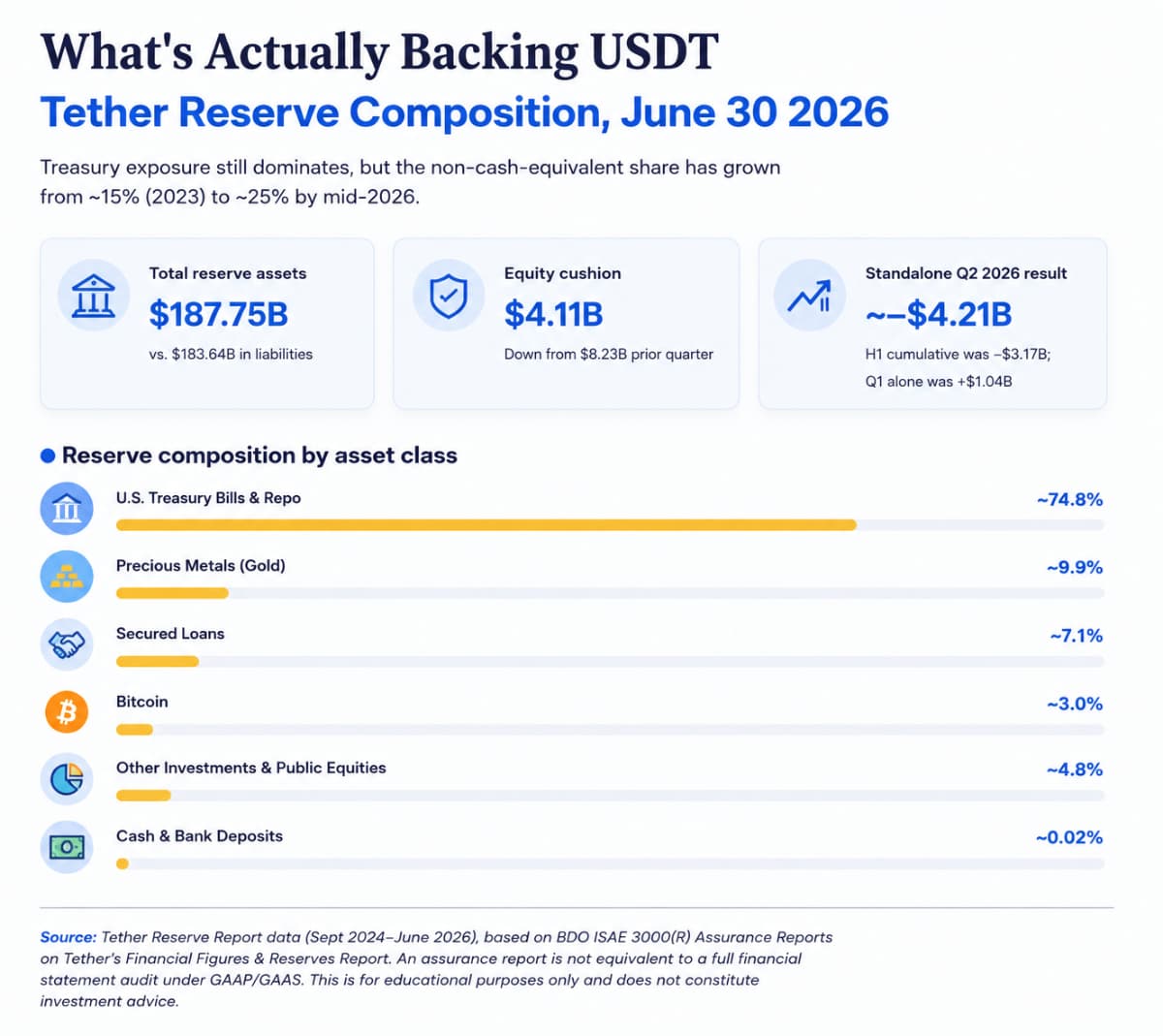
Tether's own reserve data adds texture to this. As of June 2026, its $187.75 billion in reserves runs at least 74.8% in U.S. Treasury bills and repo, and the real Treasury-linked exposure is likely higher still, money market fund holdings were about 73.4% indirectly Treasury-backed as of the last full breakdown, and overnight repo collateral was effectively 100% Treasuries (precisely 99.97%). The rest sits in precious metals (around 9.9%, up from $3.39B, or 4.1% of reserves, in March 2023, the earliest period in this dataset with a full breakdown), secured loans (around 7.1%, a category that draws the most analyst scrutiny since "secured" doesn't specify collateral quality), and Bitcoin (around 3.0%). Notably, Tether also runs a separate, non-reserve investment arm, Tether Investments Ltd, explicitly not part of USDT's backing, that grew from $4.78 billion to $12.44 billion in equity in just nine months through 2024, funded by profits from the reserve business itself. And the most recent report shows the reserve side under real pressure: a cumulative net loss of $3.17 billion for the first half of 2026, implying a standalone Q2 loss of roughly $4.21 billion (versus a $1.04 billion gain in Q1 alone), cut the equity cushion by close to half quarter-on-quarter. All of this comes from BDO ISAE 3000 assurance reports, an internationally recognised standard, but explicitly not the same as a full financial-statement audit under GAAP or GAAS.
Stablecoin Lending and the Businesses Built Around It
Holding stablecoins doesn't have to mean holding them idle. A real lending market has grown around them, split into two broad models:
DeFi lending protocols: Aave, Compound, Morpho, and Spark let users deposit stablecoins into liquidity pools; borrowers post crypto collateral and pay interest to borrow against it, typically for leverage or arbitrage. Aave alone holds roughly $20–26 billion in total value locked across 22+ networks, making it the largest venue by a wide margin. Yields compressed through 2026 as leverage demand cooled, Aave's USDC rate sat around 2.61% in April 2026, though the wider DeFi range runs 3.5–9% APY depending on platform and risk tier.
CeFi lending platforms: Centralized services that manage deposits on a user's behalf, publish audits, and use institutional custody, generally offering higher, steadier rates (roughly 6.5–8.5% APY on USDT for established platforms) in exchange for counterparty trust rather than smart-contract risk.
Issuer-side yield products are a third, newer lane. Since the GENIUS Act bars US payment-stablecoin issuers from paying yield directly to holders, platforms built around tokenized Treasury products (BUIDL, USDY) and yield-bearing stablecoin variants (Aave's aUSDC, MakerDAO's sDAI) have emerged to offer yield through a separate product layer instead. The mechanism underneath all of these is the same idea Tether's own reserves illustrate: an issuer takes in stablecoins or fiat, deploys the capital into yield-generating assets, mostly Treasuries, and shares a portion of that return.
What Countries and Banks Are Planning
Governments are running two different playbooks, and several are running both at once.
China operates the largest retail CBDC pilot globally: the e-CNY passed 16.7 trillion yuan (~$2.3 trillion) in cumulative transactions by November 2025, live in 26 cities, with interest-bearing wallets added in January 2026.
UAE is doing both: AE Coin became the first licensed dirham-pegged stablecoin in 2024, while the government simultaneously pilots a Digital Dirham CBDC on the mBridge cross-border network alongside China, Hong Kong, Thailand, and Saudi Arabia.
Japan formally regulates stablecoins under a 2022 amendment to its Payment Services Act, restricting issuance to licensed banks and trust companies; its JPYC stablecoin passed ¥50 million in volume within 48 hours of its October 2025 launch. Separately, Japan's three largest banks are reported to be planning a jointly issued stablecoin by March 2027, backed by regulators.
India is building both a rupee-backed stablecoin, the Asset Reserve Certificate (ARC), developed by Polygon and fintech Anq and targeted for Q1 2026, alongside the RBI's own digital rupee CBDC pilot, which had crossed ₹1,000 crore (~$122 million) in transactions by March 2025.
Hong Kong brought its Stablecoins Ordinance into effect on 1 August 2025, with a paid-up capital floor and full high-quality-liquid-asset reserve backing required. The Hong Kong Monetary Authority received 36 formal license applications by the September 2025 deadline and, as of April 2026, had granted exactly two: one to HSBC, one to Anchorpoint, a joint venture between Standard Chartered's Hong Kong arm, HKT, and Animoca Brands.
The European Union, separately from its digital euro CBDC work, saw nine major banks, including ING, UniCredit, and Deutsche Bank, form a consortium to launch a MiCA-regulated euro stablecoin, targeted for mid-2026.
The United Kingdom has taken a more cautious retail posture: the Bank of England initially proposed ownership caps between £10,000 and £20,000 on individual stablecoin holdings, though reports indicate exemptions are being prepared for firms like crypto exchanges that need larger holdings for liquidity and settlement purposes.
On the bank and payments-industry side, activity has moved well beyond early pilots into competing live products:
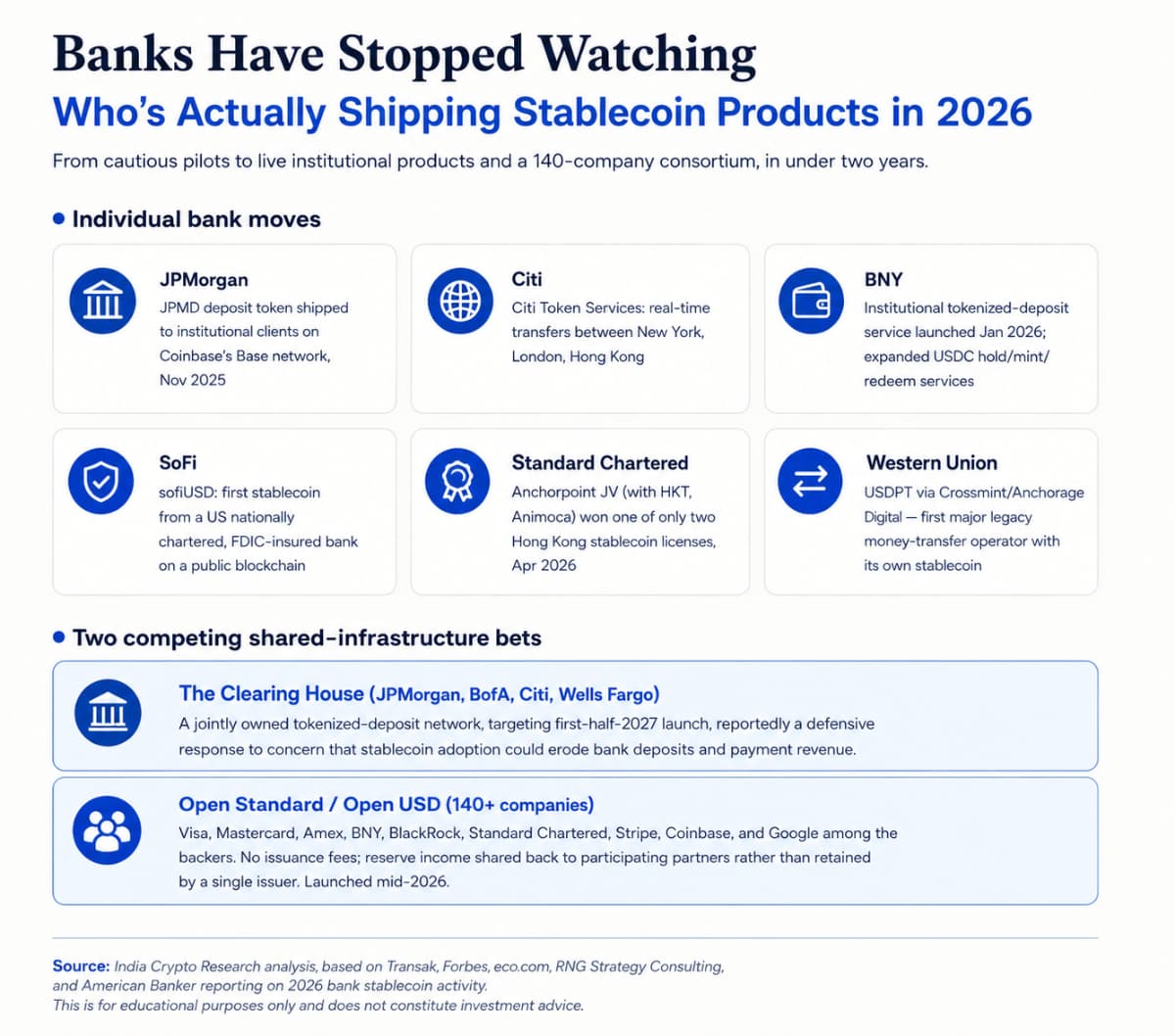
JPMorgan shipped its JPMD deposit token to institutional clients on Coinbase's Base network in November 2025, and separately runs JPM Coin.
Citi operates Citi Token Services for real-time transfers between New York, London, and Hong Kong; BNY launched an institutional tokenized-deposit service in January 2026 and separately expanded services letting institutional clients hold, mint, and redeem USDC directly.
SoFi launched sofiUSD, described as the first stablecoin issued by a US nationally chartered, FDIC-insured bank on a public blockchain, using BitGo's infrastructure, with an initial roster of institutional partners including Fireblocks, Galaxy, and Mastercard.
JPMorgan, Bank of America, Citigroup, and Wells Fargo are jointly building a shared tokenized-deposit network through The Clearing House, which they jointly own, targeting a first-half-2027 launch, a defensive move reportedly motivated by concern that stablecoin adoption could erode bank deposits and payment revenue.
A separate, larger consortium, Open Standard, launched in mid-2026 with more than 140 backing companies, including Visa, Mastercard, American Express, BNY, BlackRock, Standard Chartered, Stripe, Coinbase, and Google, issuing a token called Open USD with no issuance fees and reserve income shared back to participating partners rather than retained by a single issuer.
Western Union partnered with Crossmint and Anchorage Digital to launch USDPT, becoming, by most accounts, the first major legacy money-transfer operator to issue its own branded stablecoin.
Payment processors have moved via acquisition rather than building from scratch in some cases: Mastercard paid up to $1.8 billion for BVNK, and Stripe paid $1.1 billion for Bridge, later securing conditional approval for a national trust bank charter through it in February 2026.
Standard Chartered has separately published research warning that broad stablecoin adoption could draw more than $1 trillion out of emerging-market bank deposits by 2028, as users in higher-inflation economies increasingly treat dollar stablecoins as a de facto dollar bank account, one reason regulators in several of those markets are watching this space closely.
The throughline across nearly every institution above: as of 2026, holding back and waiting has largely stopped being the strategy. The GENIUS Act's passage in July 2025 is widely credited with converting stablecoins from a supervisory risk for banks into a product line worth competing in directly.
Future Scope
A few directions this is heading, based on where regulation and product development are pointed right now: tokenized bank deposits as a parallel track to stablecoins, letting banks offer blockchain-native settlement without ceding the deposit relationship, already underway with The Clearing House's shared network; deeper TradFi integration, tokenized Treasury funds like BUIDL already trading on public DEXs; the CBDC-vs-private-stablecoin question staying unresolved, with most major economies hedging by building both rather than picking one; consolidation and shared-infrastructure models, illustrated by Open Standard's 140-plus-company coalition betting that shared governance beats a single dominant issuer; and continued scrutiny of reserve composition and issuer transparency, an area where Tether's own trajectory, growing non-Treasury allocations, a newly disclosed investment arm, and a first loss-making quarter, shows exactly why that scrutiny is warranted even for the largest, most established player.
What This Means for Readers
The center of gravity has shifted from trading to payments and yield. The biggest stablecoin story in 2025–26 isn't a new coin, it's institutional payment adoption and a maturing lending market around existing ones.
USDT and USDC serve different jobs, not just different brands. USDT's edge is dollar access in weak-banking-infrastructure markets; USDC and newer entrants lean regulated and institutional.
Yield on stablecoins comes from real underlying activity, not magic. Whether DeFi lending, CeFi platforms, or issuer-side products, the return traces back to interest on Treasuries or interest paid by borrowers, understanding which one you're exposed to matters more than the headline APY.
CBDCs and private stablecoins aren't necessarily competitors. China, UAE, and India are all building both, aimed at different jobs, wholesale settlement versus retail/corporate payments.
Even the most established stablecoin isn't static or risk-free. Tether's Q2 2026 loss and shifting reserve composition are a live reminder that "backed 1:1" doesn't mean "unchanging," and issuer disclosures are worth reading past the headline number.
Disclaimer
India Crypto Research operates independently. The information presented herein is intended solely for educational and informational purposes and should not be construed as financial advice. Before making any financial decisions, it's essential to undertake your own thorough research and analysis. If you're uncertain about any financial matters, we strongly recommend seeking guidance from an impartial financial advisor.



 Part of a series