BrandLogo
Table of Contents

India: Enforcement Over Legislation

United States: Regulators Move Without Congress

European Union: MiCA Is Live, But Already Changing

Steady and Predictable: Dubai

What This Means for the Reader

FAQs

beginner

Regulation’s Week- ICR Crypto Regulation Updates

By India Crypto Research|4 mins read
Last Updated on: Sep 22, 2026|Published On: Sep 22, 2026
Key Takeaways
  • India is choosing enforcement over legislation. The Finance Ministry has ruled out a dedicated crypto law and is leaning on tax and AML enforcement instead, with FIU IND already acting against 15 offshore exchanges.
  • U.S. agencies didn't wait for Congress. After the CLARITY Act fell short 49–50 in the Senate, the SEC and CFTC issued their own exemption and rulemaking proposal within 48 hours.
  • MiCA is fully in force but still evolving. With only 244 firms fully authorised as CASPs, the EU is already consulting on "MiCA 2.0" to bring non EU stablecoin issuers into scope and centralise supervision under ESMA.
  • Dubai keeps setting the pace on predictability. VARA's updated rulebook now permanently allows exchange traded crypto derivatives, and the UAE's licensed VASP count has crossed 80 as oversight becomes the focus.
India Crypto Research
LearnPart of a series
Crypto Market Updates
Bitcoin's Week. A Mixed CPI Report, Four Days of ETF Outflows, and a Vote Nobody Can Call
  • 1. Tuesday-Wednesday, 8-9 September
  • 2. Thursday, 10 September: The worst day of the week for ETFs
  • 3. Friday 11 September: balanced CPI data grew confidence for both hawks and doves
  • 4. Monday, 14 September
  • 5. The vote that hangs over everything
XRP's Week. A Fall Under $1.34, a Zero-Flow Day, and the Only ETF Category That Never Went Negative
  • 1. Tuesday to Thursday, 8 to 10 September
  • 2. Friday, 11 September: price recovers, flows go flat
  • 3. 12 to 13 September
  • 4. The real story: XRP’s ETFs never went red.
  • 5. Wall Street is beginning to use XRP ETFs as collateral
  • 6. What it means
BNB's Week. A $752 Open, a Drop Under $710, and a Real-World-Asset Crown Taken From Solana
  • 1. Tuesday to Thursday, 8 to 10 September
  • 2. Friday, 11 September: The CPI spike works in BNB's favor as well
  • 3. The weekend: 12 to 13 September
  • 4. The Real Story: BNB Chain Blows Past Solana for Real-World Assets
  • 5. Still no BNB ETF, but the filings keep moving.
  • 6. What it means
Market Update: BNB’s $700 Battle, What’s Behind the Pullback?
  • 1. BNB Had Its Own Big Week Too. Here's What Actually Happened
  • 2. The rally into midweek
  • 3. The pullback
  • 4. Today, 1 September
  • 5. What actually drove the rally
  • 6. How it compares to bitcoin's week
Solana Market Update: Governance Vote Rewrites Inflation and Token Economics
  • 1. Solana Just Rewrote Its Own Economics. Here's the Full Story
  • 2. The rally into the vote
  • 3. Friday's governance vote
  • 4. The weekend and into today
  • 5. Why this matters more than a normal price swing
Market Update: Ethereum’s $2,500 Wall, ETF Inflows Keep Climbing
  • 1. Ethereum, Near-Record ETF Inflows, Staking kept climbing through the month, a Wall at $2,500, and a Close Near $2,419
  • 2. ETF inflows never went negative in the last week
  • 3. Staking kept climbing through the month
  • 4. What's still working underneath the chop
Market Update: TRX Holds Steady as Nasdaq Treasury Keeps Buying
  • 1. A Nasdaq Treasury Keeps Buying While the Price Barely Moves
  • 2. The week in price
  • 3. The real story: a Nasdaq company that keeps buying TRX
  • 4. A staked TRX ETF is still waiting on the SEC
  • 5. Why any of this matters for TRX specifically
Solana's Week. A Trip to $98.65, an ETF Market Measured in Millions Not Hundreds of Millions, and an Upgrade Still Waiting to Go Live
  • 1. Between Tuesday and Wednesday, 8 and 9 September:
  • 2. Thursday, 10 September: a multi-week low
  • 3. Friday, 11 September: the CPI spike lifts SOL back above $100
  • 4. Monday 14 September
  • 5. A network upgrade that isn't activated yet.
  • 6. Defining moments
Bitcoin Mining and Number of Bitcoins Mined Till Today
  • 1. 1. What Is Bitcoin Mining?
  • 2. 2. Why Bitcoin Mining Matters
  • 3. 3. How does the Bitcoin Mining Process Work
  • 4. 4. The Evolution of Bitcoin Mining
  • 5. 5. How Bitcoin Miners Earn Money
  • 6. 6. Bitcoin Halving and the 21 million Supply
  • 7. 7. The Future of Bitcoin Mining
  • 8. Conclusion
Ethereum's Week. A $2,654 Spike, Two ETF Outflow Days Instead of Four, and a Quarter That's Up 60%
  • 1. CPI for Friday, September 11
  • 2. Monday, 14 September
  • 3. Institutional staking as an infrastructure service
  • 4. What this means
Bitcoin's Week. A Fed Governor, a Jobs Report, and $730 Million in One Day
  • 1. Monday to Wednesday, 31 August to 2 September
  • 2. Thursday, 3 September: Waller talks, bitcoin flies
  • 3. Friday, 4 September: the jobs report undoes it
  • 4. The weekend: 5 to 7 September
  • 5. The ETF money, day by day
  • 6. What it means
Ethereum’s Week: Whales Are Buying, Retail Is Selling, and $2,544 Won’t Budge
  • 1. Monday to Thursday, 31 August to 3 September
  • 2. Friday, 4 September: a fresh high, then the jobs report
  • 3. The weekend: 5 to 7 September
  • 4. Whales Buying, Retail Selling
  • 5. ETF demand cooled off sharply
  • 6. Behind the scenes: Vitalik on Ethereum's cryptographic future
  • 7. What it means
Solana’s Week: A Death Cross, $348M in RWA Flows, and a Choppy Climb to $105
  • 1. Monday to Thursday, 31 August to 3 September
  • 2. Friday, 4 September: the jobs report cools things down
  • 3. Monday, 7 September
  • 4. ETF flows swung both ways
  • 5. Solana still leads on real-world assets.
  • 6. A death cross is now in place.
  • 7. What it means
Solana's Week. A Fall Under $96, a 17% Faster Network, and an ETF Streak That Wouldn't Break
  • 1. September 16: The Fed Hikes; SOL Remains Strong
  • 2. September 17: Positive Close on Quiet Network Upgrade
  • 3. September 18: Investor Favor Continues; Major Speed Upgrade Activated
  • 4. The recent improvements to the network and what is ahead
  • 5. What's happening
Ethereum's Week. A Drop Under $2,400, a Glamsterdam Milestone, and a Missed Shot at $2,672
  • 1. Tuesday, September 15: ether follows bitcoin lower
  • 2. Wednesday, September 16: FED raises rates, Ether tests Glamsterdam
  • 3. Thursday, September 17: further Ether outflows
  • 4. Sept. 18: Rally arrives, flows turn positive
  • 5. The remainder of the week, Sept. 19-20:
  • 6. What the recent test run means
  • 7. What it Means
XRP's Week. A 9.8% Crash, Ripple's Legal Team Speaks Up, and a Ledger Upgrade Racing Toward Activation
  • 1. September 15: The Crash, and What's at Stake for XRP
  • 2. September 16: bottom before the rate hike
  • 3. September 17: sideways price action and the approach of the Ledger update
  • 4. What the Batch V1.1 update does and the reason for a partial rebuild
  • 5. What it Means
BNB's Week. A Dip to $704, a $768 Peak, and a Correction on a Previous Claim
  • 1. Thurs. 17 September: continued climb
  • 2. Fri. 18 September: Week's high
  • 3. 19-20 Sept. Weekend
  • 4. Revising BNB's ETF section of last week's report
  • 5. What it means
Bitcoin's Week. A Failed Senate Vote, a Fed Hike, and a Rally That Shrugged Off Both
  • 1. Tuesday, September 15: The CLARITY Act Fails
  • 2. Wednesday, 16 September
  • 3. Thursday, 17 September
  • 4. Friday, 18 September
  • 5. The Weekend: Sep 19-20
  • 6. The Cross
  • 7. What it means
Current Article
Regulation’s Week- ICR Crypto Regulation Updates
  • 1. India: Enforcement Over Legislation
  • 2. United States: Regulators Move Without Congress
  • 3. European Union: MiCA Is Live, But Already Changing
  • 4. Steady and Predictable: Dubai
  • 5. What This Means for the Reader
Bitcoin Treasuries Week: Trump's MSTR Stake, Strategy and Strive Both Buy, and BTC Breaks $84,000
  • 1. Top 3 Latest News on BTC Treasuries
  • 2. Top 5 Bitcoin Holding Companies
  • 3. Top 5 Bitcoin ETFs
  • 4. Top 5 Government Bitcoin Holdings
  • 5. Top 5 Ethereum Treasury Companies
  • 6. Most Important Digital Credit Instruments
  • 7. Summing Up

Four different regulatory scenarios played out last month. The biggest difference maker was likely the 15th of September session of the U.S. Senate. If just eleven more votes had been cast in favour of the CLARITY Act, it would have delivered the first-ever comprehensive legislative framework for digital assets in the world's largest economy, but it fell short 49-50. Meanwhile, just over a week before that, India's financial intelligence unit had already taken action against 15 offshore digital asset exchanges. As the U.S. and India presented examples of legislative gridlock and enforcement-led regulation respectively, the digital asset regulatory landscape in Europe and the UAE continued to evolve as well.

India: Enforcement Over Legislation

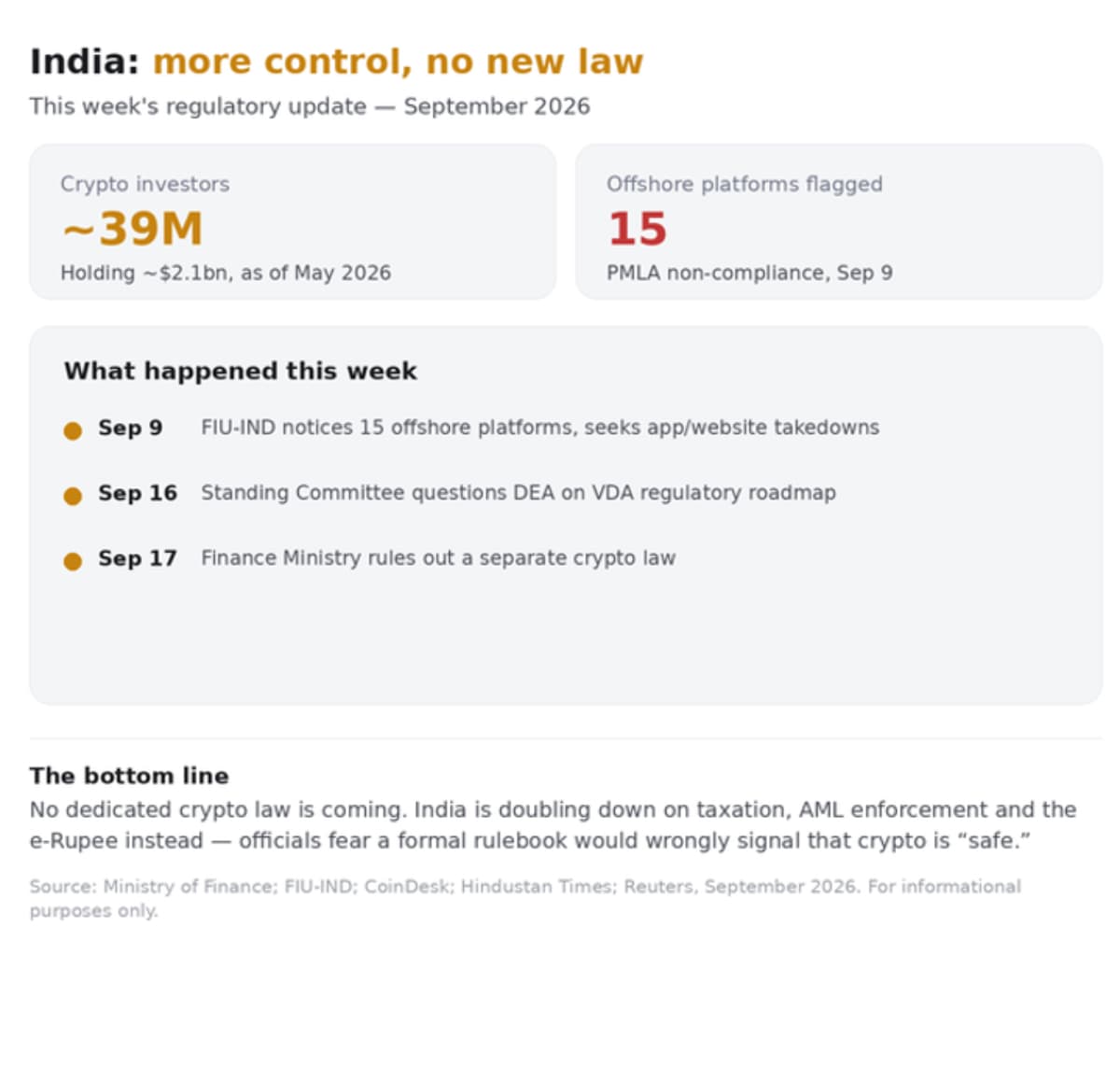
The focus of India's regulation of the digital asset space this month was the government's decision not to pursue a separate law. On September 17th, the Indian Finance Ministry told Parliament's Standing Committee that a dedicated law to regulate digital assets was not under consideration. Officials pointed to the Digital Rupee as the "safe" alternative and expressed concern that a formal regulatory framework for digital assets could create a false sense of security among investors, suggesting government backing where none exists.

This statement came two days after the Department of Economic Affairs (DEA) was questioned before the Standing Committee on where its VDA policy actually stands. Just over a week before that, the Financial Intelligence Unit (FIU-IND) had issued notices to 15 offshore cryptocurrency exchanges, including Weex, Blofin, Bitunix and Pionex, for operating in India without registering under the Prevention of Money Laundering Act (PMLA). Any crypto platform serving Indian users is required to register under the PMLA, verify customers and report suspicious activity, regardless of where it's based. FIU-IND asked for their apps and websites to be blocked outright, the same strategy that was used against Binance in 2024, which eventually led to Binance registering in India and paying a fine of ₹18.82 crore (roughly $2.23 million).

India's focus is clearly enforcement over legislation. With an estimated 39 million Indian investors holding around $2.1 billion in crypto, and fewer than a quarter of them actually declaring their gains at tax time, it's not hard to see why the government is leaning into enforcement rather than writing new law.
Blog_Image

United States: Regulators Move Without Congress

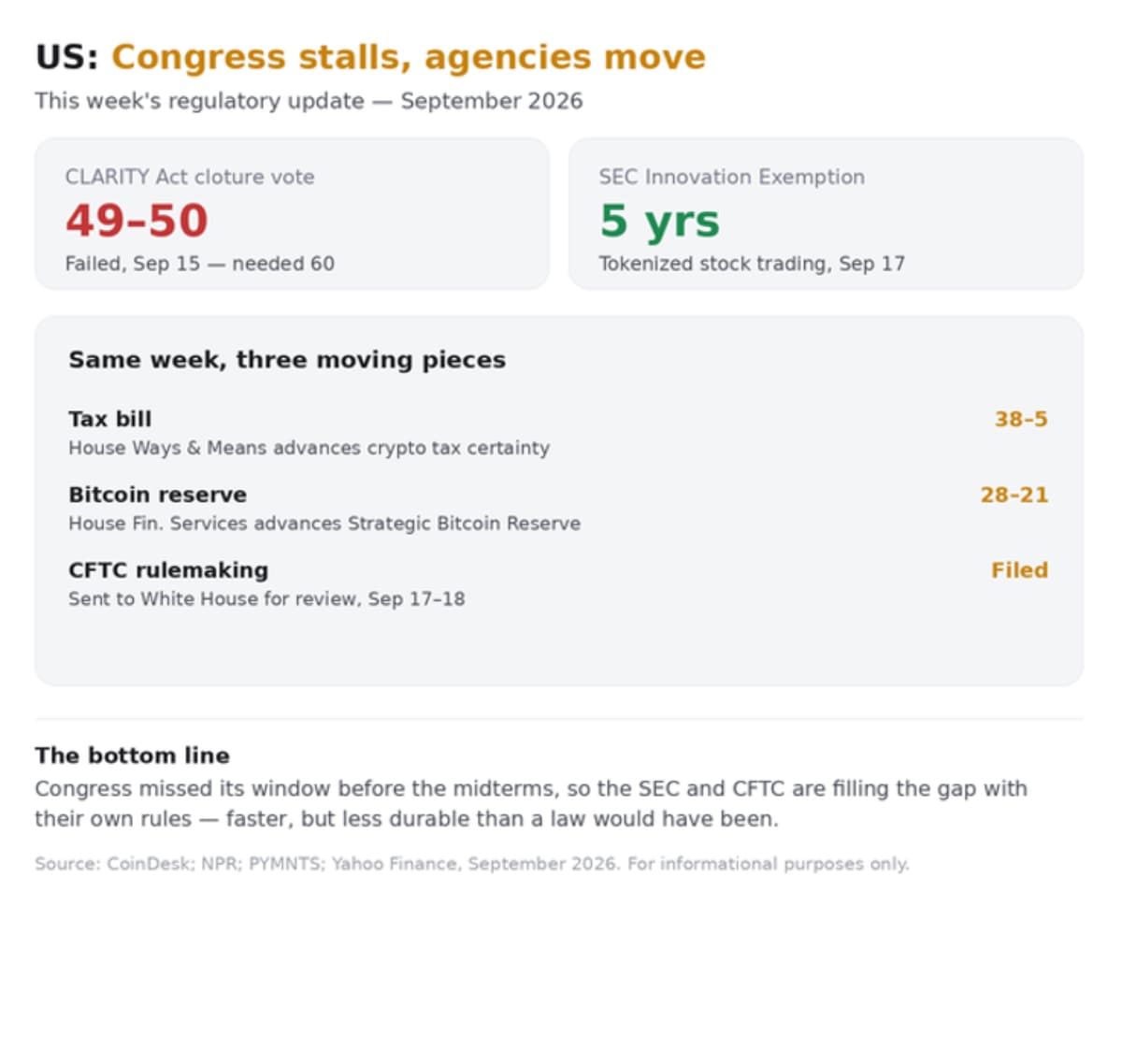
The most important part is what happened afterward. Within 48 hours of the CLARITY Act's failure, the Securities and Exchange Commission (SEC) rolled out a five-year "Innovation Exemption," allowing qualifying platforms to trade tokenised versions of US securities on chain without registering as full exchanges. The Commodity Futures Trading Commission (CFTC) also sent its own broad crypto rulemaking proposal to the White House for review. In effect, both agencies decided not to wait on Congress.

During the same stretch, two narrower bills kept moving: the House Ways and Means Committee voted 38–5 to advance a crypto tax certainty bill, and the House Financial Services Committee voted 28–21 to advance the bill formalising Trump's Strategic Bitcoin Reserve. The pattern is becoming familiar. Narrow, targeted bills keep gaining support, while the big comprehensive bill keeps stalling.
Blog_Image

European Union: MiCA Is Live, But Already Changing

On July 1st, the final phase of the Markets in Crypto Assets (MiCA) framework entered into effect across all 27 EU member states. MiCA mandates uniform licensing and operating rules for crypto firms and sets out risk disclosure and client asset safeguarding requirements. But the framework being fully in force doesn't mean it's finished.

As of early July, only 244 firms had completed full authorisation as Crypto Asset Service Providers (CASPs), MiCA's licence category for exchanges, custodians and brokers. Brussels has already opened a consultation on what's informally being called "MiCA 2.0." The headline proposal is bringing non-EU stablecoin issuers into scope, largely aimed at US issuers riding in on the back of the GENIUS Act, alongside dedicated rules for tokenised deposits and payments.

There's also a push to centralise supervision of authorised firms under the European Securities and Markets Authority (ESMA) rather than leaving it scattered across national regulators. ESMA has separately kicked off a multi-year review, running into 2027, of how licensed firms are actually safeguarding client assets, a sign the EU is shifting from "get everyone licensed" to "make sure the licence actually means something."

Steady and Predictable: Dubai

Regulatory movement from VARA continues in its usual, undramatic way. VARA's updated Exchange Services Rulebook (v2.1) took effect on March 31st, and for the first time permits excha crypto derivatives, including futures, options and perpetuals, under a permanent regime, with controlled retail access rather than a blanket ban or a free-for-all.

It isn't acting alone, either. The UAE's federal Capital Markets Authority rolled out its own Virtual Assets Framework in April, expanding its regulated activities from three to eight, running in parallel with VARA's Dubai-specific rules rather than replacing them. VARA also published fresh AML/CFT risk assessment guidance in June. Altogether, the UAE now has over 80 licensed virtual asset service providers across its five regulators, and the emphasis has clearly shifted from "can you get a licence" to "can you keep it."

What This Means for the Reader

Four different regulatory postures from India, the U.S., Europe and the UAE, each reflecting a different regulator's approach. India and the UAE are steadily pressing ahead with enforcement and rule updates, while the U.S. and Europe are working around legislative gridlock through agency action and rulebook revisions.

The overall trend is clear: almost nobody is waiting for comprehensive legislation anymore. Regulation is showing up through whatever tool is already available: tax law, agency exemptions, rulebook revisions, licensing regimes. In these four markets, it's more likely a new rule will arrive as a tax notice, an agency exemption, or a compliance circular than as a headline-grabbing new law. Worth keeping an eye on which of these approaches actually holds up.

Frequently Asked Questions

Why is India ruling out a dedicated crypto law?

The Finance Ministry believes a formal law could be misread as government backing or a "safety" signal, so it's sticking with tax and AML enforcement while pushing the Digital Rupee as the preferred alternative.

What happened to the CLARITY Act in the Senate?

It failed a procedural vote 49-50 on September 15th, eleven votes short of the 60 needed to advance. It isn't dead, but it has little runway left before the midterms.

Is MiCA a finished rulebook now that it's fully in force?

No. Full enforcement began July 1st, but only 244 firms hold complete CASP authorisation, and the EU is already consulting on "MiCA 2.0," which could bring non EU stablecoin issuers into scope.

What sets Dubai's approach apart from the other three regions?

VARA just keeps updating its rulebook on a predictable schedule. Its March 2025 update permanently legalised exchange traded crypto derivatives, and the UAE now has over 80 licensed VASPs across five regulators.
Disclaimer

India Crypto Research operates independently. The information presented herein is intended solely for educational and informational purposes and should not be construed as financial advice. Before making any financial decisions, it's essential to undertake your own thorough research and analysis. If you're uncertain about any financial matters, we strongly recommend seeking guidance from an impartial financial advisor.