
The Deal in Numbers
Inside Demat 2.0: Two Wallets, One Settlement
Timeline to the Pilot
Market Context
Not Everyone's Calling It a Fix
What's Next

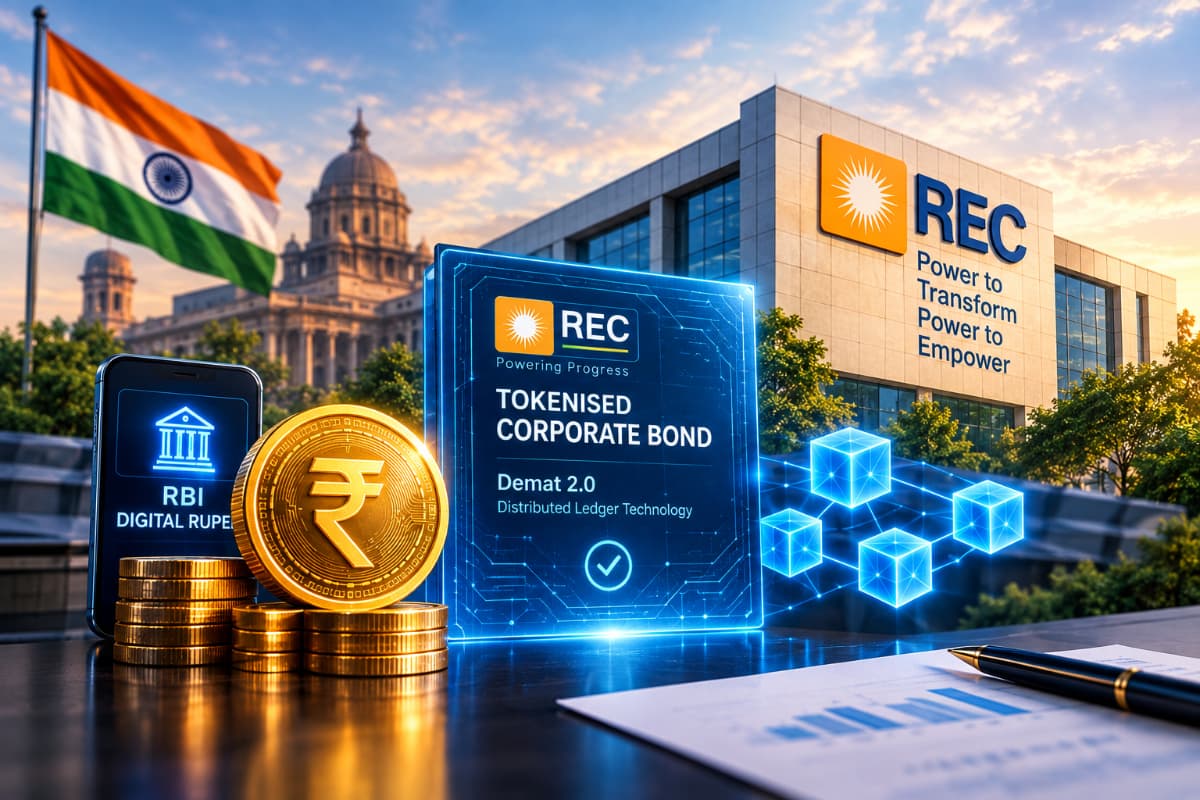
REC Limited, the Maharatna power-sector lender under the Ministry of Power, on September 7 closed India's first pilot issuance of a tokenised corporate bond, a milestone its chairman called a foundation for the “next generation” of the country's debt-market infrastructure.
The state-run non-banking financial company accepted ₹500 crore, split between a ₹100 crore base issue and a ₹400 crore green-shoe option, against bids worth ₹796 crore, roughly eight times the base amount. Around 20 institutions took part, including HDFC Bank, ICICI Bank, Axis Bank and Yes Bank, alongside mutual funds and dealers such as AK Capital Services, ICICI Securities Primary Dealership, Taurus Group and Trust Investment Advisors. The notes carry a 7.30% annual coupon and a tenor of one year and nine months.
₹500cr Amount accepted | 7.30% Annual coupon | ~8x Oversubscription | T+0 Settlement cycle |
₹796 crore of bids came in against a ₹100 crore base issue before REC exercised its green-shoe option to upsize to ₹500 crore. Source: REC, NSE EBP disclosures.
The technical novelty is not the bond itself; REC's notes remain an ordinary debt security with an issuer, coupon and maturity, but how ownership and payment move. The pilot runs on Demat 2.0, a new tokenised securities framework India's two depositories have been jointly building, which records bond holdings on distributed ledger technology instead of the conventional depository ledger. On the cash side, the deal draws on the RBI's Unified Markets Interface, a platform the central bank disclosed in its FY26 annual report for tokenising financial assets and settling them using wholesale central bank digital currency (CBDC), or digital rupee.
To participate, an investor needs two digital accounts that don't exist for ordinary bond trading: a wholesale CBDC wallet issued by a participating bank, and a Demat 2.0 securities wallet. When a purchase is made, payment moves through the CBDC wallet while ownership of the bond moves through the securities wallet, with both legs designed to settle together, collapsing a process that conventionally passes through a depository, a clearing corporation, and a payment bank over a day or two.
| Conventional bond settlement | REC's tokenised pilot | |
| Securities record | Depository ledger (NSDL/CDSL demat account) | Demat 2.0 wallet, on distributed ledger technology |
| Cash leg | Bank transfer via payment/settlement bank | Wholesale CBDC (digital rupee) wallet |
| Intermediaries | Depository → clearing corporation → payment bank | Existing trading infrastructure retained; settlement layer simplified |
| Settlement time | Typically T+1 / T+2 | Same day (T+0) |
| Servicing | Manual coupon/redemption processing | Potential for smart contract automated coupon and redemption payments |
| Date | Development |
| Jan 2, 2026 | SEBI Chairman Tuhin Kanta Pandey announces a technology roadmap for exchanges, clearing corporations and depositories at the BSE Sensex's 40th anniversary. |
| May 26, 2026 | SEBI formally announces a pilot to test whether tokenisation can improve settlement speed, traceability and transparency, targeting a six-to-nine-month rollout. |
| Aug 2026 | Reuters reports REC is preparing a sub-₹500 crore tokenised issue; RBI's FY26 annual report discloses the Unified Markets Interface. |
| Sept 7, 2026 | REC prices and settles India's first tokenised corporate bond under the Demat 2.0 framework. |
| By Dec 2026 | Exchanges expected to develop secondary-market trading for tokenised bonds once the initial three-month lock-in period lifts. |
The pilot is small by design. SEBI data show ₹2.65 lakh crore of corporate bonds were privately placed across 603 issues between April and July 2026 alone, making REC's sub-₹500 crore tokenised tranche a tightly capped test rather than a parallel bond market. Pandey has noted that outstanding corporate bonds have grown from more than ₹17 lakh crore in FY15 to more than ₹59 lakh crore in FY26, with issuance in the latest fiscal year exceeding ₹9 lakh crore. SEBI has framed persistent limits on liquidity and participation, not the absence of a market, as the problem tokenisation is meant to address.
“The Demat 2.0 initiative and tokenisation of corporate bonds represent a landmark step in the evolution of India's debt markets, laying the foundation for the next generation of capital-market infrastructure.”
— Rajesh Kumar, REC Limited
Sidharth Sogani Jain, founder of Blue Aster Capital and CREBACO Global, told Business Standard that India's corporate bond market already functions reasonably well, and that tokenisation's real contribution may be programmability and faster settlement layered onto existing infrastructure rather than a wholesale replacement of it. He also noted the deal runs on a permissioned ledger, not a public blockchain; the bonds are not cryptocurrency, and access stays restricted to authorised, regulated participants.
Venkatakrishnan Srinivasan, founder and managing partner of Rockfort Fincap, pointed to the more immediate, practical upside for institutional investors: faster and more efficient settlement, lower operational friction, and better transparency across the bond's lifecycle, since coupon and redemption payments could eventually be automated through smart contracts. But he cautioned that the real test is whether better infrastructure translates into greater investor participation and secondary-market liquidity, and that cybersecurity, operational resilience, and interoperability will need careful management as the system scales beyond a pilot.
The bonds carry an initial three-month lock-in, during which trades can only occur between participants holding both a compatible CBDC wallet and a Demat 2.0 securities wallet, keeping the pilot inside a controlled group rather than opening it to the wider market. Exchanges are expected to build out secondary-market trading for tokenised bonds by December, which will be the first real test of investor appetite once the lock-in lifts. If regulators are satisfied with how settlement, custody and investor protections held up, tokenised issuance could move from sandbox experiment toward a standard tool other issuers and potentially other asset classes can draw on.
Figures and quotes compiled from public reporting by Bloomberg, Business Standard, Reuters, Coinpaprika, CryptoTimes, IBTimes, Tech Times and REC's own disclosures, September 2026.
India Crypto Research operates independently. The information presented herein is intended solely for educational and informational purposes and should not be construed as financial advice. Before making any financial decisions, it's essential to undertake your own thorough research and analysis. If you're uncertain about any financial matters, we strongly recommend seeking guidance from an impartial financial advisor.


