Who Sets the Rules for Crypto in India
What the RBI Did and Why
Safer Returns Now Compete Harder With Crypto
Your Bitcoin is priced in Rupees.
Where Bitcoin Stands Going In
The Fed Matters More Than the RBI
What This Means For You

RBI increased repo rate by 25 basis points to 5.50 % on 7th October 2026, its first hike since February 2023, and also changed its monetary policy stance to calibrated tightening.
There was no change in the Government of India's crypto rules. The central bank hike works on crypto indirectly via the rupee, deposit rates and how much cash or liquidity people have to invest in the markets.
Indian investors hold crypto in rupees. A stronger rupee would trim the rupee value of a holding, even if the dollar price of Bitcoin is unchanged.
The repo rate of the RBI was raised from 5.25 % to 5.50 % at 10 am on 7th October. Yesterday, Bitcoin was trading near 84,000 dollars, which is about a third below its all-time high. For an Indian investor, does a rate hike at home impact a coin whose price is in dollars and is traded around the world?
The short answer is that the RBI does not. India has no dedicated crypto law. Crypto is legal to hold and trade, and the government taxes it as a VDA (Virtual Digital Asset), the Indian government's legal term for crypto, tokens, and NFTs, used in tax law instead of cryptocurrency.
Each body has a particular function. The Income Tax Department decides the taxes levied on VDA gains. The Financial Intelligence Unit, India (FIU-IND), requires exchanges to register under the PMLA, Prevention of Money Laundering Act, 2002. The Reserve Bank of India (RBI) has not recognised crypto as legal tender and has warned about risks. However, these warnings are only that and do not impact the law. Currently, SEBI does not regulate VDAs.
RBI’s job is money. Its repo rate is the rate at which it lends to banks, and banks ultimately impact loans and deposits. A basis point is one hundredth of a percentage point, so 25 basis points is 0.25%. Today’s announcement changed the cost of money in India and did not affect any crypto regulations.
The six-member Monetary Policy Committee (MPC), the group responsible for setting the repo rate, voted 6 to 0 to increase rates. It also changed its stance from neutral to calibrated tightening, indicating further rate hikes are possible. The change to calibrated tightening was voted on more closely, 4 to 2.
The chart shows the turn. RBI cut by 125 basis points through 2025 and held at 5.25% for four meetings before today.
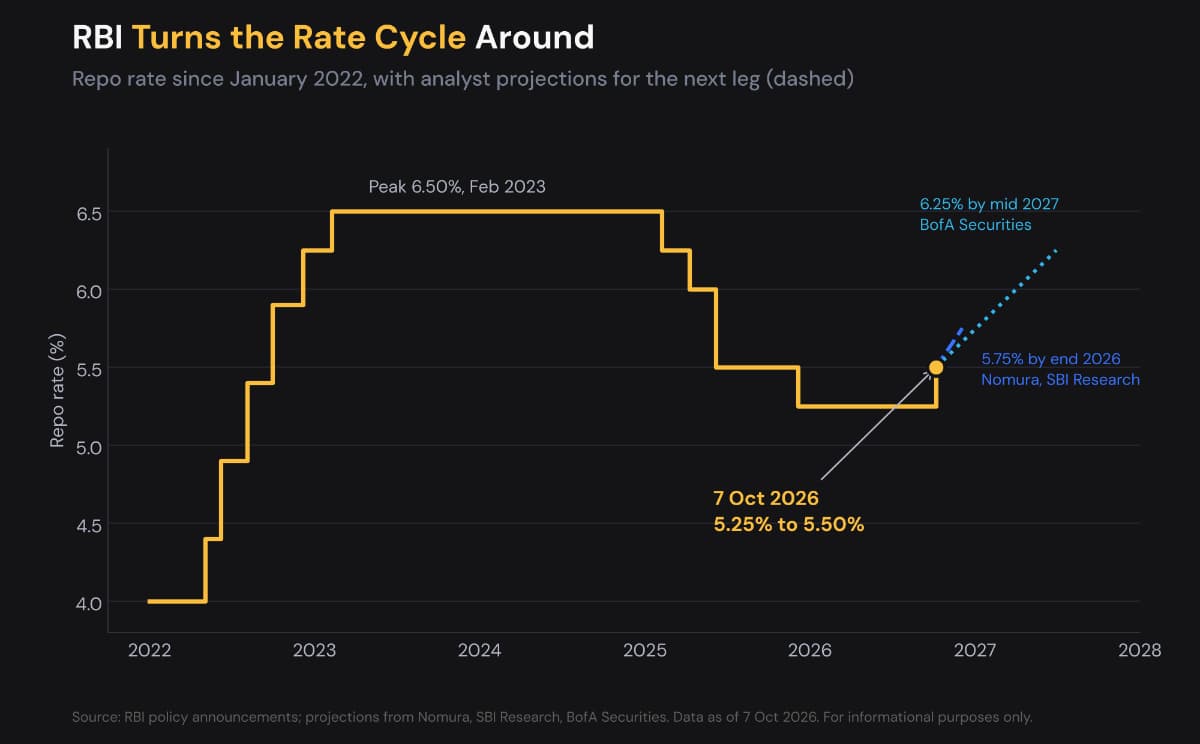
RBI turns the rate cycle around: repo rate since 2022 with analyst projections
High inflation roiled markets again, with August 2026’s 4.82% CPI, the third straight month CPI was above the 4% target. Crude oil remained above $100 per barrel for most of September, and the INR breached 95 to the USD. Inflation expectations remained elevated, and the RBI raised its FY27 inflation expectation to 5.2% from 5%, while raising its FY27 GDP growth expectation to 7.1% from 6.7%.
The stance is more important than the hike. Nomura and SBI Research expect the repo rate at 5.75% by the end of 2026. BofA Securities expects 100 basis points in all, taking the repo rate to 6.25% by mid 2027.
Higher safe returns tighten the risk/reward gap. India’s 10 year government bond yield rose to 7.19% on 30 September 2026, the highest in about two and a half years. The 10 year US government bond yield, the US Treasury, rose to about 5.3% in early October 2026, the highest since 2002. The chart shows these yields against inflation.
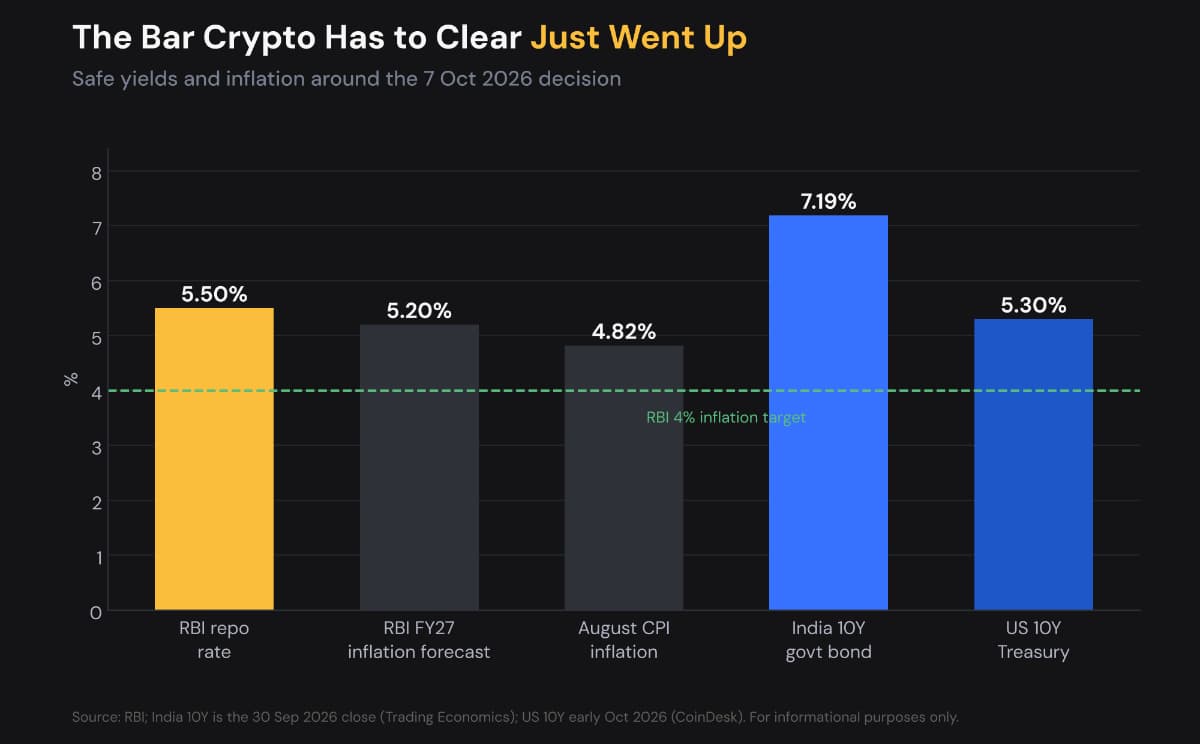
The bar crypto has to clear just went up: safe yields and inflation around the decision
The tax code further widens the risk/reward gap. The VDA tax rules carried over unchanged when the Income-tax Act, 2025 replaced the 1961 Act on 1 April 2026, with new section numbers.
| Rule | 1961 Act | Income-tax Act, 2025 | What it means |
|---|---|---|---|
| 30% flat tax on VDA gains, plus 4% cess | Section 115BBH | Section 194, Table Sl. No. 4 (as reported) | Only purchase cost is deductible |
| 1% TDS on VDA transfers | Section 194S | Section 393(1), Table Sl. No. 8(vi) | Applies above ₹50,000 a year for specified persons, ₹10,000 for others |
| No loss set-off | Section 115BBH | Same treatment | A loss on one coin cannot reduce tax on a gain from another |
TDS (Tax Deducted at Source) is the tax that is deducted automatically by the exchange at the time of transaction. In practice, you buy Bitcoin at Rs. 1 lakh, sell it at Rs. 1.5 lakh, and you’ll owe Rs. 15,000 plus cess on the Rs. 50,000 gain. A Rs. 50,000 loss on a different coin that year doesn’t help with that bill. Interest from a FD is taxed at your income tax slab rate and the principal isn’t dependent on the market.
An exchange is a platform where users buy and sell crypto for Rupees or other Crypto, similar to a stock broker app. On an Indian exchange, the price shown to you is roughly BTC/USD * USD/INR.
One Bitcoin is trading around $84,000 and Rs. 96 to the Dollar, making it about Rs. 80.6 lakhs. If tighter policies make the Rupee appreciate to Rs. 92 to the dollar, then the same Bitcoin becomes about Rs. 77.3 lakhs, a fall of about 4% without any movement in Bitcoin.
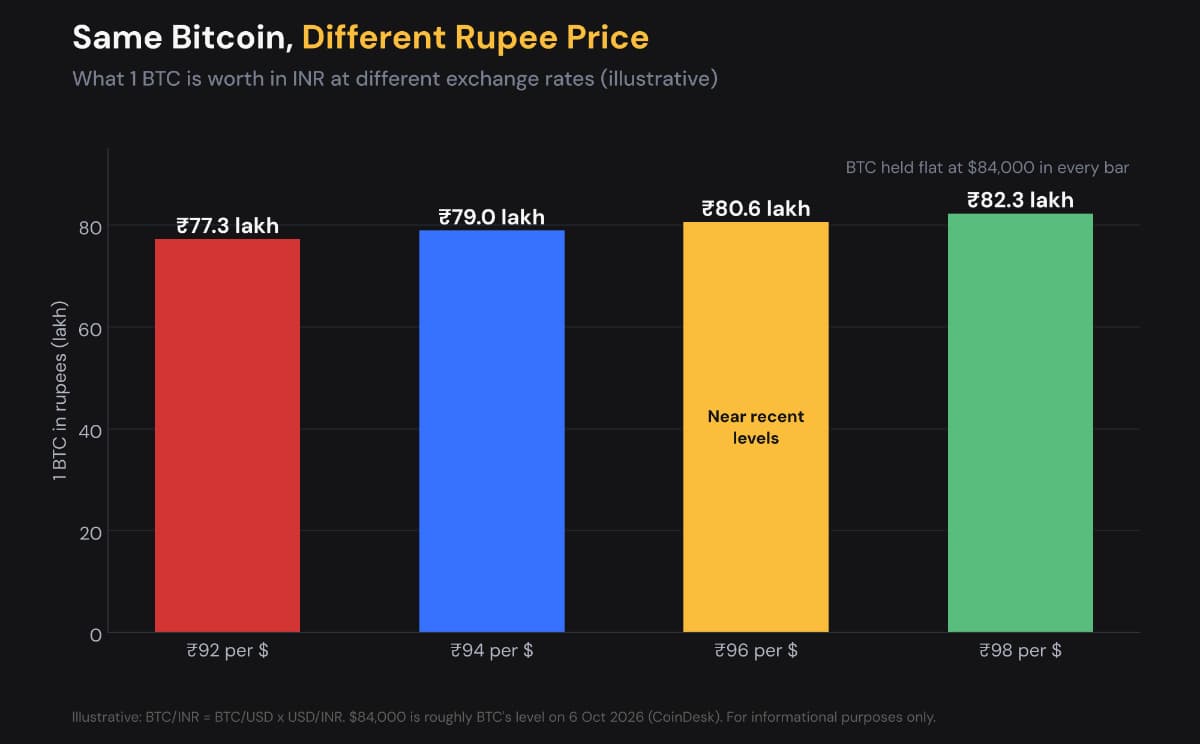
Same Bitcoin, different rupee price: 1 BTC in rupees at different exchange rates
It works the other way around. A weaker Rupee lifts the rupee value of the holding. Whether this hike strengthens the rupee is uncertain, as oil prices and foreign capital flows also impact the currency.
After hitting all-time highs of around $126,000 in October 2025, it crashed to around $60,000 in February and June of 2026 and recovered to around $84,000 in October 2026. Since September 23 it has failed three times to break $87,000.
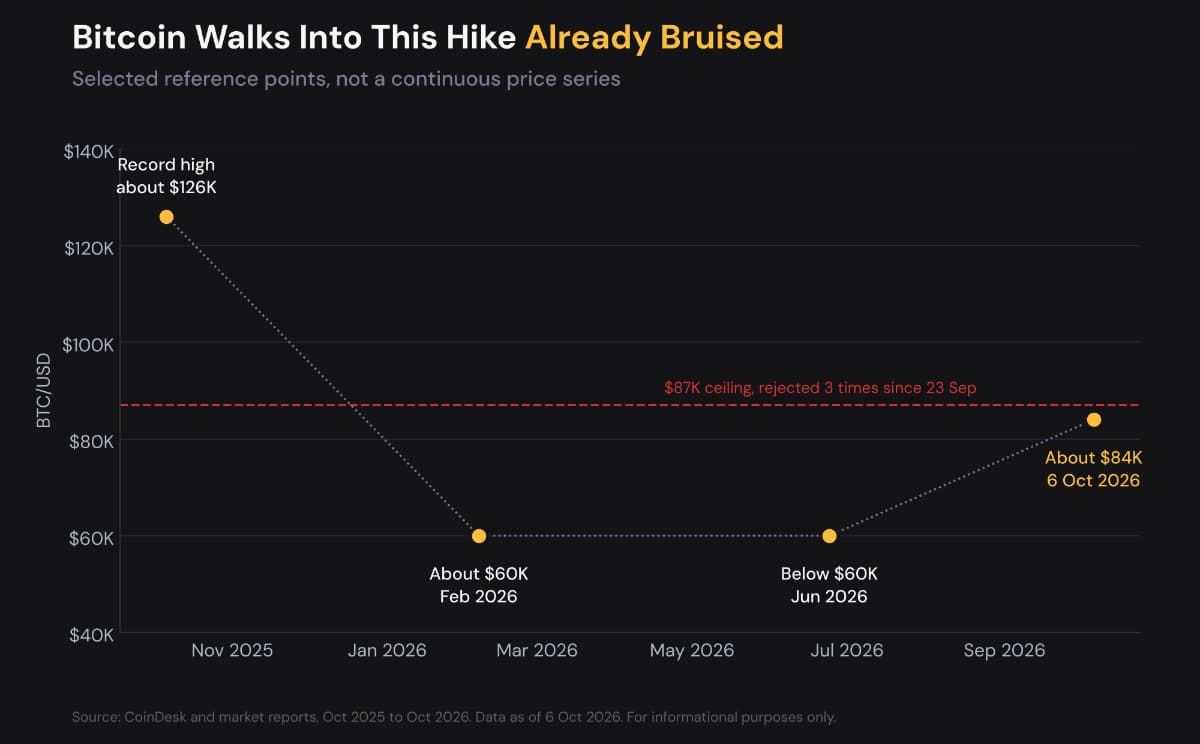
Bitcoin walks into this hike already bruised: selected BTC price points, Oct 2025 to Oct 2026
Demand Has Been Uneven
US spot Bitcoin ETFs, exchange-traded funds that hold real Bitcoin for investors who buy shares on a stock exchange, have seen their strongest inflows this year in late September. However, on October 1, they broke an eight-day straight run of inflows and saw net outflows.
While Bitcoin's price in other currencies can fluctuate due to several reasons, its price relative to the dollar determines its global price. The price of the US dollar and what the US Federal Reserve does also affect Bitcoin the most. In September, the Federal Reserve raised its benchmark interest rate by 0.25%. As of early October, according to CME FedWatch, there were roughly even odds of the Fed raising interest rates on October 28.
US bond yields have capped Bitcoin's rallies this autumn. On September 30, a weaker US inflation report boosted Bitcoin to $85,500. The increase was short-lived as the 10-year US Treasury yield held near 5.3%.
The map below shows the two channels. RBI changes affect Indian investors' conditions (rupee, interest rates, liquidity, and cash). The Fed, US yields and ETF flows affect the dollar price.
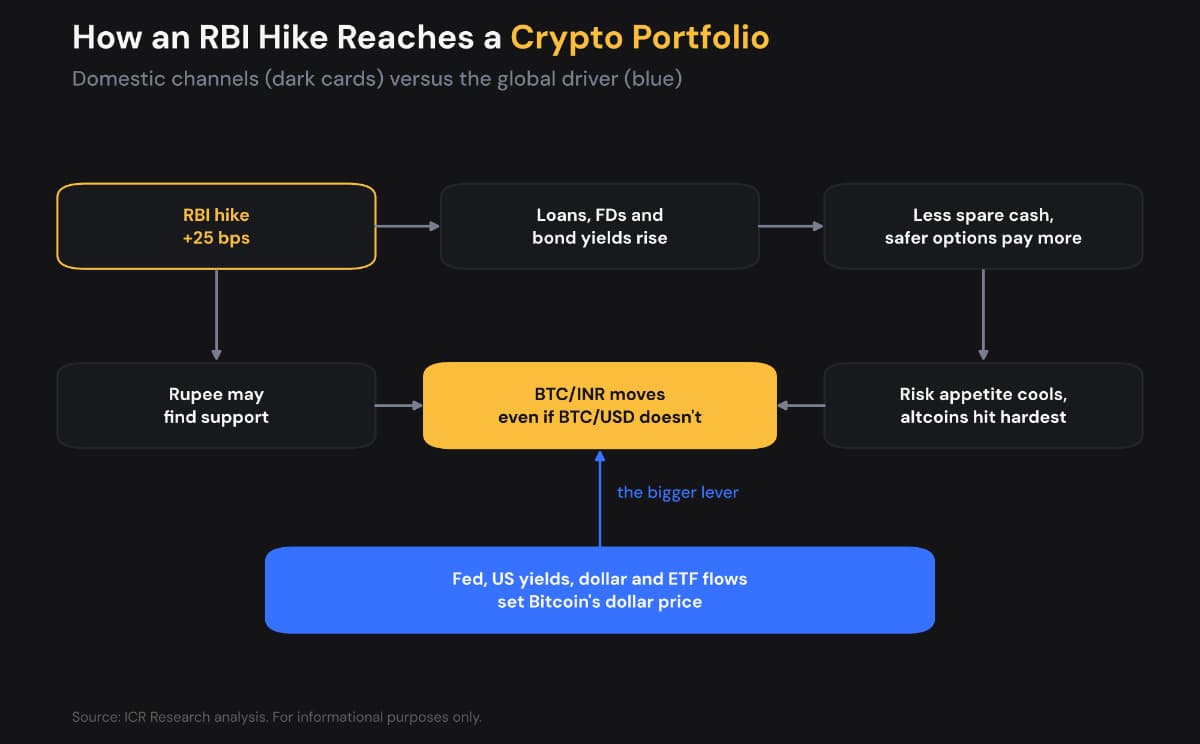
How an RBI hike reaches a crypto portfolio: domestic channels versus the global driver
Tightening tends to hit smaller tokens harder than Bitcoin, as money moves toward the most liquid assets. That is a pattern from past cycles, not a rule, and it can break when a single token has its own news.
Domestic tightening boosts safe returns and can strengthen the rupee, while bitcoin’s price in dollars follows global money. So, an Indian holder of bitcoins is exposed to two separate risks: the dollar price and the exchange rate, and the RBI’s decision mostly impacts the rupee side. So, it is wise to monitor both, rather than RBI alone.
The RBI in December: A second hike would further confirm their cycle. A pause would mean today’s move was precautionary.
The USD/INR: A stronger rupee will push bitcoin’s price in rupees lower, even if Bitcoin is flat.
The Fed on October 28: A hike or a hawkish hold by the FOMC on October 28 will be more relevant for Bitcoin than any action RBI may take.
US 10 year yield: Near 5.3%, it has acted as a ceiling for crypto prices.
Spot Bitcoin ETF flows. Sustained inflows can outweigh a lot of macro noise.
Leverage and funding rates. Leverage is trading with borrowed money. The funding rate is the periodic fee between buyers and sellers of perpetual futures. A high rate means crowded bets, and a small shock can then force large sales.
There is a caveat. Evidence that past RBI decisions moved BTC/INR is thin, and global swings usually swamp any local effect. If inflation cools and RBI stops hiking, today's move becomes part of a steadier rupee and an eventual easing cycle. That would be a slow positive, not a fast one.
Sources: RBI decision: IIFL, The Week, Business Today. Forecasts: Free Press Journal, NewKerala on BofA. India 10-year yield: Trading Economics. Bitcoin, Treasuries, ETF flows: CoinDesk (6 October and 1 October), Coinedition. VDA tax under the Income-tax Act, 2025: CryptoSlate, Toolisky, Patron Accounting.
India Crypto Research operates independently. The information presented herein is intended solely for educational and informational purposes and should not be construed as financial advice. Before making any financial decisions, it's essential to undertake your own thorough research and analysis. If you're uncertain about any financial matters, we strongly recommend seeking guidance from an impartial financial advisor.