What Crypto Basket Actually Is
How the Weights Are Decided, Market Cap Weighting Explained Simply
Why Not Just Split It Equally
We're Exploring Other Weighting Methods Too
Why a Basket Makes Sense for a Volatile Asset Class
What the Trend Looks Like When Short-Term Noise Is Smoothed Out
How the Crypto Basket Has Performed vs Individual Coins
A Quick Word on What This Isn't

 Part of a series
Bitcoin alone has turned $100 into over $11,000 in the past decade. That kind of return is exactly why putting all your money into one coin feels tempting, and exactly why it's risky.
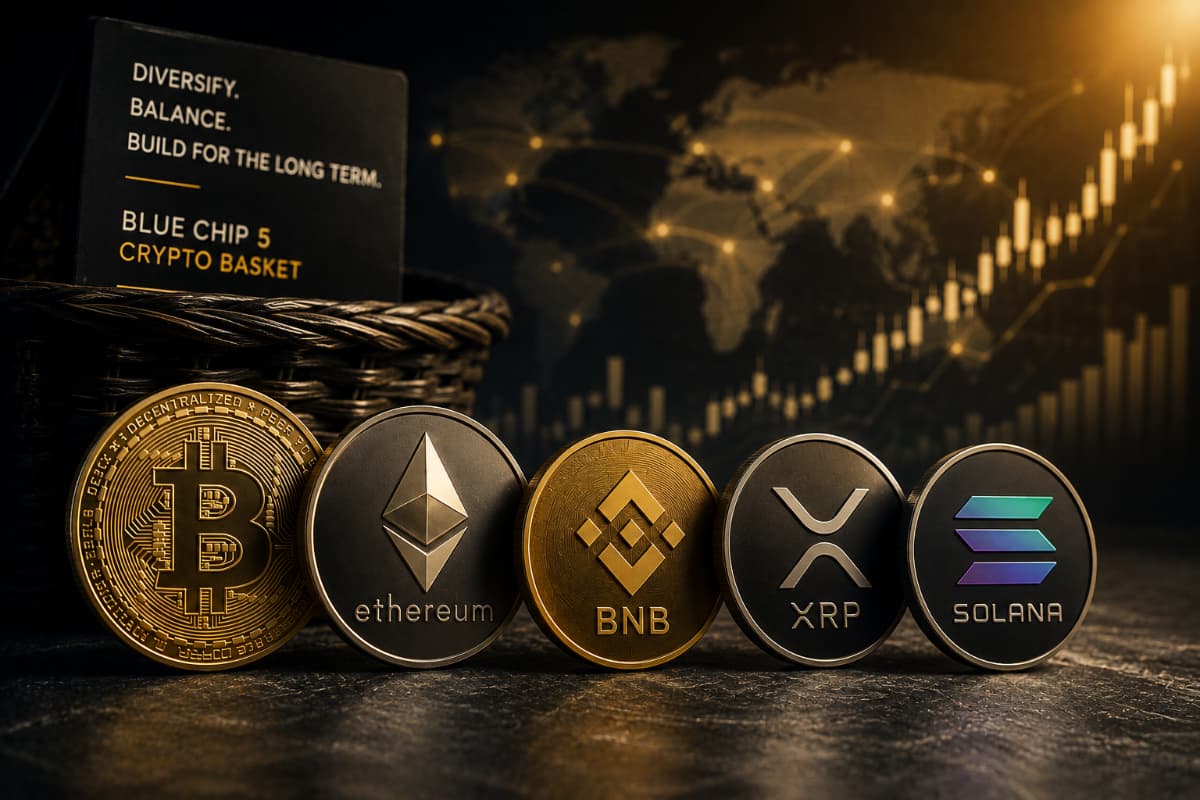
A crypto basket brings the familiar basket-investing idea into crypto, using Bitcoin, Ethereum, BNB, XRP, and Solana in one portfolio instead of relying on a single asset.
Crypto is a basket made up of five of the largest, most established cryptocurrencies:
Bitcoin (BTC)
Ethereum (ETH)
BNB
XRP
Solana (SOL)
Instead of picking one of these five and hoping it's the right one, the basket holds all five together in fixed proportions.
The Crypto basket currently uses market cap weighting. Here's what that means in plain terms.
Every crypto asset has a market capitalisation (market cap), its price multiplied by the number of coins in circulation. It's the same number used to say a company is worth a certain amount on the stock market. Market cap weighting means the bigger an asset's market cap, the bigger its share in the basket. The market decides the proportions; nobody guesses them.
This isn't a new or experimental idea. The S&P 500 works this way, and so do most crypto index funds and Bitcoin ETFs globally, which makes it one of the more conservative ways to build a basket, not a fringe one.
Applied to the Crypto basket, this is what it currently looks like
| Asset |
|---|
| Bitcoin (BTC) |
| Ethereum (ETH) |
| BNB |
| XRP |
| Solana (SOL) |
In simple terms, Bitcoin and Ethereum together make up close to three-quarters of the basket, because they're by far the two largest cryptocurrencies by market value. The remaining three, BNB, XRP, and SOL, split the rest more evenly, since they sit closer to each other in size.
This isn't a hand-picked split. It's a direct reflection of how the market currently values these five assets relative to each other.
You might wonder why not just give each of the five coins an equal 20% share.
That's actually another way people build a basket, called equal weighting, and it has real advantages. It's easy to understand, and it doesn't let any single coin dominate the basket.
The problem is that it treats all five coins the same even though they're very different assets. Solana is a smaller, younger coin than Bitcoin. Bitcoin is larger, more established, and carries a different risk profile entirely. Equal weighting flattens that distinction away.
Market cap weighting accounts for it instead. It lets the basket lean more heavily on coins like Bitcoin, the ones the market has already judged to be the biggest and most liquid, while still holding smaller coins like Solana for diversification. In effect, market cap weighting reads how the market values each coin and sizes the allocation accordingly, rather than treating every asset as interchangeable.
Crypto baskets currently use market cap weighting. That's not the only way to build a basket, and it won't be the only method used going forward.
A few alternative approaches are worth naming, each with its own tradeoffs:
These methods are being evaluated for what actually helps everyday investors, not for what sounds sophisticated on paper. Any change to how crypto baskets are weighted will be a transparent one, communicated clearly before it happens.
Crypto is famous for its price swings. Individual coins can move very differently from each other, sometimes within the same week.
Holding a group of coins instead of just one doesn't make prices stable. What it does is make the swings less severe. If one coin drops sharply, that doesn't mean the whole basket drops with it, because the coins in the group don't all move at the same time or by the same amount.
This is the same logic behind diversification in traditional investing, a well-established rule there. It applies just as directly to crypto, a far faster-moving asset class where that cushioning effect matters even more.
One way to look past day-to-day price swings is a moving average. The infographic below uses a normalised 12-month moving average view, so the direction and volatility of the Crypto Basket illustration can be compared more clearly against the S&P 500.
Important: The chart is an illustrative, equal-weight comparison of BTC, ETH, BNB, XRP, and SOL for trend analysis only. It's separate from the current market cap weighting described earlier in this article.
A more useful question is how the Crypto Basket has performed compared with investing in each of its five cryptocurrencies individually.
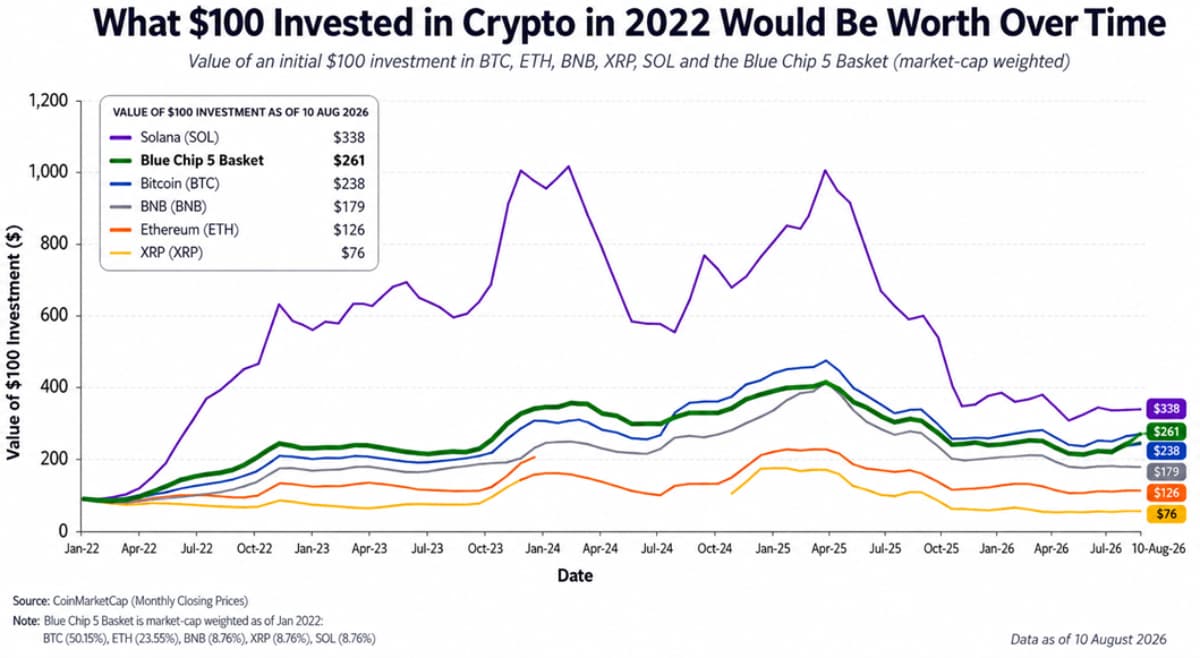
To make that comparison fair, every investment needs to start from the same point. So instead of comparing raw coin prices, we assume $100 was invested in Bitcoin, Ethereum, BNB, XRP, Solana, and the basket at the start of 2022, then track how the value of each investment changed over time.
This approach makes the comparison easy to read at a glance. A value of $200 means the original $100 doubled. A value of $50 means it fell by half.
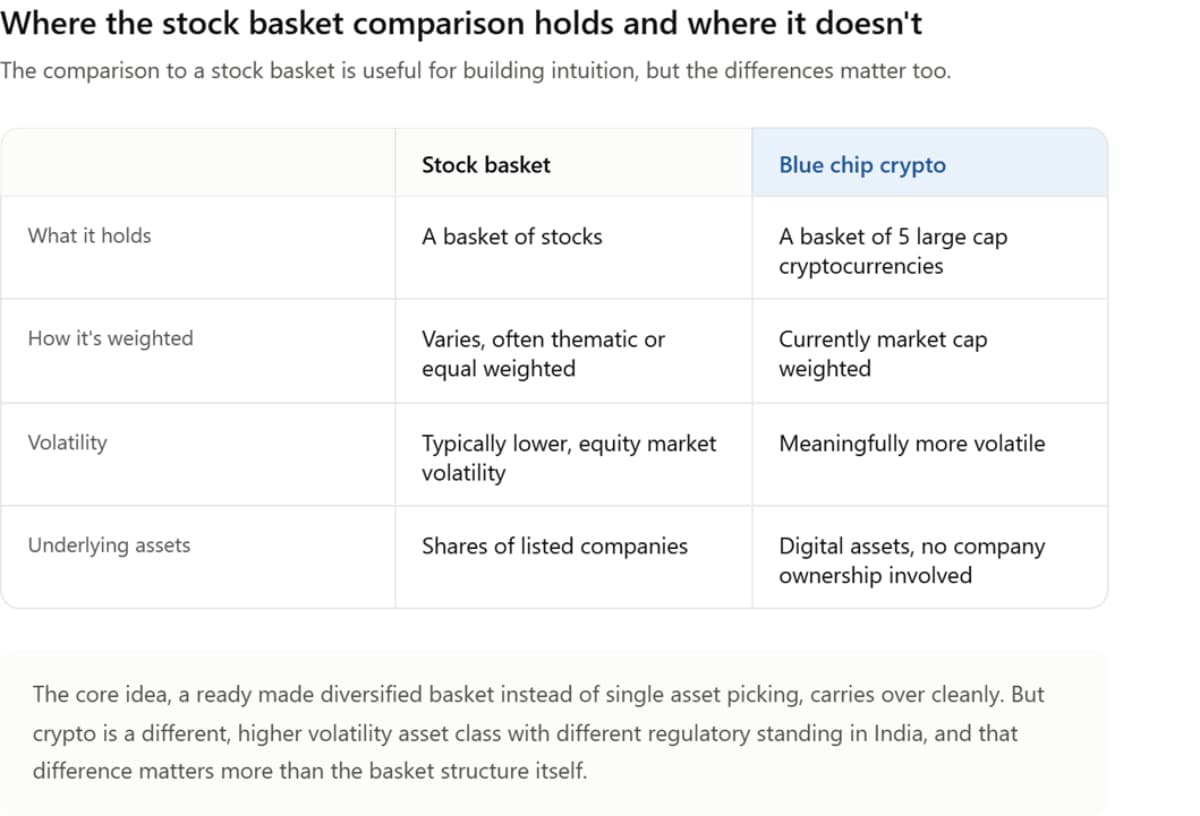
The basket isn't a simple average of the five coins. It uses the basket's market cap-based weights, so Bitcoin and Ethereum carry far more influence over overall performance than BNB, XRP, or Solana do.
The result is a clean comparison between two different approaches: concentrated exposure to a single crypto asset, versus spreading that same $100 across a weighted basket of large-cap cryptocurrencies.
The chart below shows how those investments moved through the market cycle, including the sharp declines, the recovery that followed, and the stretches where individual assets significantly outperformed or underperformed the basket.
Rather than asking which coin delivered the highest return, the more useful question is whether the basket offered a more balanced path through crypto's volatility, while still participating in the major market recoveries.
The three coins with a full 10-year history (August 2016 to August 2026)
| Asset | Price, Aug 2016 | Price, Aug 2026 | Growth | 10-Year Return | Approx. Annual Return (CAGR) |
|---|---|---|---|---|---|
| Bitcoin (BTC) | $575 | $64,940 | 113x | 11,190% | 60% |
| Ethereum (ETH) | $11 | $1,914 | 174x | 17,300% | 68% |
| XRP | $0.0065 | $1.04 | 160x | 15,900% | 66% |
| S&P 500 | 2,170.95 | 7,757.64 | 3.6x | 257% | 14% |
Note : S&P 500 figures are price returns only, not including dividends, which would push its real-world return a bit higher
If you rescale just these three to that proportion, BTC at 61%, ETH at 29%, and XRP at 11% of the sub-basket, the blended 10-year growth works out to roughly 135x, or about 13,400%, an approximate 63% annual return. That's the closest thing to a genuine 10-year basket return the data allows.
BNB and Solana, measured since their own launch (not 10 years)
| Asset | Trading Since | Starting Price | Price, Aug 2026 | Growth | Approx. Annual Return (CAGR) |
|---|---|---|---|---|---|
| BNB | Nov 2017 (9 years) | $1.50 | $603 | 400x | 98% |
| Solana (SOL) | Apr 2020 (6.3 years) | $0.77 | $76 | 99x | 107% |
These numbers are dramatic, but that's typical of an asset's earliest years; it's easier to multiply 100x when you start from a market cap of a few million dollars. It would be misleading to expect anything close to these growth rates to repeat now that BNB and Solana are far larger, more mature assets.
Two important caveats on all of this.
The S&P 500's 14% annual return over the same period is itself a strong long-term result by traditional standards. The crypto numbers above simply sit on a different scale of risk and volatility, and understanding that difference is the point, not an invitation to extrapolate it forward.
Here's the honest answer, with an important catch upfront. Two of the five coins in basket, BNB and Solana, don't have 10 years of price history. BNB started trading in late 2017. Solana didn't exist until 2020. So a true, like-for-like 10-year basket return can't be calculated for all five coins together; the data simply doesn't exist for that period. Rather than paper over that gap, here's what the numbers actually show, broken into what's real and what's approximate.
Zerodha's smallcase, for comparison, changed the way a generation of self-directed investors thinks about buying shares. It didn't invent a new type of investment. Instead, it packaged an existing idea, spreading money across groups of stocks, into something easy to understand and use. India Crypto Research is trying to apply that same idea to cryptocurrency. It starts with a method for picking coins based on market size, and it stays open to improving that method as we learn what actually works for self-directed investors.
India Crypto Research operates independently. The information presented herein is intended solely for educational and informational purposes and should not be construed as financial advice. Before making any financial decisions, it's essential to undertake your own thorough research and analysis. If you're uncertain about any financial matters, we strongly recommend seeking guidance from an impartial financial advisor.