From Taxation to Compliance: The First Two Pillars of India's Crypto Regulation
Financial Stability and Investor Protection: India's Next Regulatory Priorities
The Road Ahead: What India's Regulatory Evolution Means for the Crypto Ecosystem

India's crypto policy is shifting from taxation to broader regulation.
Tax compliance remains low, despite the 30% tax and 1% TDS.
AML compliance, RBI oversight, and investor protection have become key regulatory priorities.
Industry-government dialogue is increasing, but comprehensive crypto legislation remains absent.
The future of India's digital asset ecosystem will depend on balancing innovation with robust regulation.

 Part of a series
Over the past four years, India's cryptocurrency policy has been defined by a single question: how should digital assets be taxed? The implementation of a 30% tax on gains from Virtual Digital Assets (VDAs) and a 1% Tax Deducted at Source (TDS) in 2022 marked one of the world's most rigorous tax regimes for cryptocurrencies. At the time, the policy was widely viewed as the government's first major initiative to regulate a budding asset class without formally recognising cryptocurrencies as legal tender. Since then, discussions surrounding India's digital asset ecosystem have primarily focused on fiscal policy, trading volumes and investor sentiment.
However, latest developments suggest that India's regulatory discourse is entering a new phase. Rather than focusing entirely on taxation, policymakers are increasingly addressing wider implications such as financial stability, anti-money laundering (AML), institutional exposure and investor protection. The Reserve Bank of India (RBI) has emphasised its concerns regarding private cryptocurrencies and stablecoins, while Maharashtra has become one of the first Indian states to specifically include virtual digital assets within an investor protection law. Viewed alongside existing tax mechanisms and compliance requirements under the Prevention of Money Laundering Act (PMLA), these developments signal that India is gradually building a wider regulatory architecture for digital assets.
This evolution is pivotal because India is no longer a niche crypto market. According to figures cited in latest government-related reporting, an estimated 39 million Indians hold cryptocurrency, with total holdings valued at roughly US$2.1 billion. Despite ongoing regulatory ambiguity, India remains one of the world's largest crypto markets by user participation. As implementation expands widely, policymakers face a complex challenge: protecting consumers and preserving financial stability while driving progression in blockchain technology, tokenisation and Web3 applications.
The central question is therefore no longer whether cryptocurrencies should be taxed. Instead, it is whether India is moving towards a more extensive regulatory infrastructure one that combines taxation, compliance, financial stability and investor protection to integrate digital assets into the country's advancing financial system.

India's regulatory roadmap began with taxation. The 2022 Union Budget introduced a 30% tax on income deriving from the transfer of Virtual Digital Assets (VDAs), accompanied by a 1% Tax Deducted at Source (TDS) on eligible transactions. Together, these measures signified India's first comprehensive attempt to regulate the cryptocurrency market through fiscal policy.
The initiative served a dual purpose. First, the government targeted to ensure that profits generated from crypto transactions were brought into the tax net. Second, the introduction of TDS was intended to create an open source audit trail, providing tax authorities with greater visibility into market activity. Unlike traditional capital gains taxation, the framework prohibited investors from offsetting crypto losses against other income and applied a unified tax rate regardless of the holding period. The message was clear: while cryptocurrencies were not recognised as legal tender, transactions involving digital assets would remain subject to taxation and reporting obligations.
Despite establishing a formal reporting framework, latest evidence suggests that taxation alone has not been adequate to achieve comprehensive compliance. According to documents reviewed by Reuters, fewer than one-quarter of approximately 645,000 individuals who traded cryptocurrencies reported those transactions in their FY2023 income tax returns. This highlights one of the fundamental challenges of governing digital assets through taxation alone. Unlike traditional financial markets, cryptocurrencies operate across a decentralised and borderless ecosystem where investors can access offshore exchanges, decentralised finance (DeFi) protocols and self-custodied wallets that often fall outside the direct reach of domestic tax authorities.
However, these findings should not be interpreted as evidence that India's tax infrastructure has failed. Rather, they illustrate the limitations of relying only on taxation to regulate a rapidly evolving digital asset market. Effective supervision requires complementary measures that address transparency, financial integrity and market conduct alongside revenue collection.
Recognising these challenges, policymakers have systematically expanded India's regulatory approach exceeding taxation towards compliance and financial oversight. Over the past two years, Virtual Digital Asset Service Providers (VDASPs) have been brought within the scope of the Prevention of Money Laundering Act (PMLA), requiring exchanges and other service providers to deploy Know Your Customer (KYC) procedures, maintain transaction records and report fraudulent activities to the Financial Intelligence Unit (FIU-India). These requirements align India's regulatory approach more closely with international standards, where crypto businesses are increasingly expected to perform under the same anti-money laundering and compliance obligations as traditional financial institutions.
This progression reflects a wider shift in regulatory posture. Taxation remains an important pillar of India's crypto policy, but it is no longer the sole instrument of oversight. By integrating AML compliance, customer due diligence and transaction monitoring into the regulatory framework, policymakers now see digital assets as core financial infrastructure, not just taxable investments.
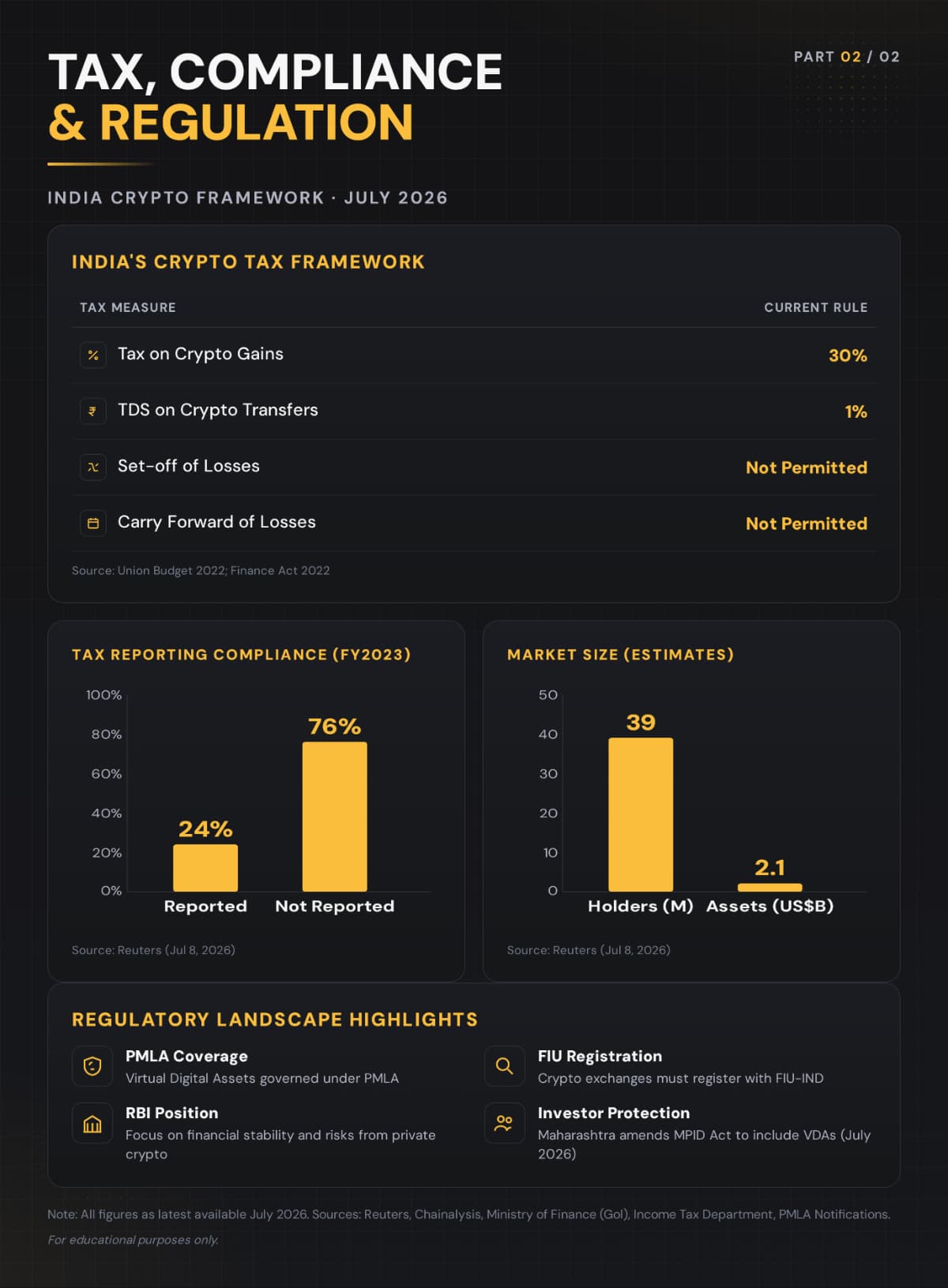

While taxation and compliance form the foundation of India's crypto regulatory framework, latest policy developments signal that regulators are increasingly focusing on a wider objective safeguarding the financial system and strengthening investor safeguards.
The prime example of this shift is the Reserve Bank of India's (RBI) current stance on cryptocurrencies. During latest discussions with a Parliamentary panel, the RBI reportedly maintained its long-standing concerns regarding private cryptocurrencies and privately issued stablecoins, arguing that regulated financial institutions should remain insulated from direct exposure to these assets because of the potential risks they pose to financial stability. Although this position is consistent with the central bank's earlier statements, this renewed focus aligns with digital assets expanding integration into global financial markets. From the RBI's perspective, the risks extend well beyond the price volatility typically linked with cryptocurrencies. Stablecoins, designed to maintain a stable value by being pegged to traditional currencies or other reserve assets, as critical pillars of the global digital asset ecosystem, these assets now dominate cross border payments, Decentralised finance (Defi), and settlements. However, their rapid scaling sparks urgent questions around monetary sovereignty, capital flows, and systematic risk. Consequently, the RBI continues to advocate a cautious approach towards privately issued digital currencies while supporting the development of the Digital Rupee (CBDC).
Importantly, the RBI's position is not aimed only at retail investors or speculative trading. Instead, it reflects wider concerns about how digital assets could interact with India's financial infrastructure if banks, payment systems and institutional investors become more deeply involved. The focused has changed. Regulators are no longer just watching single investors, they are safeguarding the whole ecosystem.
A similar shift can be observed at the state level. One of the most significant policy developments in July 2026 came from Maharashtra, which amended the Maharashtra Protection of Interest of Depositors (in Financial Establishments) Act, 1999 (MPID Act) to explicitly include Virtual Digital Assets (VDAs) such as cryptocurrencies within its scope.
Although the amendment may appear technical, its consequences are substantial. The MPID Act was originally enacted to protect depositors by enabling authorities to attach and recover assets linked to fraudulent financial establishments. As cryptocurrencies became increasingly common in investment scams, enforcement agencies often encountered legal uncertainty when tracing and recovering digital assets that could be transferred across jurisdictions within minutes. By explicitly recognising VDAs under the Act, Maharashtra has strengthened its legal framework for identifying, attaching and recovering crypto assets associated with financial fraud.
Significantly, this amendment does not regulate cryptocurrency trading or prohibit investment in digital assets. Instead, it strengthens investor protection by ensuring that cryptocurrencies are treated as recoverable assets in fraud investigations. This distinction reflects a more mature regulatory approach one that recognises digital assets as part of the financial ecosystem while reinforcing the legal mechanisms required to protect investors.
Taken together, the RBI's latest position and Maharashtra's legislative reforms illustrate that India's regulatory priorities are expanding beyond taxation and compliance. Financial stability and investor protection are budding as equally important pillars of the country's evolving crypto policy, reinforcing the view that digital assets are increasingly being regulated through a coordinated, multi-layered framework rather than isolated policy measures.
The advancements surrounding taxation, compliance, the RBI's latest position and Maharashtra's legislative reforms point to a clear shift in India's approach towards digital assets. Instead of relying on a single comprehensive law, different institutions are addressing different aspects of the ecosystem according to their respective mandates. Taxation, anti-money laundering compliance, financial stability and investor protection are gradually emerging as the four pillars of India's evolving crypto regulatory framework.
For market participants, this progression presents both opportunities and challenges. Exchanges and Virtual Digital Asset Service Providers (VDASPs) are likely to face much higher compliance standards, while investors may benefit from greater regulatory clarity and more robust consumer protection. At the same time, policymakers will need to ensure that measures designed to reduce financial risks do not unintentionally stifle innovation in blockchain, Web3 and tokenisation.
The most significant change, however, is not the introduction of any single regulation but the evolution of the regulatory debate itself. The question is no longer whether cryptocurrencies should exist or simply how they should be taxed. Instead, policymakers are increasingly focused on defining how digital assets can operate safely within India's financial system.
Although India still lacks a comprehensive national cryptocurrency law, the policy developments of July 2026 indicate that the country is perpetually moving towards a more structured and multi-layered regulatory framework. Whether this ultimately results in a unified crypto law or continuous supervision through multiple institutions remains uncertain. What is becoming increasingly clear, however, is that India's digital asset ecosystem is transitioning from a market defined by regulatory uncertainty to one increasingly shaped by governance, accountability and financial oversight.
India Crypto Research operates independently. The information presented herein is intended solely for educational and informational purposes and should not be construed as financial advice. Before making any financial decisions, it's essential to undertake your own thorough research and analysis. If you're uncertain about any financial matters, we strongly recommend seeking guidance from an impartial financial advisor.