
What the Bharat Web3 Association has launched
Two former senior officials will run it.
What the new body will check
What BWA’s rulebook currently says
Why it matters now
What the new body cannot do yet
What to watch next

On 28 October 2026, the Bharat Web3 Association (BWA), an industry group of crypto and Web3 firms, launched a self-regulatory body (SRB) for India’s crypto sector.
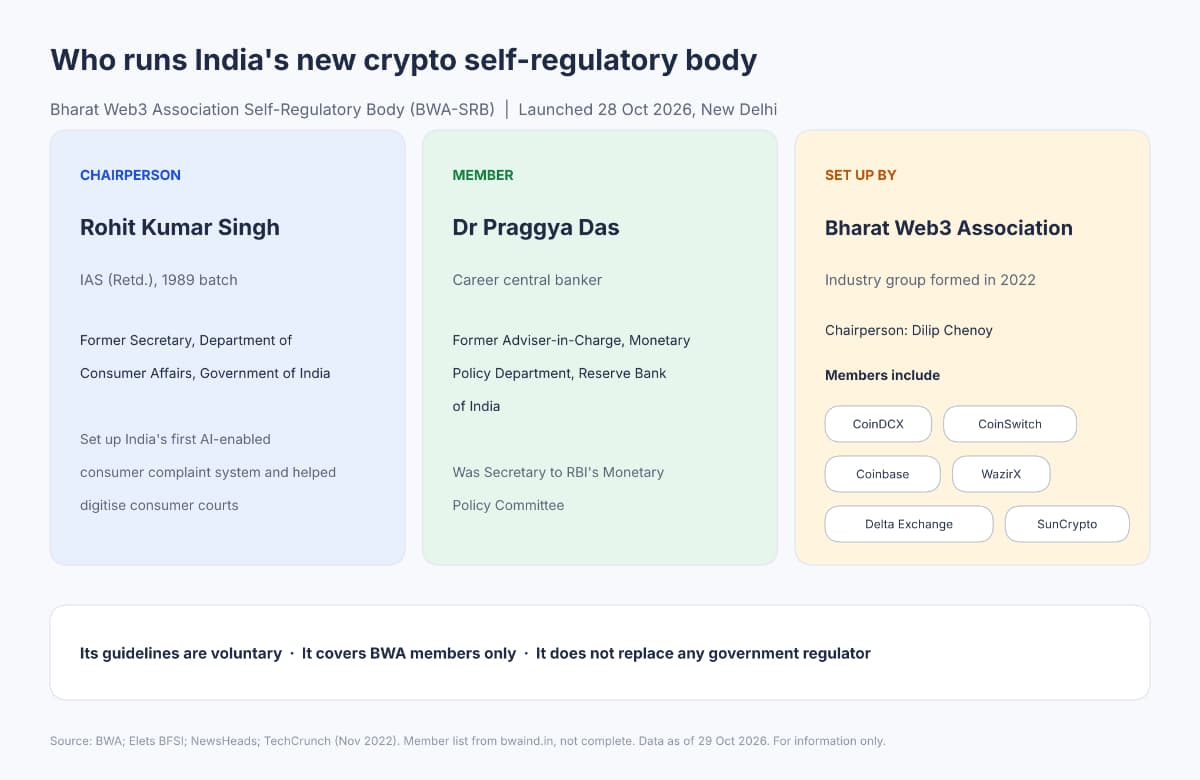
It is chaired by Rohit Kumar Singh, a retired IAS officer and former Consumer Affairs Secretary. Dr Praggya Das, a former senior RBI official, is a member.
It will review member firms on areas such as money-laundering checks, cybersecurity, token listing, consumer protection and advertising, and suggest fixes.
Its guidelines are voluntary and cover BWA members only. It does not replace any government regulator.
It comes three months after a Parliament committee suggested that crypto be overseen for now through self-regulatory bodies recognised by the RBI or SEBI.

 Part of a series
India still has no comprehensive law governing crypto assets. The government taxes them, and exchanges must register with FIU-IND to comply with anti-money-laundering requirements, but no regulator licenses crypto businesses or oversees how they treat customers. This week the industry decided not to wait. It set up its own body to write standards and check whether its members follow them. Below is what that body is, who runs it, and what it can and cannot do.
A self-regulatory body is a group set up by an industry to make rules for itself and check that its members follow them. Think of it as a referee chosen from within the game, while the government’s referee has not yet arrived.
The Bharat Web3 Association (BWA) is the industry group behind it. It was formed in 2022 by firms including CoinDCX, CoinSwitch, WazirX and Coinbase. Its members today include crypto exchanges, blockchain companies and gaming platforms, and it is chaired by Dilip Chenoy, a former Secretary-General of the industry body FICCI.
On 28 October 2026, BWA announced the creation of the BWA Self-Regulatory Body (BWA-SRB) in New Delhi. BWA states that the body’s job is to guide its members and raise standards, not to replace government regulators.
BWA picked leaders with backgrounds in government and the central bank, instead of people from crypto companies, to head the body. This choice is meant to signal that the body will act independently of the firms it reviews.
The Chairperson is Rohit Kumar Singh, a 1989-batch IAS officer who retired as Secretary of the Department of Consumer Affairs. In that role, he set up the country’s first AI-based consumer complaints system. The other member is Dr Praggya Das, who led the Reserve Bank of India’s Monetary Policy Department and served as Secretary to its Monetary Policy Committee.
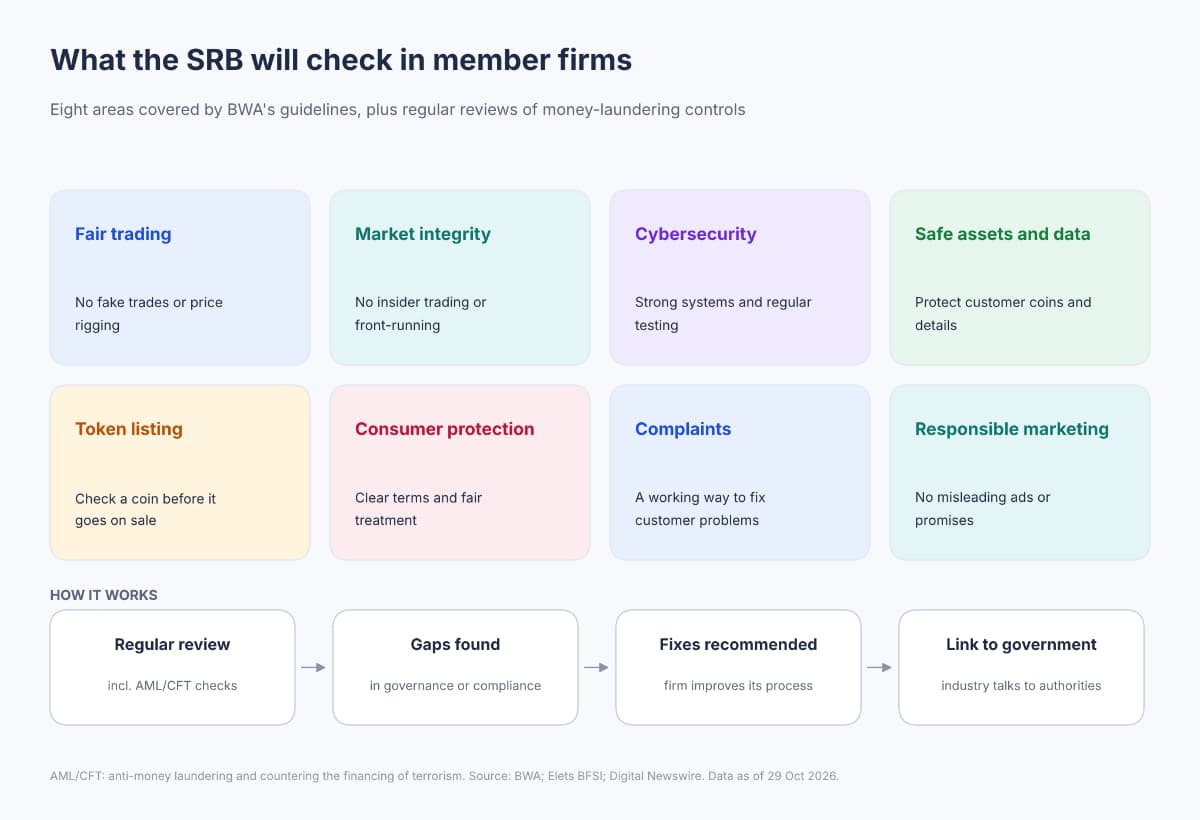
The SRB will ask members to follow BWA’s guidelines in eight areas: fair trading, market integrity, cybersecurity, protecting customers’ coins and data, token listing, consumer protection, complaints handling and responsible marketing.
It will also carry out periodic reviews of members. A major part of those reviews will focus on AML/CFT, short for anti-money laundering and countering the financing of terrorism. In simple terms, these are the checks that stop criminals from using crypto to hide or move money. Where the SRB finds gaps, it will recommend corrective measures. BWA says the framework draws on global practice and on the RBI’s rules for self-regulatory bodies in fintech.
BWA has already published several of these guidelines. They give an idea of the kinds of things the SRB will look for.
• Fair trading. Members should not rig prices, run pump-and-dump schemes, or trade among their own accounts to create a false impression of trading activity, known as wash trading. They should also not use advance knowledge of customers’ orders to trade first, known as front-running. Platforms are expected to run systems that spot these patterns.
• Token listing. Before listing a coin, an exchange should check that it is legal in India and not on any sanctions lists. Coins that pass the checks are then classified as high-, medium- or low-risk assets. Exchanges should announce listing dates in advance and add extra risk warnings for tokens from airdrops and token sales.
• Cybersecurity. Customer coins should be split across hot (online) and cold (offline) wallets, with several people needed to approve large transfers. Systems should be tested every quarter and certified by independent outside auditors.
BWA describes these guidelines as recommendations, not binding rules.
Crypto adoption is increasing among young people in India and beyond the large cities. Dr Das said at the launch that about 75% of crypto investors in India are aged 18 to 35, with adoption also growing in smaller Tier-2, Tier-3 and Tier-4 cities. Many of these investors are new to financial markets and may not know how to spot a risky platform.
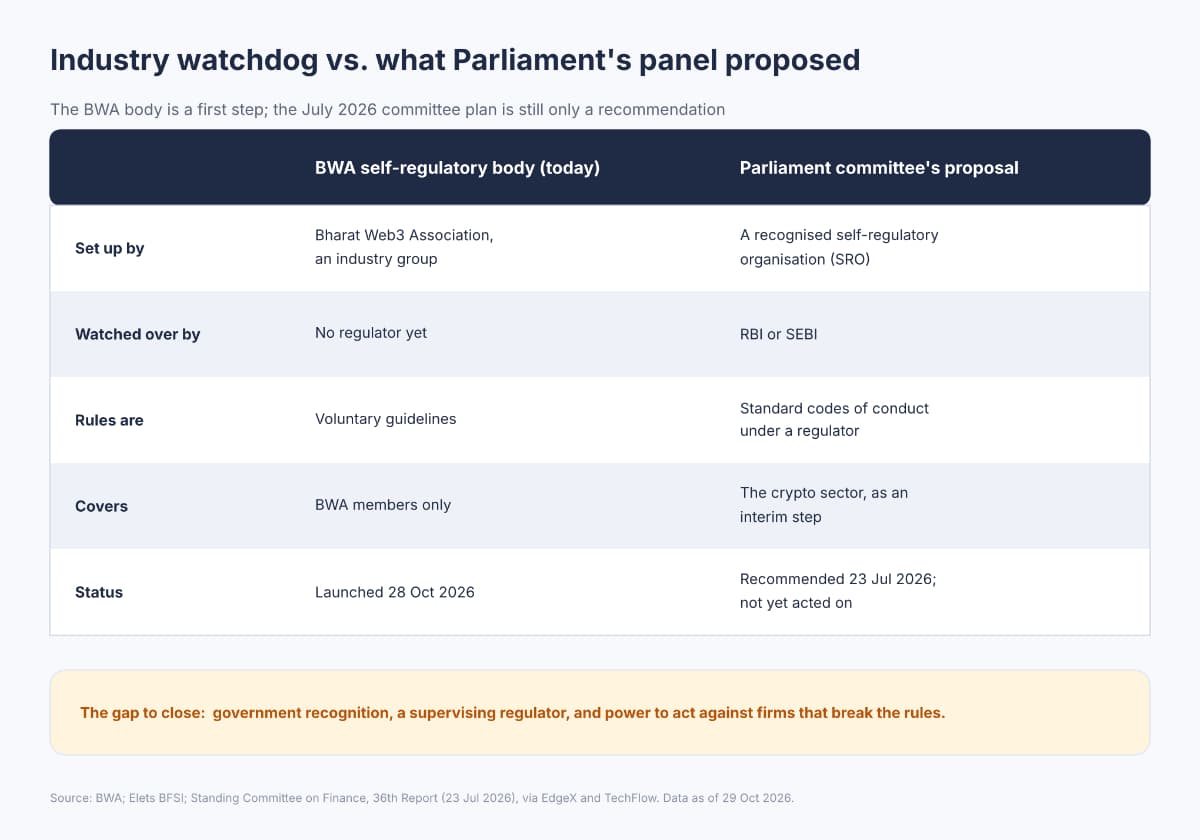
Policy is also moving. On 23 July 2026, Parliament’s Standing Committee on Finance recommended an interim system for crypto run through recognised self-regulatory bodies, supervised by the RBI or SEBI, until a comprehensive law is passed. The RBI remains cautious. On 3 October 2026, Governor Sanjay Malhotra said India would stay careful on crypto while backing the technology behind it. By launching its own body first, the industry is trying to show it can police itself.
The SRB is a step forward, but it is not the system described by the parliamentary committee. It has no statutory powers, covers only BWA members, and has not been recognised by any regulator. Platforms outside BWA, including offshore exchanges, are not covered at all.
Several questions are still open. How many firms will join? Will the reviews have real consequences, and will their findings be made public? And will the government or a regulator ever recognise the body’s standards? BWA’s announcement also did not say how ordinary users could submit complaints directly to the SRB, so complaints still go to the platform first.
For users, nothing changes immediately. Income from the transfer of virtual digital assets is generally taxed at 30%, subject to applicable statutory provisions, with 1% TDS on transfers. Crypto assets are not protected like bank deposits. Checking whether a platform is registered with India’s Financial Intelligence Unit (FIU-IND) is still the first step before using it.
• Membership. Whether more exchanges and Web3 firms join BWA and become subject to the SRB’s framework.
• First reviews. Whether the SRB reports on its reviews and what fixes it asks members to make.
• Recognition. Whether the RBI, SEBI, or the government responds to the Parliament committee’s plan, and whether that includes this body.
• Complaints. Whether the SRB opens a route for users to raise problems with member platforms.
Read more from India Crypto Research and browse every article on our Learn blog.
Sources: Bharat Web3 Association (SRB page, self-regulatory guidelines, About BWA, Fair Trading, Token Listing and Cybersecurity guidelines), Elets BFSI, NewsBytes, Digital Newswire, NewsHeads, TechCrunch, EdgeX and TechFlow.
India Crypto Research operates independently. The information presented herein is intended solely for educational and informational purposes and should not be construed as financial advice. Before making any financial decisions, it's essential to undertake your own thorough research and analysis. If you're uncertain about any financial matters, we strongly recommend seeking guidance from an impartial financial advisor.


