Over 44,000 Investors Flagged for Missing Crypto Disclosures
India’s Crypto Tax Rules Remain Among the Strictest Globally
Crypto May Be Unregulated, But It Is Not Invisible
How Authorities Are Identifying Undisclosed Crypto Income
Enforcement Capacity Around Crypto Is Expanding
Can You Ignore Crypto Tax Filing?
How Investors Can Simplify Crypto Tax Reporting


India’s crypto ecosystem is still evolving, but one thing is already clear. Tax enforcement around digital assets is no longer passive.
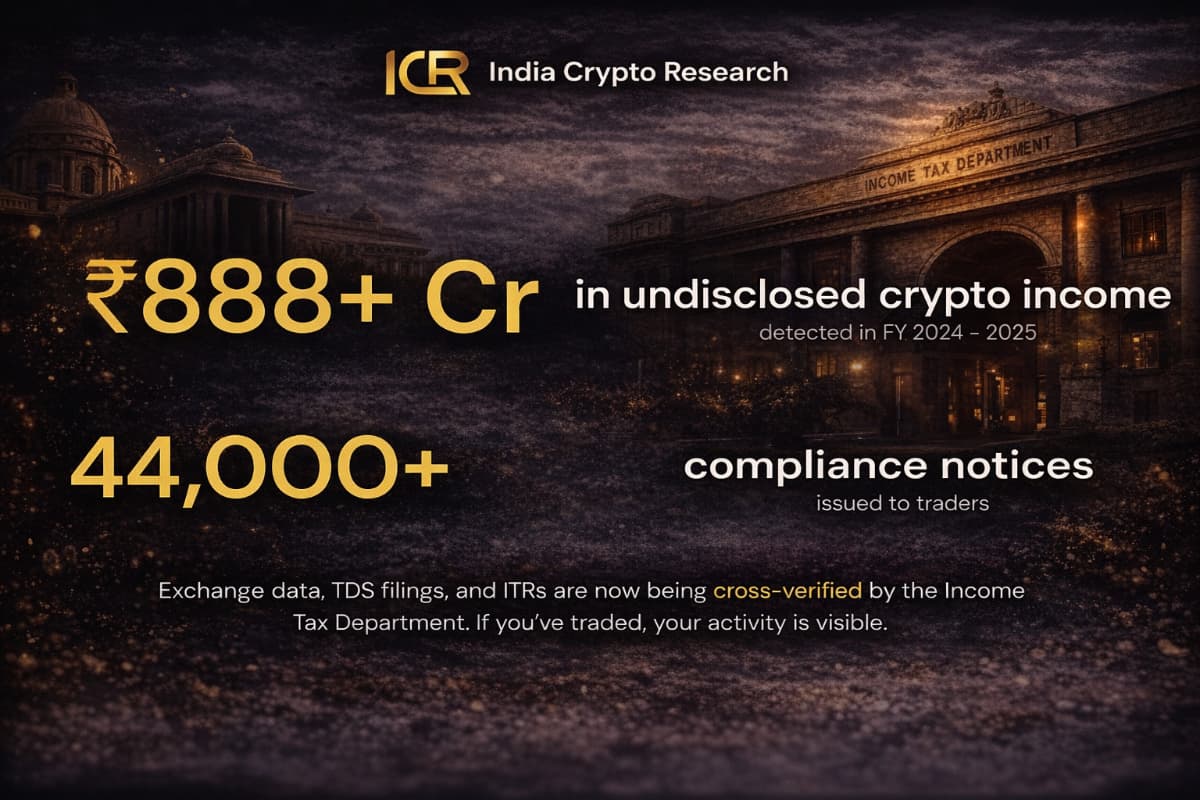
As of December 2025, the Central Board of Direct Taxes (CBDT) has identified ₹888.82 crore in undisclosed income linked to Virtual Digital Assets (VDAs), including cryptocurrencies and NFTs. At the same time, over 44,000 taxpayers received compliance communications for failing to report crypto activity on their income tax returns.
This marks one of the strongest signals yet that crypto transactions are firmly within the tax department’s monitoring framework.
The Income Tax Department has been actively comparing exchange data with filed returns to identify mismatches. Where crypto trades appeared but were not declared in Schedule VDA, automated alerts were issued to taxpayers.
Most of these cases involved:
These communications were issued under the government’s data-driven compliance initiative designed to encourage voluntary correction before stricter action begins.
Since 2022, India has followed a dedicated tax framework for digital assets. Under Section 115BBH:
In addition, a 1% TDS applies to specified crypto transactions, creating a reporting trail that helps authorities track trading activity across platforms.
Together, these measures ensure that most transactions leave a compliance footprint.
India still does not have a comprehensive regulatory law governing cryptocurrencies. However, this does not reduce tax obligations.
Government officials have repeatedly noted that because crypto assets operate across borders, regulation requires international coordination. Yet taxation remains enforceable regardless of regulatory status.
In practice, that means investors are expected to disclose crypto income just like any other taxable asset class.
Tax enforcement today relies heavily on analytics.
Authorities use tools such as:
These systems help identify discrepancies quickly and at scale. In several cases, undisclosed income surfaced during search and verification exercises that compared trading records with reported income.
Investigating digital assets requires specialised technical expertise. To strengthen monitoring, officials are being trained in:
This reflects a broader shift. Crypto enforcement is moving from reactive audits toward structured digital surveillance supported by analytics and investigation tools.

For investors, this changes the risk equation. Non-disclosure is no longer difficult to identify, only during audits. It can now be flagged automatically through system-level verification.
Maintaining accurate records across exchanges and financial years is quickly becoming essential rather than optional.
Realistically, no.
The detection of ₹888.82 crore in undisclosed crypto income shows that enforcement is already active and scaling. Officials have also confirmed that thousands of communications were issued specifically to taxpayers who failed to report VDA transactions.
As monitoring improves, the likelihood of unnoticed discrepancies continues to shrink.
Crypto may be a new asset class, but the obligation to report taxable income is not.

For many investors, the biggest challenge is not the willingness to comply but managing fragmented data across exchanges and wallets.
To address this, India Crypto Research has developed a Crypto Tax Calculator designed specifically for Indian reporting requirements.
The tool enables users to:
As compliance expectations increase, structured reporting tools can make tax preparation significantly easier and more accurate.
India Crypto Research operates independently. The information presented herein is intended solely for educational and informational purposes and should not be construed as financial advice. Before making any financial decisions, it's essential to undertake your own thorough research and analysis. If you're uncertain about any financial matters, we strongly recommend seeking guidance from an impartial financial advisor.