Europe gets tough on stablecoins.
Greece to impose a 10% tax on crypto.
Banks and funds edge towards crypto
More from the US
India: less action this week, but the net is tightening.
What to watch next

Europe: ESMA told EU-licensed crypto firms to stop providing services linked to stablecoins that are non-compliant with the EU's framework, and to clear their remaining exposure within about 3 months.
Greece: A draft bill proposes a 10% tax on crypto gains with an annual exemption of €500. The bill is not law yet.
Mainstream finance: Standard Chartered got a Dubai licence to offer crypto trading, Thailand approved Bitcoin and Ether ETFs, and Russia's biggest bank is moving into the crypto business.
United States: Blockchain.com applied to offer crypto derivatives, and the CFTC proposed rules on event contracts.

 Part of a series
It's been a busy week for crypto rules around the world. Some rules are in the name of user protection, while others are to raise taxes and welcome banks and stock exchanges to the crypto world. Here is what happened, in simple terms.
On the 8th of October, ESMA, the European Union's markets watchdog, published an opinion on stablecoins that don't comply with MiCA. MiCA is the main crypto law of the European Union. ESMA says crypto firms which hold an EU licence should not provide services related to those stablecoins. Services include trading, exchange, custody, transfers and advice.
ESMA says firms should put controls in place to stop customers from buying more of these stablecoins. National regulatory authorities (NRAs) should check that firms have put these controls in place. Firms should clear any leftover exposure to these stablecoins as soon as possible, and no later than 3 months after the publication of the ESMA opinion. During that time, firms can still help customers sell, convert, withdraw or move these coins.
ESMA did not name any stablecoin or company in its opinion. According to CryptoSlate, some exchanges have already restricted Tether's USDT for European users. But that is CryptoSlate's reading, not ESMA's.
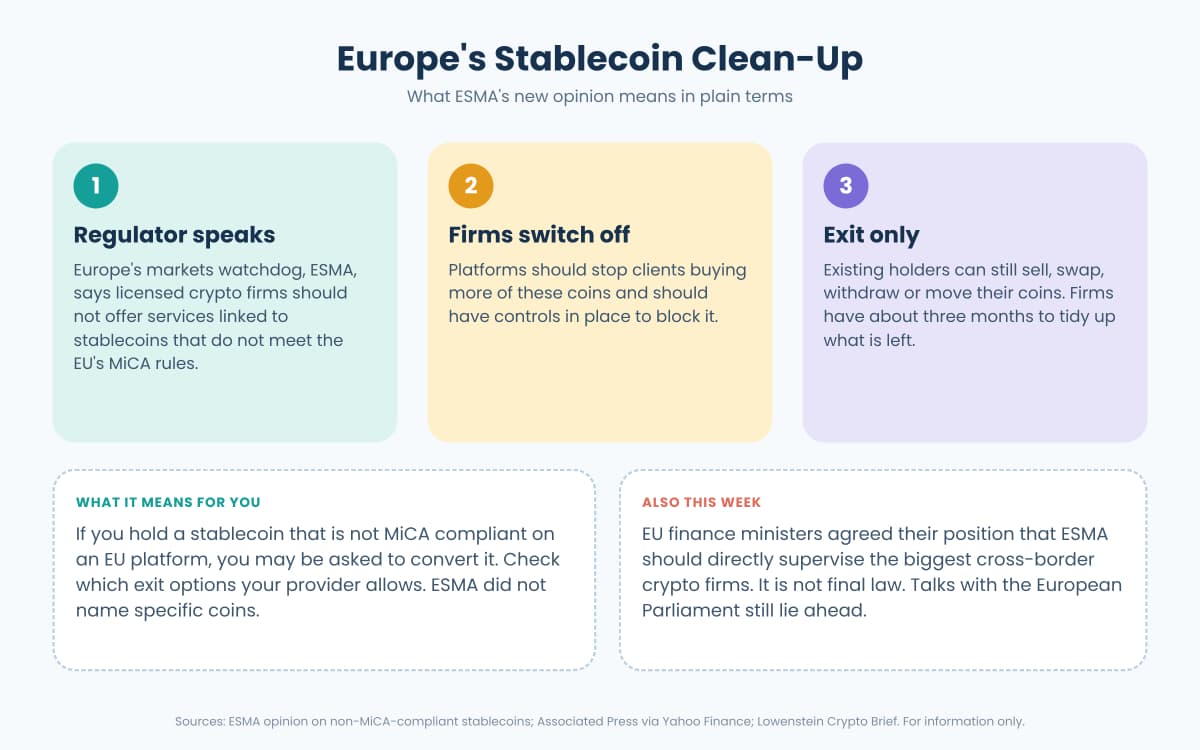
There was also some development regarding who would be the crypto police. On the 9th, the EU's finance ministers backed a plan to have ESMA supervise the largest cross-border crypto firms directly, as opposed to leaving it to each member state. The ministers' plan is narrower than the plan outlined by the European Commission. It is not yet law. The 27 member states still need to agree the details with the European Parliament. Separately, ESMA released a consultation on using tokenised assets as collateral in clearing and requested the industry to submit their views by the 15th of January 2027.
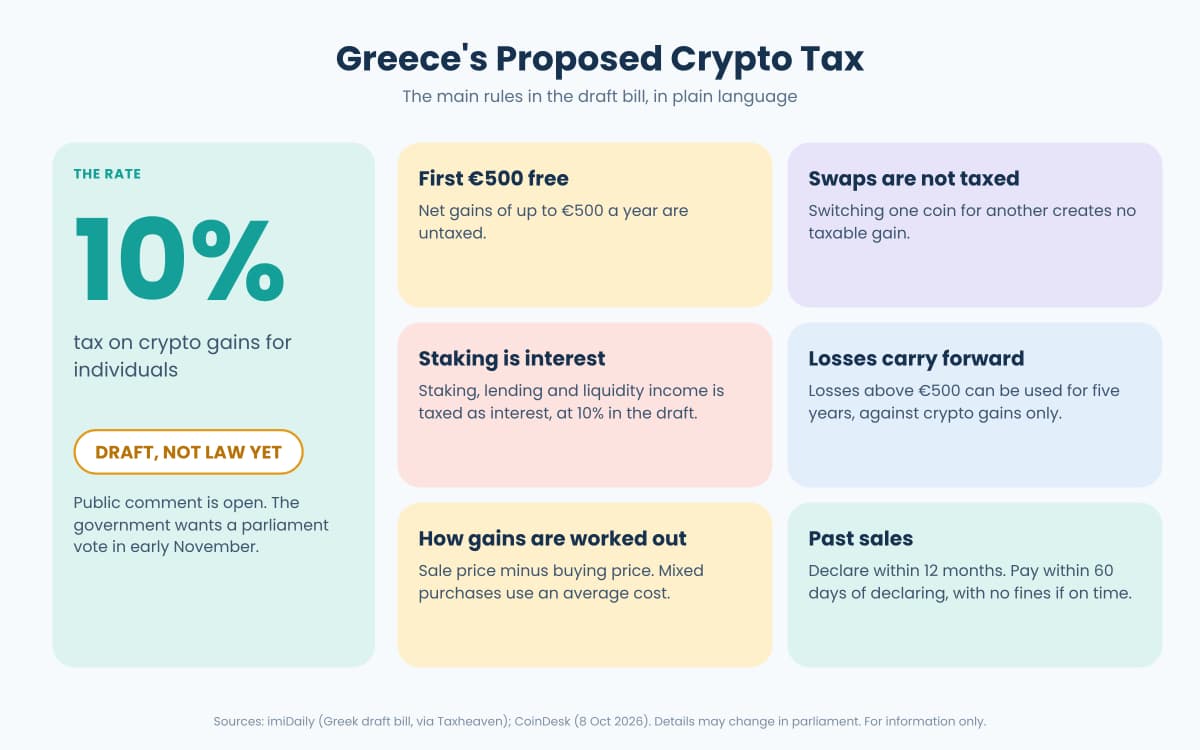
Greece's Finance Ministry released a draft bill on October 7th to impose a 10% tax on individuals' crypto gains. The first 500 euros of net gains a year would be exempt from taxation. The consultation would end on the 22nd of October, and the government wants parliament to vote on the bill in the first week of November. However, the ministry has not set a start date for the tax. One Greek report suggests that if the bill is passed without any changes, the main articles of the bill would apply from the 2027 tax year.
The draft bill includes some friendly provisions. If a crypto asset is swapped for another, no taxable event would occur. Losses above €500 could be offset against crypto gains over the next 5 years. People who sold crypto before the law is implemented would have 12 months to declare those gains and 60 days to pay, without a fine if they pay on time. Income from staking, lending and liquidity provision would be taxed at 10% and treated as interest.
CoinDesk suggests that 10% is a low rate compared to several other EU countries. Greek investors reportedly prefer platforms based abroad, and as such, the local market is hard to gauge. In France, a plan to tax swaps from crypto into stablecoins has stalled. According to Finobird's round-up, a parliamentary committee adopted the idea and then rejected the budget section that carried it. Finobird's report is the only source we found, so consider the detail carefully.
Four stories show how crypto is becoming more mainstream, each with its own boundaries.
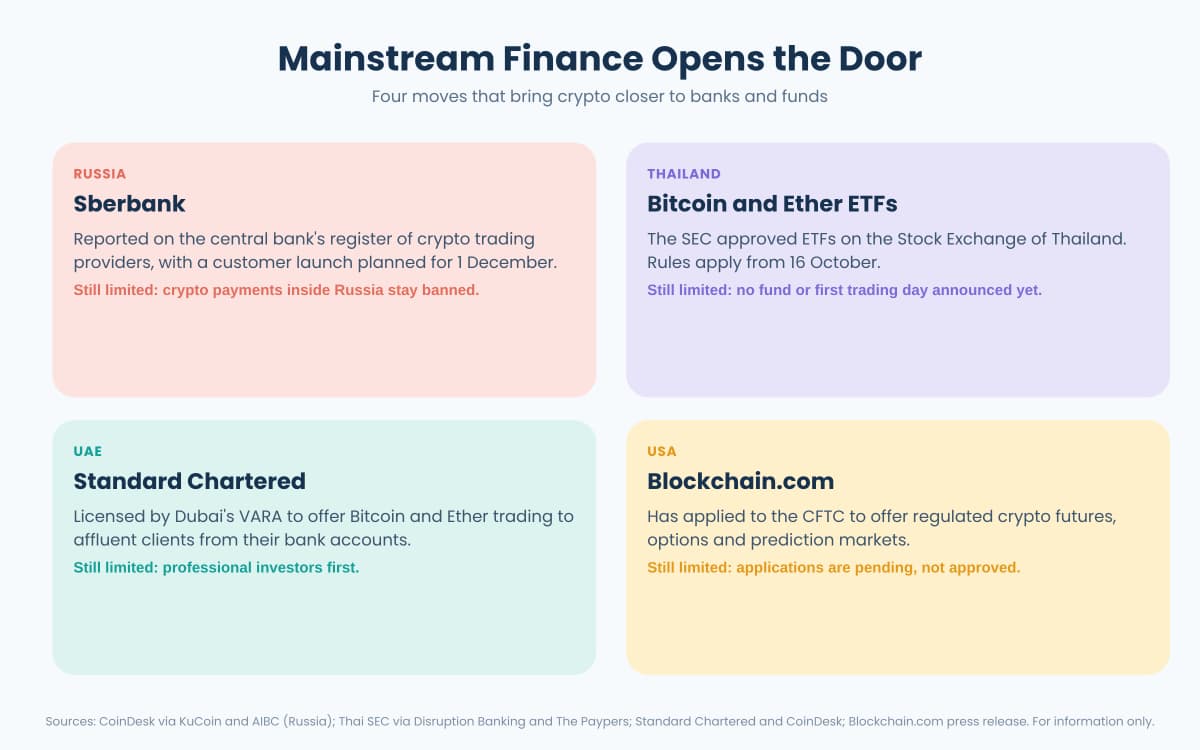
Thailand. The SEC issued rules on Oct 8 allowing Bitcoin and Ether ETFs to be listed on the Stock Exchange of Thailand, with the rules taking effect on Oct 16. Funds must be passive and hold their assets with regulated custodians. Investors must go through risk education. No fund or first trade date has been announced.
United Arab Emirates. Standard Chartered announced on Oct 14 that Dubai's Virtual Assets Regulatory Authority had licensed the bank to provide Bitcoin and Ether trading through its bank accounts, starting with professional investors. The bank said this was the first time an international bank was allowed to provide such services in the UAE.
Russia. CoinDesk, as relayed by KuCoin, reports that Sberbank has joined the Central Bank's register of crypto trading providers, with a launch for all customers planned for December 1. Sources differ on the exact dates, and a claim that it is the "first bank" has no clear source, so we treat these details as reported rather than confirmed. Crypto payments are illegal in Russia, and ordinary investors can only purchase cryptocurrencies worth 300,000 rubles per year through one intermediary.
United States. Blockchain.com announced on 13 October that it has applied to the CFTC to become a Futures Commission Merchant and Designated Contract Market. If approved, the company will offer regulated crypto futures and options as well as prediction market contracts. As of the time of writing, the applications were still pending.
On 9 October, the CFTC proposed to treat qualifying event contracts, such as bets on politics, culture and weather, as swaps under its own authority. Comments on the proposal will be due 30 days after it is published in the Federal Register. The CFTC also adopted an interim final rule to keep ordinary sportsbook bets and casino games out of the swap definition. The same day, the New York Attorney General announced a settlement with Celsius founder Alex Mashinsky, who is now barred from the securities, commodities and crypto industries.
Two earlier proposals are still accepting comments. The first, the SEC's 1 October proposal, would widen advisers' and funds' ability to hold crypto, including through state trust companies. The second, the CFTC's 5 October notice, requests comments on rules for leveraged retail crypto trading. We checked the SEC's press page and did not find any new crypto releases from October 8 to 14.
This week, we found no new official crypto rules from Indian regulators. The story to watch is still on the tax front. India's reporting rules for crypto platforms are live, and our recent blog on the global reporting framework explains why it is increasingly difficult to hide crypto gains. It is also reported that India's Financial Intelligence Unit has issued notices to offshore crypto platforms that have not registered. However, that claim comes from a single article, with no platform names or dates, so we did not rely on it.
Greece. The end of consultation and the November parliamentary vote.
Thailand. Whether any issuer announces a Bitcoin or Ether ETF once the rules apply.
Europe. How exchanges treat non-compliant stablecoins, and whether the supervision plan survives Parliament talks.
United States. Comments on the CFTC and SEC proposals, and any decision on Blockchain.com's applications.
India Crypto Research operates independently. The information presented herein is intended solely for educational and informational purposes and should not be construed as financial advice. Before making any financial decisions, it's essential to undertake your own thorough research and analysis. If you're uncertain about any financial matters, we strongly recommend seeking guidance from an impartial financial advisor.