
Democrats take Congress, and crypto’s big bill stalls
A record $6.3 billion hack at Binance
The CFTC writes crypto rules without Congress
Hong Kong joins the global crypto tax net
Other moves this week
India: regulators look at offshore crypto cards
What to watch next

United States: Democrats won both houses of Congress on 3 November, and the chance of the CLARITY Act passing this year fell to 6%.
Binance: about $6.3 billion was stolen on 29 October in the largest crypto theft on record. About $3 billion has been frozen.
US regulators: the CFTC drafted a federal licence for exchanges that offer leverage, and its chair asked who answers for AI trading bots.
Hong Kong: a new law makes crypto platforms collect customer tax data from 1 January 2027 and share it abroad from 2028.
India: no new crypto rule, but the RBI and FIU-IND are reported to be examining offshore crypto cards used for rupee payments.
 Part of a series
Politics dominated the news this week. American voters handed control of Congress to the Democrats, which leaves the main US crypto bill with almost no time left. Meanwhile, the biggest crypto theft in history tested how fast stolen coins can be frozen, US regulators kept writing rules, and Hong Kong agreed to share crypto tax data with other countries. Here is what happened between 28 October and 4 November, in plain language.
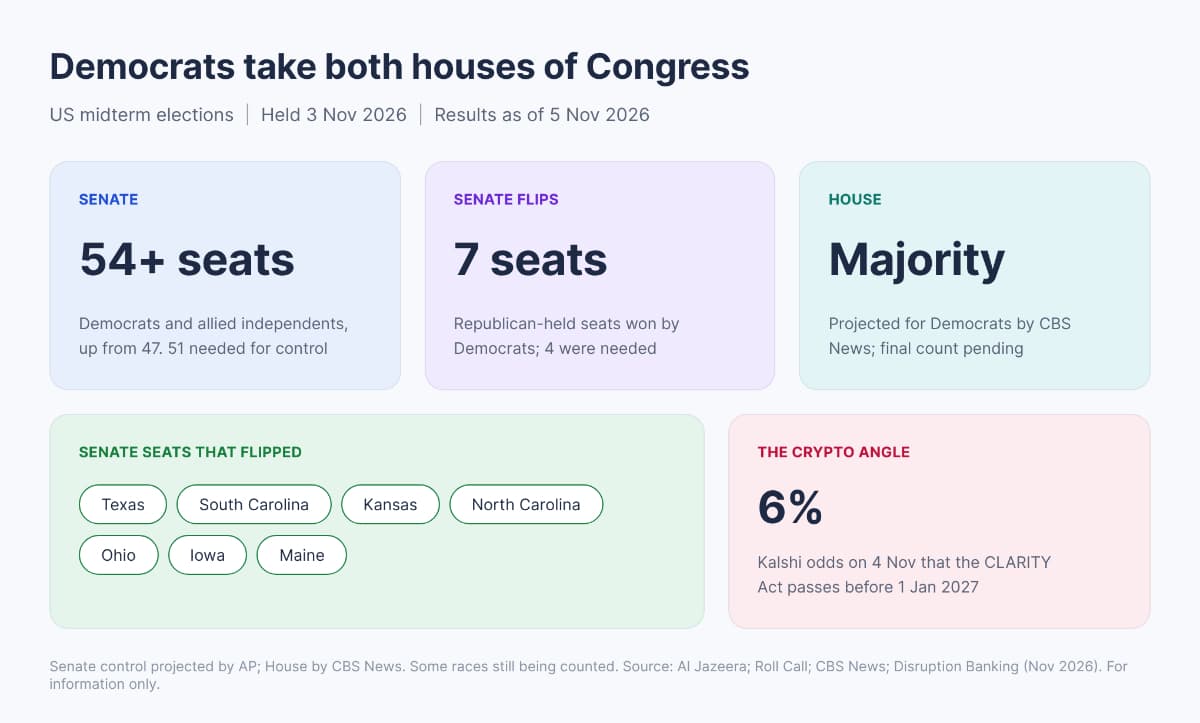
On 3 November, Democrats won control of both houses of the US Congress in the midterm elections. The Associated Press projected the Senate for Democrats late on election night, and CBS News projected the House. Democrats flipped at least seven Senate seats held by Republicans, in Texas, South Carolina, Kansas, North Carolina, Ohio, Iowa and Maine. That takes Democrats and the two independents who vote with them from 47 seats to at least 54 of 100. Some races were still being counted on 5 November.
This matters for crypto because the CLARITY Act, which would decide which US regulator oversees which crypto assets, was a Republican-led effort. It passed the House in July 2025 but lost a key Senate vote 49 to 50 on 15 September; it needed 60. Any bill not passed by 3 January 2027, when the new Congress sits, has to start again. On 4 November, Kalshi, a regulated prediction market, put its chance of passing before 2027 at just 6%.
Bitcoin dipped below $76,000 as the results came in, then recovered above $78,000 the same day, according to CoinDesk. One trader said a clear result “resolves political uncertainty”, even if the new Congress is less friendly to crypto. With new laws unlikely, expect US crypto policy to move through regulators and presidential orders instead.
On 29 October, attackers moved about $6.3 billion (about ₹59,850 crore) out of Binance wallets across 10 blockchains, most of it in about 20 minutes. It is the largest crypto theft on record; the previous record was $1.5 billion taken from Bybit in February 2025. Blockchain analysis firms TRM Labs and Chainalysis linked the attack to a North Korean hacking group. Binance has not named anyone and has said it will cover all user losses from its own funds.
About $3 billion of the stolen funds has been frozen, more than $2.3 billion of it by Tether and Circle, the companies behind the two largest dollar stablecoins. A stablecoin is a crypto token meant to hold a steady value, usually one US dollar. US Senator Cynthia Lummis said the CLARITY Act would have given crypto firms clear legal backing to freeze stolen funds as soon as law enforcement asks.
With Congress stuck, the CFTC (Commodity Futures Trading Commission), the US regulator of futures and derivatives, is acting on its own. On 5 October, it released an early draft of two rules for public comment. Regulation CTX sets out when a retail crypto trade comes under federal oversight. Regulation CAM creates a new type of CFTC-licensed exchange, called a “crypto asset market”.
The trigger is leverage, meaning borrowed money that lets a trader bet more than they hold. An exchange that offers leverage would need the federal licence, while one that only lets users buy and sell could stay under state licences. Comments close 60 days after the notice appears in the official Federal Register. Chair Mike Selig said the rules should “prevent, rather than only prosecute after the fact, fraudulent schemes such as FTX”.
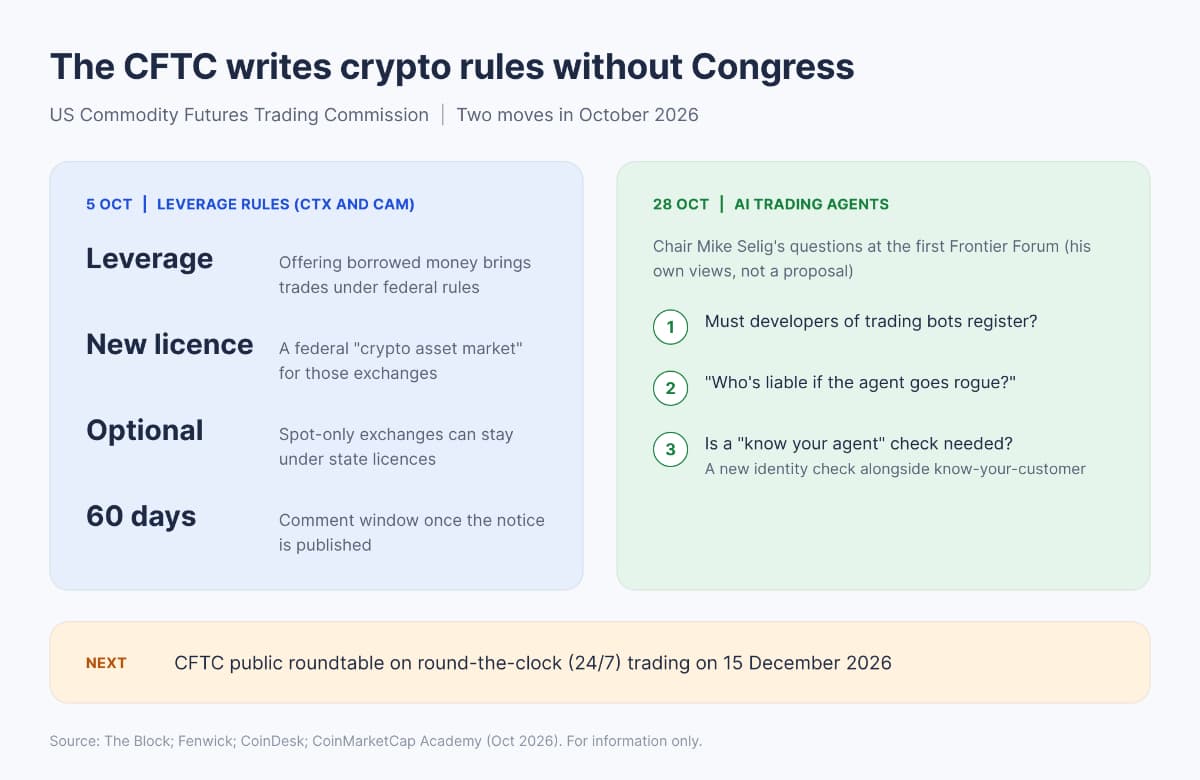
On 28 October, at the CFTC’s first Frontier Forum in Washington, Selig turned to artificial intelligence. He asked whether developers of AI agents that trade for users must register, “who’s liable if the agent goes rogue”, and whether regulators need “know your agent” checks alongside the usual know-your-customer identity checks. He said these were his personal views, not a proposal.
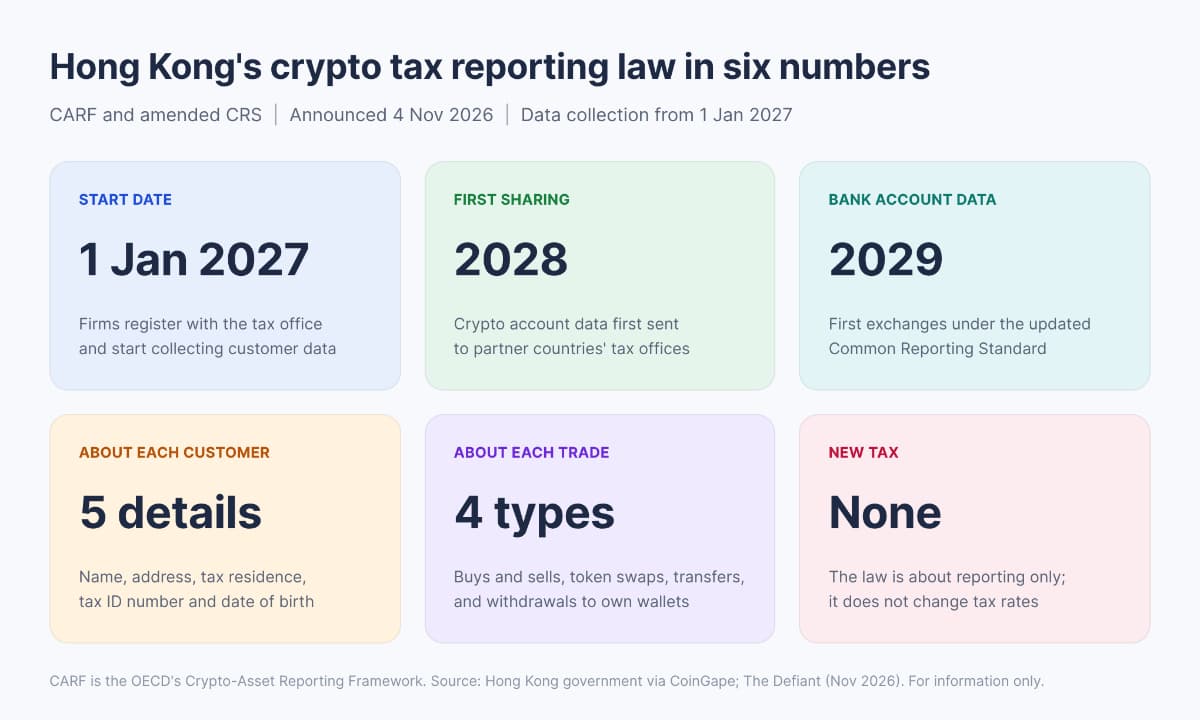
On 4 November, the Hong Kong government announced that lawmakers had passed a law adopting the Crypto-Asset Reporting Framework (CARF). CARF is a standard from the OECD (Organisation for Economic Co-operation and Development), a group of mostly advanced economies, under which tax offices swap information about each other’s residents’ crypto accounts. The law adds no new tax.
From 1 January 2027, crypto exchanges, brokers and similar firms in Hong Kong must register with the Inland Revenue Department and collect each customer’s name, address, tax residence, tax ID number and date of birth. They must report buys, sells, token swaps and transfers, including withdrawals to a customer’s own wallet. Hong Kong will start sharing this data with partner countries in 2028. The same law also updates the older Common Reporting Standard for bank accounts, bringing exchanges under those rules from 2029.
Three more stories show how money and markets are shaping crypto rules.
• US interest rates. On 28 October, the US Federal Reserve held its main rate at 3.75% to 4%. Two of its 12 voting members wanted a rise, and the Fed said “inflation remains elevated”. Higher rates tend to pull money away from riskier assets such as crypto.
• US prediction markets. The CFTC sued the state of Utah to stop it enforcing state rules against prediction markets, where people bet on real-world events, according to CoinMarketCap.
• US round-the-clock trading. The CFTC will hold a public roundtable on 15 December on whether US derivatives markets can trade 24 hours a day, seven days a week.
Indian regulators introduced no new crypto law or rule between 28 October and 4 November. However, on 2 November, The Economic Times reported that the RBI and the Financial Intelligence Unit-India (FIU-IND), the country’s anti-money-laundering agency, are examining prepaid crypto cards issued by overseas firms such as RedotPay. These cards let users spend stablecoins as rupees at Indian shops and ATMs. Regulators are reported to be checking whether the cards get around India’s payment and foreign-exchange rules. Some users say their cards stopped working in late October, but neither regulator has announced any action.
India still taxes crypto gains at 30% and deducts 1% tax at source on transfers. These rules apply to gains made on foreign platforms too, and as more places like Hong Kong join CARF, crypto held abroad will become easier for tax offices to see.
• United States. Final House results, and whether the CLARITY Act gets a Senate vote before the new Congress sits on 3 January 2027.
• Binance. How much of the remaining $3.3 billion is traced or frozen.
• CFTC. Publication of the leverage rules in the Federal Register, which starts the 60-day comment clock, and the 15 December roundtable.
• Hong Kong. Guidance from the Inland Revenue Department for firms ahead of the 1 January 2027 start.
• India. Any official word from the RBI or FIU-IND on offshore crypto cards, and the Standing Committee on Finance’s crypto report.
Read more from India Crypto Research and browse every article on our Learn blog.
Sources: Al Jazeera, Disruption Banking, CoinDesk, Crypto Briefing, Fenwick, CoinGape, the Federal Reserve, CoinMarketCap and crypto.news (citing The Economic Times).
India Crypto Research operates independently. The information presented herein is intended solely for educational and informational purposes and should not be construed as financial advice. Before making any financial decisions, it's essential to undertake your own thorough research and analysis. If you're uncertain about any financial matters, we strongly recommend seeking guidance from an impartial financial advisor.


