How FOMC Decisions Shape Bitcoin
Where We Left Off
Real rates, not headline rates
Bitcoin and global money supply
The Test Case: Autumn 2025
Six Reasons the Correlation Comes Apart
A Genuine Disagreement, Not a Settled Question
What to Watch Next
Real Reason

India Crypto Research Brief
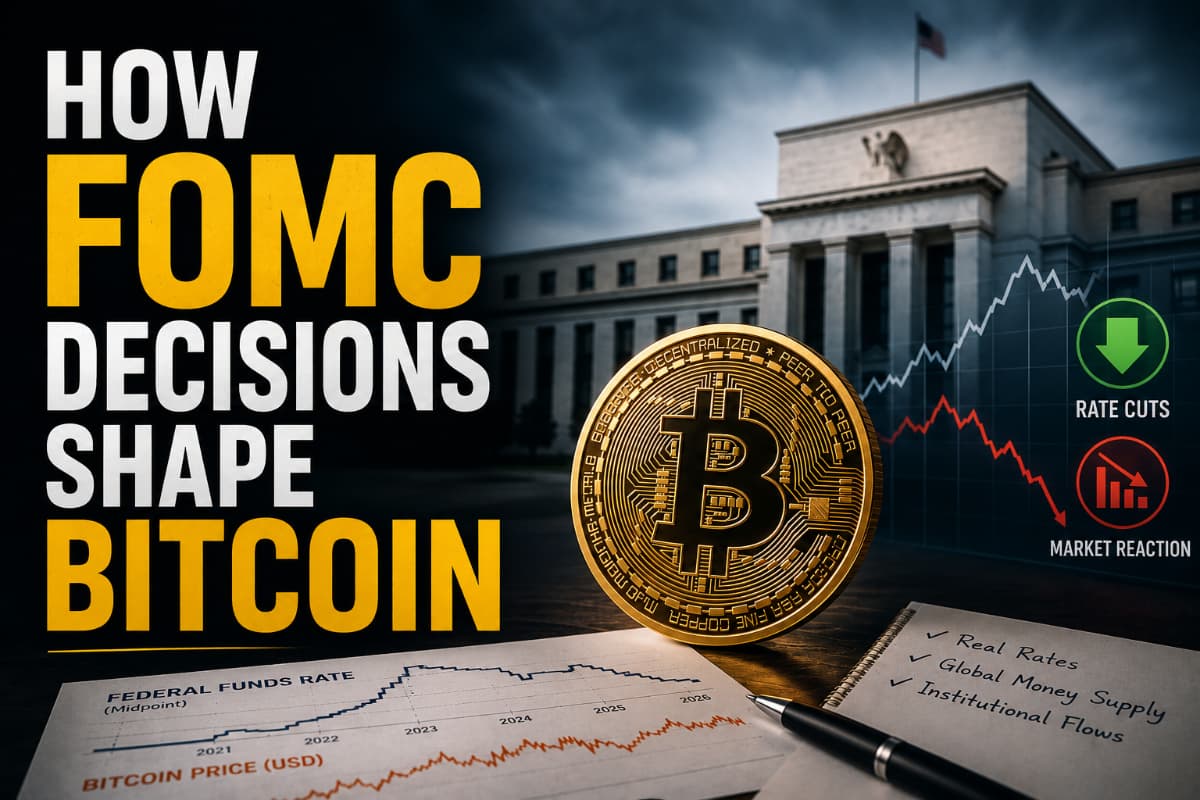
The Fed held rates steady at its latest FOMC meeting. Nothing new there. But the market reaction was telling. It pointed to a growing gap between what monetary policy is doing and what Bitcoin is actually doing. For most of the last cycle, softer rate expectations meant higher Bitcoin. Not this time. Rates are easing, and Bitcoin is still weak. So liquidity clearly isn't the only thing driving this asset anymore.
Rewind to October 2025. India Crypto Research Brief #7 looked at where Bitcoin stood after the Fed's rate cuts and the US government shutdown. Three things to watch, it said. Real rates. Global money supply. Institutional flows. Ten months on, all three have moved. And Bitcoin still went down.
So what's actually happening here?
Fed cycles and Bitcoin's return
Before 2020, rate policy and Bitcoin barely spoke to each other. Big institutional money hadn't shown up yet, so Fed moves didn't really touch it. Bitcoin ran on its own logic.
That changed after 2020. Bitcoin now trades like a risk asset. Cuts tend to help, hikes tend to hurt. But it's not that simple. The reason for the cut matters as much as the cut itself. A cut that reads as “we're supporting growth” tends to lift Bitcoin. A cut that reads as “the economy is in trouble” can push it the other way, even though it's the same 25 basis points on paper. Rate policy and Bitcoin are tied together now. That link wasn't there before.
Here's the part people skip. What actually matters for an asset like Bitcoin, which pays no yield, is the real return on safe alternatives like Treasuries. A fall in real yields means a fall in the cost of holding Bitcoin instead.
The catch is that a nominal rate cut only lowers real rates if inflation doesn't rise and eat the difference. Keep that in mind, because it does a lot of the heavy lifting below.
Bitcoin has usually followed global M2 with roughly a twelve-week lag. More cash sitting in the system, more of it eventually spills into Bitcoin. This is a pattern, not a one-off. You can see it around past run-ups.

Fed funds rate (midpoint) and Bitcoin price at each FOMC meeting, Jan 2021–Jul 2026. The 2022 hiking cycle and the 2024 cuts both moved BTC in the expected direction; the Sep–Dec 2025 cuts did not.
Here's where it gets interesting. The Fed cut rates three times back to back between September and December 2025, from 4.00–4.25% down to 3.50–3.75%. By the book, that should have been bullish. Instead, Bitcoin dropped from roughly $115,000 to $87,500 over that window, and kept sliding into mid-2026.
The framework failed its own test case.
None of this means the original framework was wrong. It means the relationship weakens or inverts sometimes, for documented reasons, and several of those reasons were firing at once during this stretch.

Bitcoin price, Sep 2025–Jul 2026, with the three rate cuts and the structural shocks that coincided with them. The mechanism and the shocks were pulling in opposite directions.
Not everyone reads this the same way. Fidelity Digital Assets' January 2026 outlook still backs the M2 relationship, arguing Bitcoin's fixed supply lets it absorb liquidity better than other assets over a full cycle. Others see the divergence as a warning, pointing to earlier periods where Bitcoin and M2 decoupled and prices fell hard afterward. A smaller group chalks it up to one-off factors unique to this window, hard to prove either way.
The divergence itself isn't up for debate. What it means next is.
The three variables from the original brief still matter. They just need updating. Real rates hinge on whether inflation cools enough for nominal cuts to actually pull real yields down. Money supply needs to be read net of Treasury General Account moves, not off the headline print. And institutional flows remain the clearest near-term tell; a sustained reversal of the ETF outflow streak would be the strongest sign the supportive channel is reopening, regardless of what the Fed does next.
Bitcoin didn't fail the framework in autumn 2025. The framework was never a formula to begin with. It's a set of forces that sometimes line up and mostly don't. For four years, enough of them pointed the same way often enough that watching the Fed alone felt like it was working. Autumn 2025 was simply when they stopped agreeing.
That's not a reason to throw the model out. It's a reason to stop treating it like a switch you can flip. Next time a rate cut lands and Bitcoin doesn't move the way the chart says it should, don't ask why the correlation broke. Ask which of the other forces is winning right now. Bitcoin and these forces are always interacting, and that question always has an answer. It's just rarely the same answer twice. Which is exactly why this market is worth watching, not modelling.
India Crypto Research operates independently. The information presented herein is intended solely for educational and informational purposes and should not be construed as financial advice. Before making any financial decisions, it's essential to undertake your own thorough research and analysis. If you're uncertain about any financial matters, we strongly recommend seeking guidance from an impartial financial advisor.