How Does Tokenisation Work? From Real-World Asset to Digital Token
Valuation
Legal Ownership
The SPV: A Legal Container for the Asset
The Custodian
The Smart Contract
Token Creation and Investor Purchase
What Happens After Purchase
Why the Simplest Version of This Already Works Everywhere
The Full Chain
What This Means for Readers

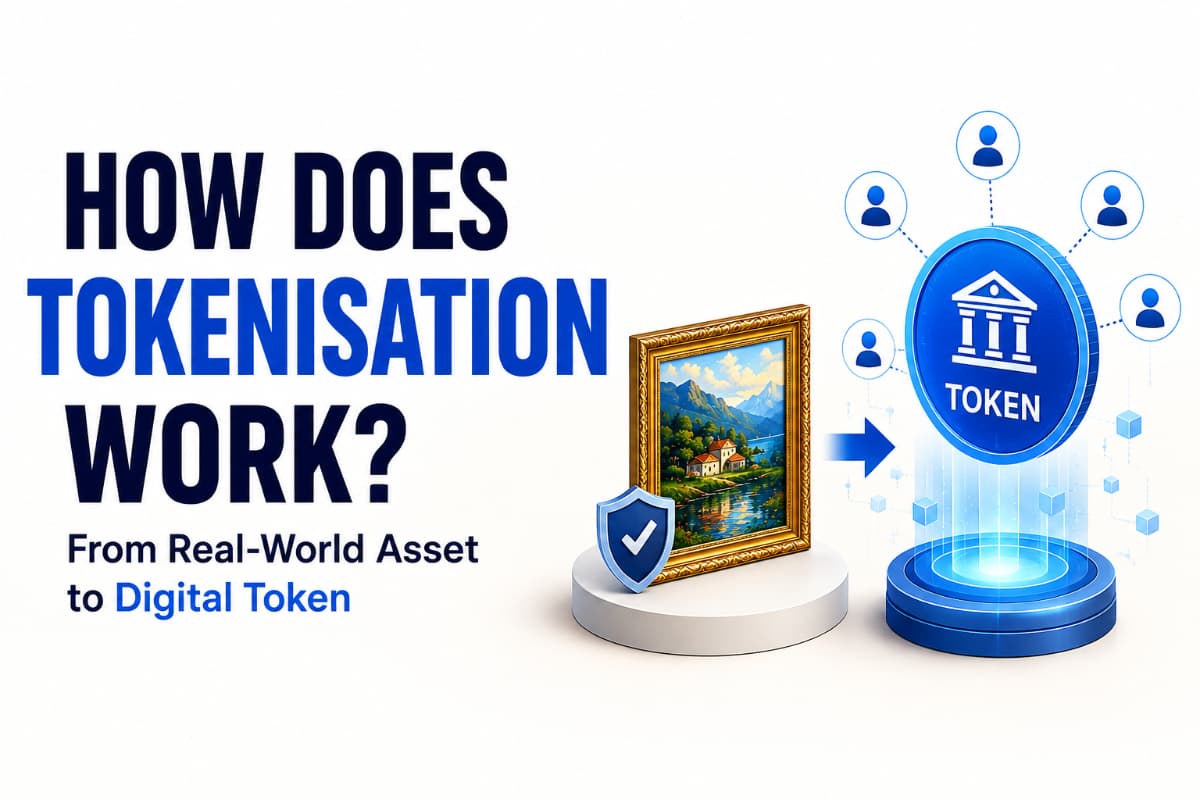
A ₹1 crore painting doesn't become 1,000 tradeable tokens overnight. Between "I own a painting" and "an investor holds a token representing a slice of it" sits a chain of six legal and technical stages, and skipping any one of them is exactly how a tokenisation project turns into an unenforceable digital record instead of real ownership. This piece walks through that chain, then checks it against how tokenisation is actually playing out globally right now.

Before anything gets tokenised, the underlying asset needs an independent, defensible valuation: a professional appraiser's assessment of what the painting is actually worth. This matters more than it sounds. Every token's price traces back to this number, so if the valuation is inflated or unreliable, every token built on top of it inherits that flaw. For our painting, say an appraiser values it at ₹1 crore.
Someone has to actually, legally own the painting before it can be tokenised: a clean title, free of disputes, liens, or unclear inheritance claims. In practical terms, you can't tokenise what you don't clearly own. This sounds obvious, but it's where many real-world tokenisation attempts stall globally, since the technology is often ready before the legal ownership question is settled.
The painting gets transferred into a Special Purpose Vehicle (SPV), a standalone legal entity created for the sole purpose of holding this one asset. Investors own a fraction of the SPV, and the SPV owns the painting. Most legal systems, including India's, don't yet have a clean way to register that 1,000 people jointly own 1/1000th of a painting directly. An SPV converts that into a company-shares problem, which existing law already knows how to handle. The token, later, represents a share in the SPV, not a direct legal claim on the painting itself.
This stage is the single most important one in the entire chain, and it isn't unique to India. A Deloitte advisor speaking on institutional tokenisation recently described legal basis as a non-negotiable requirement, alongside KYC/anti-money-laundering compliance and cybersecurity: a token needs to carry the same enforceable legal weight as a traditional title deed, recognised identically wherever the asset sits. Without that legal basis, a token is just a technically impressive digital record, not enforceable ownership.
Someone has to physically hold and protect the actual painting: insured storage, controlled access, protection against damage or theft. The custodian's job is entirely separate from the SPV's legal role. The custodian holds the physical asset safely, while the SPV holds legal title to it. This is the same function a bank vault serves for gold, applied to any physical asset being tokenised.
A smart contract is self-executing code deployed on a blockchain (a shared, tamper-resistant digital ledger) that encodes the rules of the tokens: how many exist, how ownership transfers, how income gets distributed. The smart contract doesn't "know" about the painting directly; it only enforces the rules the SPV has instructed it to. It's a rulebook, not a source of legal rights on its own. The rights come from the SPV stage above.
For our example, the smart contract is programmed to create exactly 1,000 tokens, each representing a defined 0.1% economic interest in the SPV, so each token corresponds to roughly ₹10,000 of value at issuance.
With the legal structure and smart contract rules in place, the 1,000 tokens are minted and made available to investors. An investor buying 5 tokens isn't buying "part of a painting" physically; they're buying 5 units in the SPV, tracked and transferred via the token on the blockchain.
Two things typically follow. The first is income or appreciation: if the painting is loaned for exhibition, sold, or appreciates in value, that benefit flows back through the SPV to token holders, proportional to their holding. The second is redemption or the secondary market: depending on how the SPV is structured, holders may sell their tokens to another investor, or redeem them for a proportional payout if the asset is eventually sold.

Stablecoins, digital tokens pegged to a real currency, usually the US dollar, prove this entire chain can work smoothly when the underlying asset is simple. A stablecoin issuer holds one real dollar in reserve for every token issued; the token is a direct, one-to-one proxy for money that already exists. That market is now worth roughly $256 billion, with Standard Chartered forecasting $2 trillion by 2028, by far the most successful tokenisation use case to date.
The reason is exactly what the stages above predict. A dollar needs no valuation dispute, no title question, no physical custody problem. A painting, a building, or a bond carries all of that real-world complexity, which is precisely why institutional tokenisation, despite live products from JPMorgan's Onyx platform, Goldman Sachs' Digital Assets Platform, and asset managers like BlackRock, hasn't yet produced the same liquid, easy market that stablecoins have. Individual tokenised bonds get issued, but a genuine secondary market hasn't emerged, partly because banks are largely building on separate private networks instead of one shared venue for trading.
Painting, valuation, legal ownership, SPV, custodian, smart contract, 1,000 tokens created, investor purchases tokens, income or appreciation, redemption or secondary market. This is the same chain that makes a stablecoin work in seconds and a tokenised building take years. The asset at the start of the chain determines how hard every later stage becomes.
1. A token is only as good as the legal structure behind it. Before evaluating any tokenised asset, ask what the SPV or equivalent legal vehicle actually is, not just how the blockchain part works.
2. Custody and legal ownership are two different questions. A platform can have excellent technology and still fail if the underlying asset isn't safely and verifiably held.
3. The smart contract enforces rules, it doesn't create rights. Rights come from the legal structure described above; the smart contract only automates what that structure allows.
4. Simple assets tokenise fast; complex ones take years. Stablecoins prove the model works. The friction with real estate, art, and bonds isn't the blockchain, it's the real-world legal and valuation complexity every such asset carries.
India Crypto Research operates independently. The information presented herein is intended solely for educational and informational purposes and should not be construed as financial advice. Before making any financial decisions, it's essential to undertake your own thorough research and analysis. If you're uncertain about any financial matters, we strongly recommend seeking guidance from an impartial financial advisor.