What Went Wrong Inside the Wallet
Galaxy Research's Numbers, Verified and Growing
How the Thefts Were Actually Carried Out
What This Means for Bitcoin Self-Custody Holders

 Part of a series
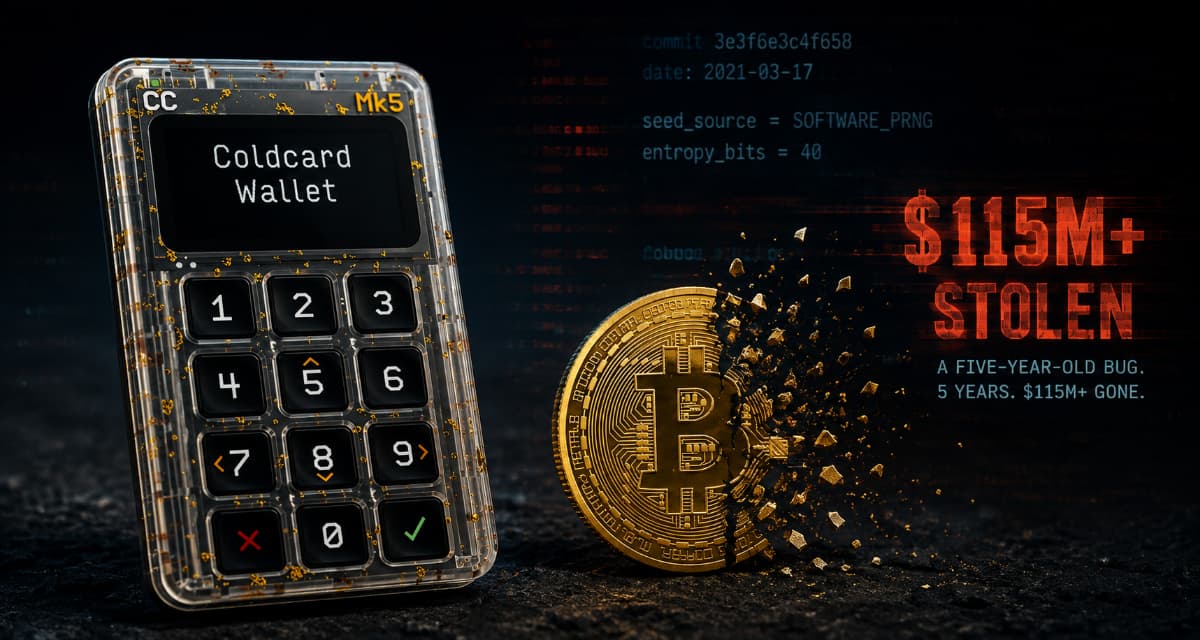
A single firmware commit made on March 17, 2021, has cost Bitcoin holders more than $115 million as of August 16, 2026. Galaxy Research, the blockchain intelligence arm of Galaxy Digital, has spent 18 days tracing the theft back to that one release, speaking directly with over 200 victims to reconstruct exactly how attackers found and emptied their wallets. The vulnerability sat in plain, publicly viewable code for more than five years before anyone appears to have exploited it. What Galaxy's investigation shows is not just the scale of the loss, but a forensic map of how the theft actually unfolded, address by address, wave by wave.
Coldcard is a hardware wallet: a small physical device made by the Canadian company Coinkite that generates and stores the private keys that control a Bitcoin holder's coins. It is kept deliberately offline so it cannot be hacked remotely. The entire security promise of a hardware wallet rests on one step: generating a truly random "seed," the master string of words that all of a wallet's private keys are derived from. Randomness here is not a nice-to-have. If an attacker can predict or narrow down the possible seeds a device could have produced, they can reconstruct the private keys without ever touching the device.
That is what happened. A firmware update released on March 17, 2021, when Bitcoin was at block height 674,951, quietly rerouted Coldcard's seed generation away from its dedicated hardware random number generator, a chip built specifically to produce unpredictable output, and onto a software fallback: a predictable pseudorandom number generator running on the general-purpose chip. In practical terms, this collapsed the effective randomness of affected seeds from 128 bits down to as little as 40 bits. Each bit doubles the number of possible seeds an attacker must search through, so this was not a modest weakening. It took a search space that would be uncrackable and shrank it to one a well-resourced attacker could feasibly recreate offline.
The bug went undetected in a wallet marketed as one of the most security-focused in the Bitcoin ecosystem. Attackers only began exploiting it in earnest starting July 30, 2026, meaning vulnerable seeds sat exposed, unexploited, for more than five years before someone acted on the flaw.
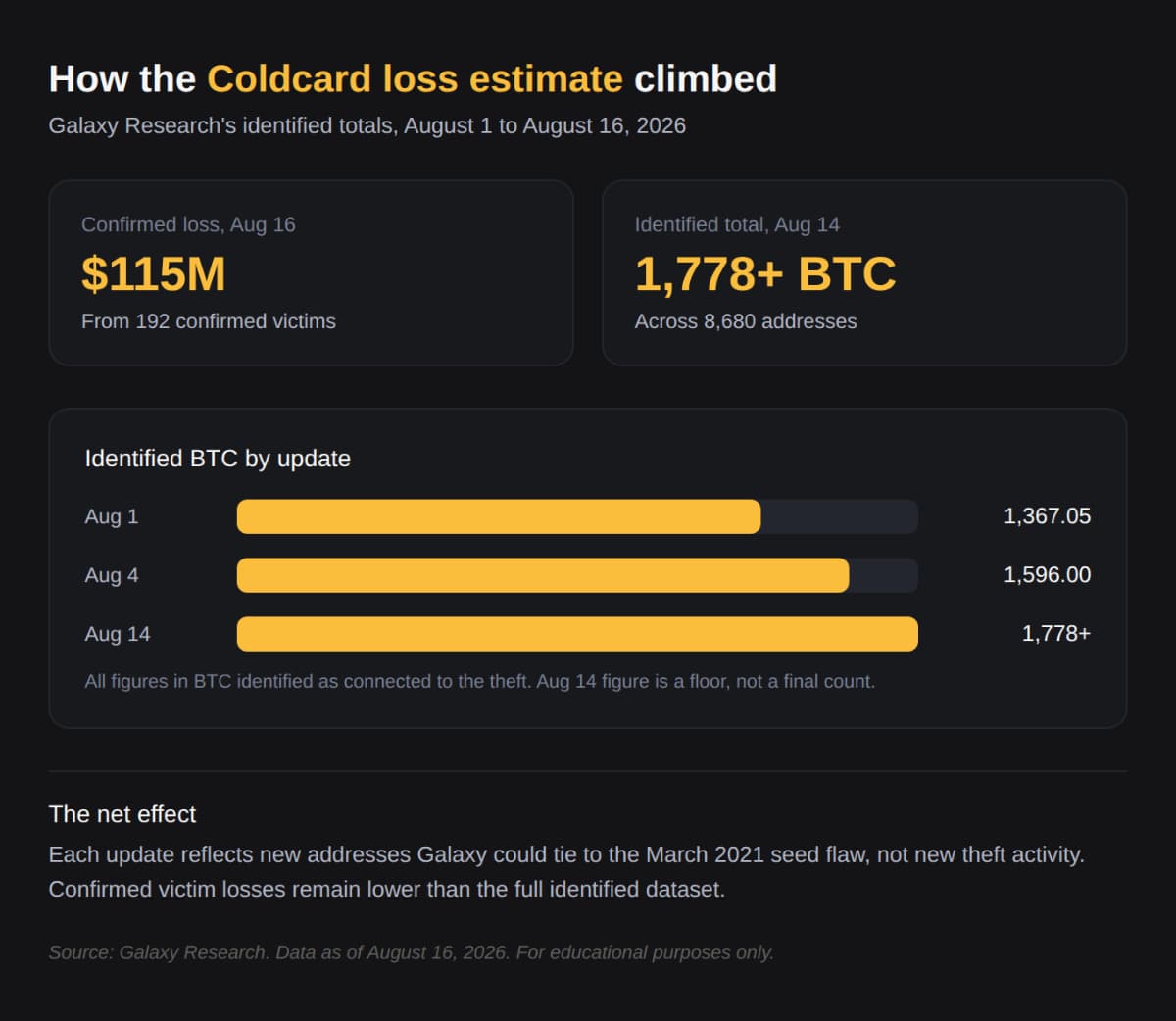
Galaxy Research's public dataset lists 8,680 addresses connected to the theft, together holding roughly 1,778.6 BTC. That is the scope Galaxy can trace on-chain. A narrower, higher confidence figure comes from direct victim contact: 192 people have come forward with confirmed losses, covering about 1,790 addresses and 714.8 BTC between them.
The total value of the theft has moved with both new tracing and Bitcoin's price. Early estimates on August 1 put losses at 1,367.05 BTC, about $88.6 million, across 4,585 addresses. By August 4, Galaxy had identified 1,596 BTC stolen from 7,300 addresses across three confirmed attack waves, warning that a fourth, unconfirmed wave could push the total toward 2,000 BTC. As of August 16, the date of Galaxy's most recent public update, confirmed losses stand at roughly $115 million, and Galaxy has said the true figure could climb past $150 million once currently unmoved funds and unconfirmed clusters are fully accounted for.
Most of the affected seeds were generated in 2021 and 2022, the period immediately following the flawed firmware release, when Coldcard adoption among self-custody holders was climbing. That timing matters for anyone trying to assess whether they are exposed. A wallet seed generated on vulnerable firmware in that window carries risk regardless of how carefully the device itself was otherwise used.
Galaxy's investigation didn't stop at totalling the losses. It built a forensic fingerprint of the attackers' behavior, using patterns in block timing, transaction fees, lock times, and destination addresses to group the thefts into distinct waves and footprints.
| Pattern | Scale | Behavior |
| Wave 1 | About 1,082.65 BTC (blocks 960,183 to 960,191) | One victim's coins per transaction, swept into four collection addresses |
| Wave 2 | 19 victims | Distinct transaction habits from Wave 1 and Wave 3 |
| Wave 3 | 63 victims | Distinct transaction habits from Wave 1 and Wave 2 |
| Footprint E | Up to 795 victims in a single transaction (median 118 per transaction) | Batches many victims' coins together rather than sweeping one at a time |
Source: Galaxy Research. Data as of August 16, 2026.
The table above illustrates why Galaxy is confident these are the work of multiple distinct operators, or at least multiple distinct operating patterns, rather than a single actor working uniformly. Wave 1's method, one victim per transaction into a small set of four collection addresses, is mechanically very different from Footprint E's approach of batching hundreds of victims into one transaction. Some attackers scattered stolen funds across hundreds of addresses to complicate tracing. Others kept everything concentrated in just a handful of wallets.
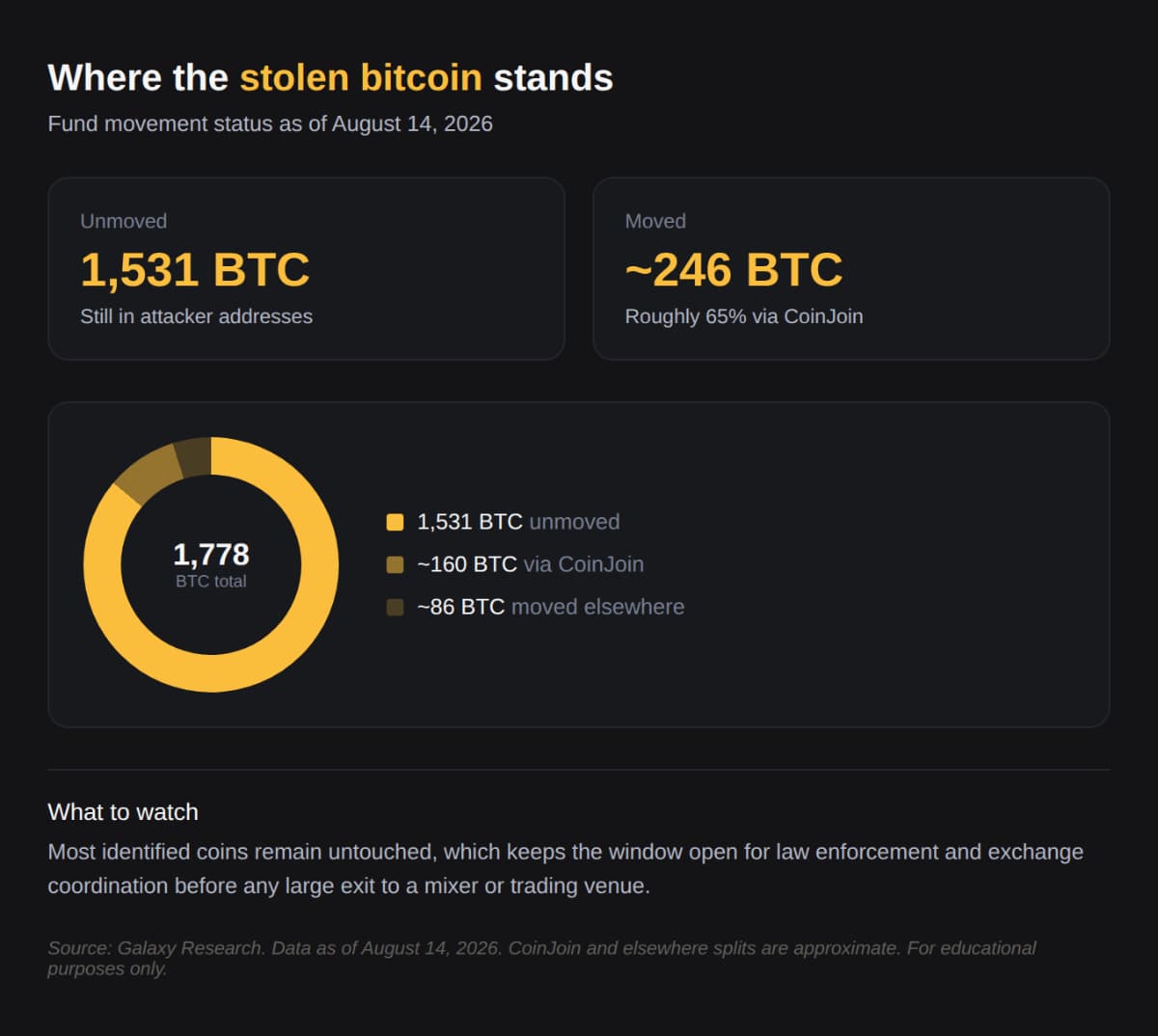
Galaxy's newer data, published August 14, adds a further layer. Of the roughly 1,778 BTC identified as stolen, the large majority, about 1,531 BTC, remains sitting unmoved in attacker-controlled addresses. Of the smaller portion that has moved, roughly 65% has flowed through CoinJoin transactions, a privacy technique that mixes multiple users' transactions to obscure which coins belong to whom, making the funds harder to trace to a final destination such as an exchange. Attack activity across Galaxy's confirmed waves and footprints stopped appearing after August 6, which Galaxy attributes to the pool of easily reachable vulnerable wallets running dry rather than the underlying method failing.
No large new theft or laundering transfer was confirmed on August 18. The meaningful development instead is that the forensic trail connecting the theft to its root cause, and possibly to the attacker, got noticeably stronger.
Galaxy Research's conversations with over 200 victims on August 16 reinforced a detail that was already suspected: the affected coins trace back to wallets created around March 17, 2021, the same date the vulnerable firmware shipped. In practical terms, this closes off the possibility that some of the losses came from an unrelated cause. Every dollar in the confirmed dataset now ties directly back to the seed generation flaw, not a separate phishing or malware vector.
The second development sits on the law enforcement side. A separate investigation published August 17 argues that the transaction pattern behind Wave 1, the fastest and largest sweep, may carry identifying clues about the operator behind it. This is forensic intelligence rather than a confirmed identification. In other words, investigators may already hold information useful for attribution, but no name or entity has been publicly confirmed as responsible.
Three specific on-chain positions were also being tracked as of August 18, based on publicly available blockchain data:
| Tracked item | Status as of August 18 |
| Address bc1qq85v2c926eg6pgxhwp6q7lf6cnsz80qs3fcu9r | 562.02021083 BTC held across 11 unspent outputs, no pending transactions, last indexed activity August 1 |
| 64.9 BTC Wasabi transfer | 64.90373764 BTC moved into a Wasabi-related address on August 5, 2026, at 04:42:48 UTC; no confirmed onward destination identified |
| 30.185 BTC transfer | Moved to a new wallet on August 7, as reported by Lookonchain; no confirmed subsequent mixer or exchange deposit identified |
Source: on-chain tracking data, Galaxy Research. Data as of August 18, 2026.
Taken together, these three positions reinforce the broader pattern already visible in Galaxy's wave and footprint data: attackers are largely holding, not cashing out. The bottom line for August 18 is not a bigger number. It is a stronger case linking every confirmed loss to the March 2021 flaw, and an early but real possibility that Wave 1's operator could eventually be identified.
The Coldcard incident is a reminder that hardware wallets shift where risk lives, not whether it exists. A device can be air-gapped, open source, and marketed as best in class, and still fail at the one step, seed generation, that everything else depends on.
Bitcoin holders using any hardware wallet, not Coldcard specifically, should treat seed provenance as a question worth revisiting periodically, not a one-time setup detail.
India Crypto Research operates independently. The information presented herein is intended solely for educational and informational purposes and should not be construed as financial advice. Before making any financial decisions, it's essential to undertake your own thorough research and analysis. If you're uncertain about any financial matters, we strongly recommend seeking guidance from an impartial financial advisor.