Borrowing Big Is Normal in Crypto, and That's the Problem
At 100x, Even a Tiny Price Move Wipes You Out
How One Trader Getting Wiped Out Drags Everyone Else Down
Small Triggers Keep Causing Massive Crashes
For Indian Holders, Panic Selling Adds a 30% Tax Hit
Watch the Borrowing, Not the Headlines

Most crypto trading is leveraged. Around 75% of crypto trading volume now comes from perpetual futures rather than spot markets, making leverage a major driver of price movements.
100x leverage leaves almost no room for error. A price move of just 1% against your position can liquidate your entire investment.
Liquidations create a domino effect. When one leveraged position is force-closed, it pushes prices lower, triggering more liquidations and accelerating market crashes.
Small events can trigger huge sell-offs. Good news, rumours, tweets, or even quiet trading sessions have all sparked multi-billion-dollar liquidation events because of excessive leverage.
Spot investors aren't automatically forced out. Unlike leveraged traders, investors who simply hold their crypto cannot be liquidated during sudden price swings.
Indian investors face an extra cost. Panic selling after a leveraged crash can trigger India's 30% tax on gains along with applicable TDS, making emotional decisions even more expensive.
Watch leverage, not just headlines. The amount of borrowed money in the market often determines the severity of a crash more than the news that appears to trigger it.

 Part of a series
Crypto is the only market where a regular person can borrow 100 times their money. Open an account on an offshore crypto exchange, and the slider runs up to 125 times on Bitcoin and 500 times on smaller coins.
That one design choice explains most crypto crashes. Not the news everyone blames. The leverage. It leaves each trader sitting a hair away from zero, and it stacks thousands of them so close together that a single dip can wipe them all out at once. This piece looks at both sides of that: what high leverage does to you, and what it does to the whole market when everyone is using it at the same time.
Perpetual futures, the leveraged contracts people use to bet on price without owning any crypto, are now about 75% of all crypto trading. In 2025, they traded roughly $61 trillion against about $18 trillion of actual spot buying. The market mostly doesn't own crypto. It bets on it with borrowed money.
Here is how high the leverage goes, next to what you can get elsewhere.
| Where you trade | Max leverage | What ₹1000 controls |
| Offshore crypto, small-cap pairs | up to 500x | ₹5,00,000 |
| Offshore crypto, BTC and ETH | up to 125x | ₹1,25,000 |
| On-chain perps | up to 40x | ₹40,000 |
| Regulated US crypto futures (Coinbase, Kraken) | ~10x | ₹10,000 |
| Source: exchange disclosures, India Crypto Research | ||
Most of this leverage sits on offshore exchanges, outside the reach of any regulator. And the highest numbers are aimed straight at small retail bets, the people least able to absorb them. A beginner can open an app and be offered 100x on their very first trade.
Here is what leverage does to a single trade. Your liquidation price, the point where the exchange closes your position and keeps your money, sits about 1 divided by your leverage away from where you bought.
| Leverage | Margin to open a ₹1,00,000 position | Move against you that wipes you out |
| 2x | ₹50,000 | ~50% |
| 10x | ₹10,000 | ~10% |
| 25x | ₹4,000 | ~4% |
| 50x | ₹2,000 | ~2% |
| 100x | ₹1,000 | ~1% |
| 125x | ₹800 | ~0.8% |
| Source: India Crypto Research | ||
Now put that next to reality. Bitcoin moves 1% in a normal hour, several times a day, on no news at all. So a trader at 100x is not really betting on where Bitcoin goes. They are betting it will not do the most ordinary thing it does before their target hits. At 100x, you do not need a crash to lose everything. A quiet Tuesday will do it.
The sales pitch only ever mentions the upside. 100x is sold as 100 times the gains. It is just as much 100 times the speed to zero, and in a market this jumpy, zero usually arrives first.
Everything so far is about one person. The billion-dollar crashes happen because thousands of these traders sit on the same exchange at the same time.
When everyone is running 50x to 100x, their liquidation prices do not spread out across the chart. They bunch into a thin band just below the current price, all of them sitting 1% or 2% down. Think of a row of dominoes lined up right under the market.
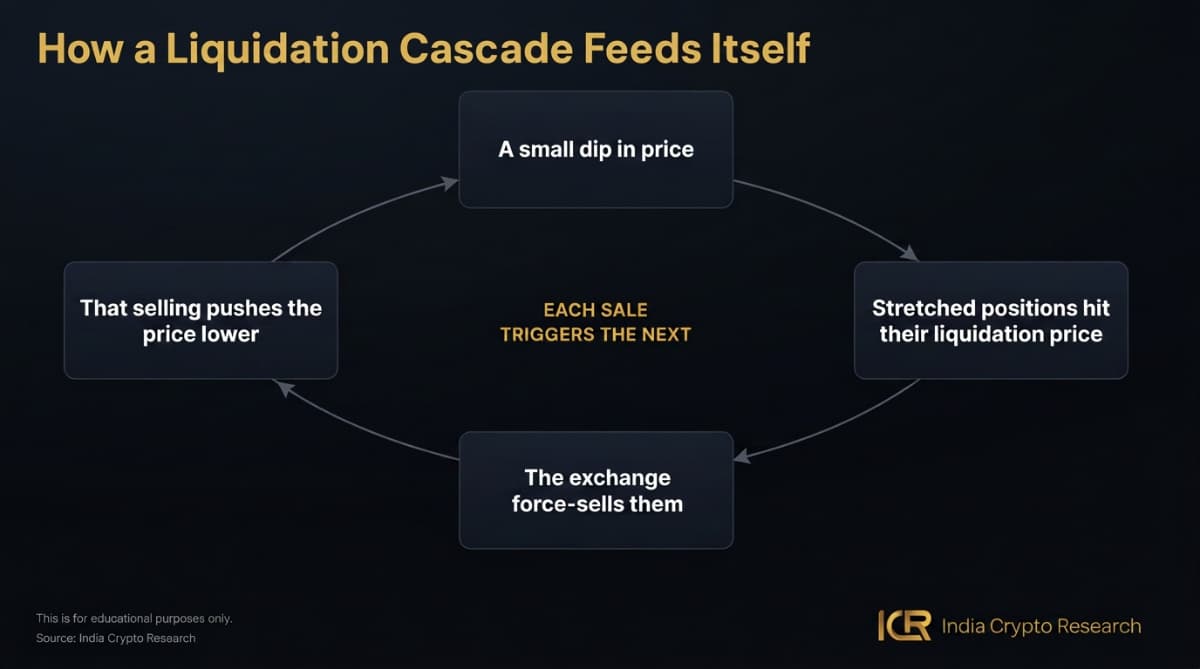
Then a small dip knocks over the first one. The exchange force-sells those positions, and that selling pushes the price a little lower. The lower price knocks over the next row, which forces more selling, which pushes the price down again. The chain keeps going on its own. It needs no fresh sellers and no fresh panic. Each forced sale sets off the next.
Three things make it worse, and each one removes a safety net. Buyers disappear, because the market makers who normally place buy orders pull them the second things get volatile, so the selling hits an empty market and drops the price further. The exchange also closes out some winning traders to cover the losing ones, so even people who bet the right way get pulled in. And because many accounts share one pool of collateral across coins, the damage spreads from one coin to the next. A market full of high leverage does not just risk a crash like this. It is built for one.
If leverage is really the cause, the triggers should look almost random. They do. Here are some of the biggest single-day crashes, lined up by how small the trigger was.
It starts with good news. The day El Salvador made Bitcoin legal tender, 7 September 2021, a supposedly happy event, around $3.6 billion was wiped out as Bitcoin fell from about $52,000 to $43,000. Then no news at all, just a quiet weekend on 4 December 2021, and $2.3 billion gone as Bitcoin dropped more than 20%. Then a rumour, an unconfirmed story about Chinese miners losing power on 18 April 2021, and about $10 billion liquidated in a day. Then, a spillover from another market, the yen carry trade, unwound on 5 August 2024. Then, a stock-market scare bled into crypto on 6 February 2026. And finally, one social media post about tariffs on 10 October 2025, which set off $19.37 billion in liquidations, the largest in history, hitting 1.6 million traders in a single day.
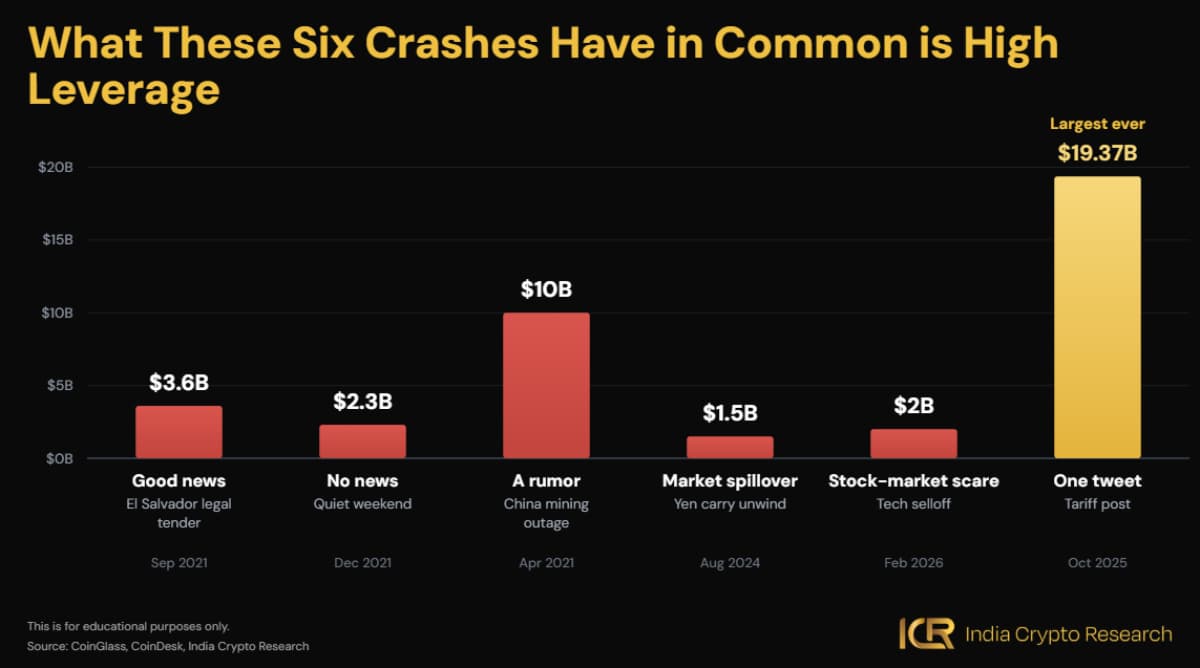
Read that list again. Good news. No news. A rumor. A tweet. The trigger barely grows, but the damage explodes. Good news wiped out $3.6 billion. A tweet wiped out nearly twenty. The size of the trigger never decided the size of the crash. The leverage already sitting in the market did. And notice what is missing. Not one of these came from a fraud, a company going bust, or a broken coin. They were just borrowing money, getting flushed out of a market that was otherwise fine.
Here is why this matters even if you never touch leverage. These crashes are fast and violent, and they create real panic. Prices fall 15% in a few hours, and the headlines scream. The natural urge is to sell and get out.
For an Indian holder, reacting that way is expensive twice over. First, you are selling a spot position into a dip that, in every case above, was caused by leverage flushing out, not by anything actually wrong with the coin. Second, the moment you sell at a profit, you trigger India's flat 30% tax on the gain. There is no lower rate for holding longer; you cannot use a loss on one coin to reduce the tax on another, and a further 1% is taken at source on the sale. So a panic sale locks in a tax bill on top of the timing mistake.
The people wiped out in all of these crashes were the leveraged ones. The people who simply held their coins lost nothing they had not already chosen to risk, because no one can force-close a coin you actually own. The calm response and the tax-smart response turn out to be the same one.
A crypto crash is not really a mystery. A market loads up on borrowed money, thousands of liquidation prices stack into a thin band, and then any small spark, a tweet, a rumour, a quiet weekend, even good news, knocks the first one over. The forced selling does the rest. The headline that gets blamed barely matters. The trigger only decides when a crash happens. The leverage decides how big it gets. So the number worth watching is not the news. It is how much borrowed money is sitting in the market before the spark arrives.
India Crypto Research operates independently. The information presented herein is intended solely for educational and informational purposes and should not be construed as financial advice. Before making any financial decisions, it's essential to undertake your own thorough research and analysis. If you're uncertain about any financial matters, we strongly recommend seeking guidance from an impartial financial advisor.