
The ₹1,025 Crore Milestone
What is Demat 2.0?
No Need to Worry, This is Not a Crypto Bond
What is Important
REC was the first to leverage Demat 2.0.
L&T had its own successful Demat 2.0 fundraising 2 days later.
And IIFL Finance closed it off
Let's Not Get Ahead of Ourselves Though
The Question Nobody's Really Answering Yet: Liquidity
What we're Looking For: Real Liquidity
Tokenised Bonds and a Digital Rupee: Bigger Than What Meets the Eye
What to Actually Keep an Eye On
Where This Leaves Us

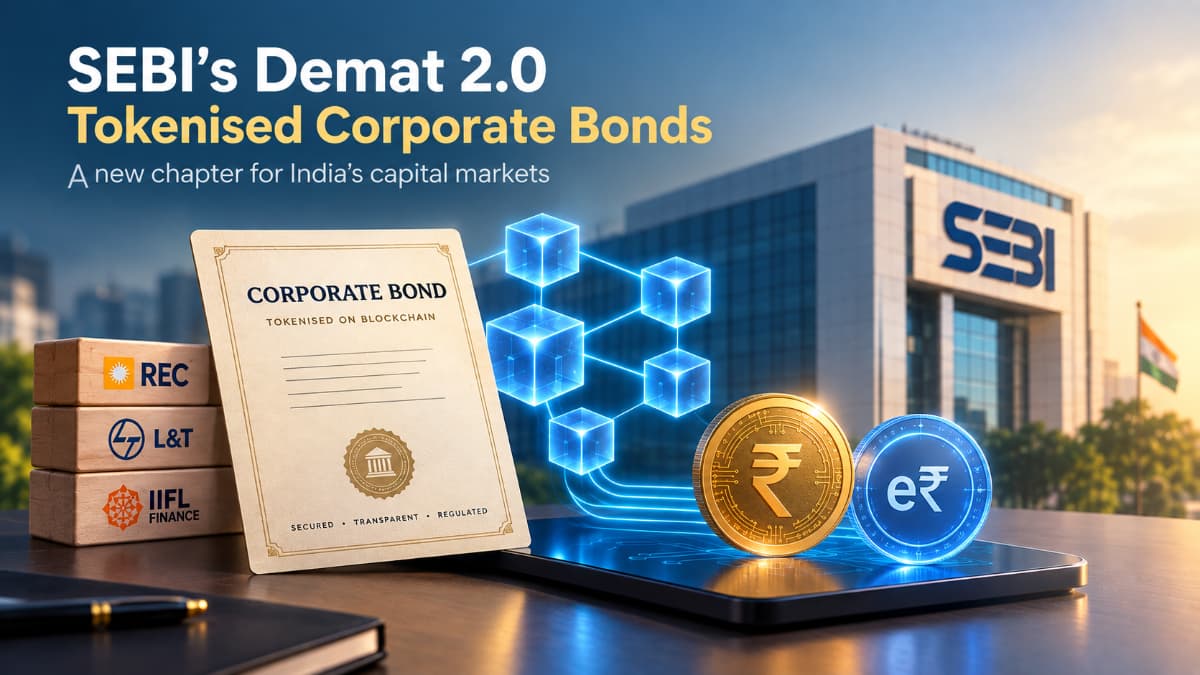
SEBI just did something most people scrolling past crypto headlines will completely miss. It launched a pilot to tokenise corporate bonds using distributed ledger tech. Demat 2.0, they're calling it.
Not a crypto play. These are regulated corporate bonds. The blockchain part is just new wiring underneath, for recording, settling, and servicing them.
Three issuers, one week, ₹1,025 crore raised. REC first. Then L&T. Then IIFL Finance.
| Issuer | Amount | Coupon | Tenure | Date | Investors |
| REC Ltd | ₹500 crore | 7.30% | 20 months | 7 Sep 2026 | 18 |
| Larsen & Toubro | ₹500 crore | 7.40% | 3 years | 9 Sep 2026 | 4 |
| IIFL Finance | ₹25 crore | 9.10% | 2 years | 9 Sep 2026 | 1 |
| Total | ₹1,025 crore | N/A | N/A | Sep 2026 | 23 |
REC received ₹796 crore in bids and was listed on the same day without any settlement drag. This was the first time a private sector corporate (L&T) and a non-PSU NBFC (IIFL Finance) sold corporate bonds under the new framework. Members of the dematerialisation service are still limited, but the coverage is increasing.
The easiest way to describe it is to compare it with what we are used to.
Demat 1.0 involves dematerialisation of securities by the depository system. This happens when shares are bought and sold. Demat 2.0 involves the creation of corporate bonds as digital tokens on a permissioned ledger that the depositories created and manage. The payment system directly links to the RBI's wholesale CBDC, the e₹-W.
There are two parallel, independent systems in play. One has the digitized bond, and one has the currency.
The placement of a bond on a blockchain should not mean that a bond is now a cryptocurrency.
The issuer is still obligated to pay the promised amount. The legal rights associated with a bond also remain the same. Credit ratings continue to apply. Debenture trustees continue to apply. The rules for the listing of bonds on an exchange, as well as the disclosure requirements continue to apply.
Nothing of substance has changed.
The tokenisation of a bond is not all that exciting. What makes this pilot worth watching is the integration with RBI's wholesale digital rupee.
Demat 2.0 uses the Unified Market Interface to access the wholesale digital rupee and execute atomic settlement. Meaning, the bond and cash exchange are simultaneous and neither party waits for the other.
Atomic settlement eliminates the need for a post-trade reconciliation. Often, there is a system to track the security and another to credit the money. Settlement is usually performed with a time lag, during which the post-trade reconciliation is performed. With atomic settlement, the buyer receives the bond, while the seller receives the money, all within the same instant.
Faster settlement, with less post-trade reconciliation, is one of the benefits introduced by the Demat 2.0 infrastructure. Self-running smart contracts are another. Instead of the issuer's back office, interest payments or, bond redemptions would be managed and completed by smart contracts.
While all of this may sound exciting, until this technology is put to the ultimate test, it's not. There are no assurances that this technology will lessen operational risk.
On September 7 2026, REC successfully raised 7.30 percent 20-month bonds amounting to 500 crores. Over 18 investors placed bids amounting to 796 crores.
This was not a hypothetical argument; this was money, a regulator, daily settlement, and the infrastructure all coming together within 24 hours.
L&T raised 500 crores over 3 years at 7.40 percent. This was the first successful fundraising by a private company utilizing Demat 2.0.
Government-backed issuers testing new infrastructure is what was predicted. Seeing a large private group doing it too shows this isn't going to remain within the confines of PSUs.
₹25 crore, 2 years, 9.10% coupon. The first non-PSU NBFC in the space.
With the lowest value on the table, we can assume the framework is flexible and accommodating to all types of businesses. NBFCs, private conglomerates, and even PSUs are in the testing phase of the same infrastructure.
India's first steps in a fully fledged system are to initiate issues. Transactions in a secondary market haven't even begun. SEBI has confirmed that the succeeding stages will enable trading through RFQ frameworks with the end goal of providing market access to retail. This still lies in front of us instead of behind.
It's comparatively easier to issue a tokenised bond. The more difficult challenge is developing a liquid market where participants can engage in buying and selling bonds with absolute ease.
This is what India Crypto Research keeps circling back to.
Even with the best possible settlement systems, it won't make a difference if there is no activity on the other side to trade the bond. Fast settlement comes to nothing when you are stuck holding the bond that there is no market for.
Does real liquidity show up? Can holdings actually be traded among different entities? Do market makers come into the picture? Ultimately, do tokenised infrastructure and traditional systems integrate?
Answer those, and you'll If you answer these questions, you'll have an idea of if Demat 2.0 will turn out to be a big thing, or if it will just remain a smart, yet unsuccessful, pilot.
An interesting aspect that is usually overlooked is that India is testing tokenised securities as well as a digital rupee on a connected railroad.
From an external perspective, this pairing is strong. The bond is the security. The digital rupee is the currency. Served with some smart contracts, transactions and related services can be executed automatically.
This ultimately constructs an integrated digital capital market within which the security, the currency, and the instructions to carry out the service are connected.
| Indicator | Why It Matters |
| Secondary market trading | Tests if these bonds can actually become liquid |
| Investor participation | Shows if this moves past a small institutional pilot |
| Settlement efficiency | Tells you if DLT + CBDC actually helps, operationally |
| Issuer adoption | Shows if corporates see real economic upside |
| Interoperability | Tests if tokenised and conventional systems can work together |
| Expansion to other assets | Could decide the size of the whole RWA opportunity |
India has taken its first real steps into tokenised capital markets. REC, L&T, and IIFL Finance have raised a combined ₹1,025 crore. Meanwhile, SEBI and RBI have continued their work to connect the settlement of digital rupee payments to records stored on a distributed ledger (DLT) with a focus on government bonds.
This is still a pilot. The real test comes with the development of liquidity beyond the primary market, wider investment demand, and the development of secondary markets. Additionally, this infrastructure must be extended beyond the bond markets to other regulated investment markets.
This pilot suggests India is interested in the real-world applications of using DLT for settlement systems of both cash and securities. Tokenised markets may become a more significant part of capital markets post DLT settlement infrastructure.
If successful, Demat 2.0 will be a much more significant story than its name suggests.
India Crypto Research operates independently. The information presented herein is intended solely for educational and informational purposes and should not be construed as financial advice. Before making any financial decisions, it's essential to undertake your own thorough research and analysis. If you're uncertain about any financial matters, we strongly recommend seeking guidance from an impartial financial advisor.


