1. Where it started: from paper to Demat
2. What is Demat 2.0 and why is it in the news
3. Demat 1.0 vs Demat 2.0: comparative table
4. Where India already stands
5. Potential benefits of Demat 2.0
6. Road ahead for India on Demat 2.0

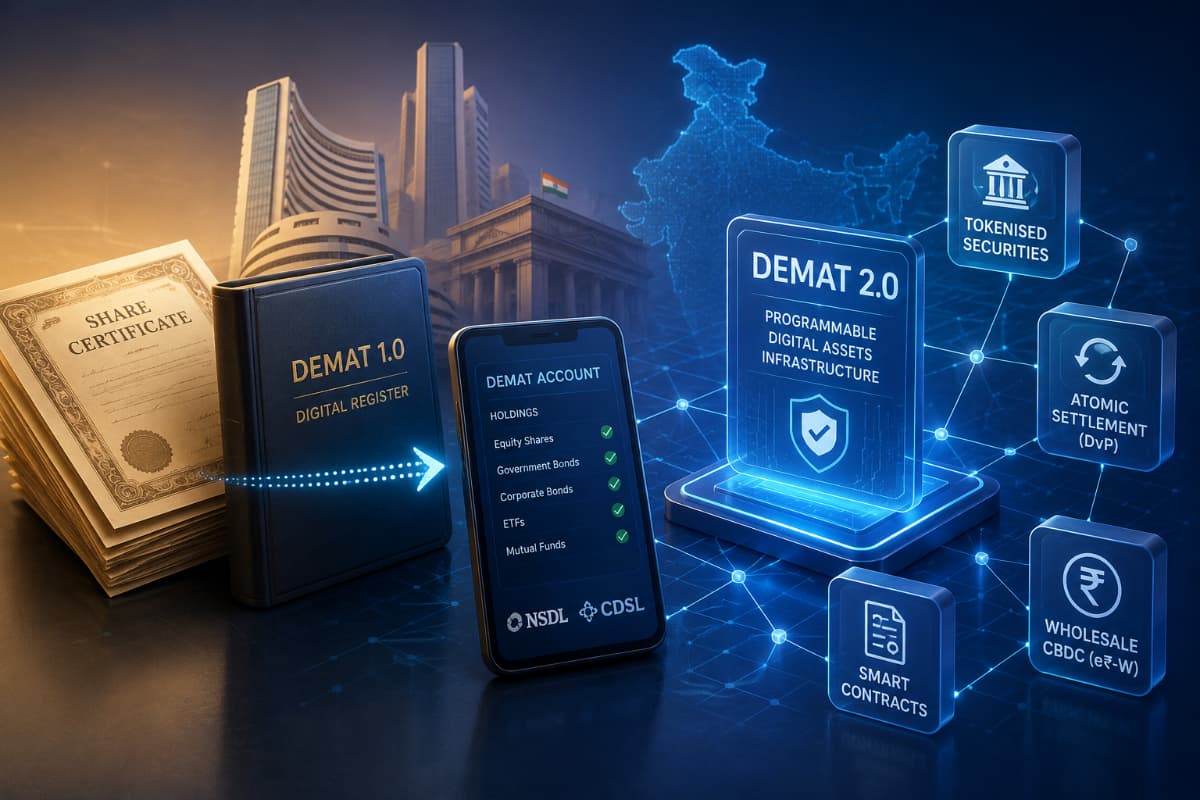
India’s financial markets are entering a new phase of digital transformation with the emergence of DEMAT 2.0. Moving beyond traditional electronic securities holding, DEMAT 2.0 aims to explore how tokenisation, distributed ledger technology, and digital currency can work together to modernise how securities are issued, held, transferred, and settled. As regulators and market institutions begin testing tokenised bonds, India is moving from conceptual discussions to real-world implementation. The development could bring faster settlement, greater transparency, automated processes, and reduced reconciliation costs. While regulatory, legal, and liquidity challenges remain, DEMAT 2.0 could become an important milestone in India’s journey towards a more efficient and digitally enabled capital market.
For decades, securities markets have been built around one question: how do we record who owns an asset? Before dematerialisation, ownership was evidenced by physical certificates, i.e., a system prone to loss, damage, forgery, and slow, manual transfers.
India's Demat system changed this. Investors' holdings are now recorded electronically through the depository infrastructure built around NSDL and CDSL, accessed via Depository Participants such as brokers and banks. In simple terms, Demat 1.0 solved the paper problem. According to SEBI, India has nearly 13.6 crore investors holding more than 21 crore demat accounts, signaling strong faith in the market, with approximately one lakh new demat accounts being opened every day, demonstrating rising interest, particularly among retail investors.
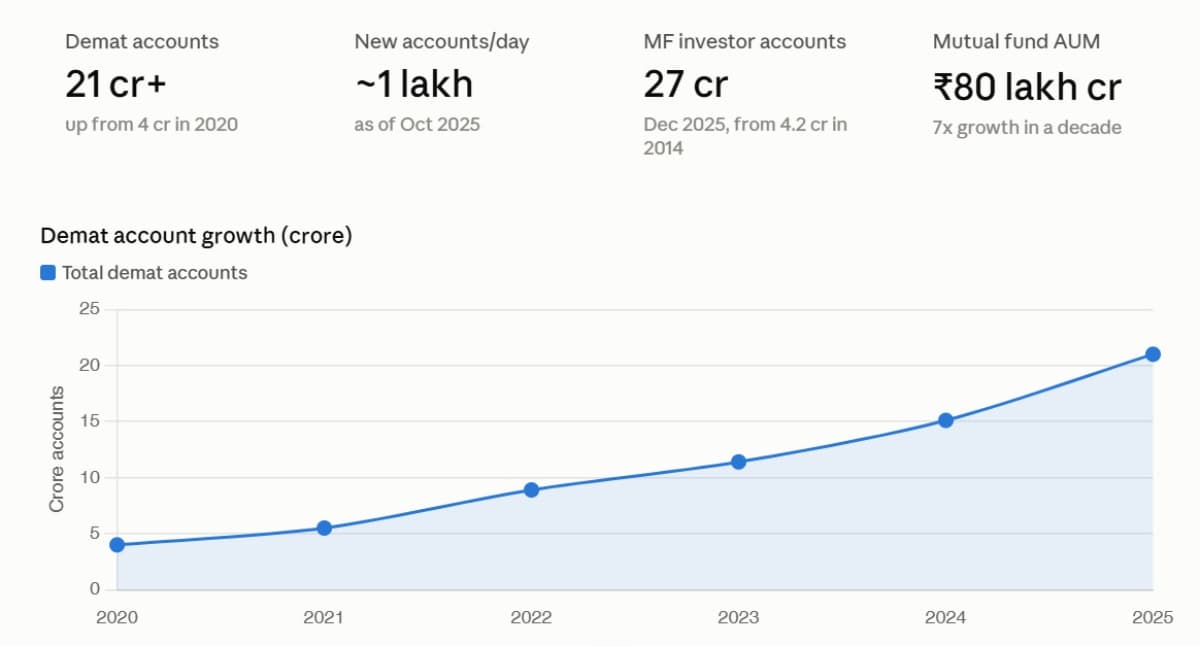
Source: SEBI, NSDL, CDSL and Economic Times (‘20 crore demat accounts and counting: inside India's retail investing transformation’).
Demat 2.0 is not a formally launched Indian regulatory product. It is an emerging concept for next-generation securities infrastructure where issuance, transfer, settlement, compliance, and other lifecycle events could become increasingly digital, automated,d and programmable.
A useful analogy: a traditional Demat account is a digital register, as it records that you own a security. Demat 2.0 could move closer to a programmable digital asset system, where the digital representation of a security connects to rules governing who can hold it, how it transfers and how associated payments are made.
According to Reuters reporting, REC Ltd. is expected to issue tokenised corporate bonds worth less than ₹500 crore as a pilot. The initiative reportedly involves RBI, SEBI and India's securities depositories, although the final framework has not yet been publicly confirmed by the institutions involved.
The interesting part is that the pilot reportedly introduces a new securities wallet referred to as ‘Demat 2.0’. Instead of recording the bond through the conventional securities infrastructure alone, this wallet would reportedly record tokenised bond holdings using distributed ledger technology (DLT).
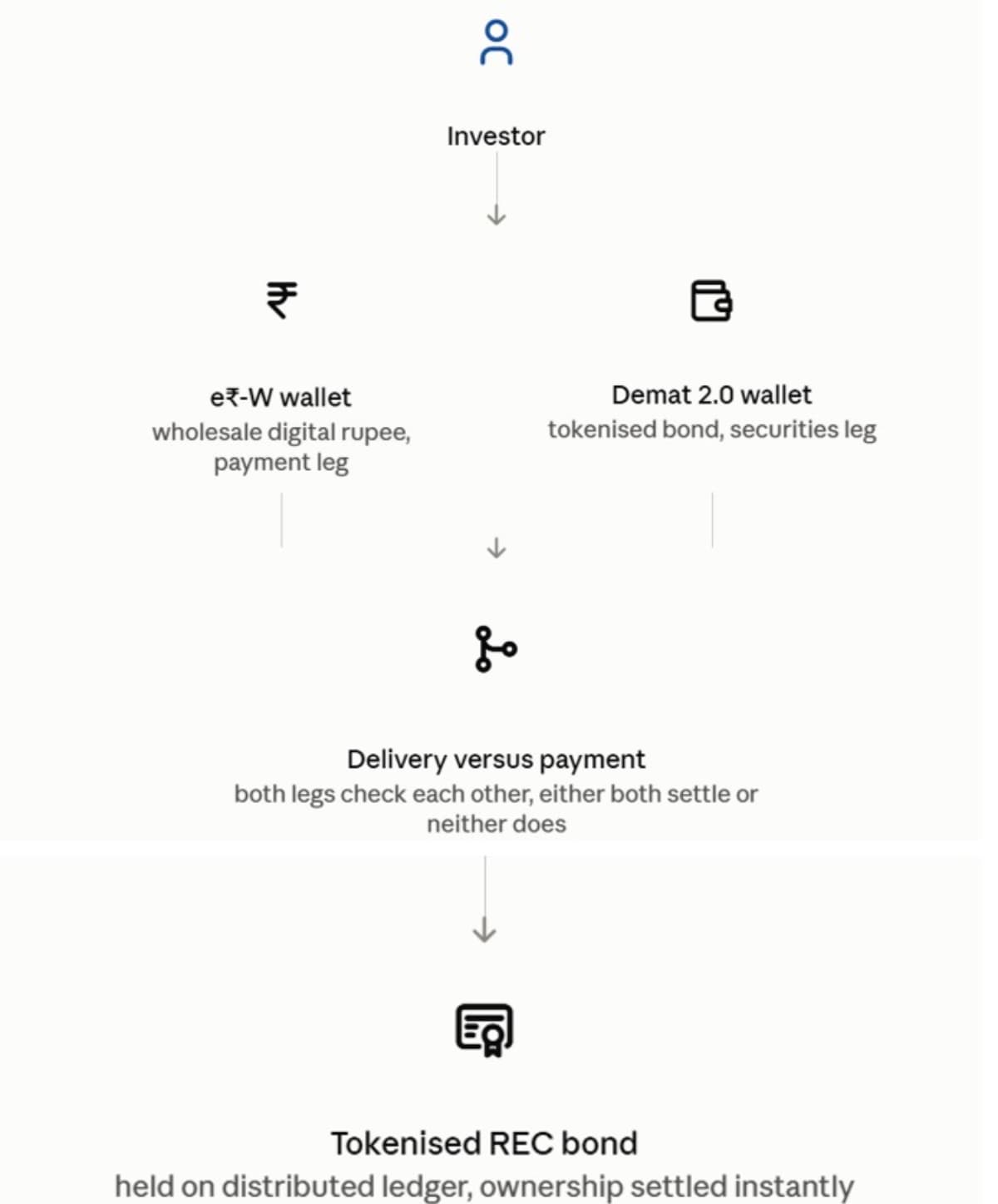
Source: Reuters (via Yahoo Finance), Business Standard and Outlook Business.
Dimension | Demat 1.0 | Demat 2.0 |
|---|---|---|
| Core question | How do we replace physical securities with electronic records? | How do we make securities and their lifecycle digital and programmable? |
| What gets digitised | Ownership records only | Ownership, transfer, settlement, compliance, corporate actions and payments |
| Underlying infrastructure | Centralised depository (NSDL / CDSL) | Potential DLT / blockchain-based, regulated digital infrastructure |
| Settlement | Multi-step, intermediary-dependent | Potential atomic settlement via delivery versus payment (DvP) |
| Payment leg | Separate banking system | Potential integration with wholesale CBDC (e₹-W) |
| Status in India | Live and mature since the 1990s | Emerging concept; not a formally launched regulatory product |
India's tokenisation journey has now moved beyond discussions and has entered the pilot testing stage. SEBI, along with the RBI, is testing whether bonds can be converted into digital tokens and recorded on a shared blockchain-based ledger. The idea is to allow the bond and the payment for it to be settled at the same time. This could reduce paperwork, reconciliation work, and settlement delays. Smart contracts could also be used to automatically make coupon payments to bondholders. This is part of SEBI's effort to make India's ₹59 lakh crore corporate bond market more efficient. SEBI Chairman Tuhin Kanta Pandey has described the project as an efficiency test that will work with India's existing financial infrastructure. The pilot is expected to run for around six to nine months on a limited scale and will be connected to the RBI's wholesale CBDC (digital rupee) system.
India has already taken some steps in this direction. NSDL and CDSL, the country's major securities depositories, have been using blockchain technology since 2021 to monitor compliance related to bonds. Separately, REC is expected to issue India's first tokenised corporate bonds in September 2026. These bonds are expected to use a new Demat 2.0 e-wallet, with transactions settled using digital rupees.
However, tokenisation still has some challenges. India does not yet have a completely clear legal framework explaining who owns a tokenised asset and how disputes will be resolved. There may also be limited trading activity in the beginning, because the secondary market for tokenised bonds is still developing. Retail investors also have relatively low participation in the corporate bond market.
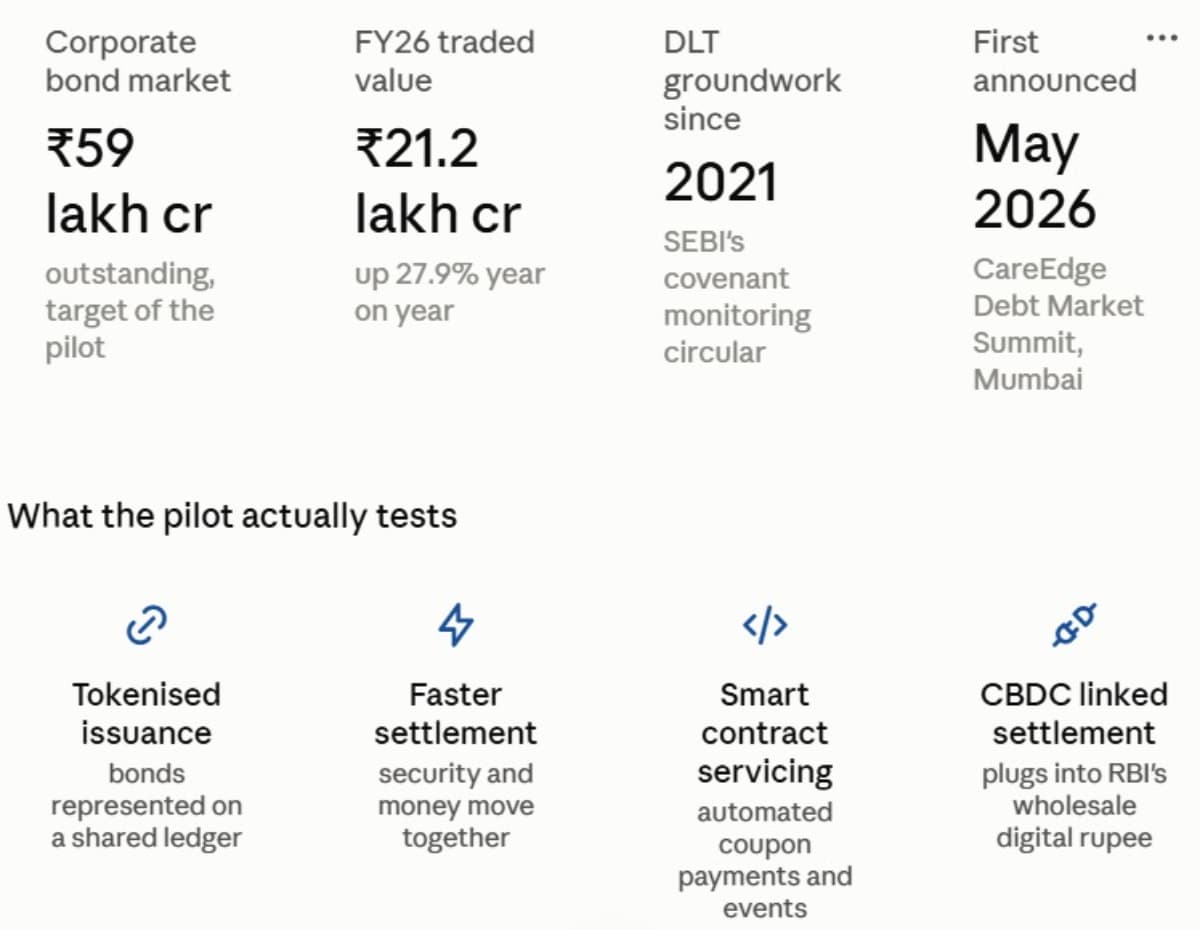
Source: Business Standard, SEBI's FY26 annual report, Analytics Insight and CareEdge Debt Market Summit remarks by SEBI Chairman Tuhin Kanta Pandey.
If Demat 2.0 develops as intended, it could make India's securities market faster, more automated and more efficient. The key potential benefits are:
The road ahead for Demat 2.0 is likely to be gradual rather than an immediate replacement of the traditional demat system. The first major step is the planned pilot of tokenised corporate bonds, reportedly involving REC in September 2026. The pilot would connect a Demat 2.0 securities wallet with the RBI's wholesale digital rupee (e₹-W), allowing the digital security and payment to move together.
The next stage will be to test whether the system actually works at scale. Regulators and market infrastructure institutions will need to examine settlement speed, security, ownership records, investor protection, and operational reliability. If the pilot performs well, the model could gradually expand beyond a small group of investors and potentially cover more corporate bonds and other securities.
A particularly important step will be the development of a secondary market. The reported plan is for exchanges to develop a market for trading these tokenised bonds by December 2026. This is crucial, because tokenisation is useful only if investors can easily buy and sell the securities after issuance.
Another major area will be regulation and legal recognition. India will need clear rules on who legally owns a tokenised security, how transfers are recognised, what happens if there is a technical failure, and how disputes are resolved. Without this clarity, large-scale institutional and retail adoption will be difficult.
Sources -
SEBI, annual report FY 2025-26 and public statements by Chairman Tuhin Kanta Pandey and Whole-Time Member Amarjeet Singh. Reserve Bank of India, wholesale central bank digital currency (e₹-W) pilot updates. NSDL and CDSL, depository data and 2021 circular on security and covenant monitoring using distributed ledger technology. Reuters, reporting on India's first tokenised corporate bond pilot (via Yahoo Finance), August 2026. Analytics Insight, "SEBI advances corporate bond tokenisation pilot with RBI CBDC rails."
India Crypto Research operates independently. The information presented herein is intended solely for educational and informational purposes and should not be construed as financial advice. Before making any financial decisions, it's essential to undertake your own thorough research and analysis. If you're uncertain about any financial matters, we strongly recommend seeking guidance from an impartial financial advisor.