
1. The CLARITY Act in a nutshell
2. Why the US needed it
3. Who regulates what
4. How a token gets its label
5. The bill’s journey so far
6. What changes for exchanges and brokers
7. What it means for everyday investors
8. Why the Senate stopped it
9. Why it matters for India
10. The path after the midterm election
Key dates at a glance
What to watch next
FAQs

The CLARITY Act (H.R. 3633) would split US crypto oversight. Tokens sold to raise money stay with the SEC, and trading in digital commodities such as Bitcoin moves to the CFTC.
The House passed it 294–134 on 17 July 2025, but a Senate vote to start debate failed 49–50 on 15 September 2026, short of the 60 needed.
Ethics rules for officials’ crypto holdings and rewards on stablecoins are the main sticking points.
If the bill does not pass by 3 January 2027, it expires. The post-election lame-duck session is its last chance this Congress.
India: the bill does not apply here, but it shows the “who regulates what” rulebook India still lacks.
 Part of a series
On 15 September 2026, the US Senate voted 49-50 on whether to begin debating the CLARITY Act, the bill that would decide who polices crypto in the world’s largest financial market. It needed 60 votes to proceed, so it stalled. In the first part of our Act and Its Fact series, we cover the 10 things to know, from the basics to what happens after the US midterm election, in language that’s as simple as possible.
Throughout, “crypto” means what Indian tax law calls VDAs (Virtual Digital Assets, the government’s legal term for crypto, tokens and NFTs).
• A rulebook for crypto markets. Its full name is the Digital Asset Market Clarity Act, and its bill number is H.R. 3633. A bill is a proposed law, so it is not yet in force. Its goal is to set out in law who regulates crypto in the US, and the rules that crypto exchanges and brokers have to follow.
• Who wrote it? Representative French Hill introduced it on 29 May 2025, with G.T. Thompson as co-author. Hill chairs the House Financial Services Committee, which covers the securities regulator. Thompson chairs the Agriculture Committee, which covers the commodities regulator. Both regulators are part of this story, which is why both committees wrote the bill.
• Two referees and an unclear rulebook. The US has two market regulators that can lay claim to crypto. The SEC (Securities and Exchange Commission) polices investments such as shares. The CFTC (Commodity Futures Trading Commission) polices commodities such as gold and oil. With no law saying which one owned crypto, the answer was often left to the courts, through lawsuits and enforcement actions rather than written rules.
• Confusion has a cost. Companies could not tell in advance whether a token was legal to list. Investors could not tell who would protect them if an exchange failed. The CLARITY Act tries to fix this by writing the definitions into law, so market participants know the rules before anyone trades.
• The SEC regulates fundraising tokens. If a project sells tokens to raise funds and buyers expect to profit from the project team’s efforts, the token stays under the SEC. Think of it like a company issuing shares: the SEC wants full disclosure to protect buyers. The House version of the CLARITY Act also allows token sales of up to $50 million (about ₹475 crore) in any 12 months, with disclosures.
• The CFTC gets the trading markets. Tokens that work like the raw materials of a network, such as Bitcoin, become “digital commodities” under the CFTC. For the first time, the CFTC would get clear power over spot markets, meaning the everyday buying and selling of tokens for immediate delivery, not just futures.
In short, money-raising tokens stay with the SEC, and the trading markets shift to the CFTC. The infographic below shows this split.
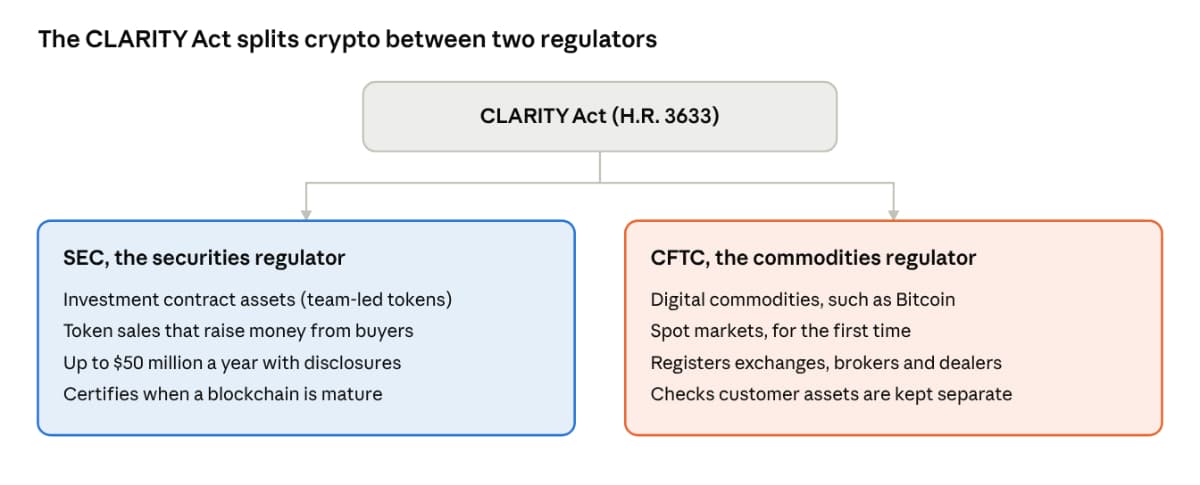
• Two main boxes. An “investment contract asset” is a token bought mainly to profit from a central team’s effort. The SEC regulates it under the US Supreme Court’s long-standing Howey test for what counts as an investment. A “digital commodity” is a token tied to a network no one person runs, and the CFTC has jurisdiction.
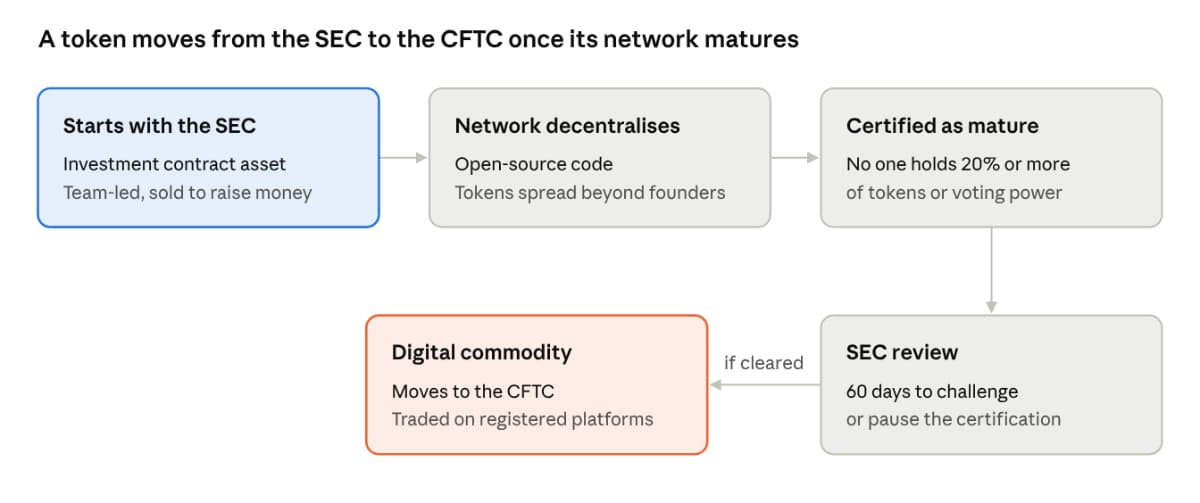
• The mature blockchain test. A token can move from the SEC’s box to the CFTC’s box once its network has “matured”, meaning no single person or group controls it. One key check is that no single party holds 20% or more of the tokens or voting power. The project certifies this to the SEC, which then has 60 days to challenge it. Think of it as a startup that has grown into a public utility.
So a token’s label is not fixed for life. The path below shows how it moves from the SEC’s control to the CFTC’s as control of the network spreads out.
• An easy win in the House. On 17 July 2025, the House of Representatives passed the bill by 294 votes to 134. Seventy-eight Democrats voted yes alongside most Republicans, so support crossed party lines. In the US, a bill must pass both the House and the Senate before it goes to the President for signing.
• A slower path in the Senate. Two Senate committees each wrote their own part. The Agriculture Committee approved the CFTC section 12–11 on 29 January 2026, along party lines. The Banking Committee approved its version 15–9 on 14 May 2026. The two texts were then merged into one bill for the full Senate.
• Registration and reporting. For the first time, crypto exchanges, brokers, and dealers would have to register with the CFTC. They would need to keep records, report trades daily, and warn customers about risks. It is similar to how a stockbroker in India must register with SEBI before it can take your money.
• Anti-money-laundering duties. Registered platforms would have to follow the Bank Secrecy Act, the main US anti-money-laundering law. That means KYC (Know Your Customer, verifying who each user is), reporting suspicious transactions, and checking sanctions lists. India already asks exchanges to register with FIU-IND (Financial Intelligence Unit) under PMLA (the Prevention of Money Laundering Act) for the same reason.
• Your coins kept separate from the company’s. Brokers and dealers would have to keep customer assets separate from the firm’s own money and hold them with qualified custodians, meaning approved firms that safeguard assets. This targets the failure seen when FTX collapsed in 2022, and customer funds were found mixed with company funds.
• Your right to hold your own coins. The bill protects a person’s right to use their own wallet and to trade directly with another person. A wallet holds the keys to your coins, not the coins themselves. Section 604 also says software developers who never control user funds are not “money transmitters”, so they do not need to register like a payments company.
• The 49–50 vote. On 15 September 2026, the Senate held a cloture vote on whether to begin debating the bill. Cloture is the step that ends delay, and it needs 60 of the 100 votes. The bill got only 49, so it stalled. Senator Thom Tillis switched his vote to “no” so that he could file a motion to reconsider, which keeps the door open for another vote.
• Ethics and stablecoin rewards. The main point of contention was the ethics rules for public officials’ crypto holdings. Democrats argued that the draft did not effectively cover the President and his family. Republicans argued that they had made more than 100 changes at Democrats’ request. A second fight is over stablecoins, tokens pegged to the US dollar. The Senate text bans paying interest-like rewards just for holding them, and banks and exchanges disagree on where that line should be drawn.
• India has the tax but not the rulebook. India taxes VDA gains at a flat 30% and deducts 1% TDS (Tax Deducted at Source, tax withheld automatically on each trade). These rules came in under Sections 115BBH and 194S of the Income Tax Act, 1961, and carried over unchanged into the new Income-tax Act, 2025 from 1 April 2026. What India lacks is a law naming one market regulator. In July 2026, Parliament’s Standing Committee on Finance suggested an interim self-regulatory body for crypto until a full law is passed.
• US labels travel abroad. Many of the tokens Indians trade are listed on global platforms that follow US rules. If the US formally calls a token a commodity or a security, that label could shape which tokens get listed and how they are treated worldwide. With the EU’s MiCA (Markets in Crypto-Assets) rules already in force, a settled US law would leave India as one of the few large markets still without a crypto rulebook.
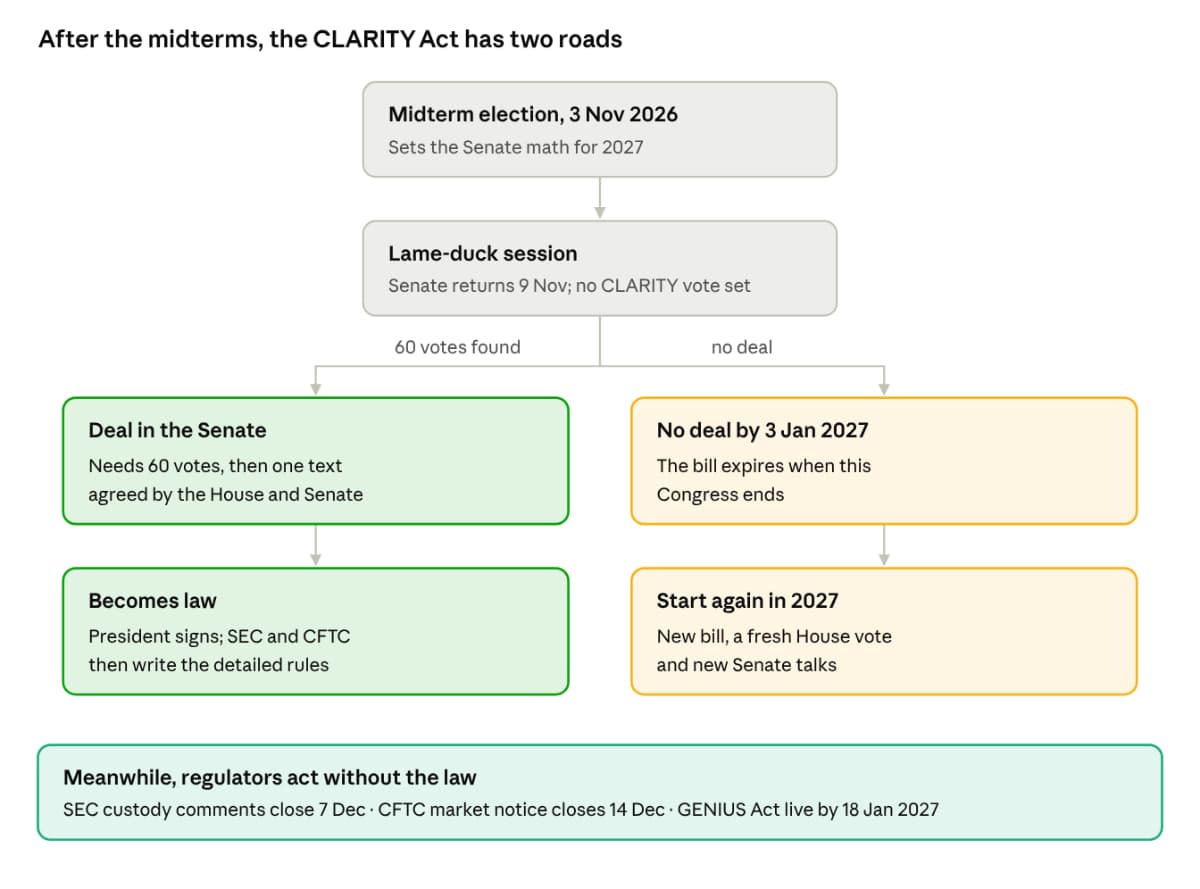
• A short window before the clock runs out. Americans went to the polls on 3 November 2026 for the midterm election. Congress then returns for a “lame-duck” session, the weeks between an election and the new Congress taking office. As of 2 November, no new CLARITY Act vote was scheduled. If the bill does not pass by 3 January 2027, it expires and must start again, including a fresh House vote. Whoever controls Congress after the election, the bill will still need 60 Senate votes, which means support from both parties. Prediction markets on 2 November put the odds of a US crypto market-structure law at about 6% before 1 January 2027, and about 31% before 1 January 2028.
• Regulators fill the gap in the meantime. On 17 March 2026, the SEC named 16 tokens, including Bitcoin, Ether, XRP, and Solana, as digital commodities. The SEC’s custody proposal is open for public comment until 7 December, and the CFTC’s crypto-market notice until 14 December. The GENIUS Act, the US stablecoin law signed in July 2025, takes effect by 18 January 2027. But agency rules can be reversed by the courts or a future administration. An Act of Congress is much harder to undo, which is why the CLARITY Act still matters.
Whichever road the bill takes, the SEC and CFTC will keep writing rules in the meantime. The infographic below maps both roads.
The table tracks the bill from its first day in the House to election day, newest first.
Date | What happened |
|---|---|
3 Nov 2026 | US midterm election day |
15 Sep 2026 | Senate cloture vote fails 49–50 |
14 May 2026 | Senate Banking Committee approves 15–9 |
17 Mar 2026 | SEC names 16 tokens as digital commodities |
29 Jan 2026 | Senate Agriculture Committee approves 12–11 |
17 Jul 2025 | House passes the bill 294–134 |
29 May 2025 | Bill introduced in the House |
• United States. Whether the Senate holds a second cloture vote in the lame-duck session, which resumes on 9 November.
• The deadline. If the bill has not passed by 3 January 2027, it expires and must be reintroduced in the new Congress.
• Regulators. Feedback on the SEC’s custody proposal (due 7 December) and the CFTC’s crypto-market notice (due 14 December).
• Stablecoins. The GENIUS Act takes effect by 18 January 2027, regardless of what happens to the CLARITY Act.
• India. Any government response to the Standing Committee’s call for crypto self-regulation.
Sources: Binance Academy, DeFi Rate (2 Nov 2026), CryptoSlate and Swarajya (24 Jul 2026).
India Crypto Research operates independently. The information presented herein is intended solely for educational and informational purposes and should not be construed as financial advice. Before making any financial decisions, it's essential to undertake your own thorough research and analysis. If you're uncertain about any financial matters, we strongly recommend seeking guidance from an impartial financial advisor.


