When exactly does tax apply?
DeFi, Rewards, and Grey Areas in Crypto Taxation

One of the most common questions crypto investors ask is surprisingly simple:
Many people assume tax applies only when crypto is converted into Indian rupees. That assumption leads to mistakes. In the eyes of the tax system, what matters is whether ownership of value changes.
Any action that changes ownership or results in receiving value can attract tax.
The most common taxable actions include selling crypto for money. When crypto is sold, and a profit is made, that profit becomes taxable income. This part is easy to understand and widely known.
What is less understood is that swapping one crypto for another is also considered a transfer. Even though no cash is involved, ownership of one asset ends and ownership of another begins. From a tax perspective, value has moved.
Receiving crypto can also trigger tax. This includes rewards from staking, incentives, referral bonuses, or airdrops. When crypto is received, it represents value entering your control. That value may be taxable at the time of receipt, depending on the nature of the transaction.
Using crypto to pay for goods or services is another taxable action. Even if crypto is used like money, the system treats it as an asset being transferred. Any gain embedded in that transfer becomes relevant for taxation.
In simple terms, the following actions generally attract tax:
Selling crypto
Exchanging one crypto for another
Receiving crypto as rewards or incentives
Using crypto to pay for something
The key idea is this. Taxation follows the movement of value, not the movement of cash.
Once this mindset is adopted, crypto taxation becomes easier to reason about. Each action can be evaluated by asking a simple question. Did ownership change or did value enter my control?
If the answer is yes, tax rules likely apply. Take a look at the line of events that have taken place in last couple of years.



After understanding common crypto actions, many readers realise that their activity does not stop at buying and selling on exchanges.
This is where decentralised finance, often called DeFi, enters the picture.
DeFi refers to crypto activity that happens without traditional intermediaries like exchanges or banks. This includes staking tokens, lending crypto, earning rewards, participating in liquidity pools, or receiving tokens through airdrops.
From a user’s perspective, these activities often feel informal. Tokens appear in the wallet without an obvious transaction. There is no invoice, no receipt, and sometimes no clear price at the moment of receipt.
From a tax perspective, however, the absence of formality does not remove responsibility.
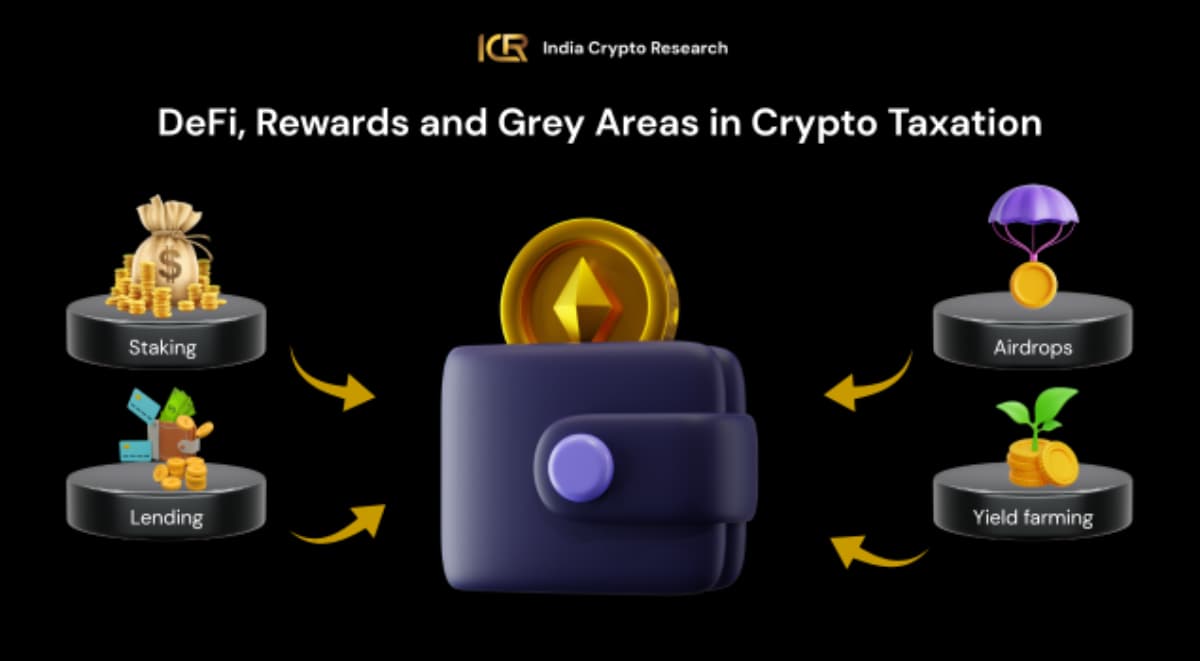
When crypto is received as a reward, incentive, or distribution, it represents value coming under your control. Even though no purchase took place, ownership has changed. This is why such receipts are often treated as income at the time they are received.
A second layer of taxation can arise later. If the received crypto is sold or exchanged in the future, any change in value from the time of receipt to the time of transfer becomes relevant again.
This creates confusion because one activity can lead to two different tax moments. One when value is received, and another when value is transferred.
Grey areas exist mainly around valuation and timing. Questions like which price to use, which exchange rate to rely on, or how to record the moment of receipt do not always have perfectly defined answers. In such cases, consistency and good records matter more than finding a perfect rule.
The key principle remains unchanged. When value enters your control or leaves it, the tax system expects visibility.
India Crypto Research operates independently. The information presented herein is intended solely for educational and informational purposes and should not be construed as financial advice. Before making any financial decisions, it's essential to undertake your own thorough research and analysis. If you're uncertain about any financial matters, we strongly recommend seeking guidance from an impartial financial advisor.