
1. What Is Hash Rate and Why Does It Matter?
2. Where Is Bitcoin Mined in 2026?
3. Electricity Price: The Cost That Decides Everything
4. How the Map Changed After China's Ban
5. New Mining Corridors: Cheap Power, Fragile Supply
6. Rules That Move Miners
7. Miners and the Power Grid
8. What About India?
9. Bitcoin Mining: Where Do We Go from Here?

US leads, but the map is concentrated: The US mines about 38–42% of all Bitcoin, followed by Russia (16–17%) and China (14–15%), where mining is officially banned.
Power price decides profit: At current prices of about $82,031, mining only covers its electricity where power costs are below about $0.10 per kWh.
Cheap power is getting dearer: Miner tariffs increased in Ethiopia and Paraguay, and all of Paraguay's mining contracts end on 31 December 2027.
India on the edge: Industrial power in India works out to about $64,000–92,000 per coin, about in line with current prices, and mining income is taxed twice.

 Part of a series
Bitcoin mining has become a global, industrial business. The network now runs at close to one zettahash per second, and most of that computing power sits in just three countries. Where mining happens, and what electricity it uses, decides who makes money, how clean the network is, and how exposed it is to any single government.
To win a block, a mining machine must find a special number called a hash. There is no shortcut, so machines keep guessing. Hash rate is the number of guesses a Bitcoin mining machine, or the whole network, makes in one second. In Bitcoin, winning blocks is a lot like a lottery, with each miner's winning chance set by its share of the total hash rate of all machines on the network.
Table 1: Hash rate units
| Unit | Equals | Typically used for |
|---|---|---|
| TH/s (terahash) | 1 trillion guesses per second | One mining machine |
| PH/s (petahash) | 1,000 TH/s | A small mining farm |
| EH/s (exahash) | 1,000 PH/s | Big mining companies |
| ZH/s (zettahash) | 1,000 EH/s | The whole network today |
The network crossed 1 ZH/s (zettahash per second) for the first time in September 2025 and peaked near 1,157 EH/s (exahash per second) that October. It's now in the 950–1,000 EH/s range.
Hash rate is important for a few reasons. For one, it sets a security threshold. In Bitcoin, an attacker would need more than half of all hash rate to successfully rewrite history. The more hash rate there is, the costlier an attack becomes. It's also important for competition. A miner's chance of winning a block equals its share of total hash rate, and difficulty adjusts every two weeks to keep blocks about 10 minutes apart. Lastly, geography comes into play. Where hash rate is located governs which nations could pressure miners the most.
Three countries, the US, Russia and China, control 68–74% of the worldwide hash rate. The US reached about 42.5% in June 2026, as a result of its deep capital markets and clearer rules for buying energy. Texas' flexible energy market also helps. Foundry USA, a US-based pool, handles 30–37% of the world's hash rate.
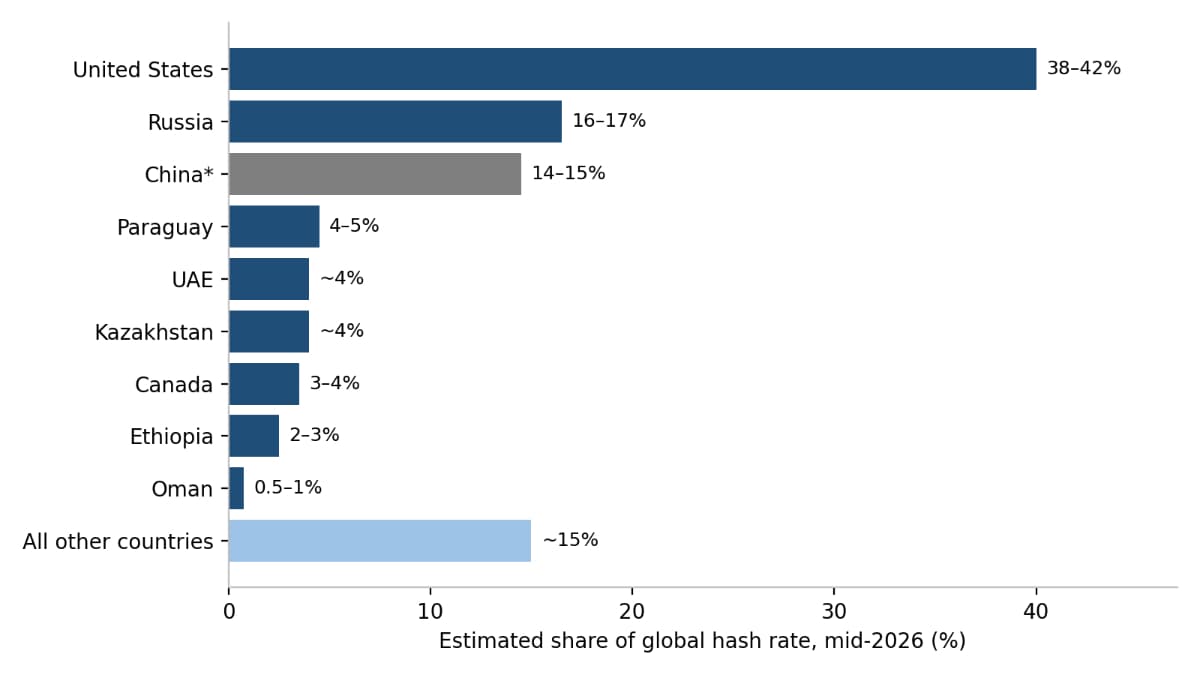
Figure 1: Estimated share of global hash rate by country, mid-2026 (*China's mining is underground)
Table 2: 2026 Country-by-Country Mining & Energy Breakout
| Country | Share | Main Energy | Power ($/kWh) | Legal Status | Trend |
|---|---|---|---|---|---|
| United States | 38–42% | Gas, nuclear, wind, solar | $0.04–0.13 (avg $0.087) | Legal; rules vary by state | Growing |
| Russia | 16–17% | Hydro, gas | $0.035–0.06 | Legal; 13 regions banned | Declining |
| China | 14–15% | Hydro, coal | – | Banned since 2021 | Rebounding |
| Paraguay | 4–5% | Hydro | $0.04–0.05 | Legal; contracts end 2027 | Stable |
| UAE | ~4% | Gas, solar | $0.045–0.055 | Licensed (VARA) | Growing |
| Kazakhstan | ~4% | Coal, gas | ~$0.05–0.06 | Licensed; must sell 75% locally | Down from 18% |
| Canada | 3–4% | Hydro, gas | $0.03–0.05 | Legal; Quebec paused new connections | Stable |
| Ethiopia | 2–3% | Hydro | $0.05–0.06 | No new licences since 2024 | Constrained |
Having one country with over 40% of the hash rate is a risk for a network meant to be decentralised, and the US and Russia already make up 54–59% of the hash rate.
Between 60–80% of a miner's running costs are tied up in the energy needed to run their operation. The cost of one Bitcoin is greatly affected by the cost of a kWh. A modern mining machine uses about 800,000 kWh to produce one Bitcoin, so every 1 cent change in the price of a kWh moves the cost of one Bitcoin by about $8,000.
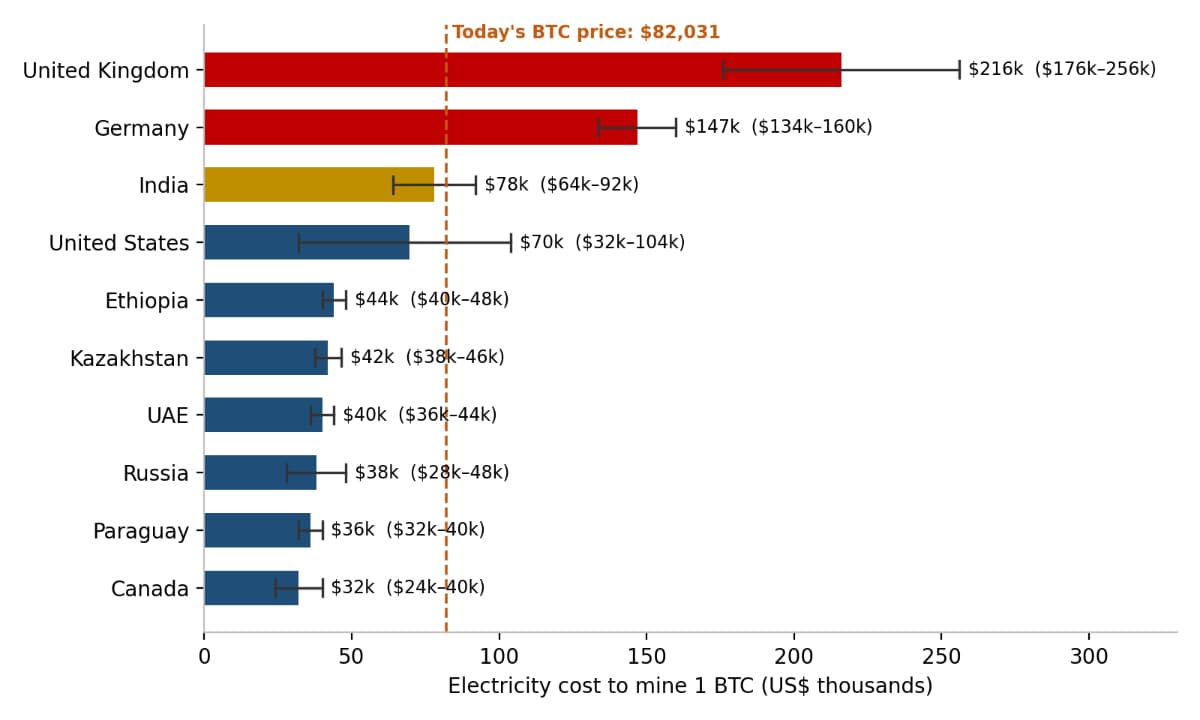
Figure 2: Electricity cost to mine one Bitcoin by country (bars show mid-range; lines show full range)
How we calculated this: cost per coin = power price × 800,000 kWh, assuming a modern 15 J/TH machine and a network of about 1 ZH/s. Electricity only. Currency conversions are approximate (£1 = $1.33, €1 = $1.16, $1 = ₹88).
At $82,031, the break-even cost of a kWh is about $0.10. Many countries, including Canada, Paraguay, Russia, the UAE, Kazakhstan and Ethiopia, are well below that price. In the US, the electricity cost of producing one Bitcoin is about $70,000, as the industrial average is around $0.087 per kWh, so US miners depend on cheaper private deals. Germany and the UK are priced out.
Electricity is only part of the cost of production. Riot Platforms, one of the lowest-cost miners, spent $49,912 per coin in Q2 2026 before counting machine wear, against a coin value of $71,667. Including depreciation, its cost was $90,631, or 126.5% of the coin's value. Even the top miners lost money per coin once machine wear was counted.
Before China's mining ban in May 2021, about 65% of the world's hash rate was mined in China. The ban caused a diaspora of miners. The US jumped to about 35%, and Kazakhstan to about 18% before power caps, crackdowns and grid problems cut it to around 4%. China itself quietly came back: by the end of 2025, its underground hash rate was about 14%, using seasonal hydropower in Sichuan.
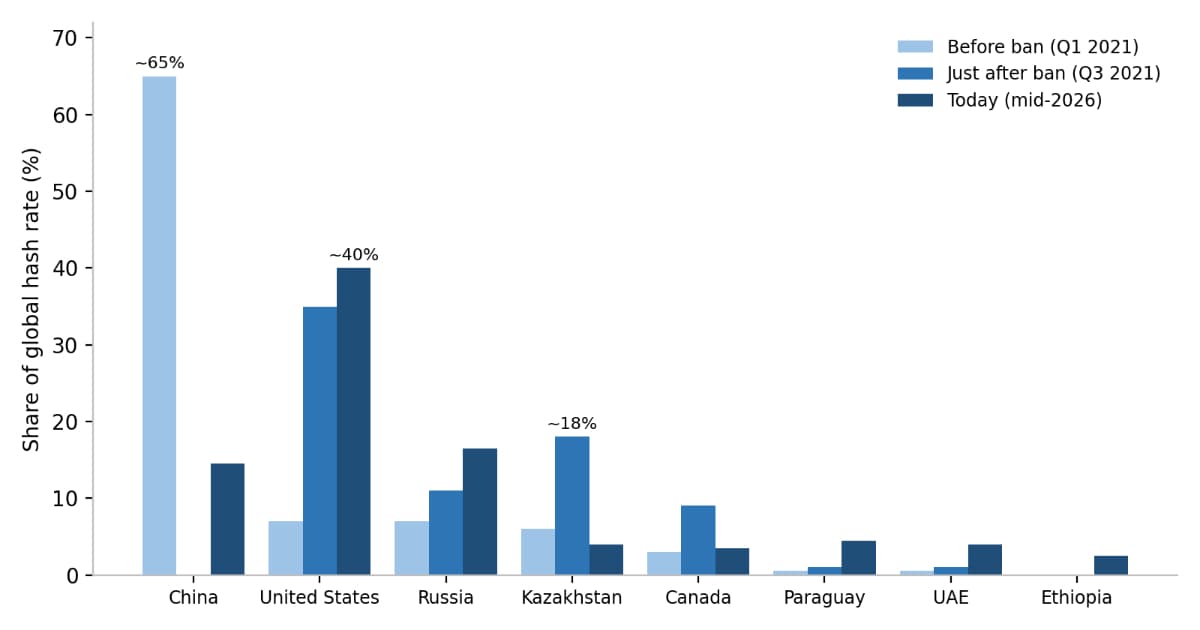
Figure 3: Hash rate share before the ban (Q1 2021), just after (Q3 2021) and today (mid-2026)
The result is a wider map. In 2021, about 5 countries had a meaningful hash rate; in 2026, more than 15 countries do, with the UAE, Ethiopia and Paraguay growing from almost nothing. In a more balanced hash rate map, no country would have more than 25–30% of the world hash rate, and in 2026 the US is the only country above this.
The Gulf, Ethiopia and Paraguay attracted miners with cheap or wasted power. In 2026, each showed how quickly that advantage can change.
Table 3: New mining corridors at a glance
| Corridor | Share | Power Source | What Changed in 2026 |
|---|---|---|---|
| UAE & Oman | ~4% & 0.5–1% | Gas, flared gas, solar | State-backed growth; Oman has invested over $1.1 billion |
| Ethiopia | 2–3% | Dam hydro | Tariff up from 3.1¢ to 5¢; drought rationing to 23% of contracted power |
| Paraguay | ~4.3% | Dam hydro | Rates up from ~3¢ to 4–5¢; all contracts end 31 Dec 2027 |
The Middle East and North Africa (MENA) account for 38% of global gas flaring (gas burned off at oil production sites), and miners can turn this into revenue. Historically, mining consumed up to a third of Ethiopia's national power, and in 2024, the state utility stopped issuing new mining licences. Paraguay's mining contract deadline (31 December 2027) alone could move 4–5% of global hash rate.
Russia legalised mining in 2024, then began restricting it. In August 2026, Moscow and parts of Kursk were banned until 2032, bringing the total to 13 regions and about 50,000 miners. Most countries have moved to license mining rather than ban it, but China illustrates that bans push mining underground.
Unlike a factory, Bitcoin miners can shut down within seconds without damage and are therefore well suited to respond quickly to the needs of a power grid. In Texas, miners are paid to reduce their load when the power grid experiences high demand. During Winter Storm Elliott in December 2022, Texas miners reduced their load by 1.5 GW within minutes, enough to power about 300,000 homes.
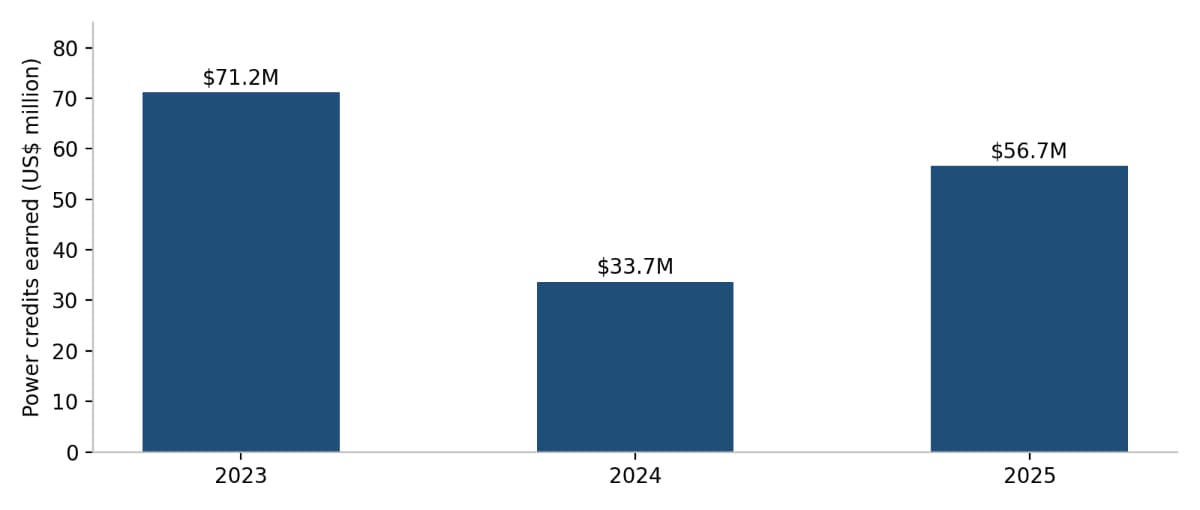
Figure 4: Power credits earned by Riot Platforms for switching off in Texas, 2023–2025
The world's mining power mix is also becoming greener. According to preliminary 2026 Cambridge data, about 59.4% of mining power was generated by low-carbon sources. Hydropower surpassed natural gas to become the largest mining power source. But total mining power consumption reached approximately 190 TWh a year by December 2025. Thus, while the power mix became greener, total consumption increased, resulting in an estimated 20% rise in mining-related emissions.
As of now, Bitcoin mining in India is totally legal. There are no laws that ban it or require any special licences. However, Bitcoin mining income in India is taxed twice. When a Bitcoin miner in India receives a Bitcoin, its value is taxed at the miner's income tax slab rate or as business income. When the Bitcoin is sold, any gain is taxed at 30% plus 4% cess under Section 115BBH of the Income-tax Act, and 1% TDS is deducted on the sale.
However, high electricity costs in India are a bigger barrier. Industrial electricity in India costs between ₹7 and ₹10 (roughly 8–11.5 US cents) per unit, after demand charges and duties are added. That is roughly $64,000–92,000 of electricity per Bitcoin, right around current Bitcoin prices. Add machines and cooling in a hot climate, and large-scale mining in India is hard to make pay.
Margins are under pressure. Hashprice, what miners earn per unit of computing power each day, hit a record low of about $27.89 per PH/s in Q2 2026 as Bitcoin fell from about $124,000 in October 2025 to around $65,000 in February 2026.
Declining margins are pushing miners towards artificial intelligence (AI). Riot signed a 20-year, 191 MW lease with a frontier AI lab, and in the first quarter of 2026, TeraWulf generated $21 million from AI hosting, more than from mining. Since AI facilities cannot easily turn off like a miner, this may reduce the grid flexibility miners provide.
Watch Paraguay's 2027 deadline, Russia's spreading bans and Bitcoin's price versus mining costs. The map is more spread out than in 2021, but it still leans on the US, and cheap power is never guaranteed.
Sources: Hashrate Geography Map, Sep 2026; US EIA; UK DESNZ; BDEW (Germany); Ethiopian Electric Power via Capital Ethiopia; Hashrate Index (Paraguay, UAE); ForkLog (Russia, Kazakhstan, UAE); D-Central (Canada); Cambridge Centre for Alternative Finance (preliminary 2026). BTC price $82,031.21 as of 16 Oct 2026; currency conversions are approximate.
India Crypto Research operates independently. The information presented herein is intended solely for educational and informational purposes and should not be construed as financial advice. Before making any financial decisions, it's essential to undertake your own thorough research and analysis. If you're uncertain about any financial matters, we strongly recommend seeking guidance from an impartial financial advisor.


