Monday, 24 August
Tuesday, 25 August
Wednesday, 26 August
Thursday, 27 August
Friday, 28 August
Saturday, 29 August
The week in one paragraph
What's next


Bitcoin started the week at $77,728. It ended at $77,678. In between, it topped $81,200 twice, got knocked down by an inflation report, rescued by Nvidia, then knocked down again by the Fed. Here's the whole week, day by day.
Bitcoin opened at $77,728. Ran to nearly $80,000 in Asian trading on more than $220 million in short liquidations. Gave it back once US markets opened. Settled in the high $77,000s.
Broke $80,000 for real this time, all the way to $81,257. The Treasury's doubled bond buyback programme and dollar-weakness fears drove it. By evening, most of the gains were gone, back to $78,692.
Bitcoin pushed to $81,235 before 8:30 am ET, then hit a wall. July's PCE inflation report came in hot, with headline inflation at 3.7% versus a forecast of roughly 3.6%, even though core PCE matched expectations at 3.3%. Q2 GDP held at 1.5%, in line. The market traded the headline anyway. Bitcoin briefly lost $78,000, then clawed its way back above it within hours as traders turned to the next catalyst: Nvidia's earnings, due out after the bell.
Nvidia delivered. Revenue of $96.2 billion against a $92.27 billion estimate, adjusted earnings of $2.22 a share against $2.09 expected. The stock jumped as much as 9% and dragged the entire risk-asset complex higher with it. Bitcoin climbed straight back above $80,000, settling at $80,258, up 1.56% on the day. Solana stole the show, up 6.89% to $109.21 after Charles Schwab said it would add Solana, Avalanche and Chainlink to its Schwab Crypto platform. Spot bitcoin ETFs pulled in another $242 million, extending a streak that's now pushed August past $3 billion, the best month of 2026 for bitcoin ETF inflows.
Bitcoin opened at $80,262, its highest opening price since 15 May, before easing to around $79,560 by mid-morning. Then came the day's real event: Fed Chair Kevin Warsh's first Jackson Hole keynote since taking office. His message was measured rather than dovish: the economy is resilient, consumer spending is healthy, the labour market is stable, and a good majority at the Fed's July meeting favoured waiting before touching rates again. Bitcoin was trading near $79,000 going into the speech. It came out the other side around $78,000.
Bitcoin sits at $77,678 as of this morning, continuing to drift lower into the weekend on thinner liquidity. It's essentially back where the week began.
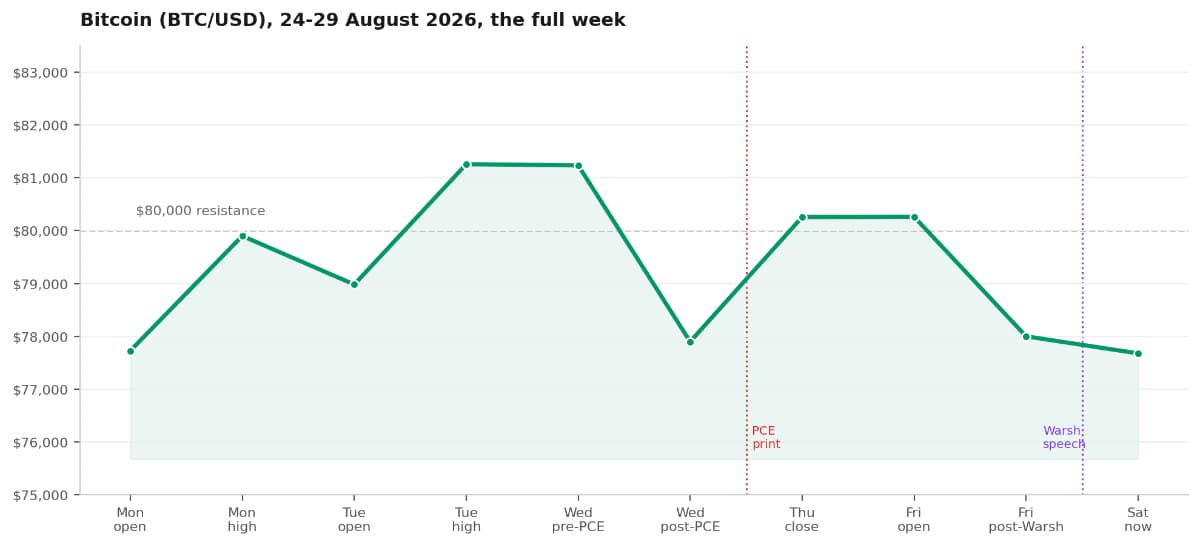
Bitcoin's full week, 24 to 29 August 2026, marked the two catalysts that defined it. Built from verified data points cited in CoinDesk, Cointelegraph, RioTimes, CoinStats, and cryptonews.net reporting.
Bitcoin tested $80,000 three separate times this week and got turned back three times, once by profit-taking, once by a hot inflation print, once by a Fed chair who wouldn't commit to anything dovish. In between, it still managed a real rally: Nvidia's earnings beat proved the AI trade and the crypto trade can still move together when the news is good enough. Spot ETF demand never went negative all week, a streak of positive inflows that stretched past $3 billion for the month. XRP was the week's most volatile major, surging over 40% at its peak before giving back a chunk of it. The story isn't that bitcoin failed this week. It's that every rally now needs a macro reason to keep going, and this week supplied two reasons to stop.
The Jackson Hole symposium wraps up today. The CLARITY Act's Senate cloture vote is still set for 15 September, still the bigger structural catalyst on the calendar. Until then, bitcoin's range looks like $77,000 on the floor and $80,000 to $81,800 on the ceiling, the same band it's traded in through options expiries and central bank speeches alike this week. Whether that ceiling finally breaks depends less on any single headline now and more on whether the Fed, the dollar, and Treasury yields all point in the same direction at once. This week, they didn't.
Data as of 29 August 2026. Prices and figures sourced from CoinDesk, Cointelegraph, RioTimes, CoinStats, cryptonews.net, CNBC, and Bureau of Economic Analysis reporting.
India Crypto Research operates independently. The information presented herein is intended solely for educational and informational purposes and should not be construed as financial advice. Before making any financial decisions, it's essential to undertake your own thorough research and analysis. If you're uncertain about any financial matters, we strongly recommend seeking guidance from an impartial financial advisor.