This week in one minute
What did the funds do?
Where did the coins go?
How much profit came off the table?
Who was forced out?
What are options traders paying for?
The network continued to grow
Macro stayed put
Where are the key levels?
What this means for Indian readers
What we expect to see in the future
FAQs

Bitcoin ended the week at $83,679 (around ₹80 lakh), losing 3.2% in the process, and recording its first weekly loss in five weeks.
There was a net sale of $679 million in spot ETFs in the week, which was the worst weekly sale since September. Wednesday alone saw net outflows of $485 million.
After weeks of decline, exchange reserves have stopped falling as coins returned to exchanges.
Among trader positions, long contracts were forcibly liquidated to the tune of $237 million, while short contracts were liquidated for $56 million.

For the last 3 weeks, we have asked who was buying. This week, we found out who was selling. Funds sold, exchange balances stopped falling, and the first down week in 5 took $2,800 off the price.
Nothing was violent. Bitcoin is still well above the average buyer's price, and selling stopped short of the floor that matters.
1. Price closed at $83,679, down 3.2%. It is still 5.6% above the True Market Mean.
2. ETFs sold $679 million. That is a swing of $920 million from the modest buying of last week.
3. The portion of supply that is in profit fell from 78.7% to 71.6%. Seven points of paper profit disappeared in a week.
4. The damage was taken by long positions. $237 million of bullish bets were force closed vs. $56 million of bearish bets.
5. The hash rate is over 1,000 EH/s. Miners continued to build through the price drop.
Spot ETFs flipped from buyers to sellers in a week.
Between 5-9 October, US spot Bitcoin ETFs lost a total of $679 million. The worst day was Wednesday the 7th, when -$485 million of flows occurred, with BlackRock's fund, usually the steady accumulator, losing $208 million of that. The next day, Thursday, another $244 million of outflows occurred.
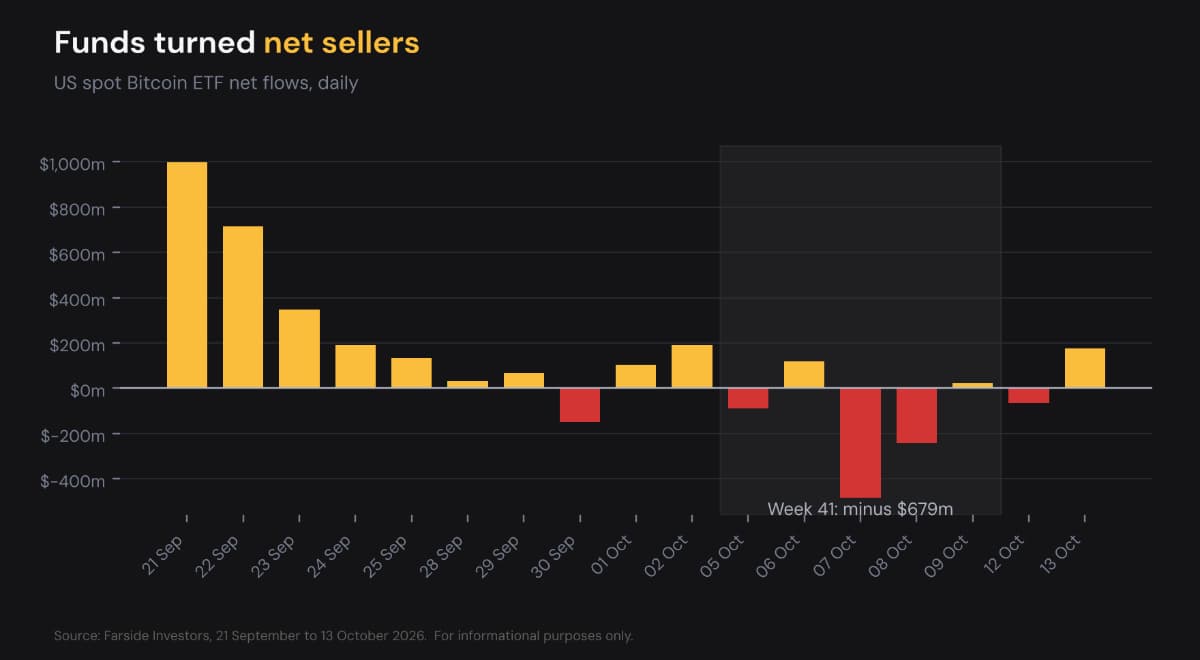
Daily US spot Bitcoin ETF net flows, September to October 2026
Looking at the last 3 weeks, it was a spike, not a trend. The first two weeks showed inflows of $2.39 billion and $241 million respectively. The last week, as we established, was outflows of $679 million. The flows from late September have largely left.
By the Numbers Spot ETFs saw outflows to the tune of -$679M, worsening from the week prior of +$241M. The supply of stablecoins was down slightly to $312.8B, from $313.7B last week. |
What this means for readers: Fund demand is now the swing factor. Outflows next week would test the downside; if flows return to the positive, we could view this week as a pause.
For the first time in weeks, coins flowed to exchanges rather than out. Exchange balances held flat at 2,681,000 BTC, ending a three-week decline, with the 13 October reading showing a net inflow of 1,246 coins. Most readings in this series show coins flowing out to off-exchange wallets.
Coins flowing to exchanges are coins that can be sold quickly, whereas coins in off-exchange wallets are not. The direction is more important than the amount in this case, and a flow of 1,246 coins is small relative to the 2,681,000 total.
By the Numbers Exchange balance of 2,681,000 BTC, flat, with an inflow of 1,246 BTC on 13 October after an outflow of 430 the week prior. |
What this means for readers: Watch next week if this continues. A single day of inflows doesn't mean much, but if flows continue in this direction, particularly if price is falling, this will support the distribution case.
The percent of the total Bitcoin supply held at a profit fell from 78.7% to 71.6%, a fall of seven points, the sharpest drop since we've been tracking, with the coins that were bought in the $83,000 - $86,000 range now in the red.
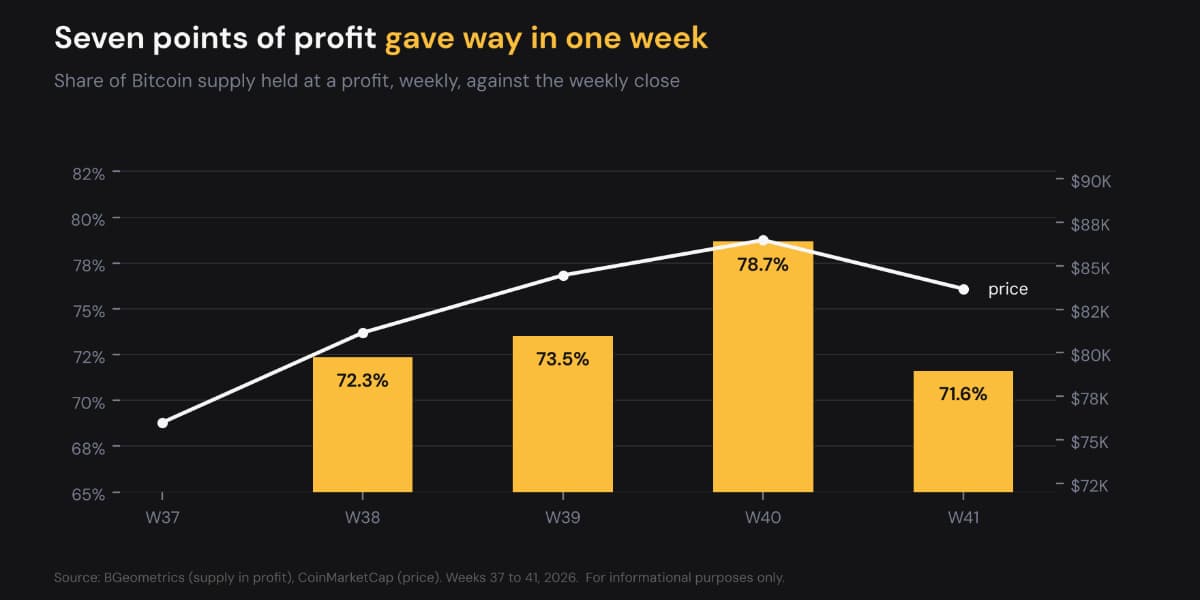
Share of Bitcoin supply held at a profit, weekly, against the weekly close
The story is more or less the same in the holder data. The long-term holder supply, coins that have not moved in roughly 155 days, dropped by 76,000 coins from 14,555,000 to 14,479,000. This is the second week of selling from the patient cohort. Short-term holders picked up those coins, rising to 5.618 million.
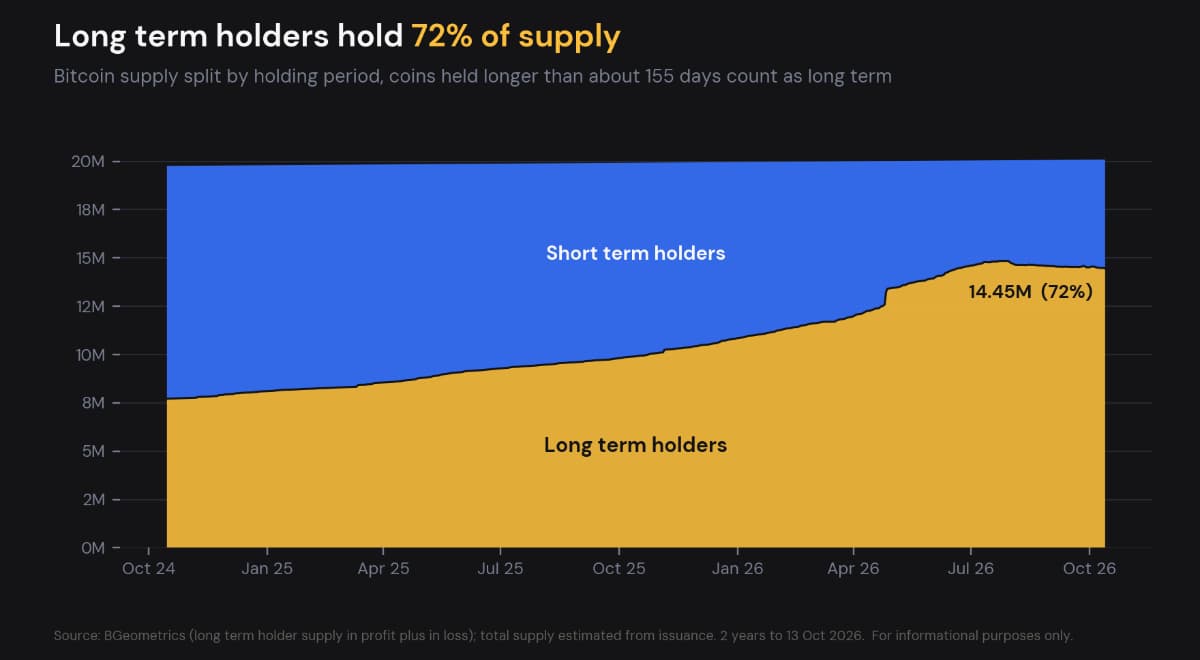
Bitcoin supply split between long-term and short-term holders
Long-term holder supply climbed through the first half of 2026 and peaked in July. It has been declining since. In other words, coins that were held through the bull run are starting to move to people who bought near the top.
MVRV eased to 1.55 and NUPL to 0.355, so the market is valued 55% above the average price paid, with about 36% of its value in paper gains. Both are in a comfortable mid-range. SOPR, however, ticked up to 1.0069, showing the coins that have moved were sold at a small profit. The people selling were in the money, not capitulating.
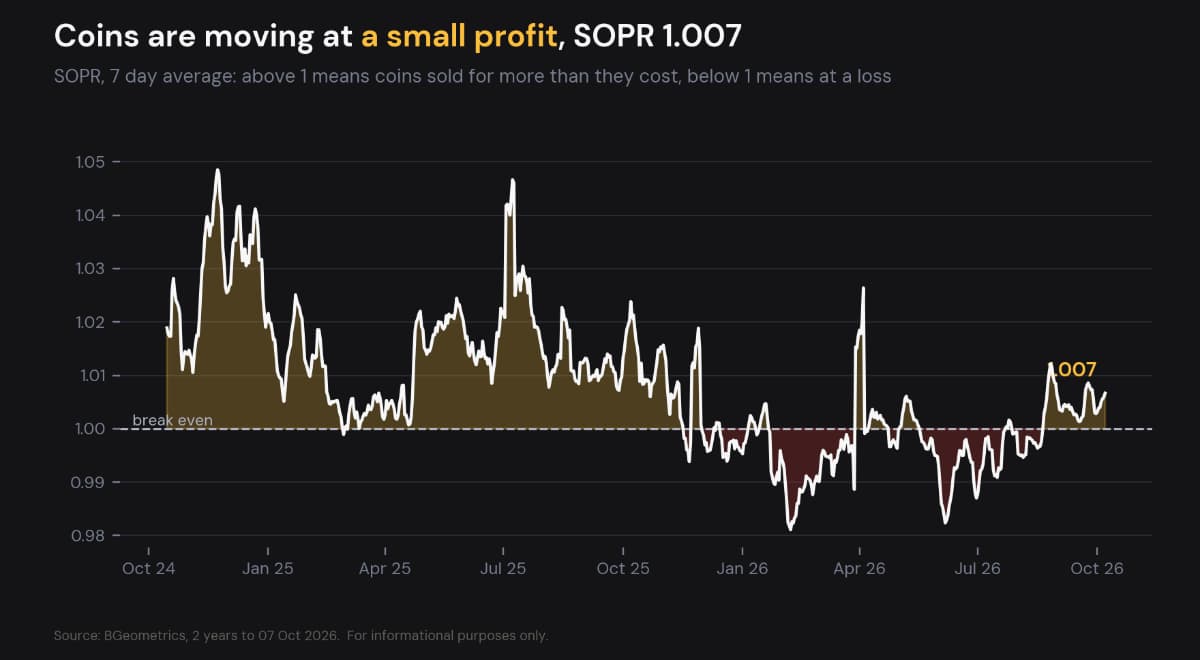
SOPR, 7-day average, showing whether coins move at a profit or a loss
By the Numbers Supply in profit fell from 78.7% to 71.6%. MVRV 1.55, NUPL 0.355, SOPR 1.0069. |
What this means for readers: The bull run froth has been taken off, but not in a panicked fashion. It does leave a band of recent buyers sitting on losses just above the market.
Forced closures indicate where traders were positioned incorrectly. This week, $237 million in long positions were closed, compared to only $56 million in short position closures, a complete reversal from last week. Open interest in futures fell by 5.6% to $52.0 billion, which means traders reduced their exposure rather than increasing it, and funding rates remained very low at 0.0026% every 8 hours.
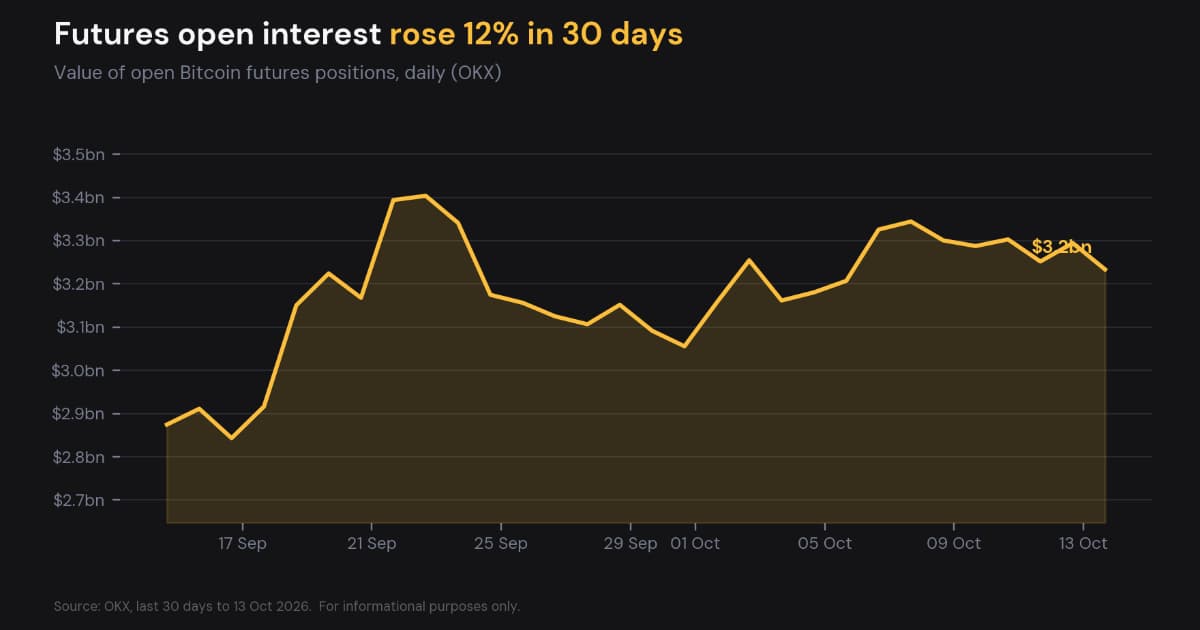
Bitcoin futures open interest over the last 30 days
What this means for readers: Long liquidations often mark a local bottom, but do not indicate direction from here. It does mean that fewer forced sellers remain.
The one-week 25-delta skew rose to plus 1.97 this week, making puts the most expensive in relation to calls since we began the series. Traders are buying downside protection. Implied volatility rose only slightly to 32.8%, so the market expects a drift rather than a shock. Open interest rose to $32.2 billion.
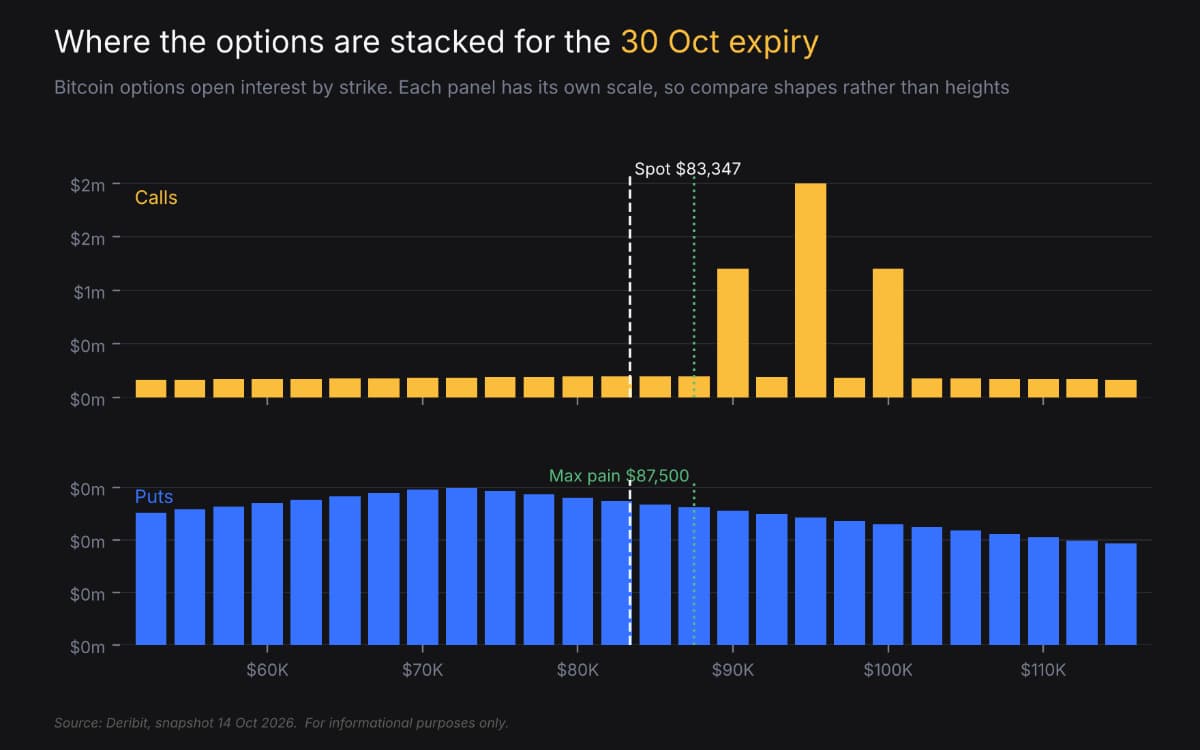
Bitcoin options open interest by strike for the next major expiry
For the next major options expiry, max pain has moved up to $79,000, which is now just below the True Market Mean at $79,266. Two different measures point at roughly the same floor.
What this means for readers: The rise in put prices after a fall means holders are more inclined to stay in the position, rather than sell. Cheap insurance would have been the better buy a week ago.
Average hash rate climbed to 1,009.8 EH/s, crossing 1,000 for the first time in our series, and revenues for miners rose to $285 million. Daily transactions hit a record of 750,370, while active addresses fell to 437,485 and fees collected fell to $1.55 million. More transactions occurring with fewer addresses is likely institutional and exchange activity rather than new users.
What this means for readers: There doesn't seem to be anything stressed on-chain right now, unlike the drawdowns that come with on-chain panic. Security and usage continue to rise.
The FOMC kept rates at 3.75% to 4.00%, core inflation was unchanged at 2.45%, and the real policy rate was at 1.55%. The 10-year Treasury yield fell slightly to 5.24% and the dollar index rose to 102.21.
What this means for readers: Macro was not the cause for selling this week. The selling came from inside the crypto market, not from a change in rates.
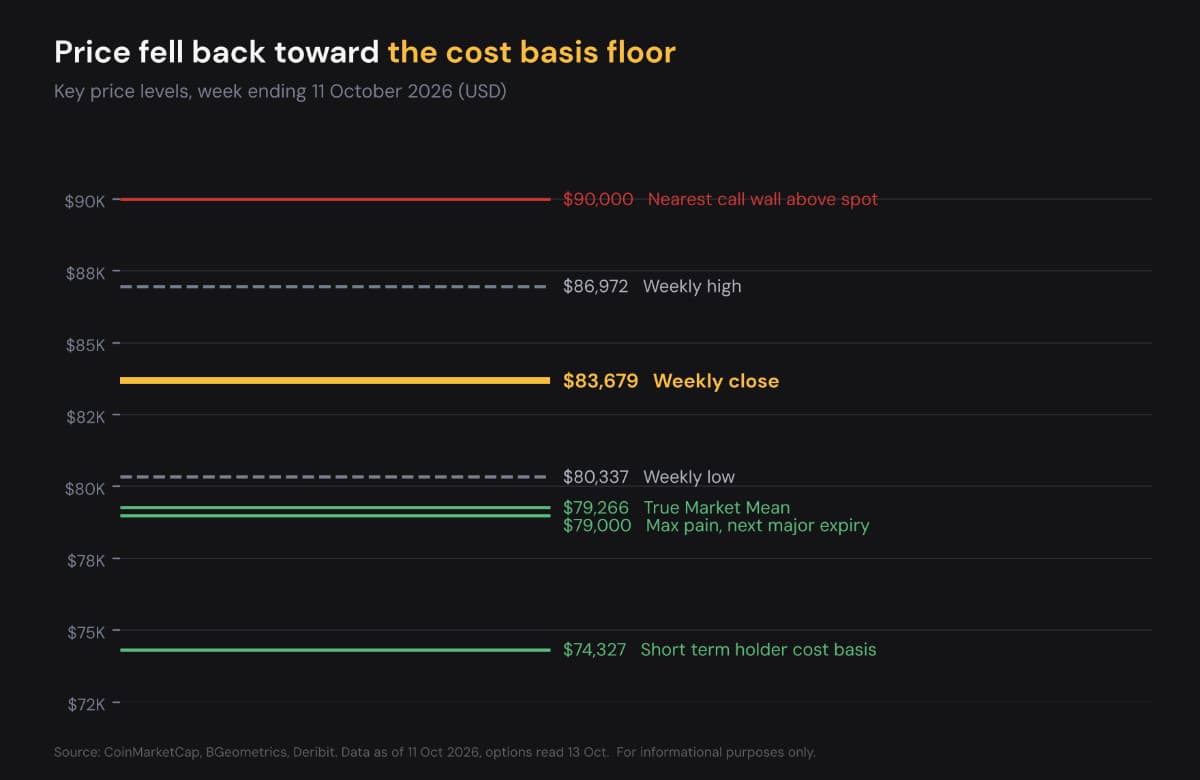
Key Bitcoin price levels for the week ending 11 October 2026
| Level | Price | Why it matters |
|---|---|---|
| Resistance | $90,000 | Nearest heavy block of call options above spot |
| Resistance | $86,972 | This week's high, and close to the W40 high of $87,146 |
| Weekly close | $83,679 | |
| Support 1 | $80,337 | This week's low |
| Support 2 | $79,266 | True Market Mean, with max pain at $79,000 just below |
| Support 3 | $74,327 | Short-term holder cost basis, up from $73,383 |
| Scenario | Trigger | Next level |
|---|---|---|
| Bull case | ETF buying returns and price reclaims $86,972 | $90,000 and the call wall |
| Base case | Price holds between $79,266 and $86,972 while flows stay negative | Range, with the floor being tested |
| Bear case | Weekly close under $79,266 | $74,327, where short-term holders break even |
In Indian Rupees, Bitcoin was close to ₹80 lakh at roughly ₹96 per dollar, down from about ₹83 lakh a week ago.
Tax rules remain the same. Gains on VDAs (cryptos, tokens and NFTs) are taxed at 30%, plus 4% cess, with 1% TDS deducted by the exchange on transfers. Budget 2026 did not change the tax rules. The Income-tax Act, 2025 governs transactions from 1st April 2026.
One important point for a down week: losses on VDAs cannot be set off against gains, not even against gains on other cryptos, and they cannot be carried forward. Thus selling at a loss to offset a profitable trade elsewhere does not help with your tax liability in India, unlike with equities.
There was no mention of corporate treasury purchases or the treasury average entry for a fourth consecutive week in Glassnode's weekly report. Also, starting from next week, the NVT Signal, a tracker that measures market value against the value actually moving on-chain, will be part of the report.
Sources and dates. Price, market cap and dominance from CoinMarketCap (daily closes, 5 to 11 October 2026). Network activity, fees and miner revenue from Token Terminal. Cost basis, holder supply, SOPR, supply in profit and Realised Cap from BGeometrics (11 October). Liquidations from BGeometrics (weekly sum). Hash rate from mempool.space. ETF flows from Farside Investors (5 to 9 October). Macro from the Federal Reserve, FRED and Yahoo Finance. Options from Deribit and futures open interest from CoinGlass (read 13 and 14 October). Funding from OKX. Exchange balance and net flow from CryptoQuant, read 13 October. Rupee rate is approximate.
India Crypto Research operates independently. The information presented herein is intended solely for educational and informational purposes and should not be construed as financial advice. Before making any financial decisions, it's essential to undertake your own thorough research and analysis. If you're uncertain about any financial matters, we strongly recommend seeking guidance from an impartial financial advisor.